Undiagnosed: Seeing the Whole Elephant

 PocketCasts
 Apple Podcasts
 Goodpods
 Audible
 Overcast
 Castro
 RSS Feed
 Haresh Patel will be the first to tell you he's not the person you'd expect to hear on a show like this. He's a Silicon Valley CEO with an electrical engineering degree from Notre Dame, and he built his career on data, logic, and measurable outcomes. He believes in science and evidence-based medicine.
For 55 years, his body staged rebellions that twelve specialists couldn't explain. Chronic hives covering 80% of his skin. Sleep disorders that defied every specialist. Heart conditions that four cardiologists initially missed, blockages that could have killed him. Each doctor measured their own piece of the puzzle. Dermatologists saw skin, cardiologists saw hearts, endocrinologists saw hormones. No one stepped back to see the whole elephant.
The breakthrough didn't come from another blood test or MRI. It came from two strangers, an Ayurvedic doctor in a Costa Rican jungle and a spiritual healer at a California wedding, who delivered the same diagnosis. When he finally followed their guidance, the urticaria that had plagued him for over a decade, simply vanished.
Haresh immigrated from India and founded Mercatus, the data platform that became a global standard in private equity before its acquisition by State Street. Now he's turned that same pattern-finding mind toward medicine, designing an app that gives physicians a diagnostic layer to see the full story of a patient's biology, history, and lived experience.
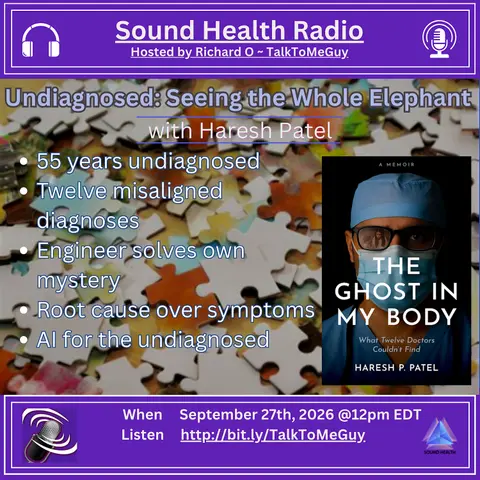
His memoir, The Ghost in My Body: What Twelve Doctors Couldn't Find, is available now in paperback and e-book. It isn't about choosing between science and spirituality. It's about integrating them, which puts him right at the intersection this show explores.
Today, we're talking about the millions of people living undiagnosed, and what it takes to finally be seen.
The Ghost in My body What Twelve Doctors Couldn't Find
•Please sign up for the email list for future notifications•
If you would like help starting your own show or podcast, as well as help selecting a microphone and setup for your voice; Please tap the microphone and leave me a message with your contact information and I will get back to you.
Or you can email talktomeguy@gmail.com
More information at: SoundHealthOptions.com
TalkToMeGuy : Haresh Patel will be the first to tell you he's not the person you'd expect to hear on a show like this. He's a Silicon Valley CEO with an electrical engineering degree from Notre Dame. And he built his career on data, logic, and measurable outcomes.
He believes in science and evidence-based medicine. For 55 years, his body stayed rebellions that 12 specialists couldn't explain. Chronic hives covering 80% of his body, sleep disorders that defied every specialist, heart conditions that four cardiologists initially missed, blockages that could have killed him. Each doctor measured their own piece of the puzzle.
Dermatologist saw skin, cardiologists saw hearts, and triconologists saw hormones. No one stepped back to see the whole elephant. The breakthrough didn't come from another blood test or MII. It came from two strangers, an Ayurvedic doctor in a Costa Rican jungle and a spiritual healer at a California wedding who delivered the same diagnosis.
When he finally followed their guidance, the urticaria that had plagued him for over a decade simply vanished. Haresh immigrated from India and founded Mercatus, the data platform that became a global standard in private equity before its acquisition by State Street. Now he's turning that same pattern finding mind toward medicine, designing an app that gives physicians a diagnostic layer to see the full story of a patient's biohistory and lived experience.
His memoir, The Ghost in My Body, What 12 Doctors Couldn't Find, is available now in paperback and ebook. It isn't about choosing between science and spirituality. It's about integrating them, which puts him right at the intersection this show explores. Today we're talking about the millions of people living undiagnosed and what it takes to be finally seen. Welcome, Haresh.
Haresh Patel : Thank you very much, Richard. Appreciate the opportunity. It's an amazing journey.
TalkToMeGuy : That's all I have to say. It's an amazing journey. I mean, really, I'm waiting for the TV movie. I just think there should be a movie here.
Haresh Patel : Yeah, it makes a roller coaster ride feel dull.
TalkToMeGuy : It really does. Wow. Would you take us back to the August night in 1967 out in Bethune, Colorado? What do you remember most vividly about the accident that changed everything?
Haresh Patel : You know, I regained my memory at age four. No, I wouldn't say regain. That's the first time I had memory. And it actually wasn't my flight from India. It wasn't seeing my dad after three, four years because he had come to study.
Uh, it wasn't even entering our home. You'd think all of those would like trigger a memory, but it wasn't until the very next morning that everything I can photographically remember. So that evening, uh, again, I don't remember exactly loading the car.
I remember loading the car during the day. I don't remember exactly leaving the house, but we left somewhere in the dark uh from Fort Collins, Colorado. We were headed uh to New Hampshire because my dad had graduated uh with his master's in physics and had his uh first job as a physics professor at St.
Anselms College in Manchester. So we decided, uh, or they decided as parents that we'll make a vacation out of it. We'll show Huresh the country, we'll see it ourselves. Uh so we drove east while everybody always drives west. And uh we were on a two-lane road at the time, now it's a major highway, right roughly a few minutes before the Kansas Colorado border on the Colorado side. And uh, you know, my dad lost control of the car. And uh the car, it was a single car accident, tumbled many times uh off the freeway. And uh in that car accident, my mom passed away. So I remember everything vividly, uh, including the ride in the ambulance with my mom, my dad stayed behind to answer questions to the police, like what happened. Um, I went back 25 years later to Burlington.
The accident happened in Bethuen, but the closest hospital and you know, uh eventually the cemetery were in Burlington. And I ended up um going back the 25 years later, and boy, when I entered that hospital, I had a retrace of footsteps. I remember everything. I didn't even need a navigation map and the smell in the hospital. So answer your question, I remember every vivid detail.
TalkToMeGuy : And it's an amazing I mean, it's a sad beginning, and yet it amazes me how it really set you up to be almost who you are today because you wanted to some part of you wanted to figure it out. That's my view. That doesn't say any of that in the book, but it just feels that way to me. Having read much of the book and listened to and read other articles, just I absorb all that. And it amazes me how you are it got you in a certain way to where you are today, that that foundation. And now you can look back, I believe, I believe, because of what you're doing with your newer companies for medical doctors, about how that night might have set the stage for what your body carried for the next 55 years. I think that's an amazing concept.
Haresh Patel : I think it took um three, maybe four. I'll lose track of count, but let's just go through each one. Clearly, if I hadn't we didn't have that car accident, you know, I wouldn't have gone through the medical journey.
Right. The medical suffering that I went through. So that was almost necessary to a certain extent to get to this aha moment that I could actually use AI to help others find, you know, a remedy or a cure or the why of what they have to get to, you have to get to the why to figure out what to do to get rid of it.
So that was probably the biggest pillar. The second one, obviously, was just my electrical engineering semiconductor background, which is a large part of my career in education, was just we live in the world of data, right? Everything is around data and signals and ones and zeros. And then the third journey was around Mercatus, which is the company that I started for my kitchen table after getting fired in 2009, not really seeing which direction to go. I just said I'll write a book one day, the best thing ever happens, getting fired, which turned out to be the ghost of my body. Um, I had to create my own silver lining.
And it was that Mercado's journey that when I got the aha moment with the doctor in Sacramento. Um basically it basically what it did is it took for private market investors that invest in wind and solar and renewable energy and traditional oil and gas and infrastructure, airports, bridges, toll roads. What the problem they had was lots of documents that were unstructured, lots of financial models that didn't connect with each other.
And our investors who are are some of the largest um investors in infrastructure in the world, names everybody would recognize privately. They said we were flying blind. We don't have the whole story, we can't see the whole picture. And that's what we solved for. So that third journey, quite frankly, was kind of the icing on the cake or the cherry on top around when the doctor in Sacramento, which is in 2023, right about when AI is just kind of the only thing that we want to talk about.
Um, when he went on the whiteboard and said, Listen, I've been quizzing you for two hours because I'm building your story. I don't want to know why you were here. I don't know what want to know why, what symptom you have.
I've I'm not even looking at this folder that my nurse created for me and the intake form. I want to know who you are. And then he drew eight quadrants. And when he drew the eight quantities, I've been systematically filling each box in.
And the entire story about your mom passing away and that stress or trauma or anxiety that you bottled up and carried, it's just called the energy vector. And when he drew those eight quadrants, I forgot I had euroscaria. I completely forgot that um, you know, why I was there. I the light bulb went off like, oh my God, this journey was all because of I can now solve a problem at scale for almost roughly one out of every three people in the world suffer from something that has a mind-body-spirit connection.
That's the root cause of you know what they're suffering with. And so I think you needed all three journeys to get there. Had I missed any one of those three, obviously the medical one, and that going through 12 doctors where they saw only a piece of me was the most important one. But the other two had to come together. And um, I'm sure somebody else would have figured it out. Was there a lot of smart people in the world? But for me, those three journeys converged in February 2023. That's amazing.
TalkToMeGuy : And that was Dr. Reddy in Sacramento. That was Dr.
Haresh Patel : Reddy in Sacramento. He's now a formal advisor to our company. Um, is we want to leverage him and other what I call some of the best practitioners in the world that really know how to um, you know, understand the whole person. And we're taking their methodology and putting it into an AI excavation engine that actually, you know, operates like them.
Uh, call them digital twins, where, you know, as you go into our platform called Sonari Health, you're answering questions in a more systematic way to kind of fill in those eight quadrants.
TalkToMeGuy : And is he was he a medical doctor, or was he a DO or some other kind of practitioner, or was he a medical doctor? He was actually a vet. Wow. Even better. Even better. I have a great fondness for vets. I think they're speaking. I think they're brilliant physicians.
Haresh Patel : So he that was his first degree. Then he decided, you know what, I'm curious about the human body. So he went and got a medical degree, started his residency, but he kind of threw up his arms because this is not for me.
This is all about pharmaceuticals and surgery. And so he went and got a degree in holistic medicine. And so he runs two practices. One is a vet clinic on one side of um Roseville, not Roseville, I'm sorry, near Sacramento. And um, another one, which is where I met him, which is for us humans. So he takes the best of both worlds. Um that's amazing.
TalkToMeGuy : That's great. Yes, I say I have a quite a great fondness for veterinarians. I've worked with a lot of animals and animal rescue. And vets are because their patients don't talk.
Haresh Patel : I know that's what I'm saying. So you have to read away.
TalkToMeGuy : You actually have to read everything, and you have to see why that limp is there, and you have to figure it out. You have to really pay attention to the signals. All the signal, all the information is coming from the body. It's just that we have to be open enough to receive that information.
I don't mean in a psychic ooh woo-woo way, although I'm not opposed to that. But I just think in the sense of if a veterinarian can help figure out how to heal an animal, they're doing something that I think traditional medical doctors are not doing. And that's the whole big picture.
Haresh Patel : I think you you've nailed it in terms of I even I hadn't kind of connected to that the way you just talked about it. But um, kind of a tongue-in-cheek joke that Dr. Reddy made um when I said I'm building scenario for humans. He said, Hurish, you should probably build it for vet for the pets first, because quite frankly, when Fifi has a problem, pet people spend a lot more money than they do on themselves.
TalkToMeGuy : That's that's very true. That's very true. Yeah. I used to travel the country selling full spectrum lighting and whole food formula minerals. And when we would go to a horse show, horse people are nuts. I mean that in a kind way, but in the sense of how much they will spend is just mind blowing. And then we would go to uh regular animal, you know, dogs or cat shows. And the same thing.
I mean, people would just pour money out, and we were doing, you know, weird work, like saying, you know, full spectrum light is really good for them because they're really meant to be outdoors, muggle boss, and and people would just go crazy for it because it was about their animal, and they would spend as the doctor as your doctor ready said, you know, wow, people will spend way more on their more rapidly, rapidly spend money on their animals than they will on themselves.
Haresh Patel : All right, and he he actually made a point. I've I've learned over time. This is kind of like I would say how all these things converge, you have to have these big ears, yeah. And they got to be listening for the smallest clues. And so he may have thrown off a clue that I maybe shouldn't be ignoring, but think about our human psychology. If I said to anybody on this viewer, like, oh, there's this fantastic resort in the Maldives, it's $2,000 a day, it's five nights, it's just bliss. You know, we probably wouldn't hesitate.
You know what? I'm gonna go spend the $10,000. I'm gonna go figure out how to, you know, dip into some savings or borrow some money. Yeah. Now you say, listen, there's this $10,000 therapy that's out not covered by insurance.
Wow. I mean, I'm putting myself in the shoes, and I'm just saying, that's that's a that's a big investment. I don't know if I want to do that. So if there's a flaw in kind of any business plan around med tech, is we're so used to having insurance pay things that we don't want to dig out of our own pockets. Um, but the patients we're going after, which by the way are 133 million Americans, is one out of every three, suffer with sleep, fatigue, pain, headaches, some form of autoimmune, um, and mental health. Those five areas, they take four to seven years to figure out what it is and the why.
And good God, if you're a woman, it takes twice as long. Just get it's just that sad reality. And so that group of people spend 1.3 trillion dollars a year in the insurance world.
Wow, trying to figure out how to get to the bottom of what they have. Because when you're suffering, you're gonna figure it out. You want to figure it out, and then people spend 134 billion dollars on top of the 1.3 out of pocket, finding healers, finding interesting modalities. And quite frankly, this has existed from the beginning of time through either word of mouth, and when libraries came along and you had something, you go to library and find a doctor that wrote a journal, and you'd find a way to scrimp and scrape and you know make your way to Sweden and get cured. Well, the internet made it easier.
AI is going to make it incredibly easier to find all kinds of doors and options you hadn't thought of. And uh when you think of modern medicine, it's only a hundred years old, right? Pharmaceuticals are only hundred years old. Well, we're thousands of years old civilizations, and some of those practices we forgot.
They're considered a bit strange today, but science needs to get behind them. But those options are have always been available. Our platform's going to make it easier. And that's where our platform will be different. Where I think today most of our competitors, including some of the big chat GPT LLMs, you name them, you know, force you through one door, which is go and solve this by taking this pharmaceutical.
Ours is around you can do that. But here are four or five modalities. If you're open and curious and open-minded, there are other ways to solve and heal the problem.
TalkToMeGuy : There are always alternatives. That's why they're called alternatives. They always exist. I want to jump back slightly, although This goes to pattern. Yep. Would you talk about the tracking down paprika as a trigger for you?
Because that was an amazing like, wow. Paprika of all things, such a benign character in the world of. I was a chef for 20 years. Uh so paprika is such a minor player in the world, and especially you coming from an Indian eating lifestyle, which is filled with spice, which is amazing. So talk about the paprika. And it took you a long time to get to have people doctors. I'm putting air quotes around that. You know, find out that that was an issue for you.
Haresh Patel : So let's start with what happened. I went to the far farmers market in Saratoga. I live in Silicon Valley, a small town called Saratoga. And they have food stalls in addition to your fruits and vegetables that are organic and really healthy. So we go there every Saturday. So this particular Saturday, I went with my son, and uh he went to the Indian food stall and got a non and uh chicken to come asala curry. And I'm a foodie, so I have to always I call it tax.
So I said, I'm a tax, which they know like you've got to give dad a little portion. So I took a big scoop um while we were walking towards a car, and um, you know, plopped it in my mouth. And by the time I sat down in the car, I don't know, I had sweat on my forehead. I felt this kind of choking feeling around the heart or the throat or somewhere below the neck. And I'm like literally telling him, and I'm kind of so I'm kicking myself. As I said, I may feel like I'm having a heart attack, and we should have gone to the emergency room.
But you know, we're men, we love to brave it out. But it went away after half an hour. So I knew that something triggered me that was red. That evening we went to uh a Diwali party, friend's house, and I had all the Indian food that you could imagine. And and the rash started building below my neck. And I just continued to ignore it, but I knew something was triggering what I had.
And by day three or four, and it was it was a long weekend, by the way. So this is one of the reasons I couldn't see my doctor right away. I could have gone to the emergency room.
Um, but I figured it's a skin rash. So by the time I think it was three, four days into it, I literally woke up the next morning and my eyes were closed shut. I that's how puffed up I had become all over the body. So I naturally said, okay, I'm eating something, that's where it started. So therefore I'm gonna do my own water fast. Now I didn't study it.
It didn't chat GPD didn't exist in 2011. Um, I just said I'm gonna stop eating, I'm just gonna do a water flush. So as I drank more water and my body flushed, the rash went away. So I like most of us will make a mistake, like I've got an allergy.
Right. And my doctor also said, my general practitioner said, Yep, you've got an allergy, I'm gonna set you up with an allergy specialist. So you go down that rabbit hole instead of taking the approach that Dr.
Eddy said, I want to know who you are and what happened. And you know, from the day you were born or even before, had that happened early on, maybe we would have avoided the whole paprika route, which is almost for 10 years. So we do a blood test that determines about 10 or 15 different things that um I was very allergic to or potentially allergic to. And uh the other thing in my blood test was the iron. I iron was so low, my doctor was shocked, like listen, you don't have any ability to remember, iron is uh anti-inflammatory. So he said, You don't have any ability to fight inflammation.
So we're gonna have to figure out the level of iron you have. We're gonna do an endoscopy. There's got to be internal bleeding. Are you sure you're not seeing bleeding while you go to the bathroom? And I said, No, um, everything seems normal. And so we did endoscopy, we did colonoscopy, right?
Doctors are adding up the specialties, they're adding up, the costs are adding up. Uh, meanwhile, um, and then we finally couldn't find anything. Then he said, Okay, there's only one part of the intestine we can't see. Uh, I mean, uh, you know, through endoscopy colonoscopy, we're gonna drop a camera. You're gonna swallow this pill, and that pills a camera is gonna tumble to the small intestine because the bleeding's got to be there.
Never found anything. And um, so ultimately I looked at that list and I said, okay, that first thing I ate was red. And it kind of did pattern matching. It was just you, you know, it's like human survival. You figure things out on the fly.
Uh you become MacGyver if you have some of those shows that you're familiar with, you just do that. And so I just kept looking at it's got to be paprika. So I started eliminating it, but I didn't realize, and as a chef, you'd understand it's in everything. Golden French fries, those lovely French fries at McDonald's that we all love. Well, they're golden because those are soaked in paprika water. Mustard. To make it yellow and brilliant yellow, they put paprika. Um ketchup.
Oh my God. And uh so I learned how to eliminate it. It took me a long time to figure out what was in paprika. The last remaining um item was I went to a Japanese restaurant. Now there's nothing in Japanese restaurants that's red outside of maybe the raw fish, right? And yet I had California rolls and I had this the salad dressing that they make, which is really, really tasty, but it was white. And so um, I just happened to say, What's the ingredients in that?
So I asked the the restaurant owner, and he goes, Yeah, we use a little bit of manual, we live this or that. And so I it kept I kept in my mind mayo, mayo, uh mayonnaise. So the next time I went to the grocery store, I looked at the jar of real mayonnaise, the brand, which pretty much everybody buys that brand, and there it was. It had paprika extract. You think of it as almost the highest concentration of paprika, which is a bell pepper, basically, which they're squeezing to get the juice, maybe to make it a gelatin.
And then when I eliminated the mayonnaise, that's when finally I was able to conquer paprika. So that's the whole allergy story. Now, 10 years later, we found out I never had an allergy.
TalkToMeGuy : Wow, all that for not having an allergy. Yeah, that's amazing. Yep. And was it from having having all the work done in the allergy world that you then went on to discover you didn't have an allergy? Or how did you get to the you didn't have an allergy part part?
Haresh Patel : Yeah, yes and no. So 10 years went by. I learned how to eliminate it. I slowly was able to add it back into my diet by, you know, let me have a little tiny lick of the ketchup, and it wouldn't trigger it. So I was slowly able to go back to a normal diet. And then 10 years later, I mean, it's on the book end of my company, right? So I'm starting Mercatus, and the rash starts within a year.
The first version I just told you about. Goes away for 10 years, then it comes back with a vengeance, the precise time that we are selling the company and negotiating with State Street Bank, selling mercatus. So I texted my doctor, same doctor, and I said, Well, my rash is back. He goes, Well, you know what to do.
I'd say that text, by the way. I said, Yep, I'll eliminate the paprika. And I did for about two weeks, it was great. But every two weeks, you know, I mean, it it something was triggering the same rash. It was getting worse, kind of back to probably even worse than the first time.
Go around. So I'm chatting with my doctor, and he said, Well, let me set you up with another allergy specialist. We're still down that same rabbit hole that now something else is causing the rash beyond just paprika. And so luckily this time, the allergy specialist that he set up also happened to have a degree in immunology. Goes back to over specialization, right? She now has two specializations.
And a couple of different things happened this time. One hour she gave me of the one hour she spent 55 minutes just talking and asking questions and just understanding what was going on, which is was beginning the clue of you need more time with the doctor to understand who you are. Now she forgot, she said, Oh, you know what, haresh, I forgot to um play doctor. I want to, you know, uh look at your eyes or your ears, your throat.
She also same up, came the same conclusion. Well, your nostrils are really small. You've got some oxygenation issue.
Remember back in the first diagnosis, it was around iron, which is a form of carrying oxygenation around your body. And uh, she ended up um looking at everything, and okay, and then there was just one last, and this is important. Oh, I forgot to listen to your heart. Now, if you guys have watched um Dr.
House MD, the show that by the way, that title doesn't exist in reality. Um, chief diagnostic officer, but it needs to in spades. That's what Sonari aims to solve is to ask the right questions. And in his first episode, he goes, you know, patients lie, they don't tell the truth. Now, they don't necessarily lie, they don't sometimes not ask the right question, or they just don't know because it's buried somewhere deep in their memory, or it happened before they had a memory. Uh and in my case, I didn't I had so many symptoms we talked about for an hour. I didn't think about this one, but she said, I need to listen to your heart. I said, Oh, Dr.
Choi, I forgot to tell you when I you're gonna see when I unbutton my shirt, but she needs to unbutton the shirt to be able to put the stethoscope there. You're gonna see my hair stand up. I'm gonna get goosebumps. And she shrieked so loud. She slammed her hands on both sides of my thighs where I'm sitting on that tissue paper on the examination table.
She tore that paper. She told her allergy team, you need to leave the room. Hurresh does you don't have an allergy. You've never had an allergy. You have this thing called eurticaria. It's a mast cell disease, it's an autoimmune disease.
You've been totally misdiagnosed for the last decade. That was the aha moment. Now, had she not listened to my heart, and I hadn't, you know, voluntarily told her something I didn't intend to hide.
It was just don't not if you don't ask you, don't tell. That brief moment is what made the difference in getting to what I had. But we still had a journey to go figure out why I had it, which never really rarely happens with these five or six clusters that I told you about sleep, pain, headaches, autoimmune inflammation, mental health. You never get to the why. Got to get to the why.
TalkToMeGuy : Gotta get to the well, you as you said, I know you have I wrote this down. It's not very complicated, but you have to connect the dots. You have to think that's always been my one of my issues with West traditional Western medicine is there, as you say, it's because I'm old enough that I grew up, I was birthed by the family general practitioner. And then he was my doctor through high school.
Yep. And he was a GP. But he knew you really well. He knew me really well. He knew me since I was born through high school.
And he was not brilliant, but he was good. And he was, you know, willing to say, oh no, don't do this, let's try that. Or how about this?
Or about that? I didn't have a lot of stuff as a kid. I was heavy. That was my only thing.
Right. But it was amazing how to then go into a world of specialists where the doctor is brilliant at your bladder or brewing it at your bowels or brilliant with your brain, but never, as you say, never looks at the whole elephant, which blows my mind.
Haresh Patel : I went through 12 specialists that looked at one part of the one part of the elephant. And it wasn't until I met Dr. Eddie when he said, I'm gonna play at Sherlock Holmes, which is a good investigator, right? Because we're investigating what the root cause is. The time just doesn't exist. We have 13 and a half minutes with a doctor.
That's our statistical average. And if you're in India, other parts of the world, you have no access to doctor, or you got four minutes. It's just humanly impossible.
So what we aim to solve for is a change in behavior. Be the CEO of your own health, build your record, build your story, make it a movie, share it with your doctor. If they don't want to listen, go find a different doctor. And doctors, quite frankly, are not the villain here. They're equally as much of a victim of the system, the way they get paid, the way insurance companies pay them, their hospital networks pay them. Um pharmaceuticals and what influence they have on how they get paid, puts them on a treadmill and they're frustrated as patient. They don't feel like they're helping cure people. They know they're treating them and treating and curing are two very different things. So time deprivation is one.
Two, we look at snapshots and specialization, right? Think about it. Have a headache, go see the doctor. Uh, well, do you try you know, aspirin? Well, great. But if you just tell him if he just asked you a few more questions, did you get into any kind of injury? Oh, yeah, I bumped my head.
Let's send you to MRI. Just that little extra fact widens the aperture, right? So the more you learn about the story of the person. So our whole mantra in the scenario health is the answers in your story, build it. Take the time to centralize your health records, which is exactly what our Mercatus platform did, right? It took records over decades of uh, let's say at airport, uh, which are lots of moving pieces, and we help put all that data in a longitudinal timeline in a visualization so an investor could say, Ah, the last time we had inflation, this is what happened. Well, now next time we have inflation, we can react faster.
And so we allowed them to do scenario analysis at scale. Think about the human body, it's another asset, right? We have lots of data over time, uh, from different medical records, doctor notes that are scribbled on little hand pieces of paper. But nobody sees all that together. So if we that's the first part of our platform, bring it all together, uh, create a longitudinal timeline. But what's missing is the exploration of what happened in the mind, what happened in the spirit. And those are equally important, if not more important. And when you put the two sandwiched together on top of each other, then you can connect the dots.
TalkToMeGuy : This is such a perfect point. I I have to jump, I had a separate question in mind, but this one seems so perfect. Please talk about meeting Dr. Vinod, which was an Ayurvedic doctor. And he was in the Costa Rican jungle.
I love Ayurvedic Doctor in the Costa Rican jungle cinematically, that would make a great movie. And the diagnosis he gave you, and it had nothing to do with lap results. What was your what was your reaction to that? You know, in in your journey.
Haresh Patel : Well, let's just give you a backdrop. I had sold a company, so this was kind of a reward, you know, vacation for my wife and I. And we were thinking of possibly even buying a property there. So we had heard so much about Costa Rica.
I said, why don't we just go visit and make it a kind of a vacation/slash real estate hunting trip? Um, but we frontloaded it with a wellness center that my wife found because she wanted to do a weight loss program. I I have the same issue, by the way, as you do in terms of weight and a foodie. I can begin to appreciate alcoholism and drugism. Yes, food is a drug. Yeah. And uh, so I said, I'll join too. And so we went there and uh did a lot of homework to find the right retreat. It's called the Retreat Costa Rica. And um, the founder of that retreat was kind of a wellness freak, if I think that's what she calls herself. She goes all over the world and tries different spas, and she happened to fall in love with Dr.
Vinod at the Ananda Spa, which is always known as one of the top resorts in the world for wellness. She hired him. She brought him to Costa Rica. And uh he was running the wellness center. Now we had no intention, we didn't know he was there. That was not why we went there. And they didn't advertise him as the as the as the guy running the wellness center. But while we were there, it's a fairly small community. We together all the meals, and so you get to know the other folks that are there.
We're just coming out of COVID, so people are dealing with all kinds of stress and mental health and who knows what that they kept private. But everybody kept, oh my God, he's game changing, life changing, walks on water. I said, Well, Vina, I said, We're this Indian couple in Costa Rica, and there's a guy from the Himalayas here. We should at least just socially say hello. That was the only intent was to just meet a fellow countryman. And uh, but we met for um uh coffee after dinner. He joined us, and he just piqued my interest because he was just naturally curious. So I told him, What do you do? He goes, Well, I do I diagnose what people's problems are. So, well, I've got this problem.
Would you be able to help me? So I signed up for his program. It was only 120 dollars, which is a bargain, right? For two hours.
Wow. And um, so that was the serendipitous. We're in Costa Rica, he's in Costa Rica, we're at this wellness center that we could have gone to any other wellness center, and we may have not even picked up on the clue. Remember, it's all about listening to small clues, but everybody was saying how great he was. I said, Well, why don't we made a great person?
So all of these had to come together. And finally I met him and he did a few things different. He goes, Listen, I don't have any ability to give you medical tests here, so you're gonna have to collect your records. I learned how hard it is to get your medical records.
It's still very hard, by the way, even passing all these laws. Good God, um, trying to get your own records in one place, very difficult. So, but he said, you know, bring them in, send them as they come to you, send them as your appointment with me is about 10 days later. Um, and I will, you know, look at each one in advance.
Get as many as you can, go back as far as you can go. And uh, that's exactly what did it Mercatus. I didn't pick up on the clue at the time, but then by the time I saw him, what he did is he manually plotted everything.
He had charts, and I said, Wow, that's interesting. This problem started many, many years ago. It wasn't just the skin, I mean, it wasn't the the paprika, the the skin rashes and the other things happened much earlier, dermatology issues, dandruff, diet, dry skin. Um, so he spent the first hour looking at the medical records, and the second hour, um, a question that everybody else asked me. He just asked it with a slight twist. His question was everybody else asked, Are you stressed now? But stress has a huge, huge impact on our physical well-being.
The body keeps a score. And uh, but he asked a different when's the first time in life you were stressed? Remember, he's building a movie, he's building a story. He wanted to know when. I said, Oh, middle school.
You know, I was the only Indian kid amongst 2,000 students in New Hampshire, and you know, middle school, middle school is mean to each other anyways, but let alone when you look different and wear different clothes and your lunchbox smells different, you're gonna get picked on. So I I was going through tremendous amount of stress. Um, yeah, but let's go back further. And that's how he took me back to age six. I wasn't planning to share that story, uh, but my, but he wanted to know about my emotion levels and eventually we got to the car accident. And that's when he didn't express any sympathy. And I wasn't upset about that, or I wasn't expecting it, but he just continued to dig. Did you bury? Did you cremate? Did you uh perform any Hindu rights? Did you do any uh Christian or Catholic rites? Uh was there a priest involved?
Was there a um an Indian priest? And I went through all of that. And when he closed his book, he said, Well, here's my bad news. I don't have any cure for you for your euroscaria, which didn't surprise me. But he said, I do have a prescription that if you're willing to keep an open mind, but I'll my diagnosis is that your mom's spirit did not rise.
Wow. People that die tragically have um a high propensity of being stuck on earth. I think we've all watched that movie The Ghost with Patrick Swayze and Whoopi Goldberg. Remember how he hangs around for weeks. Well, she hung around for me for 50 years. She goes, She's holding on to you so tightly you can't breathe.
Same diagnosis, oxygenation, but from a spiritual angle. And my reaction really that was your question. I'm I'm getting to it 15 minutes later.
That's okay. But but my reaction was you know how you have in movies, um, you know, you have one devil talking to you on an angel on one side. Well, the the devil's saying, Huresh, you're an engineer. This is just stupid.
It's just ridiculous. The other angel is now crying and weeping because he's opened up a huge gash of what I had buried with her, though, which means I never expressed any of the emotions when she passed away. I I knew what death was when my dad told me your mom died. It wasn't like you had to explain it to me.
I was six years old. Um, so I knew, but I didn't express any grief. I didn't cry at her funeral. I didn't cry at any moment.
I just moved on. And uh that bottled up grief combined with you believe you believe in in my book, by the way. It's it I do have the epic epigraph, I think is uh I Einstein says that we all should believe in the mysterious. If the world's most brilliant mathematician and physicist can be believe in the mysterious, so can I? And so that was the other angel talking, like, okay, there's something here. But I I was not ready to the devil won at that time.
I ignored it for almost uh a year and a half. Um trying to suggest what he did, his is your prescription is you have to go to Bodhgaya in India. It's where Buddha did his uh enlightenment under the tree, and uh the Hindu tore that temple down and built a Hindu temple there. Got religion for you working.
And uh and that, but that's where the portal is the thinness where a stuck soul, if you could if you conduct this very specific prayer called Pindan, it's about a couple hours of ceremonies, that's where the soul will be released, and she will release you and you'll be cured. That was his prescription.
TalkToMeGuy : Wow. And then what's the timeline of then? You meet Sherry at a friend's wedding, and she runs it down. Yeah. A month later.
Haresh Patel : So that night, yeah, that uh that night um after meeting Dr. Vinod, obviously, walking back and hearing all the creatures in a that you would hear in a uh a rainforest. Um, I didn't sleep well that night, obviously. Hit me over the head where maybe I didn't have a crack or bleeding, but it was enough to like leave you up all night thinking about yeah, and it set me on my own trajectory. But a month later, I've kind of already kind of tucked away that story, like okay, that was a bit woo-woo. But then we went to a wedding, destination wedding. A friend of ours that I was a great, not I mean good friends, but easily one that we could have not been invited.
So a bit of serendipity. And uh it turned out the groom's mom had given a speech, and she was feeling very restless the night before. Unbeknownst to anybody in the audience, maybe except her own son. She has a natural power since there's a small girl to be able to speak to media uh to the afterlife. And uh, she's called an evidentiary medium, which means they can actually they don't you don't hear them like you don't I didn't hear my mom's voice or anything like that, but she can give hints or clues, or I to say, wow, she really is she knows uh things that I even you know I barely remember that's called an evidentiary medium. She can point to things that uh will confirm that she's actually not, you know, some snake oil salesman. Um she the night before was hearing voices like, please bring me home, bring me home.
Um, you're gonna be helping somebody, you're gonna be helping somebody. And this comes to her naturally. And um after her very moving speech that she gave or what she calls a toast, uh, after her, you know, the wedding reception, she stepped out because she was feeling restless. She needed to go help somebody.
She was hearing that voice. And I stepped out because I was hungry, and I was like, when are these speeches going to stop? And when are they gonna serve the food?
And oh, by the way, what do they have on the on the menu? That's what got me out of my seat, and there we are in the lobby, and we run into each other. I don't know her.
Um from the bride's side of the family, uh, as a guest. Um, but she stops cold and her hand is struggling to stay put, and then all of a sudden it released and she goes, I gotta scan you. And I'm like, okay, this was any other stranger, I probably would have said got lost. But she's the VIP, right? I mean, she's the groom's mom, and I kind of obliged.
I was okay, fine. I'm gonna get close, I'm not gonna touch you. And she's almost doing a pat down without patting. Normally she does head to toe front, has you turn her on head to toe from the back. In my case, she stopped right where my heart was, and she says, Oh my god, I can feel your mother right here. And um you need to, she's holding you on to maliciously, you can't breathe.
She wants to take you now, but she's very lonely, and you got to tell mom, stop. Um if you take me now, um, you know, you'll I'll die and reincarnate. And you'll still be here for the rest of your life or for rest of eternity.
So we will never meet. So you, and so she said, you got to repeat, mom let me go. And so I'm like, this is like really bizarre.
But now it's like, I don't know, uh, one plus one was 10 in terms of the Richter scale of uh the emotional uh release that I'm feeling. So it was those two back to back, two continents, two random events, two seremedipitous meetings. Um, I've become much more a believer of something is off here. I've got I gotta stop listening to the devil, I gotta start listening to the angel.
TalkToMeGuy : Well, in a certain way, it fits into your whole picture of connecting the dots. It's just the that her source of material. I have a friend who happens to be a professional intuitive for decades. And so I've been around a lot of that kind of like, what? And some swear words frequently. Um And this seems to me to fit in right into your new company or Suneray, in the sense of it's it's just more material, but it is shocking when it comes when somebody comes and like suddenly reads you and gives you this kind of information.
That no, there's no foundation for them to know any of that at all, because they're telling you something that you don't really know until you feel it in your body and go, maybe swear words. Wow. Does that feel right or what? And at the time I suspect that was your feeling that you you felt the you felt what she was telling you as accurate. Does that seem yeah?
Haresh Patel : I mean, it was uh it was it was a continuation of bottling up deep emotions, uh, something that I had buried when we buried her in my body, and uh my body was keeping score, and yeah, maybe it was her spirit, but it was also the stress and the trauma, and just you know, and basically the the going back to Dr. Vinod in Costa Rica, you just said, listen, you've you've buried the story, and the fact that you don't express emotion, you know, and no wonder you're boiling inside.
And that's what your rash is it's the boiling of of just excessive inflammation and heat. Yeah, um, tying up the emotions. So, you know, sonari health is all about building a story. It it when we're successful, I'm not gonna use the word if when we're successful in getting everybody to become the health, take control of their own health, build their own story or their movie and begin to share it. You're gonna get to that right practitioner sooner. I would have probably skipped the allergist and gone directly to uh Dr. Vinod or a Dr.
Reddy from the beginning. And maybe that specialty needs to become the general practitioner or general practitioners need to move more towards understanding the whole person, but we've got to solve the time problem, which unfortunately I can't solve. I don't think any legislation can solve overnight. We have gridlock in our country when it comes to anything around health care or any issue for that matter.
So the only way to solve it is what I call the you know, grassroots, bottoms up, one person at a time, take control of your health, build your story, always have it ready on scenario health, share it with you. It's gonna help you get to the right practitioner sooner. And then as simple as that sounds, um that will solve a lot of problems of uh years of suffering.
TalkToMeGuy : And I would think well, I don't know if that's true, um, but I'll say it. That I would think that doctors' eyes will open when they realize it's not a threat, it's an aid.
Haresh Patel : I'm getting two reactions, quite frankly. Okay. Um there are those that uh say, you know, just and it's same with patients, by the way, it's on both sides. There's some of us are locked into I want only evidence-based, I want only modern medicine, I want only conventional, I'm conservative.
I call it the conservative patient, and I used to call it a conservative doctor. Uh, and then there's those that have said, okay, I'm frustrated, and I'm not willing to take no for an answer, or that there is no answer. And both the doctor has moved into a specialty where they go deeper into saying, listen, uh, there is an answer if you go deeper.
And the patient's also saying there is an answer, I'm gonna keep hunting. So there's a movement here kind of that's happening as a groundswell around where people are frustrated on both sides of the fence. People on the patient side frustrated because they're either getting bankrupt, literally because of the cost, or morally bankrupt and mental health because this all adds up to more stress. And the doctors, quite frankly, are burnt out. They're leaving in droves.
They have the highest suicide rate. So the system is breaking in what I call a slow motion train wreck. But I think people are taking more and more control.
This whole fact that people are spending 134 billion dollars a year every year for four to seven years to get to the answer. There's what I call a bottoms-up revolution happening. Well, and this is slightly stepping.
TalkToMeGuy : Uh no, it's in line though. I've read by now it's a blur of which I've whether I've read or heard you talk about this. I've heard you say that healing required integrating science and spirit rather than choosing one. Is there a line? So someone with a mysterious illness doesn't chase unproven cures instead of getting care they actually need. Is that scenari? That is.
Haresh Patel : So we're not saying conventional medicine is bad. It is doing God's work. Get into a car accident, a bicycle accident, cut yourself deeply, heart attack, cancer. Oh my God, it's working miracles and it's going to work even more miracles. I call that the firefighter. Put out the fire.
Yeah. But there's a whole specialty around how do you clear the smoke. We have smoke damage in your house.
I mean, getting that smell out requires meticulous all kinds of work to figure out how to get out of the fabric, how to get out of your clothes, how to, you know. And so that to me is scenario. That's the that's the traditional medicine. Uh, conveni I mean, ancient medicine and different modalities, you need both. It's not one or the other.
You need both. And what we do is bridge both worlds, and that's what makes Sonara unique. Um, I think most of our competitors, if not all of them, will be stuck in of stuck in the world of lobbying and and risk taking. Uh, we provide options uh if you're open to options. And uh that brings me to another point. Control your health, take control of your own health, centralize your records. But other one is if be be curious, understand the why. And uh when you get to the why, then you'll know what the cure is. And uh you have to be open-minded.
Remember, I've I violate all three rules, right? I stuck with specialists for a long time. Um, I didn't believe the prescription, I wasn't open-minded. Um, I was curious, um, because I wasn't ready to take no for an answer that there's no cure for your docaria. Wow. And this is really a step aside.
TalkToMeGuy : How do we get people? This is an AI question. How do we get people to stop or open their mind? Or I don't know what the, I don't know what the phrase is. Get over this, you know, AI is gonna kill us.
How do we clarify for people? I I'm my computer nerd. And so I work with a lot of people that are like, oh my God, AI is gonna, you know, something bad. And it could, but so could a hacker.
And and how do we get people to understand that you know something like Scenari in AI can be revolutionary for our health benefits versus it's gonna take over our life and drive us into a wall at high speed. Go ahead. Um that's a question that um is loaded lots of different answers.
Haresh Patel : So if I can kind of briefly touch on each one, please. Um, Number one, I've traveled different parts of the world. And I don't know what's wrong with us, but we're the only country who feels like we only look at the negative side of stuff, like and we exaggerate it.
Like, oh, it's gonna kill, it's gonna end the world, it's gonna end all jobs, and the rest of the world is optimistic. Or it's a non-discussion. It's there, okay, great.
It was no different when the internet came out. But somehow, every time we do something now because of the polarization of our news media and our politics, um, and selling fear versus selling optimism. Uh, we just look at it very differently than I think the rest of the world. That's problem number one. Um problem number two, which I think is a big one is trust. Uh, you know, we we trusted our data when the internet came out, and we realized they took our own data and weaponized it against us. And so the trust when it comes to your medical records or your financial records becomes even a bigger bar.
So I think we're we're seeing the same playbook again, where we've even seen OpenAI say, hey, we're going to figure out how to you know, bring advertising dollars in, which means they're gonna use your data that you're putting in, you know, uh, to have them make money, not solve my problem. So for us at Senari, trust is our biggest foundation. Our terms and conditions are going to be really simple.
Well, they're really simple. We're already implemented in our platform, which is the data belongs to you. You decide who and when to share it with. Check out our competitors' 18 pages and hire a couple of lawyers to go figure out what you're giving away. So trust is going to be a big one.
And we're falling for the same trick again, which is share all your data and who knows what's going to happen to it or how it's going to be used to help make somebody else's money instead of solving my problem. Those are, I think, two big pillars around I I look at it as, you know, I don't think we knew when well, a few people did. Um, you know, when we came out with um, well, when Madame Curie, you know, and her husband found radium, right?
Or radioactive material. I don't think we thought about that. It was usher in a nuclear age. Now, Einstein and others and Oppenheimer did saying, wow, we're unleashing something very big. But it just feels like we worked ourselves into a frenzy that um, you know, click sell.
And you know, one 27-year-old that leaves open AI and say that you know it's gonna end the world in four years without much beat behind it. I think is just it's creating it um uh a window of opportunity for other countries and other nationalities to embrace this while we stay away from it from fear. So I actually fear more the fact that we're gonna we're gonna sabotage it and not and uh take advantage of all the positive, right? Because remember that nuclear age that Madam Curie created, created the X-ray, right? It created so the MRI, it created so much good, right?
It did create the nuclear bomb, but even with all the nuclear bombs, we haven't ended the world yet. So I could philosophize about this forever, but that's kind of a quick answer to your question around AI.
TalkToMeGuy : I never Yeah, we could have a great meal together and philosophize this every day. Yeah. Because there is so much. I just see a lot of people who have a fear thing going about it.
And when I talk to them for a while, they know me well enough that they if I'm gonna if they're gonna bring it up with me, they know I'm gonna talk with them about it. And I just don't, I don't have that. Right. I don't either.
Haresh Patel : I think that here's the difference. So if so if you told somebody back in the early 1900s that 98% of the jobs in farming would go away, you'd probably say, Oh my god, that's not possible. That's we were a farming country, right?
So was the rest of the world. We that's what we had to do to just survive as a species was farm, so we could feed ourselves. But if you look at today, 98% of the jobs in farming disappeared, but we automated everything, right? And when the internet came on, it caused disruption. There's companies that went out of business, right? When the when the digital phone came out, right?
Kodak was like the Kodak moment disappeared, a company disappeared, Polaroid disappeared. So there's always constructive destruction going on. The the difference with AI, though, is that this time it was always like a 5% incline increase on your treadmill and a 5% increase in speed. This time it's a 20% incline and a 10x in terms of speed.
So yeah, it's gonna cause a lot of casualties, but at the same time, whoever figures out how to ride that ride, that treadmill is gonna do really, really well. So you can choose whichever one you want. I I'd prefer to run faster and take it advantage, take advantage of it. And that's what you know.
For me, scenario is all about. How do I help? How does my long journey of suffering and getting those dots to connect help one person shorten their journey? That's what it's all about. And information is good.
TalkToMeGuy : Information is You know, the information is king. I'm an information, not junkie, but I mean, I interview a new person every week. So I'm learning something new, like having a conversation with you every week. Right. So I'm a fan of information and having an open mind like, I don't know, maybe, but still take in the information because I think it's gonna help us somewhere down the road. Yep.
Haresh Patel : And data is kind of garbage, but if you turn it information, it's gold. And so our information gathering or data gathering is all about turning it into into a story, into a into a film that a doctor can see and begin to connect dots. We we don't want to be the we're not the diagnostic engine per se. We're the facilitator of diagnostics to make it more meaningful to give that 13 and a half minutes, five minutes of that to him for him or her to read my story to understand the whole of me, much like your doctor understood when you were born. Um, you know, we have people that we built the records and we ask them a simple question to try to go back to the beginning, which is the yeah, I would say the the the practice of asking better time travel questions like were you born C-section or natural? Yeah, you'd be surprised about half the people said, you know what? I don't know, let me call my parents.
Yeah. But that he has a huge, huge bearing on people that are born C-section. Uh, maybe had a good cause, maybe didn't, but for the reason for the C section, but the vaginal um friction that goes on as you're coming out of the birth canal are all great bacteria that you need that get missed if you're born C section. So you're on a very different trajectory from day one. Those are important clues uh around what you're suffering with now that start well before you're born.
We have a uh a patient on our platform that is actually 33, 34 comatose. Went to six of the best institutions across three continents. Uh started off with epileptic seizures when they were 10 years old. And nobody bothered to ask where they were born and what they were exposed to.
Wow. They were never asked what pets they had. They were never asked for particular tests that you know, tests for uh gut um microbiomes that might affect the brain. Uh they never analyzed the brain itself to see whether any potential parasites. Um, and you know, we uncovered those in in two hours of excavating their story to say, ah, they were born in a particular country and swam in a river and had two kittens where that particular river and those kittens have a very specific virus that infect the brain. Opened up a whole new door for a comatose patient to possibly revive by just through invermectin. Turned out mom had um while she was pregnant with this uh patient, um, lost a sibling. So, what did you do for the four months, the grieving? Right.
I just cried and I cried and I cried. Well, that trauma transfer to that fetus. Yeah. Could that be the root cause?
That's a spirituality issue, right? Those are all doors that are now open. And what I love about what I got a message from the parent was we had no hope before scenarios and now at least we have four or five rays of hope to go explore. That's a lot. Yeah. That's a lot. It's all about asking the question, building the story. Yeah, connecting the dots. Yep.
TalkToMeGuy : You see a baseball cap with scenarios on the front and connecting the dots on the back. Just saying. I'm gonna hire you as our marketing guy. Thank you. Um, I'm amazed uh that I met the point where I want to ask you uh, where would you like listeners to find the ghost of my body and where can they follow or sign up for I don't know the correct words yet for scenarios?
Haresh Patel : Good question. So uh the ghost of my body is available on Amazon as a paperback and Kindle format. So um that was that's where you would find the book. If you happen to be local, you know, stop by and I'll be happy to sign it. Um the company is uh ready to launch scenariosai. And the platform is ready to be launched and downloaded.
Uh, we are going to look for a thousand uh patients and about a hundred practitioners to start with. Um I'm I'm all about slow it down to speed it up, make sure we get really good feedback because you know, any time a platform is even it's 20 years old, it's always improving. So clearly when it's 1.0, it's going to need a lot of feedback from customers. And we got thick skin, we need to know.
So we're going to limit the number of folks that we bring on board to really get the engine to work correctly. It's all about building the story. And AI is kind of helping you match the right practitioner. Because it's not all that different than quite frankly, Airbnb, right?
It's an inefficient model. I I should have been matched with a very different doctor. I should not have gone to an allergy specialist. My own mistake, but also the medical system mistake of chasing a rabbit hole rather than stepping back and saying, I actually heard a podcast, I think there's a really good analogy. We tend to solve our medical problems looking at the leaves on a tree. That leaf turned brown, or that one has some bugs and something bitten off of it. And so treat all the leaves.
That's all the specialties. If you actually get to the trunk of the tree, there's only seven or eight really critical questions that you have to ask and look at and examine that understand why what's happening up in those leaves. We never get to that trunk. And that's what scenario is all about is building that trunk and understanding all those rings of what happened, you know, that oh, there was a forest fire back then. Right. And that left.
So it's all about trying to get to the root cause and the root means you got to get to the base of the tree and ask the simple questions of the timeline of what happened across your life and marry that with some of the issues that are happening in leaves, and that's how you connect the dots.
TalkToMeGuy : Excellent. I know we could go on longer, but we have to stop. That was great.
Haresh Patel : Thank you so much. Thank you for having me. And um, I I hope that uh folks took away, you know the most important message. Take control of your health. The medical system is going to get worse before it gets better. Build your story on scenarios, get to the right practitioner. The answer is in your story, uh, and keep your open uh mind open to possibilities and stay curious to get to the why. Don't accept no for an answer. That's great.
TalkToMeGuy : That's another t-shirt. That was really great Haresh. Um and no, I'm not going to. I'll stop. We could go on easily. Thank you so much and everybody else and everybody have a great rest of the weekend and we'll see you next week. Bye-bye.