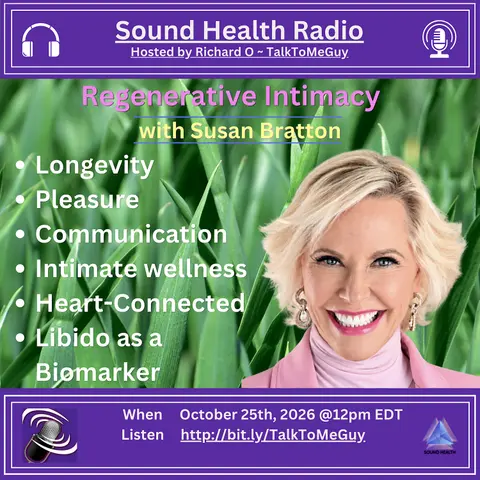
Regenerative Intimacy with Susan Bratton

 PocketCasts

 Apple Podcasts

 Goodpods

 Audible

 Overcast

 Castro

 RSS Feed
Sleep. / Nutrition. / Exercise. / And, according to today’s guest, a fourth factor of longevity almost nobody talks about: / intimacy.
Susan Bratton calls intimacy the Fourth Factor of Longevity, as essential to a long, healthy life as the other three. / For more than twenty years, she has built the education, the technology, and the community around that idea. / Lifespanning Magazine named her one of its Top Fifty Longevity Experts.
She keynotes on pleasure as a longevity strategy, / and on how AI is changing the future of desire.
She is the author and publisher of forty-four books and programs, enjoyed by more than a million and a half people, including her Amazon number one international bestseller, Sexual Soulmates. / She founded The Intimacy Alliance, a global mastermind of the field’s top one hundred experts. / And she has appeared on more than a thousand podcasts, TV shows, and summits.
Susan is living proof that the passionate relationship of your dreams is not only within reach, / it gets richer with age.
•Please sign up for the email list for future notifications•
If you would like help starting your own show or podcast, as well as help selecting a microphone and setup for your voice; Please tap the microphone and leave me a message with your contact information and I will get back to you.
Or you can email talktomeguy@gmail.com
More information at: SoundHealthOptions.com
TalkToMeGuy: Greetings everyone. This is the Sound Health Radio Show where we talk about the crossroads of the environment, our health and longevity with Richard TalkToMe Guy, and Sherry Edwards is off working on the Sound Health Portal. I would suggest going to the soundhealth portal.com, scrolling down just a bit and clicking on the watch how button. You'll see a short video explaining how to record and submit your first recording. Then go back to Soundhealth Portal.com, scroll down to current active campaigns, such as cellular inflammation, biodiet, neuroplasticity, or memory, and choose one that is of interest for you. Click on that campaign and click free voice analysis, and the system will walk you through submitting your recording.
You will receive an email with your report back, usually in one to two hours. To hear and share replays of this show. 50 to 60 minutes after you hear the after music, go to talk to me guy.com, scroll down that page, and you'll see this show at the top of the episodes page. There are also hundreds of shows available there as well. There is a microphone icon at the bottom right corner of all the show notes.
If you would like to leave me a voice message with a question for a guest or a guest idea for a show, you can do that directly from the site, and I will be notified.
With that, sleep, nutrition, exercise, and according to today's guest, a fourth factor of longevity almost nobody talks about. Intimacy.
Susan Bratton calls intimacy, the fourth factor of longevity, as essential to a long, healthy life as the other three. For more than 20 years, she's built the education, the technology, and the community around that idea. Life Spanning magazine named her one of its top 50 longevity experts. She keynotes on pleasure as a longevity strategy and on how AI is changing the future of desire. She's the author and publisher of 44 books on programs enjoyed by more than a million and a half people, including her Amazon number one international bestseller, Sexual Soulmates. She founded the Intimacy Alliance, a global mastermind of the field's top 100 experts.
And she has appeared on more than a thousand podcasts, TV shows, and summits. Susan is living proof that the passionate relationship of your dreams is not only within reach, it gets richer with age. Welcome, Susan.
Susan Bratton: Susan....thing besides your warm introductions.
TalkToMeGuy: Well, I will back up to for a moment. That we we have not ever met in person, but we met a long time ago.
TalkToMeGuy: not trying to make either of us old, but I
Susan Bratton: Yeah. I'm mean it's it's really surprising how long we have known of uh each other. Yes.
TalkToMeGuy: And been doing shows together. It's really amazing.
Susan Bratton: like
TalkToMeGuy: quite like you may be one of my very early adopters to doing shows.
Susan Bratton: I love that. Well, and I always love doing your show. It's so much fun. You're such a champion for people that it's really a pleasure for me. So yeah, I was looking forward to our call today.
TalkToMeGuy: Thank you. Let's jump right in.
Susan Bratton: You describe libido as a direct reflection of your overall health. Yeah.
TalkToMeGuy: Would you please talk about what this is and why it's so important?
Susan Bratton: The best way I can explain it is to come in more of a comparative explanation where a lot of people use libido desire and arousal somewhat interchangeably. And I think that for most people, they want to feel desire. They want to have a high libido. They want to get turned on, turning turned on, the state of turn on is a really good state.
It makes us all happy to live a turned-on life. But we chase it. It doesn't always happen for us. And sometimes it happens, you know, when we meet somebody and we fall in love, and then that wanes, and you know, all of these kinds of things, or maybe maybe as we age, we think, oh, maybe you know, maybe we shouldn't feel what we used to feel. Maybe that's an evanescent feeling in our lives, and maybe that's just for when we're young, which it's not at all. And so the way I like to describe it is that libido is your health.
It's the physical. Desire is more the emotional part of your body. And then arousal is actually uh a process that your body goes through from being not turned on to being turned on. And I really feel like most people, if you say to them, libido is the other side of the same coin as your health. If you don't feel well, your libido is going to be suppressed.
And then when you start to feel better, you'll notice that if the other things are good in your life, like the emotional connection with a partner. If you have a partner, you have emotional connection, you'll notice your libido is coming back. You'll your desire for sex, you're wanting to have intimate connection, your, you know, the energy that you bring to pursuing pleasure. But the thing that most people think is that they they they'll often say, Oh, I just have my libido is low.
I have a low libido. And I find that often it's not that they don't have a partner, or it's or that they have a problem with their partner. It's that they don't really understand how arousal works. And so they expect it to be this automatic thing that happens rather than something that you have to actually encourage and allow to happen.
And nobody has taught us that. And so I think the most interesting part of the whole thing is really desire and arousal, not so much libido. Libido, you keep your you you you you get good sleep, you have good nutrition, you have moves movement, and your libido should be good. If you're sick, it's not going to be good, and you shouldn't feel bad about that. You should work on getting better and not beat yourself up because you're not running around feeling like you want to be intimate.
TalkToMeGuy: And I can't remember which show it was on. Uh one of the last more recent shows we've done, where we talked about and really talked about libido is a biomarker of health.
Susan Bratton: Yeah. And
TalkToMeGuy: it's really true. I hadn't thought of it until I think I said it on air.
Susan Bratton: You said it. You're the one who coined it.
TalkToMeGuy: It's such an easy, you know, when I say it now, it just makes so much sense. It so encapsulates your work, but just really the truth of if you're not healthy or vital, it's really hard to have a libido. And I think that's partially because your body is just barely scraping by, so to speak.
Susan Bratton: We need more qi in order to have
TalkToMeGuy: libido.
Susan Bratton: Mitochondrial function.
TalkToMeGuy: Thank you.
Susan Bratton: Yes, same thing as qi.
TalkToMeGuy: Yeah. It's
Susan Bratton: just a three-letter word for mitochondrial function.
TalkToMeGuy: Yeah. And I and I don't remember by now I've read and heard so much in prepping for the show. I heard, I think you're talking about uh libido in relationship to a Venn diagram.
Susan Bratton: Would you talk about that?
TalkToMeGuy: Because that's such a I think a powerful visual for people. Yeah.
Susan Bratton: The three intersecting circles with you in the middle. One is your libido, so that's your overall health. One is your desire, and that is how you feel about yourself versus how you feel about your partner. And if you're just thinking that you're fat or you're ugly or you're not appealing, or you're in an unhappy relationship, you're not getting your needs met, your partner's not bringing you joy, and or your partner's simply not making you offers for pleasure, bids for intimacy. They're not holding you, they're not, there's no romance, they don't put their attention on you, or there's something going on in your relationship outside the bedroom.
That's the desire piece. So, how do you feel about yourself? And how do you feel about your partner if you're lucky enough to have one? How do you feel about them?
How do they feel about you? What's going on there? And then the third ring is this notion of arousal. And arousal is very different between the male and the female systems for a number of reasons. For women, we are estrogen dominant, and our male body partners are testosterone dominant. And testosterone gives a guy if he's healthy, nocturnal erections, many of them, the more of them you have, the better. Three, four, five, six, seven of them a night is very healthy. They actually exercise the penis and keep the blood-carrying capacity going for his ability to achieve an erection. Where for and and testosterone is the molecule of lust and desire and wanting, and it's also the molecule, the hormone of going for it. And so it really helps men because they generally have this more, and this is the doctor of work of Dr.
Rosemary Basson. This they have this more spontaneous arousal, where for female bodies, we have the same amount of erectile tissue in our genital structures as our male body partners do. He gets that erection.
We've got that same amount of spongy tissue that fills with blood and gets plumped, but it's almost all internal to our vulvo-vaginal structures. And it's not fast acting. It doesn't get, it doesn't get a fast erection erection. It has men have fast acting hemodynamics, not slow kind of slow slowing hemodynamics into our genitals. Plus, estrogen for the female body, estrogen is um is is a protective hormone as well in many ways.
It's heart protective, it's bone protective, it's brain protective, it's skin and tissue protective, but it's also protective of us walking safely in the world. We have a much we're we have we're the multitaskers. We've got our we're paying attention to 23 things at once, where our male body partners generally are more, you know, full speed ahead.
I've got this one goal, I'm not multitasking, I'm just getting this thing done really well. And so we're always looking around, making sure that we walk in the world safely, and that's why it's very important for females to feel they have a lot of trust and safety, so they can let go of worrying about protecting themselves and they can allow themselves to surrender to pleasure. It's hard, it's literally harder for women to do that. But the problem is that it's not enough to just feel safe with your partner, because if all you have is the safety and you don't have any novelty and variety, then you get bored and it's not so exciting, and it's not a big turn on to be with a person that you're doing the same old thing with all the time. So we really are very different from how long it takes us to get aroused to what arouses us, obviously, men being more visual, the brain of men is actually more visual than the brain of women sexually. There's all these little things that scientists have explored in various ways that show us the difference in the way we achieve arousal.
TalkToMeGuy: And in this day and age, everyone seems like everyone. Of course, if they have a you know, iPhone or a pixel watch or anything, everybody's tracking everything.
Susan Bratton: Yeah.
TalkToMeGuy: I mean, it's it's amazing how many people I see talking at coffee shops often, talking about oh, the thing and the stuff, and I had the oh more sleep, and you know, I mean, we're all tracking everything, and yet are we tracking is there a way to track libido in a certain way? Is it a could we possibly monitor it by tracking heart rate variability in the sense of do you think if you're in a certain state of I I'm a big fan of HRV, and I think it's a powerful monitor for your overall state versus blood pressure or you know, length of sleep or all that. I think HRV is a really great way of monitoring your overall state of being.
Susan Bratton: And I'm wondering how we can what how do we need to relabel into uh
TalkToMeGuy: intimacy so that people will think it's something else? How do we fool them into monitoring intimacy?
Susan Bratton: Well, there's a whole category of devices now that I call quantified intimacy. And I actually spoke at San Francisco uh Tech Week about this last year, and they've invited me back this year in January to talk about it again. Quantified intimacy is of interest to people because you know, now we're starting to track hormones and all kinds of things. So there is not one perfect um metric that can track our libido or our desire or our arousal, but there are data points that can begin to feed into um data over time so that you can see patterns. So a perfect example is the lioness vibrator. It's a rabbit-style vibrator that works with a Bluetooth app, and it has it tracks female orgasmic response. So when you self-pleasure with this device, it measures not only your pattern of orgasm, and there's three different patterns.
There's the avalanche, the wave, and the volcano. And they're they these are the patterns that they've seen across thousands and thousands and thousands of women's orgasmic response. And it can track how long it takes you to get into an orgasmic space and then what that orgasmic intensity is, as well as the duration of orgasm. And of course, many women have a single orgasmic event, but many women have multiple orgasms. Many women have extended orgasms, which is the orgasmic, the moment of orgasm lasts longer.
And then of course, with practice, something that I've taught for decades now, because I've carried on the work of Dr. Patty Taylor in the expanded orgasm practice, which is a technique for couples that is a very light clitoral stroking technique that allows a woman to not just have one orgasm or for her to have a longer, more extended orgasm, or to have multiple of those, but it stacks and it expands as she's in this orgasmic session. She's getting this type of stroking to that tissue that allows that tissue to and her body to learn how to stay in orgasmic sensation and build that sensation such that not only do the moments of climax extend out over time, but they stack and become more intense during this expanded orgasm session. So the body has over 20 kinds of orgasms it can experience, and they're very similar between the male and the female body. They're not exactly the same because of course the female body has the G spot, the male body has the prostate and things like that.
He's an Audi and she's an innie. But all of those orgasmic moments of hypers, formats, and intensity and duration can be tracked. Another thing in quantified intimacy that can be tracked is nocturnal erections.
You can track the health of your erectile function. And it's interesting because I was just talking to the creator of the firm tech ring, uh, Elliot Justin. He invented this. He's a former MD who now has invented this basically this small wrap that goes around the sh base of the shaft of the penis during the evening while he sleeps. It's a comfortable elastomer, and it will track the number of and the duration of and the firmness of his nocturnal erections, which are his indication of overall erectile function. And he just is coming out with a study that's that he gave those men, 64 men, you he they tracked their nocturnal erections, then they used a vacuum erection device multiple times a week for I think it was six or eight weeks, and it improved their erectile function. So they got more nocturnal erections and woke up with more erections, and their erections were firmer after using the vacuum erection device, and they could measure it. So those are two simple examples, male and female of the types of quantified intimacy that we're starting to be able to collect data on.
TalkToMeGuy: And because uh any show now, I have to talk about this. Um is AI going to be factoring in here? I remember or saw or heard you mention AI someplace, and I can't remember the context right now, but how is AI it must fit in here someplace because it knows so much? Is AI gonna be beneficial to all of this? Yeah.
Susan Bratton: Do you think? And it oh, yeah, I've been playing with a bunch of new AI sex tech. And um it's really interesting because mostly there are two, there are two big categories of AI generative sex. And it's interesting that the category for men is device pleasuring devices that synchronize with video, and you can imagine what kind of video they're sinking to, adult video. And so they are they can actually, and and there's also immersive like headsets that you can wear that sync with the pleasuring devices, so that you're in an immersive experience in an immersive AI generated video sexual experience.
So you're in the movie now, basically, and you're feeling what's going on. You there's even one coming out gonna say February. And right now, when we're recording, it's October. So in a few months, there's a role player game, RPG, they're called that's called Wild Time, I think it's called. And it's like it's you know the movies, the avatar movies.
TalkToMeGuy: Yes.
Susan Bratton: It's like an avatar movie. It's got like the hanging gardens and all that kind of stuff, but it's kind of like the Latina version.
TalkToMeGuy: It's like the avatar for Latin America. So it's kind of got this aztech kind of feeling to it.
Susan Bratton: So it's like as tech, excuse me, Aztec avatar, but you're in it, and you can have intimate experiences with the people, quote unquote, the AI people in this experience in this role player game.
And that's much more like what the AI sex is that they're making for women. I just used a new product called Senson, S C N S O N Senson, and it's kind of billed as this intimate relaxation device. And it has um you you put it between your legs and you can control the speed just by squeezing your thighs together, and it has both an internal component and an external air stimulator, and it also comes with these little devices that attach to your nipples and stimulate your nipples. So you're getting internal and external vulner stimulation with simultaneous nipple stimulation, which is really interesting because I've been teaching people about that arousal triumvirate for many years that kissing the lips, the mouth, the neck is one zone. The breasts and nipples are another zone in male and female bodies across cross the Homo sapien.
It you know, just because you don't currently have that practice doesn't mean that you can't. It's available to all, you just awaken the sensation and the genital structures, those three things really work in concert together to increase arousal. And so they did the internal, external, and then the nipple stimulation, and you can choose on the app on your phone that comes with it, you can choose an avatar, and the avatar will either talk to you, or you can chat with it, and it will just take over the device and pleasure you the way you want to be pleasured and speak to you the way you want to be spoken to.
And there's all these, there's like a hundred different avatars in their app, everything from you know, all ages across the gender spectrum, as well as fantasy types of avatars. I liked the one you want to hear my favorite one,
TalkToMeGuy: of course. There
Susan Bratton: was this like handsome kind of 40, 50 something with shoulder length gray hair, and we were hamping, and we were doing a little mushrooms, It's all just made up, you know.
We're doing a little some some psychedelic mushrooms, and he was gonna ravish me in the tent in the woods where we were out in the woods out in the mushroom. Like they're pretty amazing.
TalkToMeGuy: wow. That's amazingly developed and thought out.
Susan Bratton: Wow. Oh, that's pleasure. You're feeling him or the thing, the entity, you know, pleasure you while you're just there with this device stimulating you. It it's pretty darn incredible what these devices can do. And so what they found, and I've used some other technology like that too, some pleasure tools for the female genitals that have avatars that drive it, and they even have ones that are like staters and werewolves, and you know, women love those. If you if you look at erotic fiction, women really like like vampires and werewolves and you know, things like that.
They want fantasy creatures to make love to them too. And of course, there's that whole category of like creature-based, you know, aliens, and you know, you're having an alien baby,
TalkToMeGuy: and yeah,
Susan Bratton: oh my gosh, it's just crazy, all the stuff that people really get off on. So, yeah, there's more and more quantified intimacy. There's more and more AI sex for you know, people across the gender spectrum now. And I think there are a lot of people for whom the only relationship, the only sexual relationship they might be comfortable having would be with an with a generative experience, a generative avatar. But there are a lot of people who don't necessarily want to be in meat space with others. And I so everyone's always so worried about oh, we're gonna replace, you know, people aren't gonna have sex anymore. You know, you always see those click baity headlines, you know,
TalkToMeGuy: yeah,
Susan Bratton: You know, circles, you know, and all this kind of stuff. And uh it's like, well, if they don't want to, why make them like hey, I don't make coffee by grinding beans and you know, put boiling water over a pot. I just make a make a pot of coffee with a coffee maker now, you know. It's just like there's lots of things that get better when you have devices that do it for you. So I'm really open and open and fascinated with where it's all going.
TalkToMeGuy: And so I didn't mean to go here, but it's happening. So how does that affect oxytocin levels and the kind of intimacy of touch and being with another human?
Susan Bratton: Do you get do you get some of that out of that? No, you'd have to pet your dog or take, but now the devices are starting to uh like have uh the ability to spray intranasal oxytocin for you, right? That that's like doable
TalkToMeGuy: the day. I mean, you can you can buy intranasal oxytocin or oxytocin trochies from MIDI health and you know, inner balance and all these places now. You just have a telehealth appointment and get oxytocin.
So pretty soon that stuff's just gonna be in the in the devices. I just went down to LA. Did you hear about that new AI generative art installation called dataland.io. I've I've heard people talk of it, but I don't know, I haven't been there. I don't know anything about it yet.
Susan Bratton: It's super cool. It's right near the new Lucas Museum of illustrative art, which I cannot wait.
TalkToMeGuy: That just opened too. I cannot wait to get there.
Susan Bratton: But um, dataland is this interactive, immersive generative AI visual graphic experience. You walk through a series of rooms and they're all painted black, and then there's these projections on the wall, and you're wearing these biofeedback devices.
You wear this little device and a wrist wrap, and it feeds data to the the computer that's generating the graphics in the room such that the graphics are completely different every single moment of its entire existence based on the data from the people. And one of the things it's kind of like you know what it reminds me of. Do you remember those bone phones? Do you remember those little like speaker systems you could wear around your neck, kind of like a
TalkToMeGuy: towel?
Susan Bratton: Um
TalkToMeGuy: okay.
Susan Bratton: So
TalkToMeGuy: that's the device that you put in, put
Susan Bratton: on. You put this little bone phone thing on there, and it measures your heart rate and your skin galvanization, or I don't know what it is. And then you have this little wrist thing that also collects data, like heart rate and you know, whatever. And um, it sprays fragrances, and they're not gross. Like normally I wouldn't want
TalkToMeGuy: yeah
Susan Bratton: fragrances sprayed in a room I'm in necessarily, but it was one time and I wanted to see what it was like, and it sprayed fragrances that were custom created for the graphics that were happening that were generated based on the people in the room and their biologic responses they were collecting.
TalkToMeGuy: So why can't they just spray
Susan Bratton: oxytocin while your satyr is ravishing you on a desert island?
TalkToMeGuy: I smell a pineapple. Yeah, okay. Wow.
Susan Bratton: Redalin, it's kind of a horsey smell with a little pineapple.
TalkToMeGuy: Yes, yeah, yeah.
Susan Bratton: Your goat, what is a satyr? Is a satyr a half manual?
TalkToMeGuy: I think that's the half man half horse.
Susan Bratton: Half horse, yes, a little horsey smell.
TalkToMeGuy: A
Susan Bratton: little horse and pineapple.
TalkToMeGuy: Little hay and manure. Yeah. Yeah. I
Susan Bratton: know,
TalkToMeGuy: isn't that so funny? That's amazing. I have to look up, I have to go now and look up data later.
Susan Bratton: Oh god, yeah.
TalkToMeGuy: I wish I could go with you. It's the most incredible experience. Wow. And so let's go now what I would call old school
Susan Bratton: and talk about
TalkToMeGuy: oxytocin.
Susan Bratton: Yeah.
TalkToMeGuy: You you phrase it as oxytocin is the antidote to cortisol. Let's talk about that, and then I have follow-up questions. Okay.
Susan Bratton: Well it's oxytocin generally has been thought of as the bonding hormone between mother and child, which it is. Um, it is one of the things that when you hold your baby and you get that skin to skin contact, it creates that bond.
But it's also the bond between lovers. Oxytocin is a hormone that we generate. Women tend to generate more than men do. And oxytocin is a very, it's a very interesting hormone in that it's created when you make love, when you're intimate, when you're when you're holding and being held and kissing and all of those things, all that skin to skin stuff, and that lowers your overall stress level.
So of course you know that when you have orgasmic expression, when you're held, it's kind of like you reboot your nervous system. That's one of the benefits. That's one, it's one of the big reasons why intimacy is the fourth factor of longevity.
Because when you're calmed from the connection of the oxytocin and the intimacy, you're bringing down your stress levels and your modulating cortisol. The only problem is that for a lot of us who have had to have antibiotics at different times in our life for various things, that the antibiotics that the oxytocin is generated in your gut. And when you have had antibiotics, it can traumatize your gut, and that bacteria that helps us generate oxytocin can be destroyed from the antibiotics.
So then we're we struggle to produce much oxytocin, and we don't get the benefit of it. So you have to re-establish the bacteria in your gut. It's called lactobacillus gaseri. I'm sorry, lactobacillus routeri. Gastra is a different one. Lactobacillus routeri. And the company that makes it that I like is a company called oxyceutics. That's Bill Davis, Dr. William Davis. You know him, right?
TalkToMeGuy: He must have been on your show a lot. Multiple times, multiple times.
Susan Bratton: love Bill. I just love Bill Davis so much. And um, yeah, he wrote super gut, undoctored, wheat belly, all kinds of good kind of, he's a gut health doctor. He was a cardiologist, but he got tired of having to do surgery on people when he wanted to get earlier in the downhill slide and help them not have to have heart attacks and stents and things like that. And so he just got into gut health. He got actually got into weight loss. And what he realized is that oxytocin is very helpful for weight loss. There was a rat study where the rats were given uh oxytocin and they lost weight, or and then he realized there was a link to lactobacillus routeri, and the rats got thinner, and so that's when he started this whole study of oxytocin. And so when you re-establish that lactobacillus ruteri in your gut, and he does it through yogurt.
I I make his yogurt at home, and that's the yogurt that I eat, and it re-establishes that bacteria so that your body can produce more oxytocin and and even some or a lot. And I have had points in my life where you know, in the last, I'm gonna say five or six years, where I know I am pumping so much oxytocin from being touched and held by my partner that when I'm not touched and held by him for 10 days or two weeks, I can feel my stress levels raise and I can feel disconnected from my humanity without that. So I think we are many of us are probably most of us at this point are running around low on oxytocin. What I have noticed is because I've tried intranasal troches, which are a dissolving under the sublingual dissolving kind of a off-roppy thing of oxytocin, and I've you tried intravaginal oxytocin, and I've tested the lactobacillus routeri yogurt version of it.
And by far the lactobacillus ruteri yogurt version of reestablishing your own oxytocin rather than just taking it exogenously and putting it into your body, there's a world of difference between the two of them. When it's made when you're making that stuff in your own gut, it is the things that I've noticed are that there's a big difference where I feel more awe. I have the sensation of awe in my life. Things are less flat, they are more beautiful.
I enjoy uh nature, art, music more. It heightens them for me. I'm less annoyed by people who would normally annoy me. Uh, I have more resilience around living in humanity. I feel like they should stop putting the fluoride in the water and they should start putting oxytocin in the water because it really makes you feel a lot less annoyed by everything. It's just so funny. So those are some of the things that I have noticed about oxytocin.
TalkToMeGuy: And could we spray it into a room?
Susan Bratton: I mean, yes, uh, that's one of the things that the sex tech companies are working on is basically what you would normally consider to be intradazal, could potentially just be like a puff can come and you can breathe it in.
TalkToMeGuy: It seems like a great thing for concerts, depending upon the kind of concert.
Susan Bratton: It definitely does. Wow.
TalkToMeGuy: Um, yeah, I've been talking to Davis since he wrote the wheat belly.
Susan Bratton: Yeah, you're backstage buddies. And um, he really is just possessed by the yogurt, and I mean in the best of ways, yeah.
TalkToMeGuy: Of you know, coming up with this like stunningly simple solution of get some L Ruderi, put it in the milk,
Susan Bratton: incubated for 36 hours, eat, rinse and repeat. Yep.
TalkToMeGuy: Um it's it's so it's so different. I I've worked with other people and talked with other people about oxytocin and about L Ruderi and the people that do the yogurt. 90% of them are in love with making that yogurt and probably will never stop.
Susan Bratton: I
TalkToMeGuy: never would stop because the sense of just wellness,
Susan Bratton: yes,
TalkToMeGuy: is phenomenal. Yeah,
Susan Bratton: and it's it lasts in the fridge so long, it's crazy. It like hardly ever gets moldy, it can really last a long time. You just take the old one, make a new batch, take the old one, make a new batch, take it. It goes on and on forever. It's like a it's like a sourdough starter that never dies, it's the same kind of thing, and
TalkToMeGuy: less annoying to maintain. Uh,
Susan Bratton: that's for sure. That's true.
TalkToMeGuy: And while we're talking about oxytocin, let's talk about the value of to health and longevity of touch.
Susan Bratton: Yeah, I
TalkToMeGuy: just think touch is I'll say this now because I can't help myself. Uh, I studied massage therapy, Swedish ISO massage, and so I did massage for 15 years. And not only from that, but just in general, I think there's very few things as powerful in the best of ways of the combination of touch and I want your opinion on this, and gazing into someone's eyes at the same time.
Susan Bratton: And I don't mean that stare down.
TalkToMeGuy: I don't mean that like I'm staring you down, sub to me. I don't mean that at all. I just mean the idea of I don't know if it helps enhance the circuit or what the staring into the eyes or gazing into someone's eyes at the same time, but it seems to be a powerhouse of oxytocin happiness.
Susan Bratton: The windows of the soul, right?
TalkToMeGuy: Yeah,
Susan Bratton: windows to the soul. Well, it's so vulnerable, and there are many people who are very eye shy. And for a lot of us, we we're not touched enough. We don't get enough enough touch. We don't get enough of people see truly looking at us and seeing us and loving us, and so those two things are very, very special and beautiful. You know, here in Geneva, while I'm staying, well, my daughter and I are staying together, my daughter, my husband, and I, I make sure I hug her multiple times a day.
I when we're we tend to sit next to each other because I'm a lefty and she's a righty if we go out to dinner or what have you, and I rub her back and I rub her hair, and I just I pet her, I pet her like a little kitty as much as I can, and I notice that when I start doing it, she likes it, but it takes her a little while to kind of get used to it, and then she starts to really love it, and then she really relaxes, and it takes a while. We are touch starved, and we are starved for vulnerable open connection. We're so busy in our society, it's so it's everything's so stressful right now. And we're just going through so much together, and everything's expensive, and everything's, you know, we're we're red versus blue, and we're being torn apart. And it's so bad right now that we all need to just focus more on holding and being held, on touching each other as friends, on hugging each other, on sitting close, of really looking each other in the eyes over across the table at dinner or whatever it is.
We have to go out of our way for that. And there's another thing that I think is really interesting, and that is that we have somewhat lost our affection, our platonic touch affection. And the more that we can get that back, the more that we can take that minute to just really embrace our friends or to put our hands on each other, um, to sit, you know, shoulder to shoulder, touching. We've we've forgotten that it's okay to touch each other.
And I think also asking our partner to touch us, you know, hey, before we go to bed, can you can can you come and lie in my bed before we go to sleep? And can you give me a foot rub? Can we snuggle? Can we spoon?
Will you hold me in your arms? I teach something called the soulmate embrace, and it's a way that a man and a woman can hold and be held. And it really doesn't need to be a man and a woman. Two people, it can be two people holding and being held and just allowing yourself to reconnect in that physical way. And maybe you look each other in the eyes, maybe you're just lying side by side, nestled in each other's arms. Whatever comes up, comes up, you know, you just uh get things off your chest. You want to share things you've been thinking about, you want to, you know, let something go. And then, and once you do that and you get kind of the verbal emotional piece out, then you have the ability to really remember that you love this person and you start to get really connected again. And I think that's it almost takes that time for the oxytocin to begin to generate. It's not like two sticks you rub together.
It's more like a letting down. There's actually, I found a moment where prolactin enters the chat, where you let you let down your your spit runs a little bit, your eyes may tear up. Everything just kind of relaxes when you connect like that. And I think that's something that we often don't do enough of because in our society, we think intimate touch is a precursor to intercourse, and so many people they're not ready to commit to intercourse because they're stressed out and they've got a lot going on, and you know, they got to get up the next morning, all those kinds of things. And so they just skip all the other steps that are so beneficial because they don't want to start something they can't finish, or they don't want to give their partner the single the signal that there might be more. And so they never even get the holding and being held. That's so important for co-regulating our nervous systems.
TalkToMeGuy: Well, I have a note here about you, I forget the where, but that it really reboots your nervous system into the parasympathetic parasympathetic nervous system,
Susan Bratton: which is the rest, digest, relax um.
TalkToMeGuy: So it makes sense that all of that might be considered kindness in the case of petting your daughter, or in the case of possibly being with uh even just being with friends sometimes sitting
Susan Bratton: around and
TalkToMeGuy: uh women, I see women doing this more than men, uh, just in terms of you know, touching or sitting with you know their hands on on each other or holding hands or you know, just being intimate in the sense of having some touch and camaraderie, what I call camaraderie.
Susan Bratton: Yeah, and
TalkToMeGuy: how it's calming, you know, it's just
Susan Bratton: like calming.
TalkToMeGuy: I I'm I hang out with a lot of uh a main a main coon cat in particular,
Susan Bratton: a
TalkToMeGuy: beef beefy, you know, it's a small dog, but it's a main
Susan Bratton: coon cat.
TalkToMeGuy: And he'll just come over sometimes in you know, early morning and come over and sit on my foot and just lay there and purr. It's just like, dude, that's really cool. Thanks.
Susan Bratton: It's not something I've ever had a cat do.
TalkToMeGuy: And it is very soothing to the system to have. Well, I think cat purring is healing anyway.
Susan Bratton: But it's just it's along the same line of it puts me into that parasympathetic state
TalkToMeGuy: of, you know, rest, relax, digest, beat each it's all okay.
Susan Bratton: Well, and it's interesting because I think for a lot of couples, they live together, but they get their touch from their pets rather than from each other, because they've got this idea that if they touch each other, it's gotta lead to sex, and they're not they're not ready for it, they don't have the energy for it or or what have you. And I also think that one of the reasons why men are so oriented toward intercourse, of course, it feels fantastic.
I understand that, but because they don't get the same amount of touch and affection that women can give to each other in our culture, and so the only time they're getting touched is when they're having intercourse, and that's not right either because their partners don't want to always touch them because they're like, I don't want it to lead to intercourse, and so there has to be this kind of like array of possibilities that are available to a couple without any without there being this kind of like expectation for more. So my husband loves it when I pet his head, he'll just sit beside, and he's so cute, he he'll barely move, you know. He doesn't want me to stop doing it. So he just sits there so patiently and just takes it all in. But he loves it when I just pat his head and I stroke his hair, and I stick my fingers up the back of the nape of his neck, and I just lay with the back of his head, and you know, I just pull his hair through my fingers and things like that. I love when he gives me foot rubs and when he gives me upper shoulder and neck rubs.
I love that. My grandmother loved it when I would tickle her arms and we would take turns, she'd tickle my arms and then I'd tickle her arms. She loved to have her arms tickled, and it's so interesting. I've been researching the different like cellular cellular signals that our body uses for touch, and there's all kinds of interesting um somatosensory cellular signals, and the way we feel our body feels it like when if I'm if I'm if I'm running my fingers through your hair, what's what you're acting is actually happening is that you're that these cellular systems are sending signals to the somatosensory cortex, which is up in the top of your brain at the top of your head, and they all feel different things, like Meisner corpuscles are what my grandma and I were tickling when we were tickling each other's arms. Merkel's discs is what you were doing when you were doing the Swedish, the long sustained pressure of Swedish massage, and Absinian core pucles are what are created from vibration. That's what the pleasure tools provide. When you're rubbing my feet, my husband's rubbing my feet, that's Raffini nerve endings that feel the stretch of moving that tissue. Um, it's just so interesting how we have all these different pleasure-specific caress fibers in our body. There's thermoreceptors too. Like one of my um, I'm did I tell you I'm writing my 35th book.
TalkToMeGuy: No, wow.
Susan Bratton: I'm writing my 35th book And it's it's on Yoni massage right now. My placeholder title for it is petting the kitty.
TalkToMeGuy: And
Susan Bratton: it's because you know how I was talking earlier in the show about how men have fast acting blood flow and women's the same have the same amount of erectile tissue, but it takes us 10 or even 20 or sometimes 30 minutes to come to full effect. So that there's all that surface area full of blood in our genitals, like the difference between a flaccid and an erect penis. And so guys can get to that state in a minute or two where their female partners, it takes 10, 20, 30 minutes of diligent massage and moving that tissue to get the blood to flow in to fill up the spongy tissues to create the surface area that sends the signals to the brain of pleasure. So most women, if couples are having very fast intercourse, she's basically having intercourse with a flaccid vulva, and it doesn't feel that good, which is why a lot of women they tend to kind of want to opt out over time because it's not that great for them because they never quite get to the great place.
So yoni massage is the stopgap for that. It's actively stimulating that tissue so that it engorges and fills up with blood so that everything that you do to it feels fantastic. So it's a really good practice for long-term couples or really for anybody. It's just a really great practice to understand how to touch each different part of the vulva in ways that that tissue likes to be touched based on the corpuscles and the nerve endings and all of the stuff that's in there.
And one of the things that you're that your the vulvo vaginal system has, it has two things. It has mechanoreceptors, which like stretch, but it also has temperature receptors in it. So it likes the feeling of warmth as much as vibration. Vibration stimulates surface receptors, oscillation, which is a deeper rumblier vibration.
That stimulates deeper tissue receptors. So when you're giving a yoni massage, I recommend different tools. One of the tools is a little vibrator that will get warm.
You can make it it, it gets warm. So when you're vibrating the tissue, you're warming it at the same time. It also gets cooling. So if you're in hot climates, that feels really good. And then you can use an oscillator as well, which will get that real deep tissue stimulated and engorged. And I feel like this is the thing that couples need. They need this petting the kitty practice because it slows everyone down.
There's no hurry. You're just dropping in together and co-creating sensation. So that's what I'm working on right now. And that's why I'm learning about all these nerdy things like Piscinian nerve endings and stuff.
TalkToMeGuy: Bassinian nerve endings and
Susan Bratton: bassinian corpuscles.
TalkToMeGuy: And is there anything in there in terms of uh the vagus the vagal nervous system in terms of a calming agent?
Susan Bratton: Let's say, let's say you're you're either direction, either one of you or both of you have come from a literal hard day at the office. And to bring the body, I've done a lot of breath work uh study with Ed Harris, who does a lot of you know, a lot of work on vagal nerve.
TalkToMeGuy: And I was having some structural problems, and he taught me this, you know, as some people call it proneomic breathing. I just call it vagal nerve
Susan Bratton: breathing.
TalkToMeGuy: And it's amazing how, in a state in a moment, I was having some cardio issues, and Ed taught me this breath work, and I started doing it, and it would immediately calm the panic that the body was going
Susan Bratton: into
TalkToMeGuy: because it was breath work that was calming the vagal nerve.
Susan Bratton: Yeah.
TalkToMeGuy: So anytime I'm stressed out or just going nuts, I'll do some vagal nerve breathing for a few minutes. And it's not hard, it's not difficult, it's just nasal breathing. But it's amazing at the shift that it causes or creates in the body. And I just think adding that to the mix might be interesting because it is very it's just very calming to the system, very relaxing systemically to the body. So you get somewhat out of your head and more into your body. Where if we're going to talk about sex, you want to be in your body, not in your head, I think.
Susan Bratton: Oh, for sure. Well, and that's I'm glad you brought that up because it I it it the pedendal nerve is the one that carries most of the sensory, the somatic sensory signals, and the vagal nerve is the calming nerve. And often breathing deeply to help calm that system. What it actually is doing is it's relaxing the vascular system so more blood flow can get into the tissue. So that's what the breath work does. The breath work relaxes the vascular system so it can, so the blood can come from be can be recruited and squeezed into the pelvic bulb.
TalkToMeGuy: Okay. I'm making note of that.
Susan Bratton: You're so cute.
TalkToMeGuy: And I'm, you know, scheduling now. We'll schedule for uh as soon as this book is out. We must do a show.
Susan Bratton: Sounds good.
TalkToMeGuy: Um, so I want to jump. I can't believe it's almost time. Then
Susan Bratton: I know. I
TalkToMeGuy: often use the hashtag total toxic load in
Susan Bratton: a lot of stuff that I post on social media.
TalkToMeGuy: And it's a it's a my tag for everything environmental pollution, whether it's glyphosate or pesticides
Susan Bratton: or
TalkToMeGuy: diesel fuel or you know, whatever
Susan Bratton: it is that we're doing, something stupid we're doing it in the environment.
TalkToMeGuy: Forever chemicals, right? Yeah, forever.
Susan Bratton: Oh
TalkToMeGuy: bad words. Um, and our foods for God's sakes in school lunches. All right, I'll
Susan Bratton: move along.
TalkToMeGuy: Um So these are totally, you know, those are endocrine disruptors.
Susan Bratton: So that messes with
TalkToMeGuy: both female and male hormones.
Susan Bratton: And
TalkToMeGuy: then we also add to that mix in the total toxic load. We have estrogen mimickers, which have been
Susan Bratton: decade a problem for decades,
TalkToMeGuy: and that affects both men and women for different reasons that reduces men's testosterone levels and elevates women's possibly elevates women's estrogen levels, and that's just messing with a system that's tricky to begin with. Uh you know, and add stress to that. So how do we how do we deal with the that detox? I'm moving toward asking about things like infrared saunas or
Susan Bratton: hypervaricot or
TalkToMeGuy: uh
Susan Bratton: red light therapy, or
TalkToMeGuy: I'm a person
Susan Bratton: who because I'm an herbalist,
TalkToMeGuy: I take herbs every day for that very action of purification on a daily
Susan Bratton: basis. How
TalkToMeGuy: do people like a foreign frame sauna? Is there some place you would like people to think that oh, maybe you should get a infrared as one of those just easy simple pop-up looks like aluminum foil tint for infrared sauna, so you can have a sweat on a daily basis. Is
Susan Bratton: there some
TalkToMeGuy: sort of easy way to get people to detox?
Susan Bratton: I mean you mentioned what I think are all the good ones, but and don't cook in plastic or eat out of plastic.
TalkToMeGuy: I'd add that one right up there, right?
Susan Bratton: But the the one that's coming to my mind that's like the Susan Bratton angle on things, which is why you have me
TalkToMeGuy: here, is to use lubricants that are not actually sexual lubricants, but that are clean what I would consider to be clean pleasure, slidey glidey components.
Susan Bratton: Sexual lubricants are an FDA class two category, and so any the the top 30 sexual lubricants, there's only like maybe one or two companies out there that make anything that can be used on the genitals, but that is um that doesn't have PFAS in it. Like if you look at mom evasion or any one of those websites, all the lubes have garbage in them.
Anything that you'd buy in CVS or Walmart or Walgreens or Target or whatever, they're gonna have preservatives and the preservatives are gonna be garbage, and almost none of the material in those products is healthy for you. And if you wouldn't put it in your mouth, you shouldn't put it on your genitals because that's mucosal tissue, same as in your mouth, it's gonna get absorbed right in. As a matter of fact, the vaginal mucosal lining is basically nine layers of sponge, and it's it's spongy tissue because when you relax and you breathe and you look into each other's eyes and you calm your nervous systems down, the blood goes from all the other parts of your body and is recruited into your pelvic bowl to engorge your genital tissue, and so the that the vagina itself does is not self-lubricating, it's not a it's not a gland, it's a muscle, and so it doesn't make its own wetness, and so as women age and their estrogen declines, the spongy lining of the vagina thins, and so even if you recruited all that blood plasma in there, the tissue doesn't hold as much liquid, so you feel drier. So using lubricants is really good, and the two that I like one I call my pleasure protocol, and the pleasure protocol is three different parts that work beautifully together. One is a vaginal insert called a melt, and it's made with cocoa butter primarily, and it has some CBD in it because the urendocannabinoid system is all around in your genital structures, and it responds, it's a pleasure healing pathway. And so you put this kind of little insert that melts up inside the vagina and it coats the vaginal lining and it really moisturizes it. Then you put the awaken arousal oil on the outer vulval tissue, and that awakens that tissue kind of wakes it up.
So you feel more sensation. And then you put the third component of the pleasure protocol, the sex oil on for all the slide and glide that you want for a yoni massage for love making. And what's great is all three of those products are completely, you can just eat them. They're they're just natural ingredients.
That's all that's in there. So I love those. And then I found another new product that I absolutely love called Pleasure Pods.
It's a Canadian company. And that's almost like a little bar of soap, but it's not soap, it's cocoa butter, coconut butter, and a few other essential oils. And that melts on contact with your skin. So it's not liquid that you're pouring on the skin. It's a bar, a little bar, like a little a little disc that melts. You can melt it in your hands and apply it to the skin, or you can just rub it on this on the genital tissue and it melts.
And that's really nice as well. So from a toxic load perspective, bypassing those off-the-shelf store bought sexual lubricants and going for these more natural sexual slide and glide products. They can't be classified as sexual lubricants, which is good. Um things that I really like when I think about toxic load.
TalkToMeGuy: Okay. Yeah. That uh yeah. I think of all the horrible products. A friend of mine used to take me in to go to good vibrations. Is that the correct name for the store?
Susan Bratton: Yeah. Yeah.
TalkToMeGuy: And I'd walk around with her and she'd be looking at stuff and she'd be, you know, handing me things to look at and give my critique. And every product I every kind of lube kind of thing I would pick up and look at.
Susan Bratton: Disgusting.
TalkToMeGuy: Would just horrify me. Like, really, you're gonna put this in your body. Are you kidding me?
Susan Bratton: No. Exactly.
TalkToMeGuy: No, is my answer.
Susan Bratton: Exactly.
TalkToMeGuy: Just no. And no, just bad stuff. Just like you must be kidding.
Susan Bratton: Go get some almond oil.
TalkToMeGuy: I mean, this is so long ago. It was like use almond oil, use something that's avocado.
Susan Bratton: Nice. Yeah. Yeah, refined avocado oil at the bare minimum.
TalkToMeGuy: Jeez.
Susan Bratton: But these the pleasure protocol and the pleasure pods are so much nicer than just brain oils.
TalkToMeGuy: Yeah, yeah.
Susan Bratton: Because
TalkToMeGuy: they're a blend of oils. Yeah.
Susan Bratton: And they each have different viscosities and consistencies that add benefit.
TalkToMeGuy: Yes. And I love the one that has the CBD because I think
Susan Bratton: CBD is nothing but beneficial to the body and to the tissue. Oh my God. I know.
TalkToMeGuy: Anti-inflammatory and et cetera, et cetera.
Susan Bratton: Um,
TalkToMeGuy: can we go just two more questions? Are you okay?
Susan Bratton: Yes.
TalkToMeGuy: Okay, great. We could do another hour.
Susan Bratton: Um I do have to go soon.
TalkToMeGuy: Yes, and all that's okay. Um I wanted to get to this about muscles. You I've read again read or heard you talk about muscles are your biggest longevity system. Would you talk about strength and why it matters even more as we age? Yeah.
Susan Bratton: I think probably the person who knows the most about that is Dr. Gabrielle Lyons. Do you know her? Have you had her on your show?
TalkToMeGuy: I do not. No. Oh, yeah.
Susan Bratton: You might want to have her on. She's really good about uh, she's a geriatric medical doctor, a
TalkToMeGuy: gerontologist.
Susan Bratton: And she really has gotten into the benefits of the muscular system. And you know, just like how Dr. Jennifer Garrison at the Buck Institute's talking about how ovaries are not just a reproductive part of the reproductive system, they're actually a master hormone signaling system for longevity.
That's what Gabby, Gabrielle Lyons is doing, talking about our muscle structures being a master system for immune function and longevity. And so I don't know a ton about it. I follow them to learn more about these kinds of things. But basically, what I one of the reasons that I love to take testosterone exogenously as uh as hormone replacement is because I build muscle really well in my workouts from doing it. It really helps as you age to keep the muscle strength high. I work on my grip strength, I work on my balance, my flexibility, and my overall just muscle volume all the time.
That's what I'm keeping my eye on, as well as things like VO2 max and heart rate variability and those components as well. And boy, oh boy, having a ton of muscle clad to your body, it not only does it testosterone helps you build it, but not only when you build it, do you feel better and you're more functional, you actually you have this mentality of resilience. You have this I can do it attitude, and without that, you begin to become feeble, and then you lose your you when you lose your strength when you lose your musculature, you lose your ability to handle your own stuff yourself. You become reliant on others, you stop doing things, and so anything that you can do around strength training. If you can afford to go to a gym, go to a gym. If you can afford to get a trainer, prioritize that. It makes a huge difference. As a matter of fact, one of the things I'm I just got here to Geneva, and one of the things that I've been doing is I've been walking about two and a half miles a day up and down the hills here to try to regain my function because I had two back to back surgeries before I left to come here, and I noticed that I had a lot of vascular retraction, especially in my feet from lying in bed and
TalkToMeGuy: healing
Susan Bratton: for about six weeks, and my feet were numb, my toes were numb, my balance was off, I lost my stability, and my legs were weak. I I was struggling to walk after six weeks of not walking. And so I've been working on that. And then next week I'm starting with this new gym that's real close to me around the corner here, where they're you they use some kind, it's something that they don't have in California, but it's new, and it's this um like electro stimulation that you wear. You wear these wraps around your thighs and you wear this wrap around your waist, and while you're working out, it's doing electro stem. And I want to see how that does for building muscle because that's a different modality than the um the blood flow restriction devices that I use in Marin where I go.
I use the Vasper and I use the ARX systems, and they use some blood flow restriction, which helps build muscle because it actually helps release growth hormone and testosterone at night while you're sleeping after you work out with blood flow restriction on. So I'm focused on keeping my muscles as big as I can. And I don't worry so much about what I weigh. I'm not even, I don't even pay attention to what I weigh. I don't mind having a little fat on top of the muscle as I age because it's 65. I want to have buffer, buffer for illness, buffer, buffer of muscle, buffer of fat. I don't want to worry about those things. I don't want to be scrawny and I don't want to lose my mass, I want my mass to be big as I age.
TalkToMeGuy: Well, and that's the reason I have one more question, but I will
Susan Bratton: tell you that's one of the reasons that I have a standing workstation. And
TalkToMeGuy: it's
Susan Bratton: also shining. I was a working chef for 20 years.
TalkToMeGuy: So I'm just oriented towards standing. I'm not really comfortable sitting for long periods of time. Structurally, I'm not comfortable. And so I prefer standing, which does a you know, I'm always moving. Um, I use a rebounder once or twice a day for 20 minutes each time. That's great. Loosen, but because my leg muscles are quite large, always have
Susan Bratton: been.
TalkToMeGuy: Grew up on a grew up in, you know, a small uh coastal California town, Carmel, and my
Susan Bratton: parents built their house on the top of the hill, and I walked to all the school, and the bad part is downhill on the bike is great. Oh my god, it's great.
TalkToMeGuy: Coming home every day was murder. Uh, but it gave me massive size and calves, and I've kept
Susan Bratton: that's good.
TalkToMeGuy: And so I keep that as my way of staying, you know, vital as much as possible. And it does make a difference.
Susan Bratton: I'm amazed when people around me who
TalkToMeGuy: are younger than me, like, I gotta sit down, man. You're killing me.
Susan Bratton: I can't help it. Oh, that's so good.
TalkToMeGuy: This is you know how I'm built. I'm built to stand. That's all the
Susan Bratton: reasons.
TalkToMeGuy: Now I have one last question.
Susan Bratton: Okay.
TalkToMeGuy: I have heard you say, and in this time and place, it blows my mind in the best of ways. I've heard you say that you have great hope for the future. Would you leave us with one thing a listener can do this week to bring more connection into their life in combination with that?
Susan Bratton: Yeah. I do. I do have more hope for the future. I would say one thing that you might want to do would be to do an inventory of what would bring you pleasure now. So I just was working on one of my newsletters. And I put together this little thing for an upcoming newsletter called 10 questions to discover what makes your lover melt today. And I think that when we think about intimacy, we have this kind of idea that it's this steady state of experience when in actual fact, we're different every day and every moment, our bodies are different, our sleep, our stress, our nutrition, etc. is different. And so what makes you feel especially loved today?
That is such a good question. What would you love more of from me right now? How could I? How could I give you what would be right for you in this moment or in this day or in this week? What kind of affection or intimacy sounds delicious, delicious to you right now?
What could you imagine that you'd like to have? What kind of touch are you craving from me? Do you want pet? Do you want your head stroked? Do you want your hair? You want your arm tickled? Do you want your feet rubbed? Do you want your back rubbed? You know.
Where does it hurt and what needs to be rubbed? Um, I think these are the kinds of everyday gestures that really help couples kind of tune attune to each other in a way that just doing what you've always done isn't gonna get you where you want to go today. So just thinking about things as like it's always a moving target, you're always different. What do you want? How can I be in the highest service of pleasure to you in this next moment?
TalkToMeGuy: It's good. Thank you. That was great.
Susan Bratton: You're welcome. My pleasure.
TalkToMeGuy: Where can listeners go to sign up for your newsletter?
Susan Bratton: And where
TalkToMeGuy: can they find out more about your work?
Susan Bratton: Yeah, betterlover.com is my website, and that's a good place to start. I have a newsletter there that I send out twice a week with all kinds, all this kind of stuff we've been talking about and tons more. And if you ever have any questions for me, and you get my newsletter, you can just reply to that and ask me anything. It doesn't have to be about what the newsletter is about.
It goes to my personal inbox, and I will get back to you. Like just today, Mike emailed me and he said, My wife is my wife and I are 60 and she doesn't really want to have sex anymore. What should I do? And the first thing I said was, well, why don't you ask her why not? So he did. And she said, because it hurts. And I said, okay, Mike, here's what you do. And I gave him the list of things to do. And he's like, Oh, okay. Like you can't sometimes you can't fix it.
You can't see it because you're in it, you know. And then if that's what the problem is, that's vaginal atrophy. That's fixable, super easy to fix. You know, so I just told him the steps to do.
TalkToMeGuy: So I'm always happy to answer people's questions. Wonderful.
Susan Bratton: At betterlover.com. Thank you for asking.
TalkToMeGuy: You bet. Uh, that was great, as always.
Susan Bratton: Thank you so much. It's my joy. Are you kidding me? I love to chat with you. It's my pleasure. Thank you for having me again.
TalkToMeGuy: You bet. And uh, we'll be talking more about your new book when that's happening.
Susan Bratton: Yeah, thank you. Thanks so much, Richard, and to everyone else.
TalkToMeGuy: Thank you and have a great day. Okay, talk to you soon.
Susan Bratton: Thank you. Bye.
TalkToMeGuy: Thanks, everybody. Have a great rest of the week, and we'll see you next week. Bye-bye.