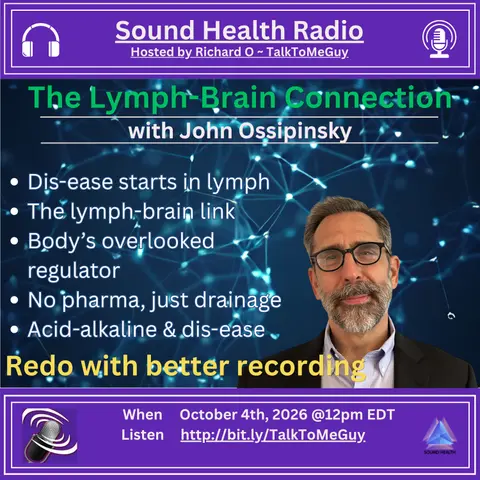
The Lymph-Brain Connection

 PocketCasts
 Apple Podcasts
 Goodpods
 Audible
 Overcast
 Castro
 RSS Feed
 For more than three decades, John Ossipinsky has watched what happens when the body's drainage system gets ignored. Most people know the lymphatic system exists almost nobody treats it as the central regulator it actually is. That's the gap he works in.
This show lives at the intersection of frequency, body intelligence, and self-directed healing and John fits right into that territory, just through a different lens: lymphatic flow as the physical substrate that lets energetic systems actually function. When cellular waste stalls, inflammation rises, fatigue sets in, and the nervous system loses bandwidth.
John Ossipinsky, known as LymphMan, started his career as a lifeguard, an Army medic, and a FDNY firefighter, before becoming a Certified Lymphedema Therapist and Diplomate in CranioSacral Therapy. For over 30 years, he's helped thousands of people restore lymphatic flow work that became deeply personal after he spent 30 years battling severe irritable Bowel Syndrome, heart palpitations, weight gain, and restless leg syndrome himself. Once he began maintaining his lymphatic system in a specific way, his health issues began resolving within weeks and he went on to lose over 70 pounds.
He's the author of; An Undetected Acid-Alkaline Imbalance, host of The Lymph-Brain Revolution podcast, and in 2023, the NIH itself confirmed something he's been clinical on for decades that lymphatic dysfunction may be where disease begins.
Today, we're exploring the lymph-brain connection no pharma, no complexity, just the mechanics of cleanup and regulation.
An Undetected Acid-Alkaline Imbalance
The Lymph-Brain Revolution podcast
LymphMan - John Ossipinsky on YouTube
•Please sign up for the email list for future notifications•
If you would like help starting your own show or podcast, as well as help selecting a microphone and setup for your voice; Please tap the microphone and leave me a message with your contact information and I will get back to you.
Or you can email talktomeguy@gmail.com
More information at: SoundHealthOptions.com
TalkToMeGuy: Greetings everyone. This is the Sound Health Radio Show where we talk about the crossroads of the environment, our health and longevity with Richard TalkToMe Guy, and Sherry Edwards is off working on the Sound Health Portal. I would suggest going to the soundhealth portal.com, scrolling down just a bit and clicking on the watch how button. You'll see a short video explaining how to record and submit your first recording. Then go back to Soundhealth Portal.com, scroll down to current active campaigns, such as cellular inflammation, biodiet, neuroplasticity, or memory, and choose one that is of interest for you. Click on that campaign and click free voice analysis, and the system will walk you through submitting your recording. You receive an email with your report back usually in one to two hours. To hear and share replays of this show.
50 to 60 minutes after you hear the outro music. Go to talk to me guy.com, scroll down that page, and you'll see this show at the top of the episodes page. There are also hundreds of shows available there as well. There's a microphone icon at the bottom right corner of all the show notes.
If you would like to leave me a voice message with a question for a guest or a guest idea for a show, you can do that directly from the site, and I will be notified. With that, for more than three decades, John Ossipinsky has watched what happened when the body's draining system gets ignored. Most people know the lymphatic system exists. Almost nobody treats it as the central regulator, it actually is. That's the gap he works in. This show lives at the intersection of frequency, body intelligence, and self-directed healing.
And John fits right into that territory, just through a different lens. Lymphatic flow is the physical substrate that lets energetic systems actually function. When cellular waste stalls, inflammation rises.
John Ossipinsky, known as LymphMan, started his career as a lifeguard, an army medic, and an FDNY firefighter before becoming a certified lymphedema therapist and diplomat in cranial sacral therapy. For over 30 years, he's helped thousands of people restore lymphatic flow. Work that became deeply personal after he spent 30 years battling severe irritable bowel syndrome, heart palpitations, weight gain, and restless leg syndrome himself. Once he began maintaining his lymphatic system in a specific way, his health issues began resolving within weeks, and he went on to lose over 70 pounds. He's the author of An Undetected Acid Alkaline Imbalance, host of the Lymph Brain Revolution podcast, and in 2023, the NIH itself confirmed something he's been clinical on for decades, that lymphatic dysfunction may be where disease begins. Today we're exploring the lymph brain connection. No pharma, no complexity, just the mechanics of cleanup and regulation. Welcome, John.
John Ossipinsky: Richard, thank you for having me on. I really love to educate people about the lymphatic system because most people don't even know they have one, and that's a big problem.
TalkToMeGuy: It blows my mind that, well, this opening question still blows my mind, that in 2023, the NAH acknowledged that disease begins with lymphatic dysfunction.
John Ossipinsky: That's what they're finding out, right?
TalkToMeGuy: So And then like, how did it take it's 2023? How did it take them so long to figure that out?
John Ossipinsky: Well, it's it's uh it's a science that we have ignored, and it's relevant to me because in 2003, I realized that disease begins with lymphatic dysfunction. I had epiphany. I said, Oh my god, if the lymphatic system can't work, uh then we're gonna fill with cellular waste, and that's going to create disease. Uh so I published an undetected acid alkaline imbalance, and it really is relevant today, even though it's 20 years old, right?
Because they're just learning what I learned 20 years ago. And the fact is that when we think about the brain, we don't think about the lymphatic system. In medicine, doctors would say, don't think about the lymphatic system for anything mental health because there's no lymphatic system in the brain. Well, in 2015, we found lymphatic vessels in the brain, directly right outside the brain and the meninges, the membranes that surround it. Uh, and that to me is a direct lymph brain connection that we can all use uh to help our brain.
Clear waste, help our immune cells. It really is a science that everyone needs to start looking if they want to be able to have an edge in overcoming a disease, preventing a disease, or aging, and that's my thing. I'm 68. I want to age with my mind intact, you know, and that's not happening to a lot of people, unfortunately.
TalkToMeGuy: I'm uh I'm 73. So I'm even more like I want I want to be able to do what I'm I want to be like Paul Harvey. And I always say, I want to be like all Paul Harvey and die while talking to the microphone.
He didn't do that, but just cinematically. I like that visual. Um And so I feel the same way that I want my brain to be as good as it is now or as I always been. My brain's always been very active. I've always been, you know, just thinking and learning. I'm a learning machine.
I can't stop. So the idea of them discover again, what took them until 2015 to discover the globatic system. Why it's always been there. Somebody just uh hobbed, like, oh, there's this thing in the brain. Wow.
John Ossipinsky: Yeah, it was just very hard to image. You had to put a dye into a lymph vessel, which is almost microscopic. Uh, and uh, but then imaging came out where they could see lymph flow in the body, they could see lymph vessels now about 20, 25 years ago.
So it's taken all this time, and that's one thing with the government. You have to know that even though they realize now that disease uh may begin with lymphatic dysfunction, and they list many, many, many, many, many in every system of your body, they mention many diseases, even cancer and blood cancer are due to your lymphatic system, not flown. And uh it's just something that they never really thought of. And now, even though they're thinking about it, it may be 20 or 30 years that we still will learn about this information where we can use it, where I'm trying to get people to learn about this system now to change their lives.
Almost overnight, they can change their lives by gaining control over a system that we all have, tiny network of vessels and nodes. It actually cleans your head, your body, your organs, it's inside your organs, outside your organs, in your blood vessels, outside your blood vessels, in every tissue, and uh it has to flow. And when it can't flow, that's where we'll have a dysfunction in those cells in that area of your body.
So we want to make sure we can open up this flow. It's like a river and has a major drain right under your clavicles, your clavicle or your collarbone and uh at the base of your neck. One little angel hair pasture on the sides of your neck, and it has to handle the waste and fluid from thousands of lymph vessels and hundreds of lymph nodes. And if it gets a little blocked, then your body's not getting complete circulation. Uh, it's not able to clean waste as effectively, and it's not able to move around immune cells.
And that's important. So that we can have an um uh strong immune system. When your lymphatic system is flowing, then your immune cells can go around and sort of go after and scavenge cancer, uh, you know, bacteria, viruses. But when your lymphatic system is not flowing well, and most people do not have a well-functioning lymphatic system, uh, then our immune system is weaker. But it really makes sense that if we have a system that has to clean every system in our body, and we don't maintain it or don't even think about it in medicine, then we're gonna be sick. And I believe that's what's creating all of our illnesses.
TalkToMeGuy: Well, it makes me, I don't know why they float up in my brain, but there was a book written on the blue zones that were the longevity study. And one of the top blue zones was the men of Sardinia. Now, Sardinia is a small island off of Italy, and the men of Sardinia spend the bulk of their day walking up and down hills with their sheep or goats.
I think it's sheep. And when I was talking to them, it really I mean, isn't that a perfect lymphatic stimulant is like moving around, being physically active, like walking up and down hills all day long.
John Ossipinsky: Yeah, that that's my whole thing that it's nice to be able to know how to drain your body, right? So you can have direct control over different parts and uh really flow. But movement is the simplest thing.
I'm gonna show you uh, I'm gonna explain some movement later, the lymph man shoulder shuffle that opens up the major lymph vessels instantaneously, and we improve circulation, not in five minutes, not in a half hour, in seconds. And that's what we need to do. We need to open up this system and move, right?
Movement is the simplest thing. I live in a two-story home. I am up and down all day long. So I know that's some exercise, but I still go to the gym, right? It's really about creating pressure from your heart to be able to push into your organs and into your brain.
And that's why we need to do a little more than just a uh a walk or you know, it has to be a little intensity into your movement and exercise, and then we can help our lymph system and our circulatory system much better.
TalkToMeGuy: You did a great show. I'm gonna I'll put a show for your podcast, uh, a link to your podcast in the show notes. Because you well, you do you're prolific. You're a ridiculously perdific prolific.
I mean that in the best of ways. And you did a great show on uh rebounding. And I've been a fan of rebounding forever. I'm like I'm 73. So for like a long time.
I think it's like the sleeper of non-technology. And I have one in the living room, and a couple of times a day, at least once every day I bounce for at least 20 minutes. Sometimes it's twice a day. Because I don't sit all day long. I stand by choice. I'd rather stand than sit. Well, it's a I was a chef for 20 years. So it's a standing is just a thing.
And so I just love the rebounder. I think it is just a sleeper. I'll call it a technology, but it's not really even a technology. It's and maybe that's why it's not so popular. It doesn't have enough bells and whistles.
Everybody needs bells and whistles and things that show you graphs and charts. And I didn't I just think the rebounder is great. And you did a great show on that. I'll put that specific show on the show notes.
John Ossipinsky: Yeah, it really is. Uh one with our fluids in our body, our veins, even your uh lymph vessels, they have valves. So when we bounce, uh you bounce and fluid moves up your your lymph vessel, and then the valve closes. You bounce again, fluid moves up, and then the valve closes, and you do that for 20 minutes, and I commend you.
That's a good time. I do about 10 to 20 minutes. I even go on for two or three minutes. If I'm having a long day on a computer and I sit a lot, even though I have a stand-up desk, I try and get up and down. Uh, I go down and I just get on for a few minutes just to move my lymph flow.
But we have to make sure we open up the major lymph vessels before, right behind your clavicles, and then are rebounding. Uh and again, it's just a mini trampoline, and there are many different types. There are springs, there are I mean, one of the first ones that I bought was when my kids were younger was $75. It was just straps, not even bungees, and it worked for a while.
Uh and then we uh the progress, we had one with springs, and then now we have one with bungees. And uh, you know, it's just such a simple thing. And you have to keep it where you see it. If you put it in the closet, if you have it in the back room, you're not gonna do it as much. You have to have it where you see it so you remember to do it.
TalkToMeGuy: Mine's in the living room, off to the side. And so I put on something silly on the TV and I bounce for 20 minutes. That's what I do too. And it's and it's because it's a uh bungee type, it doesn't make a sound. Yep. So it's bothering nobody. And I'm just like, why aren't more people I I have an older friend uh who I've been trying to get to do uh rebounding on a regular basis, and she likes it every time she does it, but she just gets lazy about doing it. And I'm like, no, this will make a big difference in your swelling in your legs. Right.
John Ossipinsky: I was walking around uh shopping the other day at a supermarket, and here in Arizona, a lot of people wear shorts all the time, it's over 100, 114. Luckily, we're going into our 90s. And uh, I was amazed at all of the seniors uh with swollen red or have sores on their legs. And it's not that they have lymphedema or have been diagnosed with any time, but they all have issues in their legs, and that's because the fluid and waste from their legs can't make it up in the lymph system, up through the legs, through their hip area, through their abdomen, through their chest, up to their major lymph vessels. And that's what we have to remember that it has to flow to a certain place. So when we have uh, you know, the neuropathy in your fingers, that means your waist is not making it up your arm through your underarm up into your neck.
If you have neuropathy in your legs, uh in your feet, then you are not moving waist up through your body. And that's my key thing is to tell people we have to. And I get on Instagram uh almost daily, and I tell people, hey, here's some science, but let's do the lymph man shoulder shuffle.
I mean, it's like 30, 40 seconds, really quick. But my goal is to just remind people, hey, what'd you do for your lymphatic system today? Let's do our lymph band shoulder shuffle. And I have people who tell me, you know, John, uh uh, my headaches are better. I I feel more uh open in my body. I I just have uh more uh less stress, uh, my allergies are gone, all these things that people are, you know, claiming that they just are moving their shoulders, right? And it shows me the power of this.
TalkToMeGuy: And you did uh you did another great show, and this is this is I have a little bit of this, so I was excited to hear you talk about it. Uh tinnitus, and uh I know most um folks, I'll say that I know that were in college that were like the DJ of the late night, you know, random the music from three to five, or you know, some kind of all have tinnitus, and they blame it on the fact that they used to wear what we would call cans or headphones and crank the rock and roll up. You needed to hear Grateful Dead at a severe ear splitting eye blood coming out of your eyes, volume. And they think that that they've damaged their ears that way, and they could have. However, they have tinnitus, and I've been sending that show.
I've this morning I sent that to a couple of people I know that have tinnitus who were in the rock and roll world, and I'm gonna see what happens with them because it's it's a great show about something I have a mild amount of it, but now that I'm going to start doing lymphatics, I hope that's going to clear up because it's annoying.
John Ossipinsky: Yeah, it I'll tell you, I was shocked. I was shocked at how many people that was my biggest show ever. My my post on Instagram had, I mean, normally I get a couple of thousand.
It had like 40 a lot, right? Wow. For me. Yeah. For me at least. And uh I was shocked at how many people have this problem.
I mean, for decades and years, some people loud noises, some people a little like clanging. Uh so uh it's something that I've had after COVID twice, uh, a month after COVID, which shows me that it's about uh uh uh your inner environment changing. Because when we have COVID, uh you get the virus, it leaves uh remnants. After it heals, it leaves some RNA remnants and it's uh it's cellular waste, and that continues to inflame, and that can spread uh from your nasal area to your ears, to your brain.
That's why so many people have uh brain fog. But I was really shocked. And it took me a long time, or I had to work hard to get rid of it both times. But it showed me how inflammation built over a month, and then boom, I got uh, you know, uh deep detinnitis. And that's the same thing with COVID. Some people they get rid of their uh virus or even a flu, and then a month later, boy, this it just hits them and they and they can't move, they have anxiety, they have brain fog, they can't sleep.
And it's because of that waste building up in the body. So it's really about uh, and I'll explain this with a problem I had on my tongue. Uh I didn't realize I had a swollen uh vein in my tongue. Uh and I went to eat falafel with my father, and I bit into it, and falafel was a little hard, and my tongue started bleeding. And I went up to the owner, I said, Hey, I think your falafel mix may have glassy.
TalkToMeGuy: I didn't realize that I had a problem.
John Ossipinsky: And uh for a year and a half, my uh my tongue would bleed once in a while, and I was like, that might be cancer, you know, right in the center of my tongue. And uh I went to the best ENTs finally, and and and they checked everything and they said, no, we don't see anything. So once I realized there's no cancer, I said, Well, I'm gonna drain this thing crazy, and I just drained it for like a week. I mean a lot.
I trained it often during the day. And that's what it has to be. It just can't be once in a while. We have to retrain our lymphatic system. After that, my tongue never bled again.
So I retrained it. What was happening was my lymphatic system was blocked. It was backing up uh with pressure into my tongue, into that vein. And when I put pressure on it, it would bleed. Once I rerouted my tongue and my neck and got it to flow a better, uh, it went away. Uh so you know, it's something that you have to work hard on, and it's really uh, you know, it's something that I think we have to investigate. Uh to me, it's so new.
I'm just starting to work with this. But uh to me, it definitely is about an imbalance in the ear uh with the environment of those cells of even in the neck, because if people just were to tighten their neck and jaw, like really squeeze it tight. My my I hear white noise. It goes super loud, like I turned the volume up, right? And I don't have it now, but when I tighten my neck and jaw, I raise that volume way up and I hear tinnitus.
So it's not just your ears, it's your neck, it's your nerves, it's it's everything around your ear, the base of the brain, and uh we just need to get that area flowing, uh vibrating. I remember I was doing a lot of I had a handheld vibrator, a nice one uh called a genie rub. And I would, and I still do it today. I still put it on my neck, my head, my ears, uh, to help uh flow out of that area area.
TalkToMeGuy: Well, and what an amazing idea that uh I haven't ever had COVID. Um, but I have a lot of people around me who have. And they all a year or two later, um, I have a client who I've worked with for years who does yoga every day, eats a very clean diet, and yet still has what I call this, uh, I would call it kennel cough. Uh it's that's something that dogs get in kennels sometimes. And it's that low-grade cough that she just can't, and it isn't an allergy, it isn't a thing. She's living in the same place she's lived in for over 10 years, and yet she still has this chronic cough.
And it just makes me think that I'm gonna talk to her about some sort of she does walk her dog every day, but you know, something to stimulate the lymphatics to get the the trash left over from having had COVID.
John Ossipinsky: And and that's one thing I saw in my kids, especially my son when he was younger. Uh he would get a cold or uh the flu, and it would linger in his lungs for you know, uh weeks or months, and and then I realized we had to change the environment.
Gave them more magnesium, Epson salt fabs, uh, vibrated his chest. So our major lymph vessels are right in your neck. And when they can get a little congested, it can back up into your lungs and uh your lungs, we see it a lot with cystic fibrosis, bronchitis, and again, these things have been linked to the lymphatic system, things with your lungs like COPD. So uh to me, it's the uh lung tissue becoming overly acidic. Uh, same thing with pneumonia, they fill with fluid. Um, so it's really about getting uh your supplements to be able to go into your lungs. So you have to sit and take deep breaths. And if you don't like Epsom salt bats, you can soak your feet in Epsom salt, uh a third of a cup of Epsom salt, that works too.
I tried it. I did uh Epsom salt because I figured, hey, some people don't like to go on a bath, let's try soaking your feet. So I took an old food container that hold two six packs of soda or beer and a couple of sandwiches. I fill it up, hot water, third of a cup of eps and salt, and I put my feet in it for 20 minutes or more. And within a few minutes, you feel your body relax.
You just feel it move through your body. So we have to do that. I wouldn't do it every day. Uh I would do it a c uh, you know, a few days a week, uh every two or three days. And what I tested was I did it twice a day for three days in a row. And I'll tell you, I went into hot sweats.
I went into a detox Herzheimer reaction. So we don't need to do that, right? Uh so it showed me that it cleaned, cleared waste from my body, because that's what it's doing when we put magnesium in when we soak our in Epson salt. When we activate our lymphatic system, we're moving waste out of our tissues that's trapped. And uh, you know, it's gonna go into your lymph system, right up into your neck, right into your subclavian vein and back into your heart again. And it's just gonna really recirculate it to go through your organs of elimination. And that can take hours, uh, could take a day or two, depending on how people uh their bodies clean. But uh, we do get more toxic uh as we start to activate our lymphatic system, and you know, that can scare some people off. But t tell your friend she's really got to get the her magnesium up, deep breathe, and might want to try the Epsom salts. Yeah.
TalkToMeGuy: And so we're gonna jump not very far, but just ever so slightly. Uh you really want listeners to remember five letters. Mg ATP. And would you explain what that actually is and why magnesium isn't an energizer the way caffeine is, however, something your cells can't use energy without it. You know, about that?
John Ossipinsky: Yeah, we don't think about our body being cells that we're alive, right? Talk to your cells once in a while. Uh your heart, your kidneys, your brain. Many of those cells are alive and they need oxygen and they need nutrition.
And the reason and get rid of their waste. And the reason many people have no energy is because we're locking magnesium, and we're finding out that you need magnesium to make ATP, which is adenose triphosphate, which is how your cells make energy. So if we don't have magnesium in our body, and it's not like a boost that's going to give you like an energy drink, it's just gonna make your cells work better. Our cells need to function.
Uh, it's about the mitochondria, which is a powerhouse of the cell. And if they can't get things like magnesium, then they're gonna have uh, you know, the difficulty. And so many people have chronic fatigue, especially after having a lymphatic session or after getting an energetic session, uh, any type of therapy, massage. People will feel fatigue. That's the biggest thing people feel, and that's the release of waste. And for some people, they'll do a therapy or do a hyperbaric chamber, and then you know, they'll feel sick and they'll say, Oh, I'm not gonna do that again. Well, that's the wrong thing, because then we'll never get rid of that waste. We have to slowly, no big big, big detoxes, but we have to slowly, over a few weeks and months, just be more consistent on cleaning up, and then we do much better.
It's really about taking time to change our cellular environment and it's your lymphatic system that must change the cellular environment. So to me, magnesium is one of the supplements that most people should take, and then very few people who need to be concerned about it, but uh always check with your health care practitioner if you have any serious health problems. But magnesium, and I like magnesium deglycinate uh and uh glycine has been shown to have some properties for anti-aging. So when we take magnesium glycinate, we're getting some of that glycine.
You're not getting a ton of it, but you're getting some of it. So I I really do like uh magnesium glycinate. And you take over 550 milligrams, you know, you almost take it until you get loose bowels, and then you back off a little bit.
But uh that's what new science is showing. It's not 350 milligrams that we need. Um research came out saying if you're taking 350, you're still gonna be sick. Uh, if you want to get healthy, you have to take over 550 milligrams because we don't absorb it all.
Most people don't realize that. And when you take a magnesium capsule, especially magnesium glycinate, decitrate, you're getting about 30 to 40% absorption. So you're most people take 400 milligrams, they're only getting less than 200. So uh we need to get that uh up, and then we start feeling much better.
TalkToMeGuy: For a while I was taking a thousand milligrams of citrate every night because I had leg cramps. Because unless I consistently rebound, I I have big leg muscles from years of lifting heavy things in kitchens.
And just as a lifestyle, I've always had big size. And so I was having leg cramp issues, and so I was taking it, and I wasn't having any bowel tolerance issues whatsoever. It just I was fine. I think go ahead.
John Ossipinsky: I think the body gets used to it. You know, uh you don't want to take all at one time. Right. We we don't want to take a high dose because that can throw off your electrical uh you know properties in your heart and your body, and we don't want to do that. So to me, it's really you build you build up slowly to see what you uh can take. I had a woman in my courses she misunderstood, and she was taking a lot of magnesium, and she said, you know, my anxiety really felt much, much less, uh, but my bowels were really bothering me, very irritated.
So it showed you, hey, it helped, but it's also affecting so we do it slowly, we build up slowly, we space it out. You don't need to take a high dose at one time. It pulls too much fluid into your bowels, and that's why we have the cramping sometimes. So, you know, if you uh take some magnesium, if you're doing it a powdered drink, don't just chug it down, do it slowly. Take it over five, 10 minutes, and then it doesn't bother you. Yeah.
TalkToMeGuy: I want to jump back for a moment and ask about you talk about like by now I've read and heard so much it's all a blur. I don't know if it was in your book.
I don't know, you know, there's it's all just in there. You talk about the brain's central gain, turning up sensitivity when auditory signals get weaker. Would you explain that for us and me?
John Ossipinsky: So basically, as we're starting to have problems with our ears and uh it's in the cochlear, there did different chambers with fluid and gases, uh, that if it can't uh sort of make sense of these sounds, your brain starts to say, hey, I need to turn up this volume. And that might be what's happening with the tinnitus, right? That it that it's also affecting the brain, and it has to sort of say, hey, uh, we're not hearing things as well. Uh let's ramp this up so it ramps up the uh, you know, part of the brain uh and the ears, and it could be part of what's going on.
TalkToMeGuy: And this is back to lymphatics and lymphatics in general. Are is the is the lymphatic system in the brain actually separate from the lymphatics, or is it just called lymphatics because we've just rediscovered or why does it have I mean, is it it's not its standalone system, it still works in a relationship to the lymphatic system, doesn't it?
John Ossipinsky: You know, it was found years before uh it was found in 2013. Okay. The lymphatic system. The lymph system was found in 2015. So I believe if it was reversed, if they found lymphatic vessels in the brain, and then they found a lymphatic system, they would have said, oh, we have a pre-lymphatic pathway in the brain.
That's the way I like to see it. But people think of the lymphatic system as a separate system, but it's really just a system and it's really around your spine too, not just your brain. Uh that just sort of pulls fluid through the brain tissue. It's like a little sheath, they say, that's just uh in the arteries and brains, uh, in the arteries that uh pulls fluid across the brain, fluid and waste.
But where does it have to go? The lymphatic system does not just say, okay, put it out in the garbage here, it goes away, the garbage and fluid. No, it goes into the meningeolymphatic vessels, which are which they found in 2015 right around the brain. So your lymphatic system, even though a lot of people talk about it, it flows into your lymphatic system. So your lymphatic system becomes the important part to really every health problem. Uh it's really the basis uh of disease uh and you know how our cells maintain everything comes down uh to our cells. So the lymphatic system, yes, it's important, but if your neck and your shoulders uh or anywhere in between in your mouth, if you have any type of a dysfunction, meaning your lymphatic vessels have too much fat in them, they have too much dead cell clogging them.
And remember, a lot of these vessels are microscopic, so they can fill up a waste, and that's uh why we have to open up this system. So anywhere we have a dysfunction, uh, if your neck is tight, then your brain may not be clearing as well. And I think that's happening with a lot of people.
TalkToMeGuy: Well, especially as we are in a world of I I just see people i i in my quiver of life experience, I was a trained uh sweetishlin masseur. And so I learned lymphatics, but I learned physical lymphatics, like actually massaging, you know, how to drain the lymphs that way.
Yeah. And this really lit up for me when I was I was reading and listening about that research has linked increased brain acidity to conditions like anxiety, depression, and even Alzheimer's. Would you please talk to us about acidity at the cellular level and how that interferes with lymphatic flow and waste removal in the brain? Waste removal from the brain seems really important to me. You would think so, right?
John Ossipinsky: Yeah, that study really resonates with me, just like the 2023 NIH report that is finding that you know our lymphatics are more important. But in 2024, brain acidity was linked to multiple neurological disorders.
They mentioned depression, they mentioned uh, you know, seizures, Alzheimer's, autism, headaches, migraines, PTSD. Uh and we never think of acid, right? We think of acid as a digestive issue when acid in our tissues is really what's uh creating your heart problem, your kidney problems. It's uh creating our our brain issues. So uh to me, that verifies my book that we are filling with cellular waste.
Uh and uh it's because your lymphatic system is not clearing. This is the body sewage treatment system. So uh, you know, we need that's where magnesium comes in.
Magnesium plays a big role in reducing uh, you know, acidity in the body, but also eating fruits and vegetables. I never ate fruits and vegetables in my life. I hated them. Uh now I eat them, you know. That's my uh not my only diet. I eat meat. I don't eat a lot of steak.
I eat uh chicken, turkey, fish, and uh, you know, a lot more vegetables. So we we need to understand acidity. It's not just a digestive issue. It's it's really affecting every cell in your body. It's breaking down our bones. When people get degenerative disc disease, that's acid breaking it down.
TalkToMeGuy: And uh well, that was gonna lead me into a rant about sugar and sodas. Uh because they seem deleterious to pH when you have people who are slamming, you know, 16 hours, big gulps. I'm not picking on big gulps. I'm just it's an image of you know, just the amount of sugar. Does it doesn't sugar skew our pH?
John Ossipinsky: Sugar is acid forming. Yeah. Okay, yeah. Sugar is acid forming. And, you know, sugars and a lot of things. Uh we we have to try and avoid it. There are some books that say, hey, you can have a five pieces of chocolate a day, good chocolate.
No, that's not true. You know, we can have a chocolate cake, we can have a piece of chocolate, but we do it as a treat once in a while when we're having something every day. And some people need to have a sweet every day, you know, have a fruit for sweet every day. But sugar is, I think in the 30s and 40s, uh, they were getting on that sugar was a neurotoxin, and they uh the government was going to shut down and really get on sugar. And then all the food producers say, no, no, no, no, it's not sugar, it's fat.
It's fat that's the problem. Yeah. So what they did, we we had this whole big fat kick, you know, removing. But what they did was put more sugar into the products.
So it's crazy. So but now we know we have to avoid sugar. Hey, once in a while I go out to dinner, I'm gonna have, you know, some type of dessert, may have some ice cream once in a while. But if you're having ice cream every night, every night, that is really not very good. The sugar, the dairy, uh, it's you know, it's meant to make a calf 500 pounds. Uh, we we don't want to do that. Yeah.
TalkToMeGuy: And when some people well intended, you know, start detoxing or doing a cleanse, they actually feel worse, which always shocks them. Like, oh my God, I feel so bad. Would you explain why that happens when lymphatic flow isn't supported first?
John Ossipinsky: Yeah, yeah. Right. Uh most people, uh, and I'll tell you a story that I did, uh, not a story, uh, when I first realized that cellular waste was filling in our body because our lymphatic system wasn't working. I did hundreds of studies on people. I had uh an office, I had a few therapists, and I said, tell your people to come in and see me. I want to see a lot of people.
And over a year I saw hundreds of people, and I just put them through three days in a row, three days in a row of sessions. I wouldn't do that now. It's too much, right?
It overwhelms the lymphatic system. And but here's what I learned. The first night they had uh this, and I did the exact same session. I call it lymph practic, uh, like chiropractic put it back. This is lymph practical for your lymphatic system. And uh I would work on them, they'd feel really good afterwards, and it was a fully closed session. And uh then a few hours later they would have fatigue, they would have a headache, they would have some digestive issues. Next day they would come in. Uh they would say, Oh boy, I felt a little, you know, off.
I would work on them the exact same way, and they would feel good afterwards for a few hours. Then they had aggression, anxiety, depression. They couldn't sleep, uh, they had uh bowel disturbances, you know, a lot of things that I saw that are affecting us in the population. And then the next day they would come in and say, What was that?
The flu? And uh I would work on them again, and they wouldn't have that bad detox reaction because we have a we had aliviate, we had alleviated some of that inflammation. We did it a little too quickly.
Now I believe we need to take a few weeks and work each week and clean up, and then over a few weeks you've reduced a lot of this inflammation and you didn't overwhelm your lymphatic system. The big thing is nobody died. Uh and I saw people with diverse cancer, cancers, autism, all different things I put people through. And it was the same thing few things anxiety, depression they would have.
People never even had anxiety or depression, would say, what was that? I felt horrible. Uh so uh it really opened up my eyes to what waste in our body is creating.
Most people are just trapped with this waste, and that's what's creating all of our health problems. And we have to move it out. And then it's not just a matter of getting a few massages. It's taking weeks and months to change your cellular environment. And then it can stay and not be where you do a little treatment, and then a month later you're sick again, right? We need to go deeper into cleaning our cells with the lymphatic system. And that's something I specialize in.
TalkToMeGuy: And do you feel that this is a completely out of nowhere question? Are such things as uh far infrared saunas or regular saunas beneficial to our lymphatics by stimulation from the heat and the swimming?
John Ossipinsky: Yes. Yes, I I love them. Uh I go to Mountain Side Fitness. If anybody, I used to pay uh me and my wife 270 for a gym was really nice.
It was right down the block. It was lifetime fitness, it was great. But then we became uh 65, and I realized that, you know, oh, we can go to Mountain Side Fitness and get it for free if we're on silver sneakers. So if there's anybody out there, you're over 65, uh, go to silver sneakers with the government, just type it in, you sign up with them, you bring your number to Mountain Side Fitness, and you get a membership for free.
So uh, you know, and I love it. I they have a great infrared sauna. If it's 30 people, I uh here's what I do. I get on some type of a machine for just uh maybe 10, 15 minutes to warm up, whether it's a treadmill, a stair climber, then I go do some weights, I do some stretching of my back, then I go on uh, you know, uh infrared sauna for about 15 minutes, then I go into a cold dip, and then I go into a steam sauna uh for about five to ten minutes. That's my routine because uh saunas uh from Finland study show that when you do it regularly, and they do it more often, it's pretty cold there, uh they show a 66% less chance of dementia. So if we can heat up our body, uh, and even far infrared, the red light therapies, those uh that I'm also trying that there, it heats up your body. And that's what allows your lymph to flow. It dilates your your blood vessels, your lymph vessels, and it's helping circulation and detoxification. Wow. Okay.
TalkToMeGuy: What was the name of the membership thing? Say that again. I have to write that down for the colour.
John Ossipinsky: Silver, most people don't know this. Silver sneakers, you know, they they think so somebody in their 80s has to do it. No, if you're 65 and older, if you have a mountainside the fitness near you, you sign up for silver sneakers, uh, you get your number, you go in with that number, uh, and uh they they you get a free membership. And I pay a little bit extra because I want to do it a cold dip. They charge you $35 for it, which is still a big savings.
$35 to use a massage chair, which is great that they have there. I really love it. Wow. Uh, you know, so it's a it's we need to go exercise. We need to move our blood, right? And might as well make it enjoyable.
TalkToMeGuy: We need to move our bodies. Yeah. You know, we stop looking down at your phone, because that's going to screw up your neck in the long run. Somewhere down the road, you're going to regret that. And get out and move. And gaming at a computer is not moving.
John Ossipinsky: Right. It's stressful. People don't realize my son's 26, he just moved out. And they game. That's what these kids do, right? They sit and they game. Uh and uh they're sitting there stressed playing, even though they're playing, it's still stressful, right?
Yeah. Uh and your body is being affected by that stress. So we have to move deep breathe and watch your posture while you're on a computer.
And most people for work are on computers, and they come home and play on computers or research on computers. Children, you wonder why we have so many anxiety and so much anxiety in children. It's because, you know, we missed the lymph brain connection.
We're not giving them the right foods, we're not giving the exercise. And they have their laptops or their iPads or their phones, and they look down the whole time. And as soon as we put our head down, uh, you know, your posture is key for your lymphatic system. It's a plumbing system. And when you slouch us a little bit, you slow or stop your lymphatic system. And uh that is, I believe, a reason a lot of people having problems, right? We're stopping our own lymph flow and how our body cleans.
TalkToMeGuy: Wow. And um now we're gonna pick on the mice. I always feel so sorry for mice. But bad karma. Uh in 2005, researchers found mice gained weight due to damaged lymphatic vessels, not excess calories. What does that tell us about why weight loss might be so resistant for so many people?
John Ossipinsky: Yeah, the study was uh unique. They took mice, uh, they uh basically damaged the Prox1 gene that makes healthy lymph vessels in them. And as they matured, they became uh the the lymphatic vessels became leaky and ruptured. And these mice either didn't make it or they became fat because the lymph vessels could not pick up fluid and fat. And uh it's eye opening. So most how many weight loss programs are there out there?
Tons of them. Not one of them mentions lymphatic system. So we know the lymphatic system plays a very large role. Uh I can lose weight or gain weight. If I pay attention to my lymphatic system, I lose weight.
If I don't, I I and it's a whole thing. It's not just draining your lymphatic system, it's diets, supplements, exercise, right? Those are the key things. So you can gain control if you understand the right science. It's amazing.
TalkToMeGuy: Our body just sends, you know, is sending us signals every day. Like, hello? Like I always have felt that uh inflammation is a biomarker of something. And I think that it's the body shouting, hey, hey, hey, hey, hey, that's inflammation. It's trying to tell us something. And if we would pay attention to that and do some of your work and get up and move around and perhaps set down the phone and go out in nature, a radical idea. Go for a walk. Right. Um, it would be amazing the difference. Yeah.
John Ossipinsky: I agree. Most people are not moving enough. And uh, you know, uh, what was your question again? I'm sorry at the beginning.
TalkToMeGuy: Uh no, there was no, that wasn't that was more of a statement. I wasn't I wasn't quiring there. No. I was moving out of something else, but I had to say that because it was just so true of like, wow, get up and move around. It's not that hard.
John Ossipinsky: As we sit as we sit more and more as we get older, we start having more health problems, right? And that's what happens. You see people that just sit all the time.
Uh you can't. And I'm seeing more and more people coming into mountainside fitness in with walkers. They're in their 80s, and I'm sure their doctors are saying if you want to be able to move, you want to be able to have uh a healthy life, a healthier life, because you're just getting, you know, sicker and sicker, you need to go to the gym. Yeah. And they get a and they get a coach, and they, you know, and and I I commend them. I think that's a great thing, right? Yeah.
TalkToMeGuy: Well, and one of my favorite people to used to be to talk to was uh William Gifford Jones, who is a medical doctor out of Canada who wrote uh advice and information columns for nationwide syndication, even though he was a Canadian, it was still published nationwide here and there. And I interviewed Doc Giff until he was 105.
Wow. And the only thing that occurred with Doc is that the older he got, I started interviewing him in his early 90s. And was that toward his 105 time, it would take him a moment longer to answer a question. However, once he started talking about what he was going to talk about, he was that same old Doc Giff, filled with knowledge and you know wisdom.
Yeah. And he he was a fan of, he wasn't like a Jack Lane crazed exercising guy, but he went out every night for a you know, a half-hour walk around the neighborhood or in the forest that he lived near. And he did take high dose vitamin C because he'd had a cardio problem and he'd done research directly with Linus Pauling that led him to understand the benefit of taking vitamin C. But he was physically active and completely fine, and then he died. There wasn't drama, there wasn't illness, there wasn't like something.
He just eventually died. And it was an amazing thing to be with somebody who was that age. My grandmother lived to be 106 as well. So I had already had the experience of like, wow, you're really old, grandma. And she was like, brah, brah, brah, you know, bad words. And but she was somebody who was still shoveling snow on her front porch until she was in like 102.
And then they made her slow down. But I mean, we don't have to, we we have this thing in the culture where we as we get older, we get in our 70s or 80s, or my God, you made it to your 90s, that we need to stop or slow down or sit down and read, you know, not do anything or watch, you know, soap operas. And I just think that's a a path to not wellness. I don't have a question there, I'm sorry.
John Ossipinsky: No, I agree. Uh and that's what happens. You know, we we just stop moving as much. And that's why going to a gym, my goal is again, I'm 68. I want to be I had kids at 40, you know, so I want to be there. I just have my first grandchild. Yeah. I want to be there for them.
I don't want them caring for me. Uh so I want to be like the few men I see at the gym. You see them on Instagram, these men who are 90 and they're like buffed. I mean, I don't want to be buffed. I don't need to have muscles, but I just want to be healthy. I want to be walking.
Yeah. The biggest thing is we need to have our legs strength. And if your leg fluid and waist can't make it up to your lymphatic system in your neck, then you're gonna have problems in your nerves and your legs, and uh it's gonna weaken them. So, you know, the lymph system plays into that. But we need to move.
TalkToMeGuy: It's not complicated. We need to move. Um, somewhere along the way, I was reading, and you you talk about zombie cells or these sensate cells that stick around and cause trouble.
I kind of have them with like bad bad men masks on. Uh, would you explain how lymphatic congestion contributes to that and how it connects to things like aging and even tinnitus?
John Ossipinsky: Yeah, we need uh some senescence cells and senescent cells, and there's a lot of waste in your body. That's what my book explains. We're filling with cellular waste, amyloidosis. You even see some commercials for that uh on TV now. But senescent cells have been well uh researched. They're zombie cells, and we all know about the zombie accompany, you know, uh apocalypse, uh uh these things that don't die. And that's what happens with these cells in your body.
They aren't taken up by autophagy. Uh, they're not replicating how they should be doing. Um that's what cells do, they replicate. And uh as they get more, we need some. Some of them are good because they help with us with cancer, with tumor growth and uh things like that. But when we have too many of them, when when when we have an abundance, an excessive amount of them is when they start ramping up inflammation and they produce cytokines, uh, and they just keep on sending out signals to create inflammation, create inflammation, which is bringing more and more cells into the system, which overwhelms the system uh and shuts down your organs and your body. And we see this in CAR T cell therapy.
Uh, it's a warning they put out uh CAR T cell therapy is they take your thymus cells, the T cells, and they ramp them up and put them back in your body, and it makes a very big uh immune response. And they've uh I believe when you hear somebody who's just got cancer, like a star, they just got cancer, they started chemo, and they died the next day, it's because it wasn't cancer that killed them. Cancer doesn't kill us that quickly. It was the therapy, in my opinion, uh that overwhelmed the cytokine storm, they said it's goes in and just overwhelms the body. And they put an alert when you're doing CAR T cell therapy to doctors, be aware of the cytokine storm because it can be very serious.
Uh but that can happen in really anything. Uh, you know, you get the flu, you get uh, you know, um it it's really just these senoscent cells have to be taken up and it's your lymphatic system that uh you know has to pick them up and our lymphatic system is not working. So and that's what makes our inflammation. That's what makes it, right? When your lymphatic system uh can't clean your body, that's what is inflammation, right?
Most people don't realize that. It's what your lymphatic system is not cleaning and what's remaining in your tissues. So uh we have to get rid of that, and we do it with the lymphatic system. But senescent cells are big. They've been equated to everything from aging to metabolic diseases to really every health problem. And it's just think about it, if our lymphatic system has a dysfunction, then we have a health problem.
And if you build it with set senescense cells that are making a lot of cellular waste in your body, then that's gonna create a blockage and you're gonna get some health problems.
TalkToMeGuy: Motion. Motion is so amazing. It's not that hard. Motion is really good for us. Our bodies, look at us. We've got feet. We're we're, you know, animals that should be moving around, I think.
John Ossipinsky: Yeah, and we need to do the lymph man shoulder shuffle. We need to go over that, Richard, make sure we go over a few things that people can do to feel lymph flow immediately. We will.
TalkToMeGuy: I that's actually coming up totally. But I I want to go back to magnesium for a minute because I think it's really I've always thought magnesium is another sleeper that people for some reason don't. It's one of those supplements that people are sort of like, nah, I've taken it sometimes. I didn't really see anything.
I didn't notice anything. But you I I read that you talked about magnesium doesn't just help muscles contract, it also helps them relax, and you connect that to lymphatic vessels themselves, having spiral muscles that need to contract and relax to move lymph forward. Would you walk us through that? Because I think it's a really important part.
John Ossipinsky: Yeah, uh, it's actually called uh every lymph uh segment uh has a lymphangion. Uh the lymphangion is a little hearts of lymph. And it's not the smaller vessels, it's the bigger ducts in the body, like in your house, you have half you have quarter inch, half inch, three-quarter inch, and one inch. It's the bigger uh lymph vessels. They have uh spiral muscles, so that when you walk, when you breathe, uh when you stretch and move your muscles, that they actually will pump for a while. And this is important because most people like for sleep, you know, most people don't realize that your brain cleans at night, most of it, the lymphatic system, 90% of it cleans while you're sleeping. So hopefully you're having a good night's sleep. And uh it really has to uh sorry, uh sorry, thought less might feel like that. What was I talking about?
TalkToMeGuy: You were talking about magnesium and spiral muscles.
John Ossipinsky: Okay. So if our body is overly acidic, uh, and most people are, we spend two billion dollars just in the US alone, worldwide, seven billion dollars on antacids and proton pump inhibitors. So that's a lot of acid that we just are ignoring. But when we become acidic in our body, your cells constrict a little bit. That's the tightness you feel.
That's the cramping you feel in your in your calf or the tightness you feel in your back. That's acid waste. So when we uh don't have the magnesium in our body, your tiny lymphatic vessels are constricted.
They really can't clean as well. So we want to have enough magnesium in our body to relax your tissues. You actually feel the relaxation. When I go into an Epson salt path or I, which gives you magnesium uh through your skin, which is a whole separate way, I feel it move, especially when I soak my feet, I feel it move through up my legs, up my body, and you just start feeling very relaxed in your mind in your body. So could magnesium taking enough of it help people who are anxious, who are, you know, having brain fog?
I believe yes. Uh but it's also about, you know, getting flow going. We just can't depend on supplements.
That's something that I did for many years. I didn't do exercise. I ate horribly, and I just took a lot of expensive supplements. And it didn't work. It didn't work as well. And once I started to put together that I'd have to change my diet, I had to take some uh, you know, personal responsibility to do exercise and drain my lymphatic system. And then it all sort of kicked in and everything started working better. We're a system.
TalkToMeGuy: We actually are a system. We just don't think of it. Right. It's amazing how much, you know, I I used to be hang out with a lot of nerds, hardcore coding nerds. And it's amazing how much attention they would pay to their computer and make sure it was perfect and running, you know, flawlessly and it had enough RAM and you know, defrag the hard drive.
That's how old I am. And, you know, we, you know, spend amazing amounts of time making our computers work perfectly as possible. Yet they couldn't imagine the idea of like going outside and walking around the parking lot just to take a break. There's none of that, there just wasn't in their consciousness of like, you know, I too am a machine that wants to be up and moving around.
And I it just has always been a sleeper. I've seen a trend in in the nerd world where they do have exercise areas, mostly they have isolation tanks, not so much tanks, but devices, you know, things you sit in that create white noise so you can chill out, but they're not really moving their bodies. Even just sitting in a vibrating chair for five minutes or 10 minutes would be, I think amazing and would have great benefit in these nerd worlds.
John Ossipinsky: Yeah, they're on the computer a lot, right? I mean, we all are. I you you are too. I mean, I'm on there, you know. Um I'm working on a course to finish uh uh a low expensive course for people that learn how to drain their neck, face, and head, because I feel everybody needs to do it. And I've been up since two o'clock almost every morning, uh late night, trying to get it done the last few days. And uh, you know, uh we we really need to just move. And I do, I get up, I move, I get my stand-up desk, you know. I I my phone, my watch tells me, okay, it's time to stand up.
Yeah, you know. Uh, but uh, I know there were times when I was working on projects that I would sit for, I mean, hours, hours upon hours and not move. And and that affected my legs uh over the last six years when I started teaching people, you know. I went from being a a physical coach, uh, I mean a physical therapist in my office. Uh, when COVID came out, I stopped.
I was like, okay, people ain't coming in. I got to change my uh my focus. And I started teaching people. So I went from working on six to eight people a day, moving around a table all day, to sitting at a desk for hours. Wow. And it affected my legs about uh a year and a half ago, I realized I'm going up the steps, my legs would give out.
Yeah. So I wasn't doing the exercise. I was going to the gym working my upper body, I really wasn't doing any leg exercises. So now I make uh my leg exercises uh, you know, a big part of my workout, and I could tell you my legs feel much stronger. Yeah. Yeah.
TalkToMeGuy: Yeah, as I say, the the restaurant world made my legs stronger. They were already strong to begin with. I grew up in a small coastal California town where my parents decided to build their house on the top of the hill. Great view. Bummer walking to school or you know, taking your Schwin bike and riding down the hill at a mile, a thousand miles an hour, and then having to ride it back up that hill. So it gave me amazing calves and thighs. But it's like it's not the easy way to go. Um I want to jump. I'm actually uh we're gonna talk about this first, and then if there's more time after, I have a follow-up question. But I really would like you to talk to us about the lymph band shoulder shuffle.
Yeah, uh, which you have a great video on, which I will post in the show notes. Because I think this was such a I don't know, as I say, I studied body work, and it never just occurred to me that we really need to be doing this sort of exercise to really get the limbs be happy. And you want happy limbs. Lymphs.
John Ossipinsky: Lymphs, yes, we do. You know, I just want to bring up one point before I do lymph band shoulder shuffle and talk about a few things we could do. Uh, you know, you talk about how you rode bikes when when I was younger, we would ride all day long.
No more nobody had water with them, but we would drive all over talent. Yeah. Nowadays, kids aren't doing that. They're on these electric bikes, yeah, right?
Yep. So they're not getting the exercise, electric scooters, and not getting the movement that they need. And I think that's gonna make a lot of problems. So what we want to do for our our lymph system is a few things. Number one is posture. If you've been sitting over your computer or your phone, sit up straight. And when you sit up straight, you should feel a difference in your body. I mean, I felt since I stood up, sat up straighter, I felt my arms tingle. I felt my legs tingle, right?
It was an immediate difference. And so no one's ever told us that if you slouch all the time, you're going to limit your lymph flow. So we have to be, I slouch occasionally. My wife will walk by, she'll see me, and then I'll just straighten up, then she'll straighten up. So when you see somebody slouching, know that's your sign to straighten up.
That's the first thing. We're a plumbing system. If we slouch, we actually crimp it.
The next thing is we want to do the lymph man shoulder shuffle. And it's great to learn how to drain yourself, right? I drain myself every night almost. I do it, it takes a few minutes, and I go to bed, I'm tingling in my lymph is flowing. Uh but during the day, we really can't just start go draining yourself out in public, right?
People think you're crazy. But we can open up our lymphatic system within a couple of seconds. So what I do is I put my remember the major lymph vessels are right under your clavicles, right at the base of your neck. So I put my hands on my lap and I just raise one shoulder up to my ear, the other one goes down. And this is straight up and down. I'm not going forward with my shoulders or back with my shoulders.
It's just straight up to your ear, one shoulder, and then the other shoulder goes up. So we're just alternating and just doing that very gently a few times. I have tingling above my left ear into my scalp, it got itchy. Uh, I feel my legs, especially my left leg, more uh circulation in it. And I help move my shoulders.
That's what I want people to realize. Just moving it a little bit. Now, if you have pain, if you have any trauma, any surgery in your neck and shoulder, do it gently like we just did it. Just do it 10 times, nice and easy, and then wait a day, see how you feel. And you may have some discomfort, especially if you have really tight shoulders, because you're gonna move acid waste out of it, and that's gonna irritate the tissues a little bit. Uh, then if you have no pain or no surgeries, we want to do it fast. So I'm just doing my shoulders up and down, one shoulder up, one shoulder down, but really fast.
Just doing that alternating motion, and you do that about 20 or 30 times. Oh, I can breathe easier. The amount of tingling in my legs uh is unbelievable.
My arms, my forearms, uh, the top of my head is all itchy. So we did that for about 10 seconds, and we created flow. Now your lymph will flow for a little while, then it's gonna shut down. And that's why we need to do this numerous times a day. When you wake up in the morning, do the lymph man shoulder shuffle, take some deep breaths, stretch your shoulders. Uh in the afternoon after lunch, do the same thing. And especially before bedtime, this way you'll sleep better and your brain will actually clean better if you stimulate your lymphatic system. Did you feel that a little bit? Yes.
TalkToMeGuy: Yeah, I I saw the video, I don't know, you yeah, I saw it someplace. Uh I think it was a YouTube feed. And I saw it uh last night, and I had to stand up and do it immediately and went, wow, I got a buzz off that. Yeah, you know, amazing. It just amazed me how it's so simple. And yet, and because I'm somebody who stands all day at a computer, my arms are, you know, sort of at that angle where you're typing all day, because I have a slightly elevated disc, so I don't have to stoop over. But it was just uh refreshing.
I I just did it while you were talking about it, and I have a slight almost tingling in my shoulders, and it was stupidly simple. Yeah. I mean, I can't I thought they'd have to be like rotate rotating to it or some special role. It's not. It's really just as you said, it's just lifting your shoulders up and down.
John Ossipinsky: One up, one down, one up, one down, alternating them. And what we're doing is we're taking the vessels and we're just tweaking the vessels. We're pulling them, like milk milking them a little bit as we do that, and that will help open that up. Again, I've had so many people on Instagram at lymph man who say it really makes a difference, and and they're amazed, right?
They're amazed. Uh so we just have to remember to do it. Just have to remember to do it a couple of times a day, and you will feel the difference. I mean, I even feel it in my head. Just doing that a few times that we did it, I can feel my head being more open and flowing. Uh, you can have we just don't have that sense of flowing, right? Most people feel bloated. When we feel bloated, uh, we're gonna have uh, you know, excess fluid in our body because your lymphatic system is not clearing it. So that's a clear sign.
Uh skin tags are a clear sign. So we need to get our lymphatic system going so that our tissues can get what they need the magnesium, the nutrients, the antioxidants, and get rid of their waste.
TalkToMeGuy: And it it amazes me, it's something that I will now put into my routine of standing here at the desk. That for me, yeah, I can feel a slight increase in circulation. I I would say, like I feel like my I feel like my head is slightly clearer. I'm not quite sure what all the sensations are yet. But I definitely know that I feel a difference. I feel slightly more alert. Uh, and my shoulders definitely feel more relaxed because I do stand here all day hunched over a computer.
John Ossipinsky: Yeah, yeah, it's instantaneous, you know. And as we do it more and more, as we're more consistent with it, doing it a few times a day. And I'd also add some deep breathing, right? Most people are not deep breathers.
You're sitting standing by your computer, you're concentrating on something. We don't even breathe, right? We barely breathe.
So we need to put signs by your desk, straighten up, do the lymph man, shoulder shuffle and take two deep breaths. I would take about 10 deep breaths. And what we do for a deep breath is you breathe through your nose in and then blow out hard.
Take a deep breath in. And we want to be able to breathe through our nose. If you have sinus problems, uh, they just found nasopharyngeolymphatics right behind your nose. And not only does it drain your nasal area, it drains a big hub of your brain, they said. So if you have nasal problems, you have sinusitis or stuffy nose, and you may not be cleaning your brain as well. So again, breathing through your nose. If you have sinus problems, you have to continually try to keep on trying over a few days and weeks, and eventually it will help to pull waste out of the tissues in that, and the acidity will be less and your tissues will open up.
TalkToMeGuy: And say that thing again about they discovered lymphs behind the nose. Was that what you did?
John Ossipinsky: Yeah, yeah, yeah. They're finding a lot of new things, right? Uh so they found a hub of lymphatics. This is just a few years ago. Uh, and uh it's uh right behind the nose, right against the brain, and it has to clear your brain. But it's also helping your eyes, it's helping your ear, everything in that area. So it all depends on flow. So uh again, we don't want to have any type of uh nasal problems, and many people have sinusitis, right? Uh that's showing you that we're we're not the plumbing isn't flowing as well, and that may affect your brain. Wow.
TalkToMeGuy: I do just even doing the combination of the breathing and the shoulder shuffle. My sinuses were congested, but they feel different. I can't quite express the what the difference is. But I mean, it's and it's all so simple. I didn't have to dress up in spandex or anything.
John Ossipinsky: Right. You feel the difference. That's the most important thing, right? We don't feel the difference. And as people learn more and more about the lymphatic system, they start feeling, oh, I am bloated. Let me do something for it. And so that's my thing to tell people is that, you know, when you get a headache, when you start to feel tight or something going on in your body, most people just wait and watch it and they wait a few weeks and they go see a doctor or a few months. Well, when you start having a problem, you want to start addressing your lymphatic system. That's the first thing.
See if it goes away, if it'll get better by just addressing this one system. And I can tell you I've seen so many people from the first session, they just feel a difference in their body because we're opening up a system that nobody has really opened. And I will say that I've held m had many people who've had lymphatic work, who've had machines for lymphatic. And when I work on them, it's different. I work on it a different way. Uh I'm really hitting it uh, you know, uh just I just understand it very differently than just doing a little bit of a massage. Yeah. Yeah.
TalkToMeGuy: And I'm surprised we're at the time where I want to ask you, where would you like listeners to find out more about your work working with you, and as well also where to find your book.
John Ossipinsky: Yeah, I I love working with people. Uh again, I work on Zoom. So no matter where you live in the world, I really help people everywhere. Uh, we'll get on a call. Uh, we'll do some coaching, uh, find out where you're blocked up, where you're having some congestion, uh, and then we'll uh coach you on some diet, uh, some basic supplements and how you can drain uh specific parts of your body. Uh and they can find me at healthy lymphsystem.com. They can get my uh my lymphatic system health guide and seven-day plan to improve your lymph flow. And uh, you know, my goal is to make people more aware of the system, and then their life changes. And it's not rocket science. It's not, I have a lot of people who are very sick and they tell me, John, I don't think I could take a course, you know. I'm like, don't worry, you'll get through my course.
It's simple, it's easy. I'm not making you a uh rocket science or a lymphatic expert. I'm making you a person who can learn how to maintain your lymphatic system. That's what you're gonna learn. You'll know about the lymphatic system, but you're gonna walk away from the course or my coaching, uh, knowing that you have to take care of the system and you'll start feeling a difference relatively quickly.
TalkToMeGuy: Well, just even the combination of shoulder roll or shuffle and the deep breathing. You know, my sinuses do feel different. They didn't feel clogged to begin with, but that I do notice because I'm so attuned to my voice, not in a narcissistic way, but just because of I know when I'm off if my voice isn't right. And it made a difference in how my sinuses feel. That's all I I'm good. Right.
John Ossipinsky: So we feel it there, but we don't feel it in our organs, but it's also affecting your organs. When you take a deep breath, you're pulling fluid through your body, lymph fluid, venous food. You're actually pulling it through your body. And that's why we have to sit a couple of times a day when you do the lymph man, shoulder shuffle, take 10 to 20 deep breaths, and and you'll see you're bringing oxygen into your body, Uh you're moving waste and really helping your cells uh, you know, live the life that they need to live. These cells want a party. That's it.
TalkToMeGuy: All right, John. That was great. Again, thank you so much.
John Ossipinsky: Yeah, I just want to remind people about my podcast, the uh lymph brain revolution podcast, because this is a revolution. Uh our health is dependent on lymphatic system. The next 20, 30 years, we're gonna hear more and more about it. Uh, but I understand it now, and I'm glad uh your listeners got to hear about it too.
TalkToMeGuy: I just think uh it just amazes me when I first was researching you. It just amazes me that there aren't more people like yourself out there talking about the lymphatic system since it's only like the foundational detox system for our bodies.
John Ossipinsky: Yeah, there are a lot of people they talk about cancer or they talk about pain, uh, where I really I I it's everything. I can't talk about one problem. People tell me, John, you'll do better if you concentrate on one thing.
I'm like, how can I concentrate on one thing? It's every disease, right? I feel that's a disservice to everybody else. So my goal is to get people to understand that this is everything. No matter what health problem you have, you have to start thinking of getting your lymphatic system flowing. Yeah. Yeah.
TalkToMeGuy: It's that it's not complicated. I mean, in that sense, it's like it's very straightforward, and that's what I like about your work so much.
John Ossipinsky: That's that's it. It's gotta be simple. Otherwise, I'm not gonna do it.
TalkToMeGuy: Exactly. All right. Thank you very much, and everybody have a great rest of the weekend, and we'll see you next week. Bye-bye.
John Ossipinsky: Keep flowing.