One Girl. One dog. One Last Chance.

 PocketCasts

 Apple Podcasts

 Goodpods

 Audible

 Overcast

 Castro

 RSS Feed
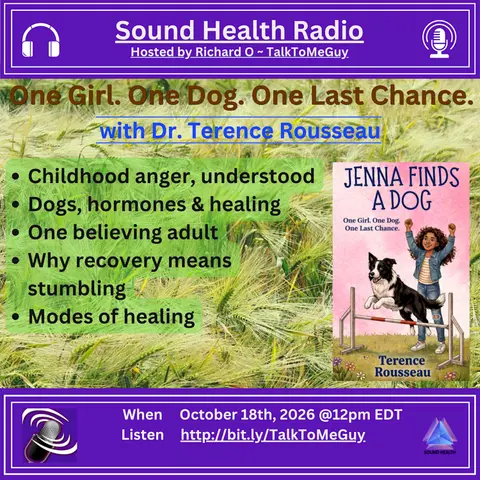
Thirteen-year-old Jenna Connor has already been hospitalized, medicated, and labeled a “psycho” by her classmates before her story even begins. Then she finds a stray border collie named Lucky, and everything starts to change.
The man who wrote her story knows something about second chances. Dr. Terence Rousseau grew up in Leavenworth, Kansas, the son of an immigrant prison guard. He dropped out of college, spent a time homeless in Phoenix, and landed his first real job as a radio DJ in Dodge City. He joined the Army, became a military broadcaster, handled public affairs during Desert Storm, and ended up anchoring the evening news in Berlin.
Then came a call to ministry, a shortwave program heard around the world, seminary studies in Michigan, and a language translation company he started and sold. And then one day his wife asked, “What are you going to do?” His answer: “I could be a doctor.”
Twenty-six years of medicine later, he is a family medicine physician in a remote mountain village in New Mexico, who has cared for thousands of patients, from newborns to those taking their last breath. As he prepares to retire, he’s stepping into the one career he can practice anywhere: writing.
His first novel, Jenna Finds a Dog, began as a screenplay he wrote during the COVID lockdown. It looks at childhood anger as something to understand rather than punish, and it weaves in what stress does to the body, how the nervous system can help us cope, and what a dog can teach us about healing.
•Please sign up for the email list for future notifications•
If you would like help starting your own show or podcast, as well as help selecting a microphone and setup for your voice; Please tap the microphone and leave me a message with your contact information and I will get back to you.
Or you can email talktomeguy@gmail.com
More information at: SoundHealthOptions.com
TalkToMeGuy: Greetings, everyone. This is the Sound Health Radio Show where we talk about the crossroads of the environment, our health and longevity with Richard TalkToMe Guy, and Sherry Edwards is off working on the Sound Health Portal. I would suggest going to the soundhealth portal.com, scrolling down just a bit and clicking on the watch how button. You'll see a short video explaining how to record and submit your first recording. Then go back to Soundhealth Portal.com, scroll down to current active campaigns, such as cellular inflammation, biodiet, neuroplasticity, or memory, and choose one that is of interest for you. Click on that campaign and click free voice analysis, and the system will walk you through submitting your recording.
You receive an email with your report back, usually in one to two hours. To hear and share replays of this show 50 to 60 minutes after you hear the after music, go to talk to me guy.com, scroll down that page, and you'll see this show at the top of the episodes page. There are also hundreds of shows available there as well. There is a microphone icon at the bottom right corner of all the show notes.
If you would like to leave me a voice message with a question for a guest or a guest idea for a show, you can do that directly from the site, and I will be notified. With that.
13-year-old Jenna Connor has already been hospitalized, medicated, and labeled as a psycho by her classmates before her story even begins. Then she finds a straight border collie named Lucky, and everything starts to change.
The man who wrote her story knows something about second chances. Dr. Terrence Rousseau grew up in Leavenworth, Kansas, the son of an immigrant prison guard. He dropped out of college, spent a time homeless in Phoenix, and landed his first real job as a radio DJ in Dodge City. He joined the army, became a military broadcaster, handled public affairs during Desert Storm, and ended up anchoring the evening news in Berlin.
Then came a call to ministry, a shortwave program heard around the world, seminary studies in Michigan, and language translation company he started and sold. And then one day's wife asked, What are you going to do? His answer, I could be a doctor. Twenty-six years of medicine later, he's a family medicine physician in a remote village in New Mexico, who has cared for thousands of patients from newborns to those taking their last breath. As he prepares to retire, he's stepping into the one career he can practice anywhere, writing. His first novel, Jenna Finds a Dog, began as a screenplay he wrote during the COVID lockdown.
It looks that childhood anger is something to understand rather than punish, And it weaves what stress does to the body, how the nervous system can help us cope, and what a dog can teach us about healing. Welcome, Terrence.
Terence Rousseau: Well, thank you so much, Richard. So wonderful, wonderful introduction. Quite a lot. I Certainly appreciate being on your show. Thank you. Looking forward to this.
TalkToMeGuy: So I'm going to open by, We'll be wandering through the story of the book, but I have questions around your storyline. And your life. Family Physician and now that I've clarified that you are a DOA, Dr. Vosteopathy, you look at the whole person, which I really respect about DOs. They really have a much what I considered a better picture of a person when you come in and work with them. As we discussed backstage, the first doctor I ever saw was a Dr. Phosteopathy. And they have a much bigger picture than a like an isolated doctor who's a specialist in ankles.
Sorry, not picking on ankles. When you think about Jenna living in a constant state of anger and stress, What is happening in her body? And could that wear her down her immune system and cause, you know, could it cascade in a not healthy way?
Terence Rousseau: Oh, of course, of course, there's so much disease in our society that's just caused by stress. Um, in the body from a biochemical perspective, the cortisol is probably uh overboard in her case. Um, and as far as musculoskeletal, she probably holds herself in a very uh uh rigid posture.
Um, of course, when it comes to the neurotransmitters in the brain, uh, you know, she's she's in a negative mode as well, and that just kind of leads into you know a catch 22, a vicious cycle that just feeds on itself. And on uh on shows,
TalkToMeGuy: I often use the well, and when I'm promoting shows, I often use the hashtag total toxic load. And for me, that means you know, everything, not just uh it could be psychological or it could be environmental, and it could be emotional, or it could be toxins like glyphosate or what we spray in the air or fire retardant from fires or just you know, the total toxic load that we have, or get get exposed to or consume.
And so the idea of that food, environment, stress, and emotions all add up in the body. Would you talk about the the your view on the idea? And if Jenna walked into your clinic, how it might apply to her.
Terence Rousseau: Oh, sure. Um, yeah, she she is. Total toxic load is in the red in her case. Um, and yeah, if something isn't done, her life's span will um will be shortened, quality of life, less less uh quality of life than what she uh has the potential for. Um, and in her case, I mean, she's basically heading for prison, really, um, with the lifestyle that she has. Um, if she came into my clinic, I mean, and they're complaining of these types of things, you know, I would I would be looking into family dynamics for sure. That'd probably be one of the first things I'd I'd I'd focus on. And then uh school, what's going on with her in school as well.
TalkToMeGuy: And because you're a DO, do you get that kind of intake with patients? Or do you is it mostly from observation and then you make notes?
Terence Rousseau: Oh, yeah, yeah, yeah. Well, I do a lot of observation. I have I have my little um my little office with my computer and all that, right where the girls bring the patients in, and then they measure and all that, and I kind of eavesdrop a little bit on what they're saying. But but uh yeah, very strategic the way I've placed my uh myself, and then I can kind of watch because they don't know, and I can watch how they're walking down the hall when they're because that they kind of walk away from me. So they're when they're rooming the patients, I could kind of see how they're walking and their gait, how they're carrying their cells, you know, how they're holding their head, their shoulders, and I can gleam a whole lot of information just from that, even before I step into the exam room. It's almost like cheating.
TalkToMeGuy: I mean, it's really cheating, but you can I I also along the way uh got a certification as a Swedish SM Massur. And that was one of the things that we learned. One of the teachers was a teacher from Islam, and he would have people walk across the room in the class, and we would all observe the gait, the shoulder positions, because that affects how you breathe, the kind of oxygenation your body's getting, whether they're in a flight or fight mode. I mean, just there's amazing amounts of information that you can gather just by watching somebody move across the room, like you say, just watching them walk down the hall tells you a lot.
Terence Rousseau: Yeah, and when they're doing it and they're don't and they don't know they're being observed, it's actually much uh uh much more beneficial for me as far as you know, determining, you know, what kind of state of mind they're in, you know, in addition to physical diagnosis, because you know, people will put on an air, you know, when they see the doctor, you know, I'm okay, everything's fine, you know. Yeah, um, but uh yeah, that way I could really get a before I even step into the room, I have a pretty good idea of what's going on.
TalkToMeGuy: And how did you I don't have this in my notes, but I have to ask, how did you choose osteopathy? Did it just light up for you? Or because you you, I mean, just from us talking, you're an inquisitive guy. Right.
Terence Rousseau: Well, it's it's kind of interesting. When I decided to be a doctor, that was a midlife crisis for me, really. Um, and it's it's very strange. They built a medical school on our I lived in Phoenix at the time, and on our way to Walmart, we used to drive past an orange grove. Uh, and one day the grove was gone. Poof, it was gone.
Wow. They put up a building, and uh then they eventually they put up a sign and it said Midwestern University. And I thought, well, these people are pretty stupid, don't they know they're in the Southwest?
Right. And um, when I decide to become a doctor, I just looked in the yellow pages, and I I found out that that was actually a medical school. So it was an osteopathic medical school. I went to talk to them, and they're like, uh, okay, that's all fine and dandy, but your degree is in English education, and you need to get the hard science prereqs. So I said, does it matter where I go to do that?
And they're like, no, you can do as long as you got the grades and you pass your MCAT scores, and we can interview you and take a look. Um, so I I just went a little further down the road to the um uh Glendale Community College, and that's where I got, you know, my biochemistry and physics, physics too, and chem too, and all those classes. Um, and yeah, it was just kind of serendipity.
I uh I applied to a lot of different schools, both osteopathic and allopathic. And um, and I went to interview there, and it just clicked and uh I was accepted there, didn't even have to move, just kept the house I'd been living in and just uh went there. Worked out perfect. That's amazing.
TalkToMeGuy: I I suspect I I had a number of chiropractors being a MSUR, I worked with a lot of local body types, and I had a number of chiropractors that kept telling me I should go to chiropractic school, and it just didn't quite appeal to me. The the working with the people appealed to me, but I always what I would get closer, it was the math and the side the hard science and the idea of studying osteopathy. I think if I was going to do it, that's what I would go for because of the broad spectrum of knowledge and the gestalt that really like as you talk about really that big view of looking at the whole person. Right. I I can't imagine any other way than looking at the whole person.
Terence Rousseau: Well, I think it's it's very beneficial uh being a DO. I mean, obviously, you know, I I've I've learned, you know, various uh forms of osteopathic manipulation, and uh I use that a lot of DOs today are kind of gotten away from it. Um it's it's one of those things.
I don't know. I mean, you can teach it and all um and practice it, but some people seem to have more of a knack for it as far as the manipulation than other folks do. So there's there's kind of not just you know a skill set and knowing the basic techniques and all that, but just there's a feel for it. There's kind of a kind of an art form uh to it as well. Well, and I would I would
TalkToMeGuy: I will agree with that from the perspective of uh having worked with a lot of chiropractors, and I won't name names, but some of them shouldn't be chiropractors, yeah. Yeah, because you were bad people, but just because they were always a little hesitant about the move.
Terence Rousseau: Yeah, yeah, yeah. And I and I tell people that too. The you know, the difference between, you know, what comes to manipulation, the difference between a DO and a chiropractor is, you know, when they graduate, if the DO isn't any good at it, they're not gonna do it. You know, they're gonna go off and be a radiologist or or whatever, or family medicine and just not do manipulation.
Right. But a chiropractor really has no choice whether they're good at it or not. Um, that's that's their bread and butter, and that's all they were trained pretty much. I mean, they'll do other things on the side, you know, they'll sell this and that and do, you know, maybe you know, other things on the side as well, you know, test your hair, whatever.
Um, but as far as manipulation, you know, yeah, some of the folks they they graduate and and and may not be so good at it, and usually with DOs, if they're not, they'll know it, and they'll go off and and do other things and not include manipulation. Right.
TalkToMeGuy: Yeah, it's a um, I I had a chiropractor who taught me how to do a lot of manipulation so that I could do it on her. Oh, right. She realized that I had the strength in my hands because the the massage in my life. And so she would say, Oh, would you do this in but so I was good at it, but I've never stuck with going to the school. The school part was hard for me. Right. If I could do a mail order school, I'd be doing it, but I don't know.
Terence Rousseau: Yeah, yeah, it's pretty hands-on. We spent a lot of hours with that in the lab. Yeah, my wife, she's really happy that I became a DO.
TalkToMeGuy: So I bet, yeah, yeah. Well, I would I would like to have I that makes me realize I would like to find a DO in my world and add it as a uh, you know, dinner party person. There you go.
Terence Rousseau: Very good.
TalkToMeGuy: And you dove into radio, and because you were even doing radio, you know, for quite a while. How did you how did you step into the radio world?
Terence Rousseau: Well, you know, uh somewhere along the line, I don't know. Um I think my sister put a little bug in my ear way back in the day when I was a little kid that you know, you'd you know, hey, I think you'd be pretty good in radio. Um, and then uh years and years and years ago, I I took a little course in Phoenix, Arizona. I think I dropped out of it though, actually, but it taught me a few things uh as far as radio broadcasting. And uh I ended up moving back to Kansas and uh I just put together a demo tape. Uh you know, I had a couple turn two turntables in a microphone, you know, set that up in in my bedroom and uh I made a little demo tape and send it out and I got a little gig in Dodge City, Kansas. That was my first uh station I worked at. Wow.
TalkToMeGuy: And then you did um sermon radio for the military. Was that for the military?
Terence Rousseau: Uh the uh yeah, our armed forces radio and television service. Uh yeah, they sent me to a very rigorous school. It's uh I think that when it comes to the Department of Defense, my understanding is is the their hardest you know, school as far as you know, dropout rate intellectually, uh, is the um uh defense language institute in Monterey. And then the uh the second one is the uh uh defense uh uh late uh defense language institute, and then it was the one that I went to, which was um uh what was it, the defense trying to remember the name of it. Um DLI.
I keep thinking DLI, but it's uh anyway, it's they send for broadcasters, uh they send you know for print journalists. Oh, the defense information school is is was the name of that that school. Uh yeah, it it had a very high attrition rate. And the first class was basically for broadcasting, was learning how to talk. And a lot of folks got kicked out because they just couldn't develop a conversational tone that was pleasant to listen to, right? Especially women had a hard time because they they have a higher frequency. Right. Yeah, and uh they had a hard, hard time.
Uh just the first that was our first class. Like if you can't, if you're not able to talk in a pleasant manner that people are going to want to listen to, then obviously you're not gonna have a future to broadcast. Yeah, yeah, exactly.
TalkToMeGuy: There's that. I happen to know a lot of DLI students because when I had my herb store, I was a partner in herb store in on Canary Row. And it was just down the hill from DLI.
Oh, right. And all of the international students would come in and get their uh like the Russian students would come in and get their uh Valerian route to make Zabrovka, which they take uh Valerian route and basically make a tincture, but it's in a full bottle of vodka. So a lot of and and I've never seen a group of people in general who are more stressed out. Yeah, they were all just like pedal to the metal, like you know, terrorized of like, oh my god. Right? I can't believe I had to learn all this and I have to know it by Friday. Yeah, yeah, yeah, yeah, yeah. I mean, the pressure was really phenomenal.
Terence Rousseau: Well, I I remember the defense information school, um, when we back then it was typewriters. Uh so when we were typing up various whatever it was, reports or this or that and the other thing, we had to do it with carbon paper, and we had to turn in the carbon copies to show that we didn't make any mistakes in our typing.
Wow. So everything had to be turned in carbon copy, absolutely zero mistakes. Um, so that was just you know, one little rule they had. Yeah, yeah.
Yeah. They they really did put the pressure on us, and we had to become experts in politics, uh, international politics, not just the United States, right? Um uh geography, culture, um, everything. We had to learn everything about about the world really, because we'd be stationed who knows where, right? You know, when once we left. Um, so yeah, that was that was uh that was quite the course, in addition to all the nuts and bolts of radio and television broadcasting, right? How to edit and how to good shot and you know, composition and all that, yeah. Wow. Oh, that's a whole separate show.
TalkToMeGuy: That's a whole super show. Um so how did Jenna come into your life? How did she Did you have the story and you figured out Jenna as the vehicle to tell the story, or did Jenna sort of wander into your mind one day and the story evolved around her? How did how did Jenna come about and how did this story come about?
Terence Rousseau: Right. Well, um, during COVID, um, I was on call at the hospital one week a month. So um, you know, and during that week in the hospital, you know, I'm busy, there's no problem with that. Um, but uh the other the other three weeks a month, you know, I'm in the clinic and it's lockdown and hardly anybody showing up.
You know, I may be seeing three, four, five, six patients a day because people are wanting to get out and they're afraid they're gonna catch COVID. So that's when I started uh working on Jenna finds a dog. Um, and I was looking at the idea that I see so many kids these days with so many troubles. And it seems like I'm seeing more and more kids starting on antipsychotic medications at younger and younger ages.
And I was like, well, you know, I should try to address this. This is not beneficial for anybody. The kids, they're not learning how to cope with their problems, they're being medicated at an age when they really need to be learning how to cope with life.
Um, and this is just going to give us a bunch of dependent adults that aren't going to know how to take care of themselves, much less the next generation, their kids as well. So that's where I came up with Jenna finds a dog originally as a screenplay, and I had it as a little boy, Jimmy finds a dog. And the producer I was working with, she was real thrilled about the story. And I think she was talking with a friend about it, and her friend was like, Well, you know, why why does it have to be a little boy?
Why not a little girl? So that was, you know, when when the producer, Miss uh Alexia Molochi at Little Studio Films, she got back with me on that, and I rewrote the whole screenplay. I had to change everybody's gender. I thought that was just amazing. And changing the genders throughout the entire screenplay was not an easy task, but I really think it made it developed the characters even that much more, really.
TalkToMeGuy: And one of the things by now I've read and heard because I listen to a lot of stuff and then I read as well. So it's a it's a blur to me. And one of the things that uh that really lit up for me, having grown up, I went from high school, I went from kindergarten through high school with all the same people. And there were some people that we noticed were, you know, like a guy who is always in a little the one with the bouncy foot, you know, that nervous I think considered a marker for adrenal stress, but they have that constant bouncy foot and they can't ever stop being the bouncy foot. And you know, he was a great guy until he got agitated or uh confronted, or you know, just anything. He wasn't he wasn't a fighter per se, but he would be scrappy and angry and out, he would go into outrage at the drop of the hat. So I'm very familiar with this as it, you know, and he was a buddy, but he'd like when he was gonna go, I could see it, I would watch him and I could see him getting ready to go, and I'm like, I'm out, right? I didn't want to be subject of because I was afraid I would hurt him, not intentionally, but just in protecting myself.
Right. And one of the things that I I noticed or read or heard you talk about was you uh you've said that some families are being terrorized by their own children and are too embarrassed to say so. Yeah, and it's more of a failure of society than it is of mothers. Would you talk about that? Because I think that is so right on.
Terence Rousseau: It is it well, it's a hundred percent true. Yeah, it is a lot of mothers, you know, or or or even fathers or grandmothers. I see mainly like mothers and grandmothers type things that are uh, you know, they're taking care of kids because you know, maybe mom's in the in jail or incarcerated or or dad or same thing. There's a lot of that going on too, a lot more than what we realize. Um, so uh yeah, I think I think our society in general has just gotten to the point where everything is such a quick fix all the time. So we have that on the one hand, kids are brought up to think that everything could just be handled immediately, and that there's there's going to be a quick fix.
And if it's not them that comes up with the answer, uh somebody else is expected to have the answer for them. And then in addition, the cultures become just much more violent overall. Uh our um our media, as far as entertainment, half the time, you know, violence happens not just in our movies and our TV shows, but now, you know, with the most popular video games, um, in the in our music, um, it's everywhere. So we have little kids growing up thinking number one, everything needs to be resolved quickly, and number two, you know, violence, there's a place for it, you know.
We we, you know, so I I think I think the culture, those two things really need to be addressed. Um, and and it's not so much like if you're if you're a well-meaning parent, and in case in Jenna's case, her mom very well meaning, single mother, her daughter was uh adapted very well to school, didn't have any problems, but and the two of them had the exact same, you know, family environment. So um, yeah, it just depends. There's so many variables on how an individual can approach their um vicissitudes their the vicissitudes of of what break of what comes to them on a daily basis and how they handle these challenges. And in Jenna's case, she just she just didn't handle them in uh in a beneficial manner that was neither good for her or anybody she knew.
TalkToMeGuy: Yeah, and I would uh this is a I won't make it an editorial, but I could. Um, I have issue with a uh a laptop, uh a tablet. Well, I won't name the brand, but I will the tablet becoming the babysitter. I just don't think it's I don't think it's good for the mind, and I don't mean like that it's gonna corrupt you. I just mean we're three-dimensional beings and we're growing up in a three-dimensional world, and I think staring at a flat device is not giving the brain the same information, no matter what your intaking. And that's coming from somebody who spends way too much time in front of flat screens working.
Terence Rousseau: Yeah, yeah, yeah, yeah, yeah. Well, we all do, you know, and I think they've done, I think they've done studies as far as learning a new language. We were talking about DLI. And I think they've done studies like learning language through these online apps and whatnot, which I use, versus to actually writing, you know, writing these words down, writing sentences and all that. Is the learning process as good? And the retention isn't as good.
Um, compared to learning the old fashioned way where you're, you know, you you you maybe have a live instructor, but I think the key is the actual physical aspects of taking what's in your mind and writing it on a piece of paper.
TalkToMeGuy: And I think that in combination with uh back to my total toxic load, I think it's a bad vortex because you've got hormones, and you know, especially in younger people, you've got hormones dancing all over the place, like you know, fireworks, and you add that, and then you add a diet that may be you know junk foody or you know, whatever you want to call it, not full nutrition. I I have to put the disclaimer in the audience knows I'm gonna do it in almost every show. I was a working chef for 20 years.
Oh, okay. So I have I have cooked a lot of like great organic because that was my drive always, like really clean food. So I'm oriented toward clean food. Yeah, yeah, yeah, yeah. And I see kids, I used to see kids come into the into the restaurants when I would peek out or hear a ruckus going on, and it was typically the child that was having a reaction, and I don't mean an allergic reaction, I just mean something, would be somebody who's you know having pancakes with syrup and having you know, just all the things, even though it was good quality, it still is just adding you know that sugar buzz to the thing.
Terence Rousseau: Yeah, yeah, yeah, yeah.
TalkToMeGuy: Yeah, and I think the kind of I think the vortex of tricky diets, I'll call it, in combination with excessive electronics, is just throwing our nervous system into a frenzy of what am I doing?
Terence Rousseau: It is, it totally is. That's kind of interesting. I have a patient, he's an award-winning chef at a country club here, and um, he's just gone vegan, you know. I I gave him all his lab results and this and that, whatnot. So he's personally himself now, he's vegan. Yeah, but you know, I'm sorry, yeah, he'll cook up everything for everybody at the at the country club, but he himself has gotten vegan now.
So and he's not he's not doing sugars or anything. So um, I just thought that I I gotta I got a pretty good kick out of that. But uh I think vegan if anybody knows chefs, chefs know when it comes to nutrition, yeah, yeah.
TalkToMeGuy: I just think vegan is very, I mean, I've known a lot of uh well, I'll make this observation uh in the herb store. I was there for about five and a half years. All the women that came in that had hormone issues.
Well, no, no, let me back this up. 90% of the women that came into the store that were vegan had hormone issues, and because they weren't getting the fats they needed to create those hormones. So if I could convince them to like, no, have a piece of steak, a small piece of steak, like twice a week, or you know, just eat some whole fats, some good whole fats.
That that they could make it happen, but it took a lot of work. Yeah, particularly as a female because they're so their hormones, especially in younger, are just all over the place. Not that guys don't have the same issue, but we're kind of louts. We just boulder our way through it.
Terence Rousseau: Yeah, yeah, yeah, yeah. Yeah, yeah. Well, cholesterol is a precursor to all the all these uh female hormones, male hormones too, you know. So um, yeah, so uh and and that's found in animal products. So um, you know, the thing I think is we we really do have to get back to I overall uh just natural nature, you know, for thousands and thousands and thousands of years, you know, we were a hunter gatherers, and then uh we we developed civilizations when we started uh with the idea that hey, I could plant this little piece of grass and nurture it, and we'll call it corn, and we'll keep working on making it a little better every year. Um and that's what we did for thousands, and that's how our genetics are set up, and then all of a sudden, within a couple generations, we've gone from you know, riding horses to you know automobiles and spacecraft, and we've gone from sending smoke signals and uh and making sounds through the air for communication to you know what we have now. Um, and that's all been within a couple of generations, and you know, not only is our our our our capabilities of our mind and our emotions, emotional uh uh self trying to catch up to this, but I mean our genetics are gonna be a long way away from catching up to what we're doing to ourselves these days in the culture that we're living in, is what I think.
TalkToMeGuy: Yeah, I'll toss into the mix because I always have to because I can hear the audience already growing. Uh, my grandmother lived to be 106. My grandmother came across the wagon from uh Illinois to Salt Lake City in a wagon, and it wasn't a tourist choice, you know, that's how old she was.
And she worked her whole life making uh she had a pie shop in Salt Lake City next to the tabernacle, and so she made pies up until her late 90s, and then she sort of semi-retired mostly because people thought she was too old. And one of the things my grandmother never knew the word organic. She didn't have to, but that's how they ate. They grew their own food, they had their own cattle, they had their own chickens, they used their own manure, they grew a lot of their own produce. My father, my grandfather was a wheeler dealer, so he was always trading guys for something, right? But they ate 90% of what they ate, they grew. Right. And they didn't know what organic was. I asked her once and she looked at me like, what are you what word is that? Yeah. Um, but she lived to be 106.
Terence Rousseau: Yeah, yeah, yeah. Well, it, you know, the it it the uh industrialization of food um has been a big downfall for us. And I'll tell patients a lot of times, whether we're dealing with weight and whatever, when it comes to nutrition, you know, I back in the old days, there was a little corner store, and they would have, you know, beans and rice and grains and all that. They may have a few canned uh uh, and most of this stuff was in gutty sacks or whatever. They may have some canned um fruits and vegetables as well, maybe some fresh fruits locally, that sort of thing.
Um, if you wanted meats, a lot of times you'd have to go to the butcher who specialized with the meat. But now I tell them, you know, all when you go to a supermarket, you know, all these things are along the outer walls, you know, you'll have your fruits and vegetables, you'll have you know, your breads and all that, you'll have your dairy, all those are along the outer walls, and all the aisles in between that people go up and down these aisles, that's all junk food, all of it, everything in between the big huge supermarket, all those aisles in between are just processed junk. And you know, how many people do you see when you go shopping? They're just going up and down those aisles. People don't think of it as junk food, but you know, that's basically what's going on.
TalkToMeGuy: Yeah, I avoid if it's in a box, I don't trust it. I think mostly that's uh, you know, rice, okay, rice in a box, I'll accept that. But you know, I mean, I you know, have been known to partake of wheat fins or you know, some kind of crunching thing.
But for the most part, you know, I started my culinary world when I was in my 20s, so I've always sort of had that orientation of I'd just rather cook or go to somebody's places in you know, somebody's home and have a great meal by just cooking. Right. And it's a great social thing. I think cooking is you know a social event. It doesn't have to be. It should be. It should be.
I think we should do more of that. Um did your dog evolve as you were writing, Jenna. Did the dog change in your mind's eye of what you thought that I see you petting your dog, your camera's on, and I see you're you know, obviously a dog guy to begin with.
I am too. Um, so did your dog change in your mind from one kind of character to another? What who was the influence of the dog? Oh cover, the cute fluffy-tailed, you know, cinematic dog.
Terence Rousseau: Oh, yeah, yeah, yeah. So uh border collie. So I got a border collie. Um, and this is after a research, doing a lot of research on dogs. I've never owned a border collie, I've had dogs all my life, but border collars are known for being, you know, extremely astute and extremely loyal. Uh, all these different breeds have their own characteristics, and uh border collies, they're it's kind of like, you know, tell me what you want me to do next. Yeah, and boom, they'll go do it. Then they'll come back.
Now, what do you want me to do? Yeah, um, you know, and their whole life is wrapped up in their in their masters, yeah. Um, and they thrive on that. That's what they that's what they love to do. Um, and it as a working dog, obviously they're out there, you know, tending to the sheep and the the shepherds or whatever, they can just do little whistles. The the dog knows this whistle from that whistle or this command from that command, and they just they just love it.
Um, and that's the reason I chose a border collie was this is a type of dog that could really bond with Jenna and a dog that uh you know, Jenna could work with and really involved with. Yeah.
TalkToMeGuy: And would you talk about the the biochemistry somewhere? I can't again, I can't remember if I read or heard you talk about this. How you know caring for an animal, although I think it's actually the animal caring for us, but that's a separate show. Um changes our biochemistry. Caring for an animal really does change our biochemistry. And is that why you you had Jenna get have a dog or acquire a dog or find a dog?
Terence Rousseau: Yeah, yeah, yeah. So yeah, it boosts our oxytocin level. Um, and that's that's and it does it with the dogs too. They've done studies with it, and the dog's oxytocin goes up too. Um, and that's that's uh that's the main uh neurotransmitter that makes us feel you know comfortable and relaxed and at home, and it's uh they call it the love, you know, the love hormone. Uh, you know, makes us feel nice and loved, uh, makes us want to give love as well.
Um, and it reduces cortisol, and that's the you know, that's the fight or flight, you know, hormone that you know, oh you know, bears chasing me, and and you know, cortisol's been shown to you know increase you know uh risks for stroke and heart attack, obesity, diabetes, all that. So, yeah, so having having dogs uh is a wonderful, wonderful thing.
TalkToMeGuy: I can't argue. We could drop the mic and stop there. Having dogs is a wonderful thing. I've either had or always been around dogs, and I just I consider them to be some of the better people, right? And you've said I wrote this down for a specific reason that you said healing often begins when we turn our focus outward to someone or something else. Would you talk about that? Because I think that's an fascinating observation. True and fast. fascinating.
Terence Rousseau: Yes, yes, yes, yes, yes. And I think it is so true. Um, yeah, I I'd say even with physical and mental health, in this aspect, I think I was referred primarily to mental health. That you know, when we have when we have mental health problems, it it uh I think by human nature just automatically makes us focus on the problem and makes us focus on ourselves and you know our future and how bad everything is. It's always, you know, obviously, if there's a mental health problem, there's going to be negative emotions involved in that, and we get into the you know, talking about back in the day, you know, we didn't hear the word so much depression, oh, they have depression or bipolar or anxiety. The words we used were more like, oh, they're feeling sorry for themselves, um, or they're a nervous wreck.
We've got we have terms that kind of have have have come by the wayside, but probably maybe more specific. That the idea is we need to quit feeling sorry for ourselves if we're depressed. We need to look outside of ourself. Because if we do, if we continue uh focusing on our own depression and our own feelings, it just feeds on itself. And we're never gonna break out of that downward spiral.
So we need to look up at something else or out at something else. It's like a rip current, you know. It's like you gotta kind of, you know, it's taking you out, but you can't necessarily fight it, but you can go 90 degrees, you know, against the rip current and go that way. So that's the idea you gotta look outside that current. You gotta maybe not 180 degrees the other way.
That might be too hard to accomplish. But if you're just like 90 degrees, like let me let me donate some time, you know, at the at the senior center, you know, or the old folks' home, or donate some time and volunteer at the you know, the the humane society, you know, something outside of ourselves, and you know, we might have to force ourselves, we might not feel like getting out of bed. We might not feel like you know, eating or any of that, but we we have to force ourselves and look outside ourselves. I'm not trying to say depression is not a serious issue, because it is. I mean, you know, that is suicide.
Everybody that commits suicide, I'd say 99.99% of these people are depressed, but um, we need to deal with it, I think, in a more organic way. And the first thing we need to do is break out of that that vortex we're getting sucked into and look outside of ourselves and find something else we can do with our time and try to take our minds off of off of that, at least for a little while while we're you know, caring for these animals, or you know, helping these old folks and the old folks home. You know, a lot of times you volunteer, it's just to maybe go in and talk with people, you know, things like that. Yeah, things that we can all do. So that yeah, I'm a big advocate of that type of that type of thing for folks that are suffering from depression.
TalkToMeGuy: And then in the book, you talk about your character, Mrs. Marlowe, plays a huge role in Jenna's recovery. Can you talk about that arena of how that what a difference that can make to have oh you know, just that character, right? I've had one of those characters in my life when I was sort of a not exactly autistic, but I didn't talk a lot, kid.
Right. A science teacher who was like that befriended me and like I lit up after that. And so would you talk about Mrs. Marlowe? Because it's such a powerful character.
Terence Rousseau: Yeah, to me, Mrs. Marlowe is the epitome of a teacher. Um, you know, she sees Jenna, she knows that Jenna deep down is actually a a good person. Um, and she knows Jenna's intelligent and has a lot of uh potential. So she just she just works with Jenna.
Um, and obviously, you know, they they they had some issues, um, you know, and Jenna had to, you know, go and apologize for a few things. And uh, but Miss Marlowe, she just never really she never gave up on her like a lot of other adults did. Um she was always in her corner and went to bat for her. And eventually, you know, that her her understanding or her deeper understanding of what Jenna could be come, uh paid off in the long run. And I think a lot of times when we're dealing with troubled kids, we do need to look at that. We need to look kind of beyond where they are now and kind of see them as what they what they can become. And I think she had a real skill and a real um uh talent for that.
TalkToMeGuy: I think that and the combination of the dog, I think the unconditional love feeling a dog gives people is so powerful. I've worked with somebody who worked with um what is it called now? Uh mentally challenged kids who more had an organic point of origin rather than a psychological point of origin, but would bring in dogs.
I actually know somebody I'd forgotten about her, she just popped up. This couple lives in Sonoma and they have a very large piece of property, and they adopted a camel. And the camel was quite young when they got it. They had already had one camel and then they got another baby baby camel, which is still quite huge. A baby camel is really quite huge, right? And I would see them walking around the square in Sonoma, and the the cam and very friendly, very curious, very, you know, not I don't know.
It's just to see a camel in person is really like wow, that's a big creature. And uh she liked to rub up against her dad to the point of like knocking him over, which was sort of a running joke because she would just come and lean into him so hard that it's like, wait, no, no. Oh, and he was down again. They used to take this camel into senior centers. Oh wow Wow because it was still it wasn't yet a full camel, it was still young enough, it was smaller, but it was still huge. But it would go in and it would visit people, and I went with them one time just to watch the process, and it was just amazing how people lit up. Right, right. I mean, just the shock of like, my god, that's what a camel, right?
You don't expect that in you know California for God's sakes. What's that doing here? But at least she was, you know, the camel, I can't remember her name, but it's just soft and friendly and nuzzled people and would like rub them against them and just be, you
Terence Rousseau: know, that was probably their highlight, you know, for how often she did that, but I don't know if it was weekly or monthly or whatever, but I'm sure that was a big highlight at the uh at the senior center there for sure.
TalkToMeGuy: They just routed, you know, sort of wandered northern California, you know, they'd put the camel in its trailer like a horse and take it around and you know, just take it to places, and people were just astonished at you know, a to meet a camel who was uh we sort of see camels as I think slightly more aggressive, mostly from cinema, yeah. But you know, as a young camel, it's just like curious and kind and loving and sort of you know nips your arm with its lips. It's never kind of bite you. But it was always just it was really amazing to see people so moved, yeah, because this giant creature was coming in and like being soft and tender.
Terence Rousseau: Yeah, yeah. Well, probably in a way like a dog. I mean, if you've got a dog, I mean, if for instance, a camel, if they're just outside, you know, chained up or whatever, and all they are are transportation, yeah. Maybe they may be a little more aggressive, but if they're raised, you know, in a home like you know, like a pet, yeah.
Yeah, they're they're probably gonna respond. So, you know, a dog that's chained out in a backyard, yeah, and never comes in the house and just barks at everybody that walks by and does it is hasn't been socialized at all, yeah, you know, versus a dog that's actually a real pet, gets to be family. Yeah, there's a huge difference there.
TalkToMeGuy: Yeah, yeah. They also had uh because they had large, not because, but they had room, they also had a couple labradors, and it was always just amazing to see the Labradors and the camel playing because the camel camels can run quite fast because their stride is huge, yeah, yeah, yeah, yeah. But I mean, they could get at quite a speed in no time, and the dogs were like, wait, no, wait. But they play. I mean, they they they'd cognitively play with each other, yeah, yeah, yeah.
Terence Rousseau: Well, the next the next uh talking about dogs and all that and camel and whatnot, the next um book that uh I'm actually starting as a screenplay too. I like that.
I like the idea of starting the screenplay now because uh it kind of helps with outline, really. But the next one is gonna be from Lucky's point of view, and Lucky was bought by a man for his daughter, kind of forced it on her, thinking, Oh, a dog's gonna be good for you. I had a dog when I was a kid, and the daughter doesn't want to have anything to do with the dog, the dog's a big mess, had to work all day, you know. So the dog ends up in the dog pound. That's how Lucky ends up. Wow, as a young puppy, and totally scarred, emotionally scarred, and uh lucky she's she ends up escaping from the dog pound, and that's how Jenna finds her. So that book is gonna be just from Lucky's perspective of you know, just uh beaten down dog that you know just had no chance in life whatsoever, and ends up finding Jenna, so that's amazing. Yeah, I'm gonna work on that one next.
TalkToMeGuy: There's a gentleman on YouTube who goes to pounds and finds a dog that's freaked out, and then goes into the kennel with the dog and sits with the dog until the dog comes around. Oh, and it's just it's an amazing process to watch. I mean, he's talking at the camera most of the whole time, but they have it out far enough, so you see both the dog and the and the guy. And 90% of the time he gets the dog to come into his lap and you know, get comfortable and be not afraid, and then the next time he goes back off and that dog's been adopted because he has a huge following, and people see the dog after he's worked with the dog, and boom, the dog is adopted. Oh, that's awesome.
But just the process of what he's doing is always you know heartwarming because here's a sad, scared dog, and this guy goes and sits with it until it realizes oh no, I could be okay. Right. And the transformation is you know amazing. Yeah, yeah. I'll have to see that.
That's pretty cool. I'll I'll if I find it, I'll set it to uh Shay D for you. Okay. Um that I think the um I like the idea of writing in a screenplay. I taught film and video production at a university, and I like the idea your take on screenplays because I it makes you think I think screenplays versus a script.
Right. I think screenplay makes you think visually Mm-hmm. because you're creating a visual scene. You're creating a story that's you're think you're fluffing it out more so it gives it more dynamic to it, it gives it more life or vitality, thinking as a screenplay. I'm a complete not writer. I have no writing skills at all. I have zero writing skills, but I certainly can talk a blue streak. Um, so I admire people who can take that and visualize you know, a screenplay.
Take it from just an idea of like these two characters, like you said, a dog and a girl, and then you next thing you know, you have this cinematic scene with other players, and then you dimensionalize it. Right. That part's exciting. Yeah, yeah.
Terence Rousseau: I I think I think that works out for me. I like that uh uh process. So I've just I've just sent my second, and it was a screenplay too, and I just said that I adapted it to a children's novel. I just said it to the uh producer slash publisher, because she's publishing now, right?
I sent it to her yesterday. That one's about uh uh uh the uh butterflies, the monarch butterflies. Um so hopefully it's called Mariposa.
Hopefully, we'll have that out in time for Christmas, uh, as as a children's novel. And you know, and that the idea for that it occurred to me a few years ago. I used to see monarch butterflies every year, you know. I used to see several of them, uh and I haven't seen any probably now in about four years.
Uh and you know, obviously there's a plight now. The western monarchs, west of the Rockies, they kind of go down there to Pacific Grove and that area, yeah. And then the winter, but the ones on the eastern side go all the way down to the mountains of central Mexico. And so I've got a couple of caterpillars that uh they hatch up in Quebec, Canada. So they go all the way from Quebec all the way down to the mountains of Mexico.
And in real life, the migration, you know, that that that they're called the super generation. They they live longer than the normal monarchs. Uh they don't become sexually mature until after they hibernate in Mexico. Um, and then they'll come north just a little bit, then they die, and then the next generation comes a little bit further north, and then they die, and then the next so it takes about four generations for the the progeny of that monarch to make it back up to Quebec camp. Um, so it's just a fascinating migration, especially for considering their insects.
Um, so I built you know, a whole story, children's story around that, um, as far as the monarchs, and of course, you know, we have to have a mental health issue with that too. Right. And character, he's almost chopped up by a lawnmower when he was a caterpillar, and a little girl that's into the monarch, she saves them, and but he has his antennas are chopped off, and so his balance isn't good, and he can't hardly fly. It's hard for him to learn how to adapt to all that, you know. So anyway.
TalkToMeGuy: I have a particular soft spot for monarchs uh growing up on the Monterey Peninsula. There used to be a parade uh when I was a child in Pacific Grove because one of the stop points was the pine trees of Monterey Peninsula, in and specifically Pacific Grove. And so you'd go through Pacific Grove. This was when I was quite young, but the trees would literally be covered by monarchs, just covered, yeah to the point at which there was actually a parade in which I was a fat little boy with wings as a monarch in the parade.
Right. But I mean, it used to be a thing where you drive to Pacific Grove during certain times of year, and the trees would just be unbelievably covered by monarchs, yeah. And now that doesn't happen. That hasn't happened for more than 20 years. But I mean, their migration has gotten so cut down.
Terence Rousseau: Yeah, yeah, yeah. They're they're in trouble. Yeah.
TalkToMeGuy: Not unlike the earth. Um, I don't want to end on a downer. Yeah. I can't, I I that was not my intention, but I I have to ask this, and we can then come back out of this. I heard or read you, I think I heard you uh talk about that you wouldn't be surprised if the next generation's lifespan takes a nosedive. Could you talk about that?
Terence Rousseau: Oh, as far as human beings.
TalkToMeGuy: Human being, yeah, we're talking about human beings now. Um, You know, diet, the whole, you know, just the whole sort of spiral we seem to be in.
Terence Rousseau: Yeah, yeah, yeah, yeah. And you know, and that that is probably very likely. I don't see our nutrition changing anytime soon. Uh, you know, on the whole scale. Um right now, I think as far as intervention for you know, uh medical issues, stroke, heart attack, that sort of thing.
I think we've kind of reached kind of an epitome. I mean, when you when you go in and replace people's vessels, you know, in their hearts and uh are able to do stents and open up vessels that have been blocked up by years and years and years of plaque deposition. Um, I don't think there's a whole lot more we can do to help people in those instances. And now we have the deal with more and more viruses that are going um uh what's what's what am I looking at? I guess the more chances of developing more epidemics and pandemics that can be dangerous, um, with you know, travel the way we have it. And now with the idea of uh the anti-vaccination movement, um, you know, measles are back again. Um, we're seeing a resurgence of tuberculosis.
Um, so yeah, I don't I think in the near term here, probably, yeah, the next generation and and maybe even the generation after may not be living quite as long as as as the generation that we have right now. Um and I think that and that goes with everything too. I mean, as far as you know, pollution and asthmatic and and everything else. It's almost like uh uh I hate to say, but like a climate change of the uh uh we're we're we're the climate change of humans too. That we're we're involved in things too that's going to shorten our lifespan well for at least the the next generation or two, I think. Yeah, I can't argue with that.
TalkToMeGuy: I'd like to, but I cannot. Uh even as somebody who is a chef, you know, I just don't see well. You have this uh one thing I know in your area that you had a program that you refer uh patients out to uh that get weekly deliveries of you know fresh fruits and vegetables. And I do, particularly being in California, um, there's a lot of that happening, but it's not enough. I mean, yes, it's good. Yes, there are great programs, but there's just we have so many toxins in the you know being applied to us on a daily basis.
Terence Rousseau: Yeah, yeah, yeah. Well, you know, the the main issue here, I think, goes all the way back to education. Um, I just don't think people are learning how to take care of their bodies for whatever reason. It seems like human anatomy isn't taught.
I don't know why not, you know, or if it is, it's just on a very cursory level, along with nutrition too. I mean, these are things aren't that aren't taught. Um, and they really need to be. Uh, I think I think three things really need to be taught uh that are overlooked a lot and probably are more important than a lot of other uh subjects that are taught. And one is, you know, we need to understand our own body, you know. I I'm amazed at how many people just don't know common terms for body parts, it's just amazing.
Um it's it's shocking, really. And with that, nutrition uh that should be taught in school uh at young age is and not just one cursory course, but several courses throughout, you know, elementary and junior high, and maybe even advanced in high school. And I'd also say the other thing is finances, how to just manage your finances. I don't think that's taught as well as it should be, too. We have too many people don't know how to handle their money, they don't know how to eat, they don't know how to take care of their body because they were never taught. And I think that's a huge shame.
TalkToMeGuy: Well, I'm old enough that I'm old enough, I will use that voice. Um, that I remember when uh in I think it was in high school, they just were stop slowing down and closing down the home at classes. And it was always a thing that boys poo-pooed taking. And I thought it would have been cool to take home at class, and it was a you know, they they did things like cooking and talking about, you know, making food and bed to dead. And you say it's part of school, it's part of your education.
And as you say, it amazes me. I mean, yeah, okay, I'm a chef. I was a chef, so I have skills, but that's because I've done it 900,000 times.
Um, but there's a lot of things that when I'm cooking in other people's homes, there are things that just astonish me that people don't know. Right. I'm not talking about how to turn a carrot into a rabbit. I don't mean that kind of crap. I just mean, you know, real just stuff.
Yeah, yeah, yeah. That people have no awareness because we're not taught that anywhere in our, you know, as we grow older, there's no skills for it. Like you said, I think you know, we should teach home in junior high. You know, just get a basic foundation of like how to make rice or you know, I don't know, whatever it is.
Terence Rousseau: Yeah, right, right, right. Yeah.
TalkToMeGuy: Unless you grow up in a more indigenous family where with like being things like beans and rice are cooked on a regular basis. Most people don't know how to make that, and that it's a perfect protein. You put the two together. Okay, I'll stop ranting. But it blows my mind. Um, okay, so now here's our upbeat closer.
We'll go just a couple minutes over. What do you hope young readers who are struggling with you know stress and anchor management, shall we say, will take away from Jenna's story. And what do you hope parents and teachers will take away? Because it seems like this is a thing that could have a great trend.
Terence Rousseau: Yeah. Um, yeah, well, Jenna finds a dog, um, is the name of the book. And I would just say the main thing that young folks could take away would be hope. There is hope. And the main thing I would like uh teachers, parents, caregivers, is the idea that if you find a a child um with troubles like this, um, you know, the see the see the potential in them, number one, and number two is if you find any type of a little spark of a passion for anything outside themselves, like hey, they have a little interest in this or that or whatever, you know, just just nurture that spark and fan that flame and try to keep that uh and and and get that passion going in them as long as it's something you know practical and isn't gonna hurt them, and you know, if they grow, maybe these passions may change, but try to find something, get them outside of themselves, and don't force it on them, don't force them to do something they're not interested in, obviously. But if you can find any little passion of anything, um, yeah, nurture that and try to get them to look beyond themselves so they can they can help themselves overcome those types of problems. Yeah, that's great.
TalkToMeGuy: And where can people find your book? And do you have a website or are you uh I feel I have a Facebook page, but do you have a website?
Terence Rousseau: Right, yeah. I uh they can find it on Amazon or any of the online uh books, it's available anywhere. As far as local bookstores, I mean it's up to them whether they're gonna carry it or not. Any of the local bookstores would be happy to order it.
Yeah, uh, that's for sure. So if you do want to support your local bookstore, um, you could go in if they don't have it, uh they'll order it. Um, and uh I don't have a website since I've only had one book. Once I get maybe a few more books under my belt, I'll have a website. Um, I have an author's Facebook page, and then I have my own Facebook page, private page, and I'm good with all that. Um, and then um my publisher that's uh little studio films publications, I think, or something like that. I think so. Um they have a website too.
TalkToMeGuy: Okay, I'll put all that in the show notes because I have her website. I just don't have it at my fingertips. Mm-hmm. All right, well, that was great, Terrence. That was an adventure. Thank you. Everybody have a great rest of the weekend, and we'll see you next week. Bye bye.