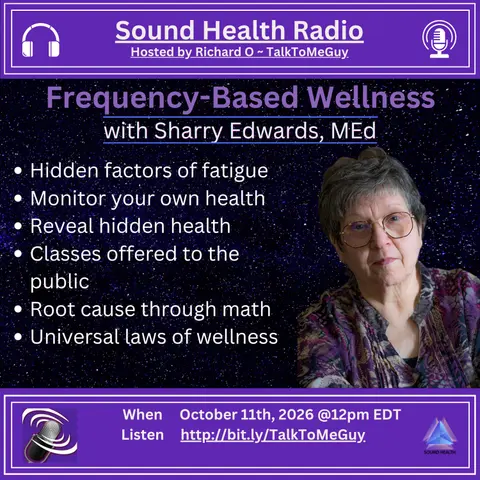
Frequency Based Wellness

 PocketCasts
 Apple Podcasts
 Goodpods
 Audible
 Overcast
 Castro
 RSS Feed
 What if your voice contains the secret blueprint to your health? What if the frequencies you carry could reveal not just what's disrupting your body, but precisely how to restore it?
For over thirty years, Sharry Edwards has pioneered revolutionary discoveries at her Institute of BioAcoustic Biology. Her research reveals, that people facing similar health challenges share remarkably identical vocal patterns. Through voice analysis and targeted frequency applications, she's addressing everything from macular degeneration and brain trauma to fibromyalgia, thyroid disorders, and those stubborn, weight issues that seem to defy explanation.
Edwards bridges ancient wisdom with cutting-edge science, demonstrating that we are sophisticated mathematical beings whose wellness can be managed through our individual, frequency signatures. Her work, connects frequency theory directly to our DNA templates, showing how our bodies can be programmed for optimal function and potentially, life extension itself.
Standing among the rare modern guardians of profound mysteries, Sharry Edwards is revealing whether frequency represents our future or an ancient science we're finally rediscovering.
Are we truly mathematical beings whose health, can be unlocked through the frequencies we naturally carry?
Sound Health Key Notes for October 2026
How Cortisol Symptoms Helped Connect Scattered Clues
•Please sign up for the email list for future notifications•
If you would like help starting your own show or podcast, as well as help selecting a microphone and setup for your voice; Please tap the microphone and leave me a message with your contact information and I will get back to you.
Or you can email talktomeguy@gmail.com
More information at: SoundHealthOptions.com
TalkToMeGuy: Greetings everyone. This is the Sound Health Radio Show where we talk about the crossroads of the environment, our health and longevity with Richard TalkToMe Guy, and Sherry Edwards is off working on the Sound Health Portal. I would suggest going to the soundhealth portal.com, scrolling down just a bit and clicking on the watch how button. You'll see a short video explaining how to record and submit your first recording.
Then go back to Soundhealth Portal.com, scroll down to current active campaigns, such as cellular inflammation, biodiet, neuroplasticity, or memory, and choose one that is of interest for you. Click on that campaign and click free voice analysis, and the system will walk you through submitting your recording. You receive an email with your report back, usually in one to two hours to hear and share replays of this show 50 to 60 minutes after you hear the after music. Go to talk to me guy.com, scroll down that page, and you'll see this show at the top of the episodes page. There are also hundreds of shows available there as well. There is a microphone icon at the bottom right corner of all the show notes.
If you would like to leave me a voice message with a question for a guest or a guest idea for a show, you can do that directly from the site, and I will be notified. With that, what if your voice contains the secret blueprint to your health? What if the frequencies you carry could reveal not just what's disrupting your body, but precisely how to restore it? For over 30 years, Sherry Edwards has pioneered revolutionary discoveries at her Institute of Bioacoustic Biology. Her research reveals that people facing similar health challenges share remarkably identical vocal patterns. Through voice analysis and targeted frequency applications, she's addressing everything from macular degeneration and brain trauma to fibromyalgia, thyroid disorders, and those stubborn weight issues that seem to defy explanation. Edwards bridges ancient wisdom with cutting edge science, demonstrating that we are sophisticated mathematical beings whose wellness could be managed through our individual frequency signatures. Her work connects frequency theory directly to our DNA templates, showing how our bodies can be programmed for optimal function and potentially life extension itself. Standing among the rare modern guardians of profound mysteries, Sherry Edwards is revealing whether frequency represents our future or an ancient science we're finally rediscovering. Are we truly mathematical beings whose health can be unlocked through frequencies we naturally carry? Welcome, Sherry. Well, thank you for that introduction.
Sharry Edwards: Well, thank you for that introduction. We have a lot of new information, and you always allow that to come out. So the health of the people. I really admire that about you, Richard.
TalkToMeGuy: Thank you. I'm still sticking with the you know, given the opportunity and choose your methodology, but today we're talking about sound. I believe that the body will heal itself. I'm not saying anybody's creating miracles, I'm not saying any of that kind of thing. I'm just saying I think the body is looking for opportunity to heal.
We're our systems are not unlike nature, where they want to be in homeostasis or balance. And I've always thought your work is that giving our opportunity. Yes, that's what we want.
More healing. Um, I want to start out by talking about our monthly keynote, uh, particularly because October seems to be sort of an itchy time, as far as I'm concerned. And uh in the keynotes, these monthly keynotes, you uh I love this term you use. You like to forewarn people of what's coming. And October is a cortisol sustressed month with short temperatures and fatigue from iron imbalance. Would you talk about how someone might use that heads up in their daily life?
Sharry Edwards: Wow, where do I start? Okay, years ago, 2019, we did uh an evaluation of COVID, and we've been adding that to almost everything that we do. And we found out as an aside that there's frequencies coming to the earth from outer space, and those frequencies can be related to things like uh what was the COVID frequencies, what was its anecdotes, how did assistine and NAC really help people with fatigue and cortisol, and in looking at that, we've been able to put together some things that are really um magic almost because we know the math and the math is always true to what's going on, and enhancing our database, we've been able to put together something called a math matrix, and it's a combination of our history, a combination of what's coming to earth, and a combination of how our body responds. Um, and so we put out these keynotes every month that's published in Masters of Health Magazine to forewarn people of what might be an issue, and in October, it is cortisol, and that's going to really affect people's hormones, their leg weakness, their fatigue. There was an article put out by a nurse called 10 symptoms of high cortisol, and it really uh brought together a lot of things that the doctor will just say, take a pill. You know, I I go to the doctor and here's a symptom, take a pill.
They don't care what the root cause is. Well, with this math matrix that has been here forever, we just didn't know how to use it. That math matrix can forewarn them of things coming, and what's coming in October is fatigue. And one of the things I ask you about is uh legs that are weak, and that's another part of low cortisol, but you doctor won't tell you that.
TalkToMeGuy: Wow. That's a wow. No, no, that no, that was great. No, because it sends me into thinking about my own. I was talking backstage, we talked about I've been having some issues with walking a couple thousand steps, and then I notice a weakness in the front of my upper right thigh, and yet I don't have blood sugar issues, so it's not that. Um, but I think that's a fascinating
Sharry Edwards: well, two things we found out about that is that to get blood back to your heart, it requires potassium and magnesium, and this cortisol imbalance messes up both of those minerals.
TalkToMeGuy: And is that because there's excess urine urinating? Because I know sometimes in blood sugar issues there's excess urinating. Is it because of loss or is it because of non-assimilation?
Sharry Edwards: It's called as part of cortisol because cortisol um manages the electrolytes. Ah okay.
TalkToMeGuy: so I need to be to consuming for me. Well, I I take liquid minerals every day because I've always been a fan of minerals, and I try and eat a lot of vegetables because I know that they're the most minerally.
Sharry Edwards: Well, we've just put up this week a cortisol template for people to go into our workstation, which is public, uh soundhealth portal.com and choose cortisol as your template, and it will tell you what you need.
TalkToMeGuy: Okay, and I know uh, because that was the next thing I was going to talk about, is you wrote a great article in uh Masters of Health, this same issue, the October 2026 at Masters of Health about your journey. How the article is I'll put this in the show notes and also in the chat in a minute, how cortisol symptoms help connect scattered clues, and how you spent almost a year trying to figure out your own, like what the blank is that like you went down the rabbit hole for yourself, which I find personally the worst person for me to ever work on or work with is myself. I'm much better helping others. I don't have patience for myself, so I know how that can be.
Sharry Edwards: You can direct them to the help, which you often do, yeah, you get a lot of response from your show, but when you begin to look at cortisol, we have backed it up to COVID. COVID messes up a gene called cytochrome P450.
That in turn messes up the cortisol, And we had to we went to the root cause of what was going on. Not well, my part of mine was gaining weight. I just kept gaining weight. And even when I fasted, my sugars were over 400. And they just said, eat less, exercise more.
Well, that wasn't working, and they didn't seem to care. One of the things that astounded me is when I did my own weight management template, it said adipenectin. And that is to control what your body does with fat. And I asked my doctor, could they uh test my adipunectin? And she came back saying, we can't even find a library or library, a lab that will test your adipinectin. I had to find the lab to give to the doctor, which I just think is a crazy kind of way. And I talked to her about it, and she said, we can only go with your symptoms. And we just we've been taught to prescribe by your symptoms, not look for your root cause. And that's what this math matrix we have created from all the history. We've created that math matrix for people to find out their root cause. Um, because that's really where it is. You said before the body wants to heal itself.
Yes, it does. And when we look at our history uh of the universe and look at all the math and the movements of the planets, and we've written several articles about this. We think we have found the rosetta stone of the math of the universe and how that relates to the human body, and so that's what we've put out for people on this uh public workstation. If they think they have cancer, use the template for cancer or the template for arthritis.
We try to go to the root cause and see what's happening. One of the fascinating things, um I found out recently, uh, sort of through a doctor, is when I had a stroke in 2015, and by the way, it was medicine caused. My left, I left lost my left side of my body.
I couldn't, I didn't know where my foot was, my leg, anything. So that legs kind of stays swollen. And the doctor, my doctor sent me to another doctor who said, wear this tight stocking and it'll help. Well, it was excruciating uh to wear that thing.
Uh, and it didn't help. My leg just kept pinching, and so I did an evaluation through the portal, and it said you lack potassium and magnesium working together. So then I went looking, and one of the things that causes the fluid to go back to the heart is potassium.
So I added potassium and magnesium, and my leg quit swelling up, and I quit having that restless leg syndrome at night, and we've tried it on many people, and yes, it works. We went to root cause, we shared root cause, we gave them a free way to check their own vocal print, and it's really changed people's lives. That's amazing.
TalkToMeGuy: I mean, the amazing thing is that you went you you bypass the oh, that's inflamed, let's give you an aspirin kind of attitude. And I'm not trash talking Western medicine completely. Um, I had 10 for I don't know, was that 15 years now?
Almost. Um as we know, as the audience knows, you know, 30 hours of surgeries, and so I believe their technology is still very skilled, but they don't seem to have any sense of just as you said here, take this. You have you have inflammation, therefore take this because and they're not they don't seem to be working on the point of origin, is how I would put it. You know, well go ahead.
Sharry Edwards: When you consider you being a chef and into nutrition and what food does, you can really change the body's inflammatory process by changing some of your foods, and you've done shows about that, and we've talked about it. Why not teach them to deflammatory, if that's a word, yeah, their body, so the body can take care of itself.
TalkToMeGuy: Yeah, it's amazing how you know food is fuel. Yeah, I like to eat a good, you know, piece of chocolate cake every once in a while. But you know, for the most part, food is fuel. And I don't think it's that complicated. Well, I mean, like you said, yeah, I was a chef for 20 years. So for me, not none of that's complicated.
But I just think there is no in all any of the doctors I've ever seen. Well, I'll I'll use this sequence. When I was in the facility uh recovering from my surgeries, I had a friend bring me some vitamin C because I thought it would be a good idea to have that going into my system. And when my friend left and I had the box in my hand, the person at the front desk asked me what it was, and she took it from me and said, Well, I'll have to run this by your doctor.
Vitamin C. And so I went back to my room rather than beating her senseless with my cane, which was my lean, and had a eventually when my doctor did show up. We had a real serious fight, like shouting at each other.
And at some point she said, Okay, I get it, you know what you're doing. Take your vitamin C, but we're not going to talk about it again. And she wouldn't even, she couldn't even acknowledge in the medical paradigm that she was in that vitamin C might be beneficial to my body healing. After 30 hours of surgeries, there's nothing that she allowed out into the conversation, like, oh yeah, that's a good idea. There are electrolytes in there, there's you know, blah, blah, blah. It'll be good for you. None of that.
Sharry Edwards: Are they restricted by their education or by their personality?
TalkToMeGuy: I think they're I think that the process of becoming a medical doctor is such a beating, because you have to memorize so much information and you know, take on skills that you would never imagine that they try and grow doctors to be more drone-like. And I'm not speaking badly about doctors.
I'm just speaking about the system. They don't want them to question or challenge or think outside the box. They want them to think there is a box and they want them to be contained in that box. Because then that's sort of like then they have a cookie cutter for like the template of what a doctor is to be in the world. And it it amazes me. Uh, we were talking backstage about this earlier, and this popped into my brain as well. It amazes me in the almost 15 years that I've been here, how many doctors I am now seeing in the past several years who are MDs who then go back and get their functional medicine degree, or go back and get their life, their acupunctures degree, or they, you know, they get some adjunctive degree of knowledge that, like, wow, I'm having amazing results now. So there is a there is a ray of hope go ahead.
Sharry Edwards: My friend who is a physician's assistant tells me that you are exactly right. That's what she reports. She's so frustrated that they're doing medicine out of a book or out of a computer. You have this uh issue, this complaint, you do this. And don't go outside of that because patients are very litigious. So we've put this on ourselves by suing doctors, and so they've restricted themselves to a book to deal with our health. So you're right.
TalkToMeGuy: And there is so many variables. That's the part I don't know how they I mean, I know what I know because I've been in and out of the field for let's just say 30 years, that's long enough. No, it's actually more than that because I was in my 20s and I'm not now.
Uh 40 years, that's enough. Um, and just accumulate a lot of information and talk to a lot of doctors. But I mean, it that that part does excite me of when I talk to a medical doctor who also has, like I say, gone back and get their functional medicine approach. Or something which, you know, that because I think you learn a lot as a doctor, but then it's what you do with it is the tricky thing.
Sharry Edwards: And it's several symptoms that they just can't bring together, but your voice is a holographic representation of all that you are, and what we have created for people over the last 40 years is this um portal uh portal where people can go and get their voice analyzed, and we're looking at 300,000 different entries of people who volunteered their voice. Okay, these three people have breast cancer. Let's look at what the commonalities are and see what is going on with breast cancer. There's a lot of research out there, but there's a lot of things being missed.
TalkToMeGuy: Wow. Did you say we just had a guest in our uh chat say, Do you want some input from a doctor? I'm a triple board certified, including functional medicine practitioner.
I think that would be great. Um, Laura, can you unmute yourself? Somewhere on your screen, there's a little thing, maybe in the center of your image. Does that work? That did, yes.
Audience Member: Hi, well, I am happy to be meeting both of you. I get catch your talks when I can. It's actually a good time for me. And I was listening to your discussion. I'm going, yeah, um, there's so much to what you're saying, and I think the big picture is the doctors, but it's also the patients.
So many people are in the system and are in the insurance system, and also believe in the process. So I became aware of the problems. Both of you are talking about a long time ago. And I was working in academics and an HMO. And you know, I wanted to do more, I wanted to do nutrition, I wanted to work with the patients, but the truth was the patients that came to me wanted the medicine that was there, and that's why they were there. Um, I at that point in time I was a dermatologist, so I would try to talk to some of the teenagers about diet, certainly was a major factor.
Most of them were not interested in making those conversations. And if I would suggest uh nutritional product or a complex homeopathic, you know, something that was more Western minded. I wasn't a classical homeopath, but I certainly had been had training in the complex, you know, the combined homeopathics.
They just wanted what was on their they had a copay for, you know, they had five dollars to take their doxycycline instead of $30 to buy some nutrition. So, you know, I've I finally realized that, you know, I just had to go somewhere else if I wanted to do something different. So it is it is the whole process of yes, the doctors and yes, we are taught that this is the way to go. And you know, I I'm talking about something really basic like acne because I was seeing a lot of that, and you know, I had patients coming in wanting accutane, and they were teenagers with hormonal acne, and I would have to try and talk them out of it, and oftentimes finally say, Well, because I didn't wasn't going to do something I didn't believe in.
I said, Well, why don't you go see one of the other doctors in the system? And so easy because those doctors believed in it, right? So yeah, it's being controlled by the pharmaceutical companies and the insurance companies, and even now with what I do, it's the economics that is really the main limiting factor.
Um, people have their insurance, and most people, even the people that believe in the things that both of you are doing, they still need to have their regular coverage in case they're in a car accident. So there's limited economics to spend on other things.
Sharry Edwards: And you think this part of it, they just want an easy fix.
Audience Member: Yes, they don't want to have to take make change. Uh and they believe in it. Um, it's the system, it's the white coat. Uh, and I know for me, it was such a relief to step out of the system because we carry as doctors um a pressure to fix. It's almost like you're the one who's supposed to make me better. And now uh, as I do more health coaching and nutrition, I'm an advisor and encourage people to take um their own control of their health and their own agency for their health.
And it it's almost like that population of people are growing, and I think, and that's why my focus has moved to education and educating people so we have more people that are aware and are making this choice, and I think we're still being held back by the economics. And in fact, I followed up with Haresh Patel that you guys was it just last week or two weeks ago.
TalkToMeGuy: Yeah, yes, last week, I think.
Audience Member: And we had a great conversation, and thank you for introducing him to me. And you know, we discussed these economic aspects, and he has some really neat ideas that I think will help bring people in at an earlier stage. Because right now, a lot of what I see are people that have tried everything, have already been in the system and have already taken all these drugs and vaccines, and it's really hard to help them.
But if we can catch people earlier at the earlier signs of dis-ease, and um help them to be in that process for more of their lifetime, I really think we can make changes. So yeah, what like you said in terms of the litigation, that is a big factor. And I was very much aware that I could give this teenager acutane, and they could have a terrible reaction and liver damage, and the system would cover me. But if I were to take a bad psoriatic, actually, more like some of somebody with an autoimmune disease, you know, there's some of these rare dermatological diseases, and do some of these holistic therapies, and they have a bad reaction, I could get sued.
So because the system wouldn't protect me, and um, I was aware that I would be out of the system out of the big boy club if I did these things. So when I did do these things, I would make uh little notes to myself that I knew I discussed nutrition, but other practitioners who would be seeing the chart wouldn't know that I was doing it because otherwise they would question me. And I know at one point someone came to tell me, are there double blank placebo controlled trials on this nutrition? So yeah, it's uh it's the big picture, and I think the more we focus on what both of you are doing and Sherry empowering uh individuals uh to take these kinds of steps and understand for themselves. And Sherry, I'm the one who's reached out to you uh in terms of the bioenergetics and um a collaboration in terms of metabolomics. Um I think I'm excited about some ways that I think you could potentiate the things we're doing and making them more powerful.
Sharry Edwards: So when did you do that? Because I don't remember getting anything from you.
Audience Member: Yeah, we've had a couple of uh emails. Um you were interested, and I suggested a follow-up presentation, and I know you're busy, so uh I do remember.
Sharry Edwards: I remember the last name.
Audience Member: And the nice thing is last weekend I was at a conference for this group of metabolomics, and they really have this intention to create a parallel system. Um, so you know, a large picture, and I did connect with one a woman who is working at bringing the bioenergetics in.
So I'd love all the three of us to collaborate. Um I think there's a lot what I what you do is different than what I see other bioenergetics people doing and the bioenergetic system that I'm working with. And um just the way you approach it, I feel it could potentiate uh the metabolomics so that it becomes more economically viable for people and accessible. So Dr.
Sharry Edwards: John Apsley came and did an internship with us, and we created a template called um metabolomics, so you can go have that tested on the portal, and it's free for people to check themselves against that. We want them to have the information so they're not caught by surprise, they can monitor their own health through the ages.
Audience Member: Well, I'd love you. Uh so the person I'm working with in this system, he's been doing metabolomics, he's developed a new um spectrophotometry methodology, and he looks at 10,000 more than that, different biomarkers, and he's made correlations with multiple diseases and found those that are most problematic. And um, we actually have a blood test and then supplementation, and I think um if we could if we could add the sound to what we're doing, uh could be very helpful. And I know you have the sound boxes, we can maybe create some sound boxes related to people's blood tests as well. So that would be great. Yes, I would love to connect. So uh now you know my name, and um well, we'll see if we can make that connection.
TalkToMeGuy: Well, and and Dr. Laura, I have to applaud you because you were one of the medical doctors that broke out or had the aha, or I don't know, I don't know what the moment is. But as I say, as I said earlier, there is a trend of medical doctors that I'm interviewing now, who have maybe it's even years later since I've been here for at least 10 years, maybe 15, that then come back and have gotten their FMD or gotten their acupuncture or gotten some other all what would be in Western medicine called alternative practice that they have added that has allowed them the gateway to then go on and actually help people. Not that Western medicine doesn't do some good things. Yeah, it's just as it is, the box that it that it is. Like you say, you knew that when you were doing dermatological things that you could give that kid accutane and that would make everybody happy, air quotes happy.
Audience Member: Yeah, and that's what I had to do if I were to stay there, and that's why I said, okay, I need to leave. And I knew my soul had to leave.
Yeah, it would kill me to stay and to be part of creating this this new parallel system. And it's taken a lot longer than I thought. Um and uh I do think RFK is helping in a lot of ways. Um So it's there's been a lot of patience and holding the Ford as both of you have. And uh I'm very hopeful that we're gonna see more rapid change now.
And I do think that we've made so much progress in terms of our knowledge, and it's the economics that really needs to shift to to get a quantum move forward in terms of really making this available to people.
Sharry Edwards: So I would like to add a story about James Marshall. He's an actor who played in a few good men and twin peaks. He ended up at our doorstep from damage from accutane.
Yeah. He had been in a hospital for two years, and they told because of the Accutane damage, and they told him to go home and get everything in order, and he got in touch with us, and we helped him re-establish his gut lining and knowing what to eat. And he's now on tour talking about alternative health and the accutane damage. Um he also wrote one of the forewords to our book about uh breaking the sound barriers of disease. So acutane can be very, very dangerous.
Audience Member: Yes, I and I saw it. I mean, there were some cases of teenage boys presenting with severe scarring, postular acne, and it turned it off, and it prevented them from having really deformative scarring, and I would love for that teenager to have had holistic care two years ago, so we never went there. But for me, the problem I saw was it was being promoted promoted to the teenage girls, and it really does not help with the hormonal acne. Um, they just take it, have the toxicity, and it goes away, but then it comes back again. Um so yeah, uh I and I have seen prednisol do magic.
So sometimes we do need these drugs in acute short-term situations. Um, but that's one percent of what's going on. So we might do a show sometime. Okay. We'll talk. Yeah, actually, um, I believe you had Dr. Goodnow on this program at one point. I saw uh Dr. Diane Goodenau.
TalkToMeGuy: I have too many names in my head, but that sounds familiar, but I can't pull it up like, oh, him, yes, I remember him.
Audience Member: No, it's yeah, okay. Well, I I thought I saw that. So um that's a metabolomics that I'm working with, but I'm also working with the bioenergetic system that does voice print scanning, and I'd love to have a chance to talk with Shiri about how what she does is different than what they do. Um the challenge with that I've had with Sherry's system is because I work remotely, um, it's hard to have the equipment for people to do that. Whereas with the voice scan that this system is doing, it can be done through the computers.
So um I'm guessing there's some subtle differences in terms of the voice and the sound and the acoustics that requires that equipment versus their system that is made based more on radionics and numbers, especially I know, that then can be done through a voice scan on the computer that makes it more accessible. Yeah. That's a whole different show. Yeah. All right. Well, I'll step back and let the two of you take over. And um, I'm glad I had this opportunity to share.
TalkToMeGuy: Thank you, Dr. Laura. That was fabulous. Yeah. Thanks for jumping in. Okay.
Sharry Edwards: It's great to have that confirmation. Yes. Thank you, Laura. Yeah.
TalkToMeGuy: Um, all right. Now back to where I'll I'll get us back there. I know I could do this. So I think I'll start way back here for some of the so there will be listeners that don't know everything that we've just that we talk about on a regular basis. So I want to talk back at the early stage of you know, the self-health outlook where people take charge of their own wellness. Damn it. Uh, would you talk about what that looks like in practice and how someone gets started?
Sharry Edwards: Well, I have to go back a little bit before that and let people know that this whole thing started because I have weird mutated hearing, and I could hear sounds from people, and part of this the beginning of it was just to prove I wasn't schizophrenic, and so I got an education. I couldn't afford college, so I got a job at the college and took my courses one at a time on my lunch hour. Took me 12 years to get my undergraduate degree, and then from there went on um trying to find out what I was hearing and how it was affecting people. And one of my graduating projects was on blood pressure, and we were able to prove that through my hearing and my voice, we could settle out people's blood pressure, and that was the first uh project that we did, and there's a lot of people and a lot of colleges at the university, Ohio University, that found this fascinating, and it just kind of grew from there.
I was trying to find out why my voice was affecting people's blood pressure, and sometimes 20, 30 points in opposing directions. So we knew it wasn't just uh uh a fluke, but it was based on my voice, and we just kept looking at it, and people just kept helping it, just it developed itself, and so we begin in earnest to try to help people, usually with little things first uh for them. Uh pain was a big one that we tried in the beginning, and we knew what frequency, and we knew what formulation, and it takes the frequency and the right formula.
A formula for pain is very different for a formula for a gene, and so trying to put all that together, and then I knew that um I need to write myself a note. Um I knew that if I died, this is gonna um was who asked that? Was Sherry's voice what Oh,
TalkToMeGuy: uh Jim did was Sherry's voice a sound for no or something else?
Sharry Edwards: My voice creates pure tones. Normally human beings can't do that, but mine does, and I've been tested in all kinds of military labs and other things for it. So I was giving back a sound to people, and their pain would go away, or their headache uh would disappear, or they had quit being anxious. So we knew it had to do with something in the frequencies of my voice, and so they took apart my voice and looked at it, and it was actually I could do pure tones when I did these sounds, so that's what we were looking for, and just slowly in doing people's voices, we were able to figure out what we were doing, but like I said, we knew that um I was getting up there. I mean, I'm 80 next year, and we wanted to teach people this so that they could uh move it forward, and what happened there is just a lot of people took it and bastardized it and ran and did other things, but we found out that certain formulations, it's not just one frequency or two frequencies or even three, and some people are out there doing it. It's how the sounds are combined that's allowing the body to accept it on different layers, different octaves, and we base all of that on what was happening with Pythagoras and Kepler early on centuries ago, and it was all around us.
The skin has a certain way of looking and accepting frequency. We just uh discovered the formulations for reversing macular degeneration. In the last 23 days, I've been working with someone who's had macular degeneration, and it is gone. Wow, and it's supposedly incurable. We've been working on that a lot of years, and I wanted to add something to Dr.
Laura. One of the things I'm finding in my own medical history is a lot of it's wrong. They are not keeping good records, at least my doctor's office isn't. They have in my um records that I had a C section in 2017. I was 70 years old in 2017. Wow.
So and I've tried to get them to change it, and they just won't. So here's doctors looking at all of this and saying she had a C section in 2017. You know, how's that? How is that possible? Is this real? Um, and you get a reputation for trying to tell them something, and you get a reputation as a bad bad patient. Yeah. So wonderful.
TalkToMeGuy: I want to clear, I want to clarify something for that. What Jim was asking about, he was asking about nitric oxide. Was Sherry's voice the sound for nitric oxide or something else?
Sharry Edwards: Um When we were using nitric oxide.
TalkToMeGuy: No, he was asking back you were talking about a card uh an issue you were working with somebody, and that it was your voice that was helping them creating a tone, but he was wondering if the voice the sound you were making was for nitric oxide or was it something else?
Sharry Edwards: We have done nitric oxide before, uh, because we have yes, it lowers blood pressure um and beats, and there's a lot out there. I'm trying to remember the very first one.
What would reduce it? Was just sound that I was giving my voice, the very first one. I gave the sound, and it lowered his blood pressure so quickly, he dropped to his knees, and we've written a story about that. Um, but for cataracts, and somebody asks that too, it's shades of oxygen and it's D sharp and E, two sounds used together to create oxygen that is reversing the cataracts.
TalkToMeGuy: So is it the harmonics of the sounds? Yes, that create the action, yes.
Sharry Edwards: Okay, the distance between the octaves, the layers, it's not just a sound that somebody can hear. We create sounds with our equipment that are below normal hearing that all different deal with different sounds and different octaves deal with different systems.
That's the next book I'm putting out, what all those formulas are because people need the formulas from their voice, but within their voice also gives us the octaves and how to put those two pieces of a puzzle together, and that's what we want to teach, and we've been teaching it for a lot of years, and a lot of times people are just ripping us off, they are interested in the money, not really helping people. So we've got a campaign coming, we've developing right now. We want to approach churches, and we want to teach at least one person in the church to take care of their congregation because their atmosphere for me is that they're interested in the welfare of their people, and so not only are we going to teach one person how to do it, but we're gonna allow them to have four or five other people taking the class with them, so only one person is paying for the class.
That's very cool. That's coming up, and we also we did a class on weight management because so much so much is being withheld from people about weight management about AMPK and Adipenectin. So we did a class, and the first part of it was free, and then they, if they take the second part of it, they got the computer program with it. So I'm going to do a demonstration on the 24th of this month on people doing that. So whoever's in the audience, we're going to pick some people from the audience and show a demonstration show people can learn this well along with the um weight management template because that's one of the places I think the medical system has really fallen down. They can't take care of a pain, they can't take care of weight management. That's a biggie.
So this in my mind is getting it to the people so it can be carried on, so it never uh loses out to some big corporation. Think of um write to me, Elizabeth, and I will send you an invitation and all the links to all the background material.
TalkToMeGuy: Is that Sherry on Air or Gmail? Yes, and it's Sherry with an A. But we want to show people how to carry this on.
Sharry Edwards: We don't want it lost. Remember the old Star Trek thing, the Borg, this big great big cube where everybody was connected, um, electronically, and they were doing bad things in the universe, and nobody could stop them, but they were one hive mind. So we don't want this lost. We want to teach it to people who care, and the people who uh money isn't their first priority of what's going on.
TalkToMeGuy: And I want to talk about something that I think uh well when I first started looking at your work, and as we've worked together through the decades, you talk about mathematical constitution, which anything in math makes my eyes cross. So mathematical constitution, and some ask whether you're saying we're sophisticated sophisticated math-based robots, programmable like music. Would you talk about that? Wow. Uh um sorry.
Sharry Edwards: Well, music is math, that's one thing, and if you look at this thing, we're looking at cataracts, it's a D sharp, which are around 18 cycles per second, or any level of that, and E, which is 20 cycles per second, or any level, 20, 40, 80, and those two notes together, some one fraction of those notes put together can equal oxygen, and that's what is the missing piece. The uh uh and glimph, the missing piece for um cataracts is oxygen, and one of the things that happens with the glimpse system, which is like lymph, only it happens when you're in deep sleep, and it takes out the trash of your body and gets rid of it, and when your glimph system goes, then your eyes begin to begin to uh to go, but mathematically, we can see it all together, like um multiples of each other or halves of each other, so it's all pieces of math.
Oh, let me give an example. Um master is in the face, it's jaw muscle, and the pterygoid, and when you chew, and this was put out by Wrigley's about a month ago, when you chew, it makes you feel good. Well, when you take those two muscle frequencies and put them together, they equal dopamine dopamine is the feel good. What can we do to take the glimph movie? Well, one, go on to the sound health portal and say, I would like a glimpse, sort of the G a glimph evaluation, and it will tell you, and a lot of times it's occuporin, which is the uh uh pressure to keep this fluid moving while you're asleep, and has to do with deep, deep sleep and and your sleep rhythms and your day and night lights and the things like that. I've written an article about it, so write to me and I'll dig up that article and send it to you. But all my articles are not all, but most of the recent ones. I've been writing for uh Masters of Health since 2018. So you can go on their site, masters of health.com and get the articles, or you can go to our professional um website, bioacoustic solutions. And all the articles are written there, and a lot of other ones. Like Philip needed a background article, and I have several there that he could go look at. But I write for many different uh publications, and there's hundreds of articles.
TalkToMeGuy: And I'll also toss in uh that if you go to, I'm answering partially Jim's question and also tossing this in for general information, that in the John Osisbinski show, which I think was last week or the week before on lymphs. He's a lymphologist, and he has a if you go to the show at talk to me guy.com and pull up that show in the show notes, it'll give you a link to a video that he made that shows you a simple shoulder move where you lift the shoulders in a specific way, and how that helps stimulate the lymphs, and particularly it's the gateway where the glimps and the lymphs come together. That by doing that by stimulating your clavicle, roughly speaking, by doing the shoulder lift, there's a very simple demo. It's he I can explain how to do the shoulder lift, but it's so much easier just to see him do it. So I would go to talk to me guy.com and find that show and find that in the show notes uh because it really shows how to stimulate lymph glimpse motion, which I think is all good.
Sharry Edwards: Well, one of the things about glimph that we learned is that it's associated. Have you ever uh cut up a raw chicken and that swiney stuff right under the skin? Yep. That's where the glimpse system is. It's not attached to anything, but there's a fluid movement through that interstitial um component of the body that goes in at night and cleans up all of the garbage out of your system. One of the things people announce when they do the lymph detox is the floaters in their eye disappear.
So it goes in and cleans everywhere there's fluid. Wow. And you can also do it on the portal, soundhealthportal.com, and just ask for glimph. And we've just put up a cortisol one too, that's really new that is um an outcome of um COVID.
I'll make this really quick. With COVID, there's a lot of lingering things going on. COVID messes up P450, which messes up cortisol and cortisol manages your uh minerals, your electrolytes, your weight gain, your skin changes, um, muscle weakness, blood pressure, blood sugar.
Um I went to the doctor probably two years ago and said, every time I eat, my blood pressure goes up. And she said, Oh, that's that can't happen. That's just stupid. And I found an article and she just treated me like a leper.
But bone loss, there's an article. Um I don't know how to get it to you guys. It look online. 10 um 10 symptoms of cortisol disturbance. Oh, 10 symptoms of high cortisol levels by Karen Berger, B-E-R-G-E-R, and she's a pharmacologist, and it was written September 3rd, 26. It's a incredible article about everything that COVID does. Cortisol does, sorry. COVID, we announced in 2019 that COVID was man-made, and they're just not catching up with us.
We could tell by the math of the genes and the proteins that it was man-made, but nobody would listen, and you'd probably go to jail if you announced it at that moment, but they're now catching up with it. Look at what's happening to um Fusey. Is that his name? Um, yeah, I had it until you said it. But he's just now admitting that it was man-made and it was deliberate. And please put that article name here.
Okay, 10 symptoms of high cortisol levels. Is that something you can do? Yep, Richard.
By Karen Berger, B E R G E R. And I knew from early on from my vocal print that it was high cortisol levels and adrenal uh function that was causing all this. My granddaughter had the same symptoms as I did in having her minerals and her emotions and her hormones all messed up. And I kept saying from her vocal pen, it's cortisol levels.
Finally, three years later, they found a tumor on one of her glands that controls the adrenals, and they did an operation and took out the tumor through her nose, and now she's getting bitter, but they would not pay any attention to her vocal print and me telling her them that it was high cortisol. So we need to get to the place where people will pay attention. So we have built that into our program that it will create um reports for the doctor for people to take to their doctor. MIT is doing this under Lincoln Labs, the Mayo Clinics doing it. Um we submitted a paper to the National Institute of Health, and they were really interested in this, and we submitted based on all of our work on Parkinson's disease, which we've done a big project on, and I'm doing very successful with it. Um, and it wasn't but three or four months till um I can't remember the name of the people doing it, but they said they could do um an evaluation of whether people are going to get Parkinson's over the phone. Well, we know knew how distorted the phone was, and we knew this wasn't going to work, so we just left it alone, but they took the material that we turned in, and it said right on the application it was going to become public knowledge, so that was stupid in my part. But we just we put out what we discover to our practitioners.
We have classes for them every week of the new stuff, and so we want this information to get around without it being given to people who are going to try to stop it. It's a whole different show. But we've had a yeah, we've had over two million dollars stolen from us, and only one of those people got a jail service jail term. Yeah.
TalkToMeGuy: Um, we're moving uh surprisingly quickly to the exit. I can't believe it's already happened. Um, but I want to ask this question because it always gets me when you talk about this. The ancients, well, let me let me say it this way. Using sound and voice for healing goes back thousands of years.
Exclamation point, bad word. Would you talk about what the ancients understood, or as I would like to say, what do they know that we didn't we don't somehow, with all of our sophisticated tools and technologies and stuff we have and AIs, and I'm not opposed to AI. But I mean, the ancients had compared to us, no technology, but yet they understood the importance and the benefit of sound.
Sharry Edwards: Well, I was raised in Appalachia with no electricity, no TVs, no radio, no running water, and I think because I only had nature as sound that my ear was trained differently, and I think everybody can do this if we just get away from the noise pollution that really messes up our um hearing.
our hearing. We see people on an experimental basis for about the first three months, and we see what we can tell from their case, then we transfer them to one of our um long-term bioacoustic people to follow them up and continue with helping them long term. So we are getting information from their voices from the volunteers that have helped us all along, And that's how we put the databases together on anything like the Parkinson's we just did and the macular degeneration. And we did a big project on cancer, and we're continually doing it on COVID and doing one on fatigue. So we are collecting data, learning how to use it in a clinical setting, and then passing it on to the people in the public.
And we need trainers and teachers. I am just swamped with cases of people that medicine hasn't experienced or doesn't know how to put together. And we give that information back to their doctor if they want us to. So some doctors are beginning to come study with us and use this in their practice, but they're keeping pretty quiet about it.
TalkToMeGuy: Because they yeah, I almost said some things. I won't. They could get in trouble, I bet for helping people without a pharmaceutical. That's my opinion.
Sharry Edwards: We took this to the FDA and we did a demonstration for uh for them. They kept our device, and then they came back to us and said, This is not medical. Go away. I said, would you put that in writing? And they would not put it in writing. But the guy's name is uh Sean Wong that we did the demonstration for at the National Institute of Health. Wow.
TalkToMeGuy: Um somebody had a question. She had her hand up, but then she pulled her hand down. Uh, who was that? Uh there you go. Pamela. Hold on a second, Pam.
Uh, let's see. You I have to unmute you. Can I unmute you? This is a trick. It doesn't let me unmute you. Pamela, you'd have to unmute you. There you go.
Audience Member: Yeah, uh, I just realized I could send you a chat message, so I was going to do that instead. But um, have you heard there's a biologist in Philadelphia called JJ Coe, and he's he's saying that um there was no COVID um COVID virus as such, because he says a RNA virus cannot pandemic. So he's uh he's uh he's uh he's a very knowledgeable biologist who actually worked with RFK Jr. on one of his books, and as he was working on this book, he came to the realization that um there could not be there cannot be an RNA virus that can travel around the world. Interesting. So his his his um his website is a giga ohm biological.
Sharry Edwards: Would you um post that in the chat or send it to me, please? I would like to follow up on this because one of the things we saw about COVID is and I'm I'm making this part up. People from New Jersey had one kind of uh COVID reaction to the shots and COVID.
People in Florida had another one, people Texas had another one. So you could look at people's COVID vocal prints, and based on the pathogens um connected to that, you could tell where they were coming from. So my thought is they were using the U well the world as guinea pigs and giving people different shots with different things in them in different geographical locations.
Audience Member: Very, very interesting. Yeah, yeah, for sure. The for sure the story we've been told is not correct, whatever whatever it is.
Sharry Edwards: Well, I know it's real because I had it.
Audience Member: Yeah, I I feel like I had COVID too, but was it COVID or was like what is it? What it what what what actually was it?
Sharry Edwards: Well, it attacks the Krebs cycle, the cellular metabolism. And what we found, two things we found if you take them together, it will really fight this and fight any kind of incoming immune hit, and that's to take NAC, acetylcysteine, and NAD. I think that's nicotine adenosine diphosphate.
One is the enzyme that makes the Krebs cycle work, and the other is for the immune system, but put them together and they create um glutathione for the body. And that's one of the major things that COVID attacked. Interesting.
Audience Member: Yeah, one of the things when I had long COVID, I took nicotine and I did get my sense of smell back very quickly. So I don't know if that relates to that the thing that you were what you were talking about. Yes.
Sharry Edwards: And people are using nicotine patches to get rid of the residue, which all of that's coming together in the Sound Health Portal because people go there and they give us information. And I've had COVID, I'm using a nicotine patch. Please run me through COVID.
And we took all of that information and put it into one pot and we call it subsequent factors. Our lawyers did not want us to use the word COVID. They were afraid we would get shut down. Yep. Yep. So subsequent factors. Just ask for an evaluation. That's everything we've found out so far. Okay.
Audience Member: So go on your website on which website? Uh Sound Health Portal. Okay. Thank you. I will do that and I'll I'll send you a message with JJ Cooley's website because it would be wonderful if you talked to him.
Sharry Edwards: That would be great. And we're doing a big project now on cortisol, which we find is one of the major factors of long-term COVID.
Audience Member: Okay. Yeah. Well, I've I've I've had environmental illness since the 90s, and yeah, cortisol's often been high. I used to work in the tech industry, so ended up with electromagnetic sensitivity.
Sharry Edwards: The October issue of Masters of Health is an article about cortisol and how it affects people. The month, the November article is how to reverse it mathematically, bioacoustically, because that's really holding people down.
Audience Member: Wow, great. Thank you. Thank you. Thank you. All right. We're stopping.
TalkToMeGuy: Wow. Because we could do another hour pretty casually. But we're going to stop now. That was great, Sherry. And thank you for everybody that contributed. That was fun having people pop in. Yeah.
Sharry Edwards: Please share this information. Send them to the portal. The first evaluation is free just to see what your direction is. And let's get this out to the public. Yes. Thank you, Philip, for all your work toward that. Yes.
TalkToMeGuy: Thank you so much, Philip, for your work. I look forward to more of those adventures. Thanks, everybody. That was big fun. Awesome. Yep. Very good. All right, everybody. Have a great rest of the week and we'll see you next week. Bye bye. Thanks, Michael.