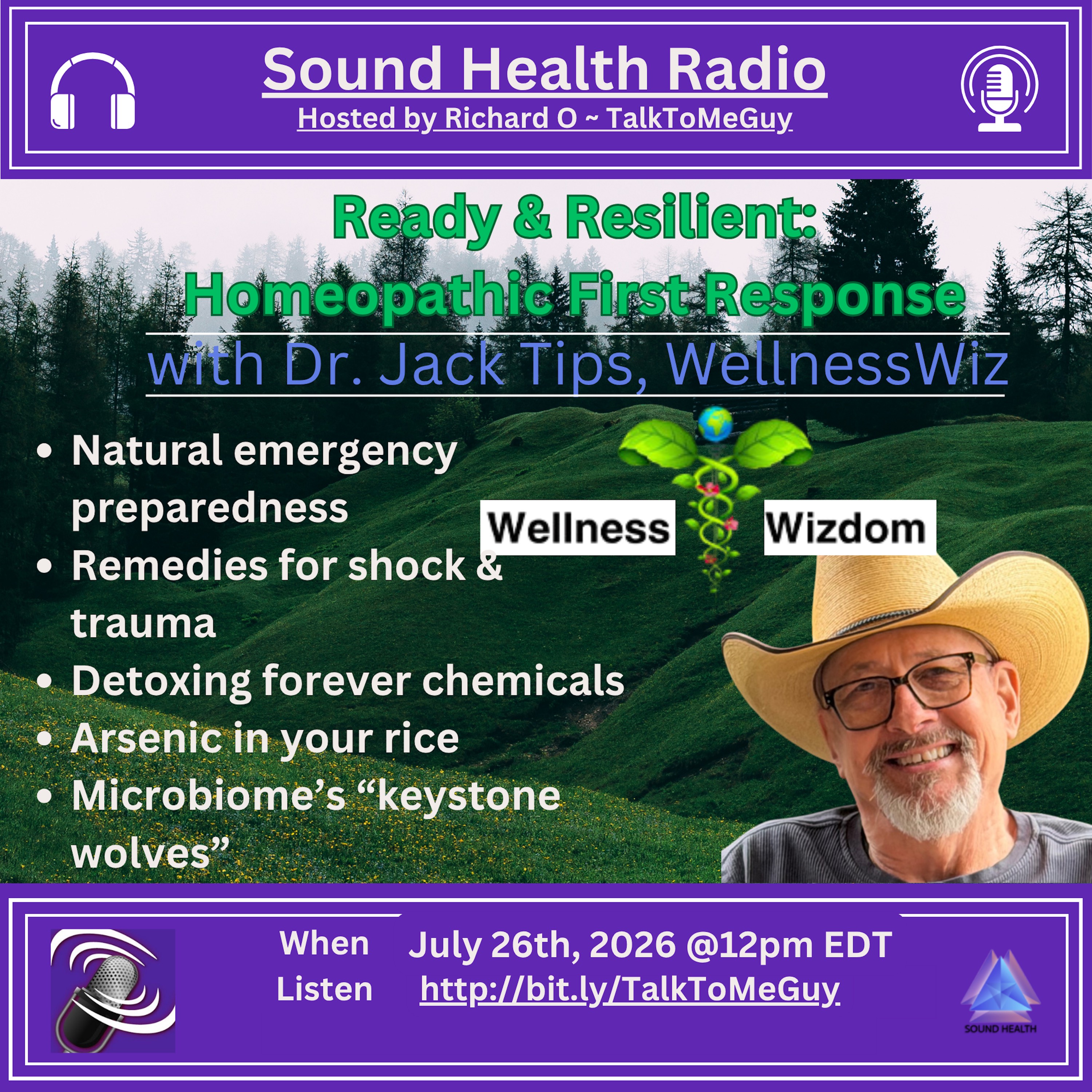
Ready & Resilient: Homeopathic First Response

 PocketCasts
 Apple Podcasts
 Goodpods
 Audible
 Overcast
 Castro
 RSS Feed
 I'm pleased to introduce a guest who's been charting his own course in natural health for over four decades.
Dr. Jack Tips is a board-certified Naturopathic Physician, a Ph.D. in Nutrition Science, and the author of sixteen books, including the foundational work "The Pro-Vita! Plan For Optimal Nutrition." He lectures at naturopathic and chiropractic colleges worldwide, serves on the advisory board of the International and American Associations of Clinical Nutritionists, and maintains a clinical practice built on three pillars: classical homeopathy, systemic herbology, and clinical nutrition.
But what really defines Jack’s work is something deeper. He speaks of natural health practitioners as those who "march to different drummer" - often applying scientific insights decades before they're embraced by mainstream medicine. His approach weaves together diet, herbs, exercise, rest, and the skilled touch of natural health practice into what he calls "the mosaic of natural health training."
And through it all, there's a golden thread that guides everything: "What helps the body function in optimal health?" It's a question of both head and heart, where science meets wisdom, and grace shows the way.
Jack Tips Ph.D., C.C.N.
For information on the Homeopathic Kits contact Jack - jack@wellnesswiz.com
Jack Tips articles
Cruciferous Vampire Slayers Defend the Colon
•Please sign up for the email list for future notifications•
If you would like help starting your own show or podcast, as well as help selecting a microphone and setup for your voice; Please tap the microphone and leave me a message with your contact information and I will get back to you.
Or you can email talktomeguy@gmail.com
More information at: SoundHealthOptions.com
TalkToMeGuy: Greetings everyone. This is the Sound Health Radio Show where we talk about the crossroads of the environment, our health and longevity with Richard TalkToMe Guy. And Sherry Edwards is off working on the Sound Health Portal. I would suggest going to the soundhealth portal.com, scrolling down just a bit and clicking on the watch how button. You'll see a short video explaining how to record and submit your first recording.
Then go back to Soundhealth Portal.com, scroll down to current active campaigns, such as cellular inflammation, biodiet, neuroplasticity, or memory, and choose one that is of interest for you. Click on that campaign and click free voice analysis, and the system will walk you through submitting your recording. You receive an email with your report back usually in one to two hours to hear and share replays of this show 50 to 60 minutes after you hear the outro music. Go to TalkToMeGuy.com, scroll down that page, and you'll see this show at the top of the episodes page. There are also hundreds of shows available there as well. There's a microphone icon at the bottom right corner of all the show notes.
If you would like to leave me a voice message with a question for a guest or a guest idea for a show, you can do that directly from the site, and I will be notified. With that.
TalkToMeGuy: I'm pleased to introduce a guest who's been charting his own course in natural health for over four decades. Dr. Jack Tipps is a board certified naturopathic physician, a PhD in nutrition science, and the author of 16 books, including the foundational work to provide a plan for optimal nutrition. His lectures at Naturopathic and Chiropractic Colleges worldwide serves on the advisory board of the International and American Associations of Clinical Nutritionists and maintains a clinical practice built on three pillars: classical homeopathy, systemic herbology, and clinical nutrition. But really defines Jack's work is something deeper. He speaks of natural health practitioners as those who march to a different drummer, often applying scientific insights decades before they're embraced by mainstream medicine. His approach weaves together diet, herbs, exercise, rest, and the skilled touch of a natural health practice into what he calls the mosaic of natural health training. And through it all, there's a golden thread that guides everything. What helps the body function in optimal health? It's a question of both head and heart, where science meets wisdom and grace shows the way. Welcome, Jack.
Dr Jack Tips: Holy cow, Richard, thank you. And of course, I am elated, excited, ecstatic, even to get to share and match our wits a little bit as we have such a deep sympathique. And I want to thank you for the kind uh four decades mention. Um, five and a half is probably a little more we don't want to scare people. Actual uh, but four is probably more in tune with my my biological age.
Uh so we'll we'll we'll go with that. But um, you know, I figure if you're really the old guy and you know, struggling to thumb my cell phone and install the latest update on my computer and uh try to diss somebody on social media or whatever, and I'm I'm not really engaged in all that. I would hope that I could sit on a little tiny dais and say, well, I've lasted this long. Um I know a thing or two. I've been down the road, I've been around the block a few times, orbited the sun, you know, uh, gosh, you know, it's someday uh a hundred times, uh, and that sort of thing. And um, maybe there's something worthy um in um in what uh the older generation uh uh can bring forth uh throughout the history of humanity. There's always been a respect, you know, for elders, but I I found recently um a grand child was driving me to go see my brother out in the tumbleweeds of Texas, and we actually got talking about um maybe um euthanasia for older people because they're they're done and the world's busy and the food is short.
And let's make room uh for the new. And uh, you know, I was thinking, yay, somebody, you know, I'm not who am I sitting with here? But he's it's very interesting because I I have a sounding board um to the 19 year old uh life experience as well as having uh children, uh, which would now be the 40-year-old life experience, and then what's left of my peer group.
Um, I think there's only two from my high school graduating class still uh out there kicking around. But um as we bring this the older perspective, at least we can weigh it because I'll be jumping up and down, pulling my well, I don't have hair, but uh pulling my hair out when I see um something in the media that's making the same mistake. Um, you know, we should have known, we should have known why are we advancing in this direction? And uh we start feeling like, and I know you feel this way, Richard, um, that we can be a candle under a bushel, we can be a voice in the wilderness. So for Jim and Philip and Laura and Elizabeth and all the gang that uh find such great value in your your show, a hearty welcome. And hey, what would you like to chat about today? Well, I want to jump to uh
TalkToMeGuy : we're gonna talk, we're gonna talk about a number of things. I I really gathered us together because well, I'll I'll say it this way. I've had a go bag in my trunk since the 70s. I grew up in California, I've always lived in California, and the go bag is was predominantly for earthquakes. Now California has also become a place that's from time to time gets set on fire somewhere or another.
And I've lived I've lived through both. I I live uh a mile and a half from where the end of the big Sonoma County fire was uh more years ago than I can remember at this moment, uh, next to the coffee park fire, where approximately 1200 homes burned down because the fire went 40 miles from Napa all the way to Santa Rosa, uh, you know, literally traveled that distance, jumped a six-lane free line freeway, landed in coffee park and just like flashed right down that hole of development. So almost 1200 homes burned. So I went from having a go bag in my car for earthquakes, and a go bag means that you might have like an emergency foil wrap in case you have to sleep in your car, because there are times when earthquakes have occurred and knocked out when I lived in Carmel, knocked out a bridge that allowed people either to get up the coast or down the coast completely.
The main highway one bridge would go out, like would fall off its tiers because the earthquake was so strong. So you just grew up in a world of not fear, but being ready in case. So I've always had box water in my car.
I've always had a space blanket in my car. I've always had some, you know, a flashlight with various things, and even maybe nowadays there'd be some kind of device where if I needed to drink stream water, I could pull it through a high pressure filtration device. And I wanted to add to this go bag, talking to you about a homeopathic first response or a kit that I could have in my car or have where I in a place I could grab it if something did happen. So I'd have an emergency first aid or aid kit. handy. Very and I just think the idea of a first aid homeopathic kit is a brilliant thing. So could you talk about the idea of that and maybe some of the substances? I know we I know you and I had backstage talked about a kit that you wanted to get in, but currently these are my words.
It's being held hostage in customs, so we don't have the kits available right now, but they'll be they'll get through. I I feel that I'm burning a candle for that.
Dr Jack Tips: They will get through. Um, I don't we don't know why the kits are being held. Uh they come in frequently. They're made by the B Jane, J A I N Company, uh, big homeopathic, highly respected uh uh group out of New Delhi. And um, it's just a perfect kit. It's got little tiny vials with little tiny pellets, and you have multi multi doses, and there's 60 remedies uh covering uh a wide gamut of as you said, your go bag first aid and the size, it's smaller than a book.
Um five inches by five inches by two inches. So it's something you can toss in a backpack, but it's um a wise thing you're you're talking about. And even uh back in the 1960s, people were using dry ice to store food and seeds.
Uh maybe they last five years, and people always uh concerned about what our decision makers and uh fellow citizens uh might be up to. And old Doc Wheelwright, one of my early uh mentors uh in the eclectic healing world in herbology, he always said um you should always have a pocket knife and a ball of string, a little piece of some string uh on and about your person. And um he did. He could, if you kind of ever ransacked through his pockets, of which he always had many, um, you could find uh a little pocket knife, maybe you know, just two or three inches.
He wasn't trying to do a crocodile dundee thing, and um, or Jim Bowie thing, and um some string tied up. And I see these in uh like the REI stores, they have little, they look like hand grenades, but they're little wraps of nylon, uh, very, very strong uh string. So you could stretch it out and hang food above the ground where you know a marauding bear wouldn't get it. Um, and you know, a knife can be strung onto a stick, and um, if we think about uh thousands of years, how treasured the ability to cut a plant or shape something with a knife, and so those two things uh seem to be prerequisite and immediately put to use um for the old uh go bag. And then the idea of a homeopathic kit means that you have self-sufficiency that you can treat yourself and others for all the common things, whether it's an infected cut, a rash, a swelling, a fever, uh a loose stool, a headache, on and on, all the little um ailments that can happen, uh, a first aid kit like that. And I would I would match that homeopathic kit with uh a first aid kit that you know has the little scissors and gauze and uh you you can have a topical ointment like uh calendula cream or or something, you know, you could have your own little natural health version, um, you know, with band-aids and and help because when we practice the first aid, we don't let things grow into bigger problems. If you just look back and you think that little thorn scratch, you know, run without check will turn into gangrene and and an amputation, you know, and even even that little hangnail um uh can infect and cause something horrible, you know, and you end up with uh uh bacteria that eats away and you know, just all the the horrible things that particularly people in the field of medicine will see and are trained that uh the worst case that can happen uh to human beings.
So a couple little first aid kits like that would mean you're a walking pharmacy, and um so um definitely we'll get these homeopathic kits and I'll I'll let you know um uh as they arrive. Um it's just the best uh ever. Uh every once in a while they'll particularly out of India, the best uh uh kits. Um of the ones in the U.S., they come in big drawers and they get bulky and and and big, you know, blue tubes that have big pellets, and um we're down to uh like I said, a five by five by two inch size and having the grace of autonomy uh for the things as your body starts to express symptoms, uh whether it's a pain or an infection or an ache or uh a wound, you've got the ability to harness your inner resources to make uh a quick and effective repair.
And then that's the internal process. And then of course, we we have a great deal of wisdom from let's say the the more medical uh side of things where you have you know a topical anti infective approach, you put it under a band-aid, you keep it clean, you clean the wound, you have uh a suture. Um, if you have a a nasty cut where you can sew yourself up and you don't, you know, need to leak out.
Um, we have things in the hiking world of blood clotting uh chemicals and and things like that, and all these things can be packed very small in just a compartment of a backpack, and um give you that self-responsibility um and self-doctoring that you are your own uh first aid chest as you find that you need to bug out in an earthquake or mudslide or forest fire and the things that happen. My only other thought on this is more, you know, let's jump into the the philosophical when you mentioned oh, you've endured forest fires, you've um endured probably uh you know the floods that come after forest fires, and you know, certainly down here in Texas, we've been in the news for the last two years with devastating floods, which are very, very typical of Texas. So again, my hair gets pulled out when I hear the Guadalupe River uh just swept 131 little girls away uh to their death. And I'm thinking, you know, this happens every 50 years, and then there's a 20 year flood, and you know, I know where a Volkswagen beetle is 40 feet up in a cypress tree, and that's how high the water was.
And wow, it's the way the terrain is. So, you know, knowledge is power, and I don't understand the flaw in humans why they didn't have the alarm system working, because um we know that river is gonna flood, it's gonna flood again, and that's nature's way, and we all love to be by the river and you know, go swim and go caught ad fishing uh and enjoy the river. But when those sirens go off and those flash floods come in Texas, you're talking a wall of water um and uh a normal natural process. But anyway, um my thoughts often turn toward well, we live on a rough planet. We have volcanoes, uh earthquakes, uh tsunamis. We have we have plenty of things that bring heartache and pain and suffering and you know, marauding animals and vipers and just on and on, you know, we um are guests in an ecosystem that can treat us very, very rudely.
So why, as we as a species, do we have ingrained that we want to hurt other people? You know, I'm I'm talking corporate world. I'm gonna crush it, I'm gonna crush that guy. I'm gonna beat the competition.
I'm going to, you know, I'm gonna put them down. And uh and we carry that on through into military uh engagements, which in the history of humanity has always been a struggle for uh repro reproductive vessels. Uh I know that was a rude thing to say about the females of the species, but men go to war, they and they're going for food, shelter, uh, goods and and reproductive rights, uh, which is just fundamental uh to human survival. But we we're a species that inflicts so much more pain on each other as if nature wasn't making life hard enough. So, you know, may what everybody could have their homeopathy kit and bug out bag and learn to get along, it would uh we would have such a a different life experience in store uh for our children, but you're you're very, very smart to what do they say, um expect the worst, uh live the best and expect the worst or something, and it's just a matter of the old Boy Scout motto of be prepared and uh that that preparation is uh so vitally important to fundamental human survival.
TalkToMeGuy : Well, even with my go bag uh in the trunk of the car down through the years, that we might just be out. I've done a do a lot of photography and always have. And you know, just being out and forgetting to bring your water bottle or something. So to be able to reach in the trunk and grab a boxed water, which is not my favorite, it's probably lined with something I don't like, but it's there and it's clean and it's drinkable, just to have that with you, and then you just replace it. It's really a handy thing until you throw it as a dirty straw.
Dr Jack Tips: So yeah, exactly. You can drink out of uh a stream or um a swimming pool or something.
Dr Jack Tips: Yeah. Uh yeah, I have.
TalkToMeGuy : I mean, I've literally, you know, Carmel was the worst. Uh, I lived through most of the big quakes there. Although I've I live in Northern California, about five miles from the San Andreas Fault. So I've been through some big quakes up here as well, but not where I've seen things knocked over. I've lived through the you know, earthquakes where the downtown Santa Cruz area was just demolished and been without power for 12 days. That's a whole other thing in the bag. Once again, flashlights, backup lights, just really what seemed to be dumb stuff, really simple. But when you need it, wow, is it nice to have?
Dr Jack Tips: Yeah, solar battery charger. Yeah. I made it through the 1975 Guatemalan earthquake, and it's quite a phenomenon, the old Terremoto. Yeah. One minute I'm standing talking to someone. Uh the next split second, I'm 12 feet away. And the next second I'm back talking to them again. The ground shifted, but that shift, you go, okay, I was out in an open field, but all around uh the roofs come down on people.
Yeah. And um, and then you can, if you're blessed to be unscathed, then you can help other people. Um, and you have your kit, and you could give instant uh support to someone if they had a broken limb, right? A deep cut.
TalkToMeGuy : So and is there a is there a sort of a not one size fits all, but a general homeopathic that you might suggest for I'll call it trauma, but I a little less than trauma, more like shock. Because there's a lot of that, again, having been through a number of earthquakes, you'll you know, I'll tell you one of the worst places to be is for in an earthquake is a grocery store because everything flying off the shelves can be quite hazardous, but you just don't think about it until you've been in that.
Dr Jack Tips: Well, I'll tell you what's on those shelves is hazardous before it flies off.
TalkToMeGuy : Well, that's a different show. That's all right. Yeah. I prefer my produce. Yeah, once again from the farmer's market.
Dr Jack Tips: But is there a tony the figure just beamed you on the head?
TalkToMeGuy : Oh, those deadly flakes.
Dr Jack Tips: Um both are in the kit and both are things you grab immediately. Um, when you said uh for the shock and uh you see glazed deer in the headlights, look uh dilated pupils. Um, the remedy is called acinite. Um, and acinite is the monkshood herb and it grows at very, very high elevation. And it's it, of course, like all homeopathic medicines for people that don't know this, they're they all need to be toxic in the sense that they poison you in the physical herb, but when you sublimate it through the homeopathic process, and you're diluting it and diluting it, and of course, you have to succuss and and have the energy, and people go, Well, that's a game.
Why am I pounding this bottle or something? But if you just would think of metallurgy where you see the blacksmith making the the super cool uh, you know, Japanese sword that's super sharp, but he's pounding the heck out of it with a hammer while it's red hot, and he's aligning the molecules to a purpose, and he's getting the the attention and the flexibility in that steel and the ability to hold that edge. And it's very similar in homeopathic medicine. The remedies uh start with these names like acinite, which if you were to look it up on the internet, it would go poison, don't ever eat it, the monkshood.
Um, and but what we know from that poison is it causes uh the body to go into uh kind of a wide-eyed fight or flight uh uh shock uh that you might experience if you had a high fever, if you had a terrible fright, um uh and had the mental uh disturbance, what you call the PTSD uh in the military, uh shell shock and all of that. And so aconite becomes a beautiful healer once it's gone through the homeopathic process, which is grinding it and diluting and diluting and succussing, which is the hammering, you might say, dilution succession, dilution secussion, and now you end up with that done 30 times, and and modern science will say, Well, there's nothing in there, it's gone past what's called Avogadro's number. There's no molecule of aconite that we can even find in that pellet, but that that pellet is now programmed and it's aligned like that fine steel.
And when you put that pellet under your tongue, it imparts that energy frequency. It imparts that alignment and goes, oh, uh, you're suffering from uh the after effects of fright and shock, and you've seen horrible things, and your your home is disappeared, and your life is torn up on end, and now your system has reacted with uh let's say mild or even severe shock. And uh you take that aconite because that plant already learned the lesson.
It's already been up there at uh eight or 10,000 feet and the severe rain and ice storms, and it's been in the high wind, and and that plant has learned how to thrive and survive in a very, very hostile, shocking environment. And so now you take that alignment safely in that pellet of homeopathic medicine, and it helps your body say, okay, I've had a shocking experience, but now I want to reset. I need to get back to my survival.
I need to get back to my normal metabolic processes. So aconite is your hero. And then for all the bruising, and you go, oh, I'm that fell down on my arm, and I have this horrible bruise. Uh, that's the old famous homeopathic remedy, arnica, which uh is short for the Arnica Montana, the the plant. And again, Arnica is a plant that you don't want to uh take inside as uh as an herb. These are therapeutic herbs, they will cause symptoms. But we know when we dilute and turn Arnica into a beautiful homeopathic medicine that it helps resolve the the trauma, the bruising.
And so um it would be the if I'm on the sidelines of uh the new NFL season, I would just be handing out Arnica like candy uh to the players who are getting all bashed around and um and so forth because that's going to be our number one remedy. So you see, a person with a kit, and I I do add I like the 60 uh kit because not only is it tiny, but most people are going around with 12 or 15 remedies and and the perfect remedy that you need for whatever happens is of course going to be under the rule of Murphy's law, and it'll be that's the one I don't have, you know. Um, so when I get kits out to people, I want them uh to not only have what's needed, but a lot of times uh, you know, patients call me and go, oh, this has happened.
And I'll go, well, thank goodness you've got the kit, and you've got the kit that has uh the larger number of remedies in it, and you're gonna have what we need. And so, you know, little little Tommy has a really bad ear infection, and he's crying, and he's capricious and he's uh in pain, and he's getting red faced and everybody's worried and the fever's climbing, and you go, hey, grab the chamomelia. Um, and you're probably familiar with that word because it comes from the chamomile plant. And we uh we do drink that as a soothing tea in the evening. But if you take the chamomile um and you you take it in large quantities regularly, you will develop similar suffering, similar symptoms. It's a therapeutic herb.
We can use it on the lower end of the scale. Sure, we can have a cup of uh, you know, chimomile tea, but we also know when that earache and that fever and that grumpiness and crankiness and capriciousness, and the child says, pick me up, pick me up, and no, no, no, put me down. Uh, and um has certain behaviors we know, and you you would look in your book that you would have your little thin pamphlet that would come with a kit, and you go, Oh, this is the remedy I want. I don't want, let's say belladonna, I don't want capsicum uh at this. Uh, he's fitting the portrait of chamomile. Um, and it's getting on my nerves, by the way. That's another uh when you say uh children, children are getting on your nerves because they're being annoying. Uh they're usually in a in a chamomile state of being. Can't help it, they're not doing it on purpose, they're reacting to their environment, their internal pain, their angst, um, and all.
And we go, ah, there's the portrait here. Take this little remedy, and the pellets go under the tongue, and literally you can sometimes watch it unfold. I love the case in the clinic when the child came in for the ear infection, uh, ear concerned, and the tympanic membrane is bulging a little bit, and they're crying and the ears red, and um, but then it's like, okay, we're gonna give you this sweet yummy uh remedy, and it's gonna help make you all better.
And that kid tried to bite me and clamp that jaw down where I'm not gonna take it, and all these obstinates and and so forth. So I went to an alternative method to deliver the remedy, which was called old faction. Um, and basically what I did is I took a liquid version of the remedy and in the palm of my hand and blew it in her face, where she got it in her nasal membranes and got it on her lips. And but what was so funny is within two minutes that child was sleeping like an angel right there on in the clinic. Um, so fun little story.
Remember, I remember that now for 30 years. This child or you would just want to uh stick an old tennis sock in their mouth and you know, lock them in a closet, being so incorrigible, and but that wasn't who that child really is. That child is reacting to fear and pain and uh you know, a lot of you know, psychological, mental um, emotional, and the insult of a pain deep in the head, and just to see a remedy work like that, um you know, definitely gets you locked in, and you know the efficacy of homeopathy, and it doesn't matter how many uh ignoramuses want to say, Oh, there's no scientific proof. Um, well, there is scientific proof, and then there's also uh what we see in front of our eyes or evidence-based uh proof.
TalkToMeGuy : And the first time you see the first time I saw homeopathy work was kind of the situation you're talking, it was a fussy child. And I was hanging out with somebody who was studying homeopathy, and they did something like what you talked about either blew it in her face, it was not a you know, they gave them a lozenge to fake getting the homeopathy into them or drop, put them drops in.
I can't remember, it was decades ago. Cool, but it was I don't like I don't want to use the word miraculous, but it seems miraculous because it's just causes a transformation. Sometimes the body just takes it on when the body takes it on, it's really amazing at the very beneficial results so quickly. Well, the body Go ahead. go ahead.
Dr Jack Tips: Thank you. I needed that information. Now I know what to do.
TalkToMeGuy : Yeah, and I just And oh wow, I'm better now. Whoa, cool.
Dr Jack Tips: I wouldn't want to set an expectation that everything has to happen miraculously or in the twinkling of an eye with homeopathy. And it's often that the more severe the symptoms and the ailment, the the more quickly the body will respond because the the person is suffering uh to such an extreme on the bell curve that then the remedy comes and it's just an immediate soothing bomb. But you might say, well, somebody else could be in uh not quite such dire uh deep uh energetic disturbance, and so now they have the ear and the behaviors enough to match uh chamomile, let's say, in our in our case, but now they they take a dose and maybe 30, 40 minutes later they're better, and then they take another dose and they work it on an acute um uh prescribing. Uh yeah, even this year we had uh somebody visiting uh my daughter brought one of her good friends over to sit around on the the back porch and enjoy the Texas spring, and she goes into a migraine, and you could just watch this girl fade, um Pay a pale skin, uh some sweating, uh, and uh it's like a spike driven right in between her eyes, and uh that happens to be the keynote of a very rare remedy and being a homeopath, it would not be in the kit. Like I said, it's very rare, but uh of course it's something I have in my uh pharmacy along with uh maybe four to four thousand other remedies and potencies. But I went and got that remedy and gave it to her, and um, she just sat uh she wanted to go in where it was quiet and darker, and she just went and sat on the couch for 20 minutes, and I visited with her husband out on the porch and learned about him and his work and things, and all of a sudden we look up, and that girl's out in the pool jumping around, you know how they do what I don't know what they do.
You get on somebody's shoulders and try to push other people over. She's just out there um having a ball. And I I looked at the husband and I said, Does she typically get over a migraine? He goes, No, no, she's down for two or three days.
And I go, I wonder what happened. Um again, um the right remedy and the right potency at the right time is uh an incredible, incredible blessing. Um And if I could go ahead and maybe stick my statements into the superlative, um, it's really the pinnacle of treatment for the human body under it would be herbology, and certainly acupuncture is well respected and moving energy and acupuncture relies a lot on herbology, and we have clinical nutrition, which is a lot of my training, um, where we know we can use nutrients, uh, you know, things like coenzyme Q10 or inosicine and different things that we can give the body the raw materials it needs to uh to make changes as well.
But when I look at what uh that girl would was doing uh medically with a suppressive drug that could never cure and it didn't cure, and now she's five years into this migraine pattern and um you know suffering, and despite the fact that she would you know, working with suppressive medicine, nothing was curing, and I think what happened to the human psyche that we don't first seek the cure. Why do we seek palliation, amelioration? Why do we seek maintenance? Why do we seek preventing progression of an existing degree uh disease? Because within each of our bodies is the lineage, the the genes, the history of the body wants to cure itself, and it can't, it's blocked, something's happened. There's a toxin, there's an emotional shock, uh there's a mental attitude that develops that alters the the joy in a person or something.
You know, life has got the boxing gloves on, and it's throwing punches at us every step of our lives, and when we can't adapt to that on planet earth, we can start developing symptoms. But within the body, it wants to heal itself and it's begging, show me what to do. So sometimes uh acupuncture, moving energy, uh releasing congestion, right? The one cause of all disease is congestion, the one cure is circulation, an old Chinese aphorism. Uh, and so we have the the Chinese medicine people genuinely helping people have better lives. Uh, maybe it's uh build up of uh you know, lactic acid and stresses, and we find the beauty of the massage therapist and lymphatic drainage. Uh, we go on up the the ladder, we have uh diet, we have herbs, uh herbs have been our magic healers for uh millennial, uh, you know, for hundreds of thousands of years, and because they grow in nature, as we have to grow in nature, and they adapt to niches, they adapt to survival, they know what it is to suffer the hot sun, the cold wind, uh, the the dryness, the microorganisms that infect us from the soil uh and the air, and they already have adapted, and then when we use those herbs, they help our bodies adapt to the the stress. So we have this beautiful practice of herbology um that uh now is so denigrated and uh the big pharma puts out a lot of uh I'm calling them bogus studies uh where they concentrate one ingredient in an herb, ram it in high, high potencies into a person, and they go, Oh, look at all the side effects. But the the wonderful thing is oh, you can't do that when you're pregnant, you can't do that if you're you know, oh, you know, go look for a horribly toxic drug, and we'll pretend with our heads in the sand that that's okay.
Then um, and then we come on up, and what are we doing? We're sublimating the energies within plants and minerals and even some animal substances, it's the all of nature is available to the homeopath, and things that would cause symptoms in a healthy person tells us exactly what that remedy can cure when it's brought into its energetic imprint and given as a remedy, and and so the the healers are all around us, and then we have uh the the deep fear of pharma, and they're they're literally millions and millions of dollars spent to put down homeopathy, um, because why? Because it's a genuine threat when you heal somebody, they don't need drugs anymore, and it cuts off the Chaching cash register when you know, with the lady that visited, and now she doesn't need the drug for migraine, she can take a what she just took a uh potency a little bit higher than the acute remedy given her. And uh I asked my daughter now that it's been uh some six months later, and uh oh no, she hasn't had any headaches, and I go, yeah, see uh the the remedy gave the information to her vital force to cure what was out of balance, and then the body moves to do that, and that's the model.
And again, you have to have the right remedy and the right potency, therefore you have to have the right homeopath and the right insight and the right understanding, and it's a whole lot more personalized than oh, you have an ear infection, take an antibiotic. Right.
TalkToMeGuy : And I I've for a long time, I mean, you and I have been talking for more than 10 years, which is shocking. Um celebrate. And I've maintained for a long time that given the opportunity or homeopathic, insert homeopathic there, uh, given the opportunity, the body will heal itself. And I believe that's true. It may as you say it may be acupuncture, it may be homeopathy, it may be herbs, it may be sound work, it may be, it could be any number of things. But I think the body is really striving toward homeostasis or balance, and perhaps that homeopathic that you gave her for her migraine was just the thing that her body was looking for. And it was like bang, and it's like, oh my God, I'm better now.
Dr Jack Tips: Yeah, I know the way. And I can now now for the next weeks, maybe adjusting metabolic processes, maybe adjusting how uh nitric oxide works, um uh vascular constriction, vascular relaxation. Um, you know, and the body knows what to do, and now that it knows, it will do it, and it works behind the scenes, and now the body is more adaptable. It's really really just about adaptability to the literally thousands of influences in our lives that can dysregulate us according to our genes, our epigenetics. Um, it's a multifaceted uh arena, health and adaptability is, and we challenge ourselves, and I think inevitably maybe you might say the role of life um is to challenge us, and there are those that will seek the solution, and those that will what you say, cowtow down or acquiesce and just look at palliation. I I think we might all do that. You know, I wear glasses, and I remember the day that I made the decision because there was so much going on in my life and hardship that I said, I'm just not good for the fight.
I don't want to have to capitalize on my diet, I don't want to be taking remedies, I don't want to, you know, luteen or everything that science could show. And I said, you know what, all I need to do is get these little grocery store magnifiers, and I can see the computer. And of course, um, you know me, uh Mr. Geek. I'm looking at the computer late at night and using my eyes, but I started going down the the crutch road, and that's what eyeglasses do, their crutches. Instead of when we find people like uh what is the Alexander uh or Bates, the Bates method, and people show us how to restore our vision when it starts to struggle. I had other struggles, and I said I can't deal with everything. So I ended up now, I'm um a person who wears glasses, and um, but I real I realize that that was a giving up. So I'm I'm I'm not I don't want to sit in judgment on any of this because we all have our lessons and we all have our, you know, you know, you have to say that old aphorism, you know, you need to walk a mile in somebody else's moccasins and that sort of thing. So you find the homeopaths are very non-judgmental, but we're looking at the body's struggle, knowing the body wants to correct it.
And a lot of times, um, you know, in the high high 90s percent, it will. And and why do I not want to present it as a slam dunk? Because some people do have those genetic defects, you know. We've seen, you know, uh a little baby that's born without an arm isn't going to be like a starfish and grow an arm because we give them a remedy. So there are uh limitations, and I try to be very, very accurate in information. Um, and we have to wonder what what is the blockage, and sometimes in homeopathic treatment, uh, let's say that migraine remedy, let's say, oh, it's a well-indicated remedy, but it didn't work, and then you realize well, the girl has emotional issues and has been abused, or uh deeper the the person has uh a deep deep mistrust because maybe she was locked in the closet as a child. And and so we do uh very quickly have to acknowledge that our physical manifestations uh and what we experience in life comes from our attitude and comes from our emotions and that that give texture to our thoughts and and that it's our our thinking, which was often programmed by parents in the first few years of life, but there can be flaws in these systems, and then 20 years later, that flaw finally, you know, like an occlusion in a diamond, it it shows up. And so um the homeopath may need to say, okay, um, we have to look at constitutional treatment. And you and I have been talking, Richard, about uh first aid, and um what we can call clinical homeopathy. Oh, your pop concern today is a headache.
Let me give you a remedy that matches your headache symptoms, versus constitutional, where we really have to understand the person, their struggles, what it is to walk in their shoes, you know, why they're seeking the solace of alcohol, or why they're seeking uh medications, or why they're grumpy, or why they're misogynistic, or you know, because there's experiences that that drive people that way, and then the remedy that fits uh the more the totality of the person can be chosen, and that's a lifting up of the bootstraps for the whole innate vitality and can set off a cascade of many, many metabolic uh changes, and then we suddenly see as a side effect of that. Oh, now their bowels are more regular. Now they're not sweating during sleep. Now the menstrual cycle is all balanced and working the way nature intended. So I'm pointing out there's different types of homeopathy and and and different focuses that different practitioners have gifts for and are trained in.
TalkToMeGuy : But yeah, that's the way I I have somebody in chat who's asking, and this could be a large chunk, but I'm gonna try and not have it be that. Is there a homeopathic remedy for GERD? Oh, yeah.
Dr Jack Tips: Um, and we look at the reflux um remedies, but remember the remedy is gonna have to cure the cause. Is the cause of hyatic hernia? That's a little bit of an uphill thing because the body needs a physical manipulation. Um is the uh the esophage esophagus, how's it is it damaged by the stomach acids, or the lungs being damaged by breathing in atomized pepsin? Um, and so with the the GERD remedies, I'm gonna say if if someone talks to a homeopath, I'm looking at predominantly 15 remedies that have excelled and shown time and again they will help the body heal um things like esophageal reflux and if they have you know H. pylori uh eroding in the stomach, the body needs to fix that. The body needs to fix the cause. And so uh by understanding the symptoms, the remedy is selected, and then the person can start their remedial thing. Here's the question.
Um will ask, did you have did a person have GERD at age three or age five? And they go, no. And so we say, okay, in the road of your life, you acquired this physiological response. And um now your body for some reason is rejecting what's put in the stomach, uh, or rejecting the acid balance. And we can blame it on a like H. pylori, helicobacter pyloria, a bacteria. We can blame it on SIBO further downstream, uh, the small intestines uh becoming deranged with overgrowth of even probiotic species. Uh we can stay right with the stomach and the uh lower esophageal sphincter and say, okay, there's been some erosion there now, things burp up in into the esophagus. And uh, but when we understand the the person and the cause, the the day, what was the day of never well since age five years old, no problema. Uh uh, and if you speak Spanish, the proper phrase is no la problema. But um the uh now we're looking at okay, there was a turning point.
Maybe, maybe not. We are aware of that. Then uh we anyway, the homeopath selects the remedy, and uh oftentimes, since I also can wear a hat of a clinical nutritionist, I might be looking at some keystone probiotic species. I might be looking at soothers, uh, things that are known, healers, anti-inflammatory, uh things that the the person can do, and then we roll up our sleeves and get to work. And if the if there's a hyatic hernia, the the body needs to uh correct that.
And uh otherwise it's just uh the uh the reflux phenomenon uh gone too far. The body's struggling, it says, I'm getting triggered. Um we know it's not the right thing, but the body says, yeah, but I'm protecting you and I'm I'm doing what I'm programmed to do. So we actually inevitably go back and ask the body, would you please correct your epigenetic um RNA transcriptions?
Uh I don't want to get too fancy here. Will you connect, will you correct your acquisition process of acquiring the disease uh based on your genetics? Will you go ahead and correct that and get back to where you used to be? We know at age five, you'd say you didn't have it.
We know you have a baseline where you don't do that. Now, if we understand the cause and the time and progression that's come up into the present moment, we find the the right remedy and administer that, and then we start the body on its healing journey to correct the maybe multiple causes, maybe a single cause, um, and get that corrected. So in the future, uh, hopefully not more than four to six months, uh, the person can say, Oh, I used to have GERD, but now I don't. So we never get a person, let's say if it's you know, the GERD people run into the gluten-free world very quickly. And um, because science has altered our wheat and and and added many, many, many new uh hybridized gluten molecules. A person may not be tooled up uh simply to eat American wheat, and it just may not be in the cards, but gosh, you can go back and get an incorn. Uh, you can get uh other grain if you want to uh keep grain in the diet and not suffer without ever having a piece of bread or a toast.
Um so sometimes there's a negotiation we do with the body, and we we look at you know what can be done or not done. Um knowing the aggravators of GERD, is it dairy? Is it wheat? Is it grains? Is it you know jalapena peppers? Um, and um that all gives information on how to select the remedy. So sorry for going so long, Richard, but the answer is yes. Um, homeopathy uh does very, very well to help people with GERD. Great.
TalkToMeGuy : I want to we're gonna jump here, and this is going to take us a little long. I want to talk about your really great and fun reading substack. It really is. It's like my daily read. You don't write every day, but you write frequently. And I'd almost say, you know, I I enjoy reading you, uh letting your inner Mark Twain out in the best of ways. Because you have a great style the way you express yourself in writing.
I mean, you're a good talker as well, but it's reading, and there's one particular substack I want to oh, and I'll put this in the show notes. Wolves in your belly, and it's such a great story surrounding the wolves, not only at Yellowstone, but just the the, you know, you you open in this with your Yellowstone wolves and starfish and tidal pools. And how does that how does that come together? And so talk to about talk to us about wolves in your belly, please.
Dr Jack Tips: Uh that was um an article, and I was hoping um I I have a bad reputation of my articles being 2,000 words or more, and that takes people 15 minutes. Well, today's people don't have 15 minutes, I find. And so I do endeavor to put uh short postings. My issue with short postings is they're usually useless when I go back and I I've you know, you have to study, and if you're a musician, you're gonna, you know, you're gonna have to listen to the Beatles or something, uh, or Mozart. But um I so I look at the people that are popular and posting, and I thought, well, I read that article.
I don't want to do anything with it. It is just you know, entertaining or whatever. It didn't really, it was shallow. And so I'm I'm known to be a little bit deeper and and and put it all out there. But this was one of my attempts at a short article, which I promised Richard or more, I finally figured out how to do it. And um I'm starting with the next posting, uh, which is about bees, by the way, our friendly honeybees, and um we'll we'll see the the pattern uh of how I'm gonna be able to write important stuff briefly.
It's it's been my big challenge. But anyway, wolves in your belly. Uh no, that's not about for our our GERD uh process that might feel like wolves gnawing in your belly. Um it's it's about keystone species. And um, I was pointing out in that article that the science of probiotics has advanced.
And um, we were talking, I believe, earlier, that um before we started the show, that um most probiotics on the market have been two to four thousand generations in an incubator. They've never known uh the immune system, they've never known stomach acid, they've never known other species that they have to uh compete with, and so there's these little ordinary species that people buy at the store that pass through, they probably don't even germinate and do anything, um, but it's what's being sold. Well, science has been able to um figure out um the keystone species, meaning like the wolf in Yellowstone, without the wolves, the the deer uh overpopulate, they overeat, the rabbits overpopulate, and uh the plants start to die, and the ecological system of Yellowstone starts to collapse when scientists, of course, over literally uh the the farmer, not the farmer, but the the cattle ranchers were going over my dead body. But um uh when they brought the wolves back, they brought the keystone back, and the wolves help maintain both the plants and the animals, and everything lives in harmony and nature flourishes. So we need the wolves in our belly, the keystone species.
And what what makes Keystones unique? Number one, they're human species, not lab rat species. They are um inviters, they work with the commensal species, uh, the ones that your science won't call probiotics yet. They work with your other inhabitants to cultivate a new terrain.
They're terraformers. And so the Keystone species will invite other species to join in, and let's all make these wonderful postbiotic compounds that run your brain and run your thyroid and balance your hormones and uh the molecules that your uh bacteria make and your body uptakes and it helps modulate your immune system so it's not over excited with eczemas and psoriasis and uh autoimmut attacks on your know your thyroid or your joints, and so these are all down to the keystone species. The reason why we haven't had those in the marketplace is because they are greatly insulted by oxygen, they're anaerobes. And when you put a probiotic in a capsule, it's gonna run into the air. You know, there's air inside the bottle, people are gonna open the bottle, and um finally uh science and my friends over at Alamentum Labs in Utah, they figured out uh kind of their secret method of not only growing human-based organisms as keystone species, but being able to preserve them in a capsule so a person can take them, and now you start taking uh a species, uh the next generation of probiotics that go in and do the work. They go in and now you have other uh species join in and they make the postbiotic compounds, and many of them are still transient. Some are made to hopefully take up residency and uh and keep doing this. So um, as of about five years ago, there's been a new thrust in natural health where we can uh majorly rejuvenate the gut microbiome.
And of course, this is important for someone with GERD and um and uh other things, any autoimmune issue. But that's what wolves in your belly is about. It's I cite some of the keystone species. We talk about it from the philosophical point of what happens if the you know, up in your neck of the woods, Richard, and a little bit further north, what if that purple starfish uh goes away because of ocean pollution, and then you have these clams that damage everything, uh take over, see. So the scientists try to, oh, we've lost the purple starfish up there, more up or maybe around Vancouver, and uh they put the purple starfish back, and all of a sudden the ecology, the reef is what was being damaged.
Now the reefs are protected, the ecology is protected. That's keystone. And um, so I'm I'm so thrilled you like that uh Keystone. If someone goes to uh wellness whiz on Substack, um they'll find you know, my little corner where I have 60 articles posted, and you can range from the um you know the clinical nutrition to uh plenty of references to homeopathy, um to the latest probiotic and prebiotic uh research and um I do my best, Richard, to you know, I hope that I wish that uh someone can have a little chuckle or a laugh every time they read an article and that the information is explained very clearly.
I'm I'm my mission is to empower people um to be able to understand the future because the what I've written about is specifically the hot topics. Um of my early articles six months ago was on the fluorocarbons, PFAS, and I did I did tell the the very evil history of DuPont and how they lied and knew that they were poisoning people, but they did it anyway, and and they haven't really been sufficiently punished. Um but they get a pass on that because they make uh military uh stuff too. But now we all have our Teflon skillets, and that's not gone from the market yet. But I see an article every week that PFAS is linked to autism, PFAS is linked to hyperinflammation and children.
PFAS is linked to birth defects, on and on. Well, if someone reads my article, they've got the story. They already know all they need to do is make a decision. Then when we hear these things constantly in the news, we go, oh, I've already mastered that subject.
So I call my substack is imparting mastery. And you go, okay, and I've already taken action. I got rid of my Teflon skillet or my so-called upgraded Teflon skillet that they now sell. It just, you know, they're good up to 500 degrees.
But let me tell you, you can crank a skillet more than 500 degrees. Um and uh on and on it goes. So I'm I'm looking at, I hope uh that you find Richard, and I want to thank you so much for sharing some of the postings with with your good folks. Um, but I'm I'm looking at them being foundationally empowering so we know how to navigate uh our our lives here, and uh it'll help us prepare our bug out bags better if if we know the yeah what we're uh what we're confronting. Um so anyway, thank you uh uh for that.
TalkToMeGuy : Well, the the Yellowstone article, uh sorry, the wolves in your belly article, particularly landed hard with me because I have a friend who's lived and lives at and works at Yellowstone National Park. Wow.
And when they came in, and he's been there for decades. He's a world-renigned uh free hand climber. Wow. Which I think, yeah, exactly, which means he's crazy in my mind.
Dr Jack Tips: Uh but mostly Yeah, completely there must be a remedy for that. That uh so he saw Yellowstone, has seen Yellowstone for decades and knows it just like the back of his hand. And when they initially started taking the wolves out, because somebody thought that was a brilliant idea, and I have so many bad words about this. They took the wolves out of Yellowstone, and what he saw is the imbalanced ecology that then happened. Too many elk, more rodents, you know, all the things that people don't think about, wolves being part of the ecosystem.
Wolves get a bad rap. And so he saw that, he observed that happening, they were trying to figure out what to do. And then this took this is a long, you know, this was a year, many years long stretch of doing this. But then once they brought the wolves back, it all came back into homeostasis because the wolves were again taking care of the rodents, the wolves were also helping manage the elk population, and not in a, you know, this is nature. Nature's tough.
She is not kidding around. But it really did make a huge difference in just bringing the wolves back. It wasn't like they trained me to do anything, it was just part of the natural order of wolves and maintenance field, and now Yellowstone is back in balance. So that's why that substack in particular really landed hard with me because it was like, yeah, I knew the guy. It's an amazing thing.
Dr Jack Tips: And then in our natural health world, we've seen um the massive uh lines. I mean, the lines in front of the gastroenterologist office rival a Taylor Swift concert. And I think, gosh, why are we all belly aching? Does anybody want to talk about the food we're eating? No, uh no, nobody wants to move Tony the tiger into the trash and take minutes more to cook up uh organic oats or something, yeah, or really get down to a farm fresh breakfast and have um, you know, uh poached eggs and uh uh some sauerkraut and some other things that could uh could work so much better uh for a person, but I I wonder how what is this um international blindness? What is where did we lose our logic that if if the lines at the gastroenterologist are expanding, there's a cause. It's not because people are being born wrong, it's obvious. I mean, is it just I feel like it's this would go hit my head against the wall because how can we not say that what else is happened?
We look at uh parallel line graphs, what's gone up, more chemicals in the food, more processing, more agricultural pesticides, um, more uh the processing, the refined uh seed oils, all of these are subjects on the the substack that can clue people right in about the difference between a seed oil and a sunflower seed that I'm feeding the birds in the backyard versus uh highly refined sunflower oil that's uh disruptive to the cell membrane uh and and generates massive inflammation and and can single-handedly be behind uh GERD and uh colitis and other GI disturbances, and then to have the the best and the brightest, the gastroenterologist be totally blind to what is so blatantly obvious. It's there's um it's it's crazy, but it's uh it's a mass hypnosis, I think. Um that um, you know, hopefully something like the Substack can start to um wake up. Um anyway, um that's our role and purpose. I do want to thank you, Richard, for um your show and and getting the word out and helping maintain these threads of the natural health model.
Um, while someone like me, I just stand back slack jawed, you know, with my mouth wide open, trying to keep the flies out, wondering why how we don't see it. I couldn't have predicted 50 years ago in this field that it would not automatically converge with medicine, that medicine would back down out of poisoning people with drugs and want to do more with the bona fide genuine natural health therapies that stand on thousands of years of genetics and practice, and that the natural health people might let go of a few really kind of wacky um biohacks, which I dearly love. I'm um a little bit self-effacing there, but let go of some things that don't stand up, a case in point, you know, people do a gallbladder flush, and then they pass these rocks out and they call it a gallstone, and the thing is like the size of a golf ball. No, that's not a gallstone that passed out, it's a conglomerate of the olive oil you drank and the grapefruit you ate, and you know the uh the process, it's old bile, which is good. It's good to clean out the old bile, but when we call it a gallstone, then we're the laughing stock uh of anyone with science. But then if you look a little closer, you do see some stone, and um and that does happen.
Uh and then natural health people save people's gallbladders. But uh, so it's always trying to move from the assumption and the ignorance. But I thought the two, I actually predicted um without a crystal ball or a deck of cards. I predicted that medicine and natural health, naturopathic medicine uh was going to converge uh because uh acupuncture was getting into the medical offices.
And I thought it's just an it's just a matter of time, you know. A doctor sees acupuncture and herbs work. Um, I've worked out of medical offices with herbs, um, and um it's just a matter of time, and then the pushback and uh dictatorial um, and I guess brainwashing is a fair word, but how do we take the best and the brightest minds and people dedicated to helping other people and pervert them into being drug pushers and you know, handing out VOX and then denying DES and opiates and you know, and now we have to say, where's Prince, where's Tom Petty, where Tom Petty? um Michael Jackson, you know, and we we see it hit so deep and so hard, and um why and and why there wouldn't be that movement to I'm a doctor, I want to correct the cause, not just palliate, ring the register and see the next patient.
So we live in a topsy turvy world, and um you and I are here to to help uh for those that you know they say have ears to hear and eyes to see. Yeah, yeah.
TalkToMeGuy : Um such a pleasure. We could do this for another hour, but we're gonna stop now. I almost brought up PFAS again, but that's a separate show.
Dr Jack Tips: Um I'm all talking, while talking, so That's quite all right.
TalkToMeGuy : Um, that was great, Jack. As always, it's an adventure. And really, I'm I'm gonna put in the show notes uh all the links to the various Substack articles I referred to. I put them here in chat, but I'll also put them in the show notes when the show gets published tomorrow morning.
Dr Jack Tips: Oh, thank you. It uh means a lot to me as uh a writer and and all that. Um there's nothing like having somebody read an article and give you the old thumbs up. So really good.
TalkToMeGuy : Yeah, I recommend his Substack. I I put it in the chat here, but as I say, I'll put it in the show notes because your Substack is always and I and I enjoy it when you let out a little bit of snark, just a little bit. It's always kind, it's always mannerly, but it's just a little bit like meh, which is great because I hope so.
Dr Jack Tips: Thank you. A lot has to be edited out to keep you um I'm out of trouble. All right. Well, thank you very much. Thank you.
TalkToMeGuy : And everybody else have a great rest of the weekend, and we'll see you next week. Bye-bye.
Dr. Jack Tips: Bye bye,