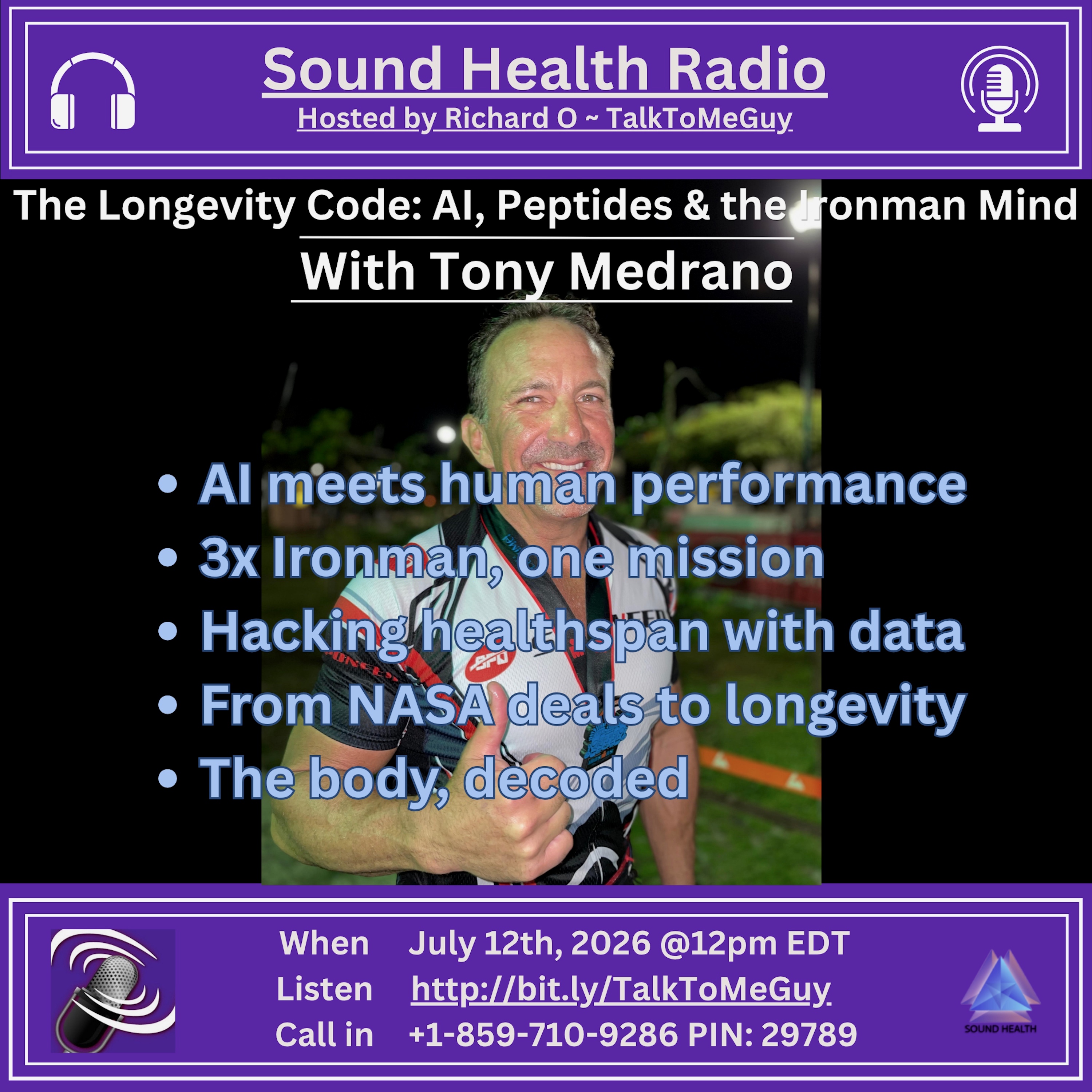
The Longevity Code: AI, Peptides & the Ironman Mind w/ Tony Medrano

 PocketCasts
 Apple Podcasts
 Goodpods
 Audible
 Overcast
 Castro
 RSS Feed
 Before he was optimizing the human body, he was optimizing everybody else's business. Tony Medrano spent years in enterprise sales bringing in half a billion dollars, in deals for NASA, the FBI, the U.S. Olympic Team, Netflix, Google. The kind of client list that doesn't take pitches from just anyone.
Somewhere along the way Harvard, then a law degree and a MBA from Stanford, a stint as a Navy officer, even a year teaching physics in New York City public schools he decided the next frontier wasn't a company. It was the body itself.
So he built LongevityPlan-dot-AI using artificial intelligence to personalize peptide therapy, recovery, and performance planning. And then he did the thing most CEOs never do. He tested it on himself. Six weeks before his first Ironman, a car hit him. Separated shoulder. He did the race anyway swam one-armed, rode a hundred and twelve miles stuck in a single gear. That was Ironman number one. There have been three since.
Today, we are talking about AI, peptides, endurance, and where the line is between hacking your health and actually understanding it.
Tony Medrano. CEO & Founder Longevityplan.ai
What's the Science of Longevity
5 Best Peptides to Treat Inflammation
•Please sign up for the email list for future notifications•
If you would like help starting your own show or podcast, as well as help selecting a microphone and setup for your voice; Please tap the microphone and leave me a message with your contact information and I will get back to you.
Or you can email talktomeguy@gmail.com
More information at: SoundHealthOptions.com
TalkToMeGuy: Greetings everyone. This is the Sound Health Radio Show where we talk about the crosshods of the environment, our health and longevity with Richard TalkToMe Guy. And Sherry Edwards is off working on the Sound Health Portal. I would suggest going to the soundhealth portal.com, scrolling down just a bit and clicking on the watch how button. You'll see a short video explaining how to record and submit your first recording. Then go back to Soundhealth Portal.com, scroll down to current active campaigns, such as cellular inflammation, biodiet, neuroplasticity, or memory, and choose one that is of interest for you. Click on that campaign and click free voice analysis, and the system will walk you through submitting your recording.
You receive an email with your report back, usually in one to two hours. To hear and share replays of this show 50 to 60 minutes after you hear the outro music, go to talk to me guy.com, scroll down that page, and you'll see this show at the top of the episodes page. There are also hundreds of shows available there as well. There is a microphone icon at the bottom right corner of all the show notes.
If you would like to leave me a voice message with a question for a guest or a guest idea for a show, you can do that directly from the site, and I will be notified.
With that. Before he was optimizing the human body, he was optimizing everybody else's business. Tony Madrano spent years at enterprise sales bringing in half a billion dollars in deals for NASA, the FBI, the U.S. Olympic team, Netflix, Google, the kind of client list that doesn't take pitches from just anyone.
Somewhere along the way, Harvard, then a law degree, and an MBA from Stanford, a stint as a Navy officer, he'd been a year teaching physics in New York City public schools. He decided the Next Frontier wasn't a company. It was the body itself. So he built longevityplan.ai using artificial intelligence to personalize peptide therapy, recovery, and performance planning. And then he did the thing most CEOs never do. He tested it on himself. Six weeks before his first Iron Man, a car hit him, leaving him with a separated shoulder. He did the race anyway, swam unarmed, rode 112 miles stuck in a single gear. That was Iron Man number one.
There have been three since. Today we are talking about AI, peptides, endurance, and where the line is between hacking your health and actually understanding it. Welcome, Tony.
Tony Medrano: Thanks, Richard.
It's great to be here. So let's start at the beginning. Well, not the beginning beginning, but the so six weeks before you decide to do an Iron Man, which I think is a stunning idea anyway, to do an Iron Man, you get hit by a car. You get a separated shoulder, thrown over the hood of the car. Then instead of going, maybe I need to rest up and repair. You think, yeah, I'll do an Iron Man now is good, doing the full 140.6 instead of scaling down. Walk me through the moment you decide not to defer doing that. How did that happen?
Tony Medrano: Yeah, uh Richard. Uh I mean, interesting story, right? I was training for my first triathlon ever in 2019, right before COVID. And you know, I had run one marathon before in my life.
I never wasn't I wasn't on the college sports teams. I never clipped into a bicycle before and had never swam competitively before for sure. Uh but I was challenged by a friend who had done 20 Ironmans at the time. And I jumped into committing to a triathlon 12 weeks before. At the six weeks prior to my triathlon date time, I was hit by a car, just like you said. It was a catastrophic injury, you know, life life-threatening accident, but the injury itself was clean in that I separated my shoulder, third degree, meaning my collarbone and my shoulder blade were no longer connected at the top.
They kind of float around. Um, but it didn't break a bone, didn't break the skin, and I still could move. Um so as soon as I was hit by the car, I made it to the expert sports injury therapist, got an MRI, had all the tests done. And the first thing I asked was, hey, can I do an Iron Man that I have scheduled six weeks from now?
He said, and he kind of laughed, but said, you know, maybe I've seen people do it before because he was an expert. Um come in in two weeks and we'll do a strength test. Um so right at that moment, um, I you know, I believe in contingency planning. So I wasn't naive about doing my first triathlon. I had signed up for both a mini triathlon and an iron man.
My stretch goal was the Iron Man. Um, but my cardio was going really well, and uh I was adapting well to three, four, five, six hours of training per day. Um, and when I got hit by the car and knew I would have to figure out a way to hack this with one arm, you know, swimming 2.4 miles in the ocean with one arm is is kind of uh tedious, it's not as efficient as one would like. Um, so I knew it was going to be a challenge, and at that moment is when I committed. It was it was awesome. The obstacles actually made me commit to the full Iron Man, and I loved it. Are you there, Richard? There we go. Sorry.
TalkToMeGuy: I was holding my head thinking there's pain with a separated shoulder, isn't there? I mean, isn't there once it's as it's separated, it's in discomfort and inflamed and painful.
Tony Medrano: Yes, it's inflamed for sure. It's painful to a degree, but not like a broken bone would be painful or like a torn hamstring or a torn Achilles. It um it sounded like a rubber band snapped right by my right ear, which is the the ligaments snapping. Um, and my shoulder hung lower than my left shoulder immediately. So I knew something was was drastically wrong. Um, but it wasn't excruciating pain.
However, you know, that's all relative. I had to train now with uh limited range of motion and some pain. And certainly inflammation was going to be my biggest worry. I already had a torn meniscus on my left knee that I suffered from military service about 30 years ago. Um that kind of got inflamed when I when I ran a lot or did long distance exercise, but it was manageable.
And then, you know, another rotator cuff injury on the other shoulder, standard standard sports guy injuries. I mean, I'm 55 years old, right? This was when I was 48, training for my first triathlon. So yeah, I had a lot of inflammation issues.
TalkToMeGuy: And then in the swimming portion, now I I understand that you had military training, so maybe this affected this. You went side stroke one arm head up the whole way. A technique you credit to the Navy training for silent long distance swimming.
But you swam the entire thing in that position. Was did you did you think you got that from the conditioning as being in the military and doing that? That that seemed like a good idea.
Tony Medrano: I don't know if it seemed like a good idea, but but it did seem possible. So, you know, growing up, I was never on the swim team or anything like that. I'm I'm 5'10, like 200 pounds normally, although I've dropped down to 180 now because of some of the peptide therapy that that I've been going um going through.
It's been awesome. But uh no one would confuse me with with Michael Phelps. However, I learned to swim for we'll call it you know, offshore survival, uh Navy as an avid deep sea fisherman, you know. Um that was my preferred stroke. It's also kind of relaxing if you just swim long distances in a nice warm climate, or you know, if you are in open water, you can swim for 10 or 15 miles, side stroke, and with your head up, you have good visibility, so you can see it's not fast.
But it is for me at least, low energy expenditure. So with six weeks to go, I figured out how to do it fast enough, and I caught myself swimming here in Pacific Beach out in the ocean, just between lifeguard towers, and estimated that yeah, I I can make the two hour, you know, cutoff for the 2.4 miles without a problem. And I actually felt pretty good because I mean, I have a really high VO2 max. I consume a lot of oxygen. Um, and that was my strength going in, as I was trained up cardio. I wasn't skilled, you know, I wasn't skilled in cycling or or swimming. Um, but my lungs were pretty solid. So I was going to take advantage of that and just make it to the swim cutoff. That was my only goal in the swim, not to do it with style. Um, and I don't, to this day, I've never seen anybody that's done it in Sidestroke before. That's amazing.
TalkToMeGuy: That's amazing. And then, and I can really relate to this. We're going to talk about the bicycle portion. I for my earlier years living in Sonoma County, I was a touring cyclist, but not with all the spandex, just a guy who liked to go out and bicycle. And I would practice every morning on rollers for about 45 minutes every morning before I'd go off to I was teaching at Sonoma State. And so I would do that, but on weekends I'd go out and bike 50 to 100 miles through Northern California.
Yeah. So when I read this, this blows my mind that you were stuck in one gear for the total 112 miles. I hope it was a medium high gear. How was that?
Tony Medrano: It was a locally the Cosmel Iron Man is a relatively flat course. Um so what happened was I I had a uh a time trial bike, a standard triathlon bike where you get down an arrow position and lean forward, and the gear changers are out at the tip of your fingers when you're leaning forward. Well, with this injury, I couldn't get in that position. So I couldn't reach the um knobs the knobs to change the gear. And only way I could change a gear was was to stop, get off of the bike, change the gear, cycle the pedal around and get back on. Um, I did do that like I think three times because there was three laps and there was a hill. So when I saw the hill, I was oh, okay, it's time to go to the bathroom. Let me go to the bathroom, cycle the gear, go up the hill, and then now I'm in the other gear. So I had to get back. Um it was again the most inefficient thing ever. And um certainly burned a lot of extra matches from my perspective, not being a cyclist either.
Yeah. I did this sort of last minute, which I would not recommend to anybody. The the first time I rode my bike was the day before the Iron Man on the practice course. I had it shipped directly out because I I knew that I was in good enough shape to do it. So I had the bike shipped out, and while the bike was being shipped, I I rented a similar bike around San Diego and trained at Fiesta Island, which is a good, you know, Ironman slash Olympic bike training track outdoors.
Um I was confident in my in my cardio, not in my bike skills, and certainly I was gunshot after being hit by a car. So um, you know, the the happiest time in my Iron Man uh career, which is you know, three successful ones and one DNF in Brazil, um, is handing that bike off at the end of my first Iron Man bike leg, where the sun was just setting. Um, and I knew that uh, you know, the cutoff was soon. And later did I find out I made the cutoff by like five minutes. Um wow.
So it was great. I made the cutoff, and then um, you know, again, nobody knows your struggles really in the Iron Man because you're sort of alone. There's uh for me at least, there was what I call the grim reaper, who is a guy on a motor scooter uh who's following the last person in line.
And if this Iron Man, uh, because I got out of the swim so late and I was not a fast cyclist, the grim reaper was right right behind me. Um at first I didn't know who he was or what his role was. I thought, oh, this is nice.
This gentleman knows my name, and he's really friendly, you know, great. I'm getting VIP service. And then I realized, oh, I'm last.
Um I better pick it up because I just don't, I don't want that, I don't want that vibe next to me. So after about halfway through the bike leg, um, and this is well, you know, in one gear, right? I I just skipped a couple um stops uh stops and kept on biking and made sure that somebody else was last, not me. So I did pick it up a little bit towards the second half. I think my my second half uh the bike was faster than my first, which is good.
TalkToMeGuy: Wow, amazing. All with a bad shoulder.
Tony Medrano: Yeah, I had to keep my arm locked um just for fear of it folding. Yeah, yeah.
TalkToMeGuy: And would you say, uh, I don't have this uh as a note, but it just comes to mind. Would you say would you think that your friends would define you as a wall head? I mean, in the sense of determined, I'm going to do this.
Tony Medrano: Yeah, it's a good question. Um, certainly in some circumstances, yes, but not randomly, not in an OCD manner about everything. I'm not, you know, stubborn, I would say. I am determined, and I do need a challenge.
So, you know, I think the the best thing, you know, best in quotation marks. The best thing that happened to me for my Iron Man career was getting hit by that car, because it gave me an obstacle to overcome to actually complete a full Iron Man. Otherwise, I probably would have been reasonable and done a mini triathlon and then worked my way up to an Olympic distance, and then maybe a half Iron Man.
And maybe by then I would have gotten tired of the whole triathlon thing and all the gear and stuff. Yeah. So jumping right in was great. I like, you know, overcame an unbelievable situation, finished, and then finished my next two, and you know, PR'd in my third one in Australia, um, training for my um, you know, to hopefully successfully complete my fourth one uh this November. Wow. Wow.
TalkToMeGuy: Well, you your initial uh action for the Iron Man was that you were going through a divorce. Yeah. And you at the time thought that this was a way of, I would say, distracting yourself from the potential depression or you know, just getting out. I I always liked exercise because it gets me out of my head.
Exactly. And I think this is a great, you know, like I say, I used to be more of a just regular cyclist out in the world. And I've always liked that, or even when I was uh in a different world of being a chef, my after hours, I would go and pump iron at the gym. And I wasn't trying to be Arnold Schwarzenegger. I was just out, I it was getting me out of my head and into my body, which I think is beneficial.
Tony Medrano: Yeah, exactly. I I really enjoyed that. Um, you know, that's one of the things I've enjoyed about running casually or long distance training through my whole life. Um, so I I knew not only from my own experiences of being sort of at peace with myself, say on a trail running, but also the research about you know, serotonin, dopamine levels, those type of things during extensive cardio were very therapeutic and very I looked at it as like preventative maintenance in a way for me to distract my my body, my um you know, my mind and my systems into the all good things that came out of cardiovascular exertion.
TalkToMeGuy: Yeah, I I concur with all of that. I I like all of that. And um here is a a number of questions for setup for where we're going next. Is what are peptides? Are they a new thing? Are they just been discovered? Suddenly I'm hearing peptides, peptides, peptides, not just from you know, talking to you and getting ready to talk to you, but they just seem to be like, oh, peptides. Is something happened that suddenly have peptides always been around and we're just discovering them, or what are peptides for starters?
Tony Medrano: Yeah, great questions there. And there is a lot of confusion and just a lot of information out there, which which is I I think is great. Um, so peptides have been around for you know decades for more than a hundred years. Um, insulin is a peptide, collagen is a peptide. Um there are new peptides that have become more popular since Ozempic. So uh Ozempic really started it, and that's a GLP one peptide that helps specifically with appetite suppression, as maybe we all know.
Um, it just enables people to lose immense amount of weight. Um that's say version 1.0 of a peptide. But the scientists have isolated about 7,000 peptides. There are about 150 peptides out on the market, available for use, either FDA approved, maybe about a third of them are FDA approved, and two-thirds of them are for research purposes only. Um, Now, what a peptide is, it's simply a small protein. It's a chain of amino acids from two to I think 40 amino acids long, 40 or 50. Um, so think of an amino acid as like a a Lego, a building block of protein. Um, a peptide is maybe like a Lego house, you know, small, small thing of Legos and a protein is like a Lego aircraft carrier or like a Lego skyscraper or city, a big um chain of amino acids. And that's all it is it's something your body, something one's body manufactures. So peptides are fundamentally natural.
What peptides out there in the market are simply signaling molecules. They tell your body to make more of stuff that it did when it was 20. So the craze is that it's really effective and generally it's viewed as is kind of safe because you're not injecting an exogenous compound like testosterone into your system or a drug into your system. This is something you've already got in your system. You're just not only injecting more of that, but instead you're you're doing something even better. You're telling your body's own endocrine system to make more of it.
So it maintains your um natural your natural rhythms and your natural endocrine abilities better than an exogenous compound like testosterone. So they've been super effective and they're great for you know older injured athletes like me. Um I've started a business around it and have also used it myself to recover from injury to get in better shape for my next triathlon, uh, to lose 40 pounds, which I have lost in the past 14 weeks. Um, and yeah, I'm in the best shape of my of my life, a combination of my experience, but peptides have helped because I couldn't recover from these injuries uh this fast with without peptides.
TalkToMeGuy: And are peptides differ um now I'll just have to ask this question and we'll work around it. Yeah. Will peptides help with a sarcopenia issue. Well, let me actually let me personalize that just a tiny bit. Um in 2012, I had 30 hours of surgeries. And I was in a healthcare facility for a year from recovery. And during that time, I lost a lot of muscle mass. I've always been uh stocky thick.
I was a working chef for 20 years, so I have that thick body type, lifting heavy things all day long, standing all day long, that kind of thing. Okay, it's kind of like me. Yeah, okay. Yeah, yeah, we're similar.
I'm just older, but same about five, five, eight, five, nine. Um, and so during that period, I lost a lot of my muscle mass. Like I used to have big chef forearms and biceps, uh again, you know, pumping iron for mental state. But so I was very muscular. Well, during that period of time, I developed sarcopenia, which is protein loss of muscles.
Yeah. And will this something like peptides be able to help reverse some of that action? Because I've heard you'd lose body weight, but you're already fit to begin with. But the was this aid in bringing back muscle mass?
Tony Medrano: Yeah, great question. Um, so of the let's call it 50 peptides that are out there and and popular in in use among you know millions of people. Um, each one is different. So some work with appetite suppression. That's what Zempic, an earlier peptide. Some do help with growth hormone release and muscle building and recovery. So those particular peptides in the later um category, like tesamorin, like CJC 1295 and epimorin will help with muscle growth and recovery, not like steroids, not like a bodybuilder would want. You don't see like bodybuilders may do peptides, but just for surface level stuff, skin, you know, optimization and and some other things.
But they're not getting giant, you know, arms because of peptides. However, for the older ex-athlete like myself or you, they do help naturally by stimulating your endocrine system, um recover better and build small amounts of lean muscle much more efficiently. So, I mean, short answer is is yes, but if you're looking to get huge, no peptides aren't aren't going to do that, but they will help you be fit. Now, the GOP1s like Ozempic that are focused on weight loss, there is a risk of uh sarcopenia of muscle loss with that, but it's not because of the peptide, it's actually because of the appetite suppression. And you needed one needs to just eat more protein and do more resistance training when on a GLP1 peptide. And also it helps to take another one of these peptides that will help stimulate your recovery. But yeah, they don't inherently eat muscle, but a bad diet will.
TalkToMeGuy: And well, also as we age, I'm in my 70s. Um as we age, we develop we, I don't know, develop might not be the right word. We have sarcopenia. I'm not sure what happens, but there's a trend in older people that as we get into our, I'm not sure what the time zone is, but somewhere in the you know latter years, whatever that means. Um we get so we have sarcopenia. So it seems like it'd be something really beneficial for people who are older. Like I think of how both my parents aged, and they both now I now know develop sarcopenia because they got thinner, they got floppy skin. They weren't physically that active.
I mean, they golfed and that kind of thing. But it seems like it would this would be that peptides alone could be helpful to people, older people for just that. Absolutely.
Tony Medrano: Um, the overwhelming majority of peptide users out there are are older, let's say over 40. Um, and there is a significant portion of them that are you know over 60 for exactly that reasons. Um peptides aren't, yeah, they're not like steroids. You're not packing on on muscle. They're telling the body to act like it was 20 or 30 again. So, you know, I'm 55, right?
It's it's perfect. I'm right, I can see into my 70s, and I know what I want to be, which is to have muscle. Now, not you know, not bodybuilder, not power lifter, not that kind of muscle, but right to be able to run around and do normal things like I was when, you know, like I am now. Um so yeah, it's the perfect tool in my mind to remind the body to be younger from a muscle perspective, from a skin and hair perspective, from a mitochondrial um perspective, too, to get that cellular energy back up to the level it was earlier in a you know, in a semi-natural way.
TalkToMeGuy: So it's really helping the body do what the body would do if everything was in alignment. Exactly.
Tony Medrano: Helps the body do what it what it used to do. Um and that's also a caveat, right? The peptides aren't a cure all, it's not going to fix everything if if the individual is not fully cooperating, meaning meaning that peptides are a tool. Like I've lost 30 pounds, gained muscle, and I'm able to do four hours of workouts five days in a row. I'm recovering quicker than I ever have, and I'm 55. Um, that's because I'm doing weight training. I'm eating uh one gram of protein per pound of body weight, even though on some of the uh appetite suppression peptides, I don't really want to. I'm uh I'm making sure I'm cooperating with the peptides and doing the most to get the most out of it.
But that's what I love about it. It's it's like a workout, it's here, and I'm uh adding you know, fuel to my workout fire with the peptides. I'm not just sitting on the couch expecting peptides to do all of the work, but they're they're certainly doubling the productivity of my work. Nice.
TalkToMeGuy: And how are peptides different than stem cells? I know they I mean, I know they are completely different, but in the sense of as you describe many of the action of peptides, I know people from many years ago and even now today, who are doing stem cells with I think some of the similar targets, so to speak. They think that it's going to make them younger, make the skin be better, make their blah, blah, blah, blah, blah. I they seem to be completely different action, but seem to direct people in a similar direction. Is that true?
Tony Medrano: Well, I think there are similar problems that want to be solved, which are to regain the efficiencies of our 30s, let's say. Metabolism, cellular energy, skin, hair, muscle, all those things. I'm not a stem cell expert by any means, But certainly regenerating tissue is one of the major attributes of stem cells. Um they seem to do that directly by, you know, you take out some cells in your body, put them in a centrifuge, and then put them back in. If I understand it right, there are other ways to do it. I think you can use somebody else's stem cells too. I don't think you can do that in the US.
I think in the US, you stem cells are legal, but you have this four-hour limit to take your cells out, spin them around, put them back in. And supposedly that that helps. Um, you know, that's pretty expensive. Uh the one thing I like about peptides is they are relatively inexpensive compared to this. For the the bang for the buck on peptides is huge, and it is in my mind fundamentally much more natural. You're just reminding the body to do something that it already has been doing, and it's much more uh targeted. So the peptides work on the endocrine system. You're not introducing new cells to your body for regrowth. It's just uh you're sending a message, you're sending a message to your endocrine system to release more growth hormone.
So repair yourself tonight. Um, release, you know, more uh cells that create blood vessels. So you're gonna build some blood vessels here around your your injury, or repair your mitochondrial walls like you normally do, but you've slowed down over uh the over the decades. And by you, I mean the your endocrine system or one's end endocrine system.
Um so um yeah, it's a great comparison because I think we're all looking for solutions to repair ourselves. And in my mind, peptides are a great way. I've found to experiment with different things quickly and easily. Like I can, you know, let's just say I get one peptide a month dosage for a hundred dollars, and it says it does one thing. I can try that out for a month for a hundred dollars on my own and see the results. And I've done that.
That's how I started with peptides, where I tried BPC 157 in TB500, um, two really common peptides. Joe Rogan's talked about them on his podcast. Andrew Huberman, you know, talks about them frequently as well. Um they're commonly used by athletes to recover and repair from injuries and anything from a pulled muscle to uh a severed Achilles tendon in one Olympic athlete that supposedly he recovered from using BPC 157. This is I think eight years ago.
Um, and they've been around for a while. So I tried that peptide out, BPC 157 on my torn meniscus that I suffered 30 years ago in military service. Um it fixed it right up in you know, two weeks. It started to feel completely better, where it was a nagging injury that you know was inflamed constantly.
Um, and it's helped with other little injuries too, right in line with expectations and with other folks' um experiences. So yeah, that's how I I view as peptides as more of a you know, it's like a box of 64 Crayolas. You got peptides do different things. Let me try one and see if this works for me. Um And they work differently for different people.
One of the things we rolled out at longevity plan is a genomics test um through one of our partners, we can um enable clients to get to do a cheek swab, test their genetics, and see what peptides will work best on them, particularly as an individual. Um, in my mind, this has been just revolutionary because it takes out the guesswork.
TalkToMeGuy: I'm gonna jump back for a moment. Uh well, actually, I had a uh thought that I think anytime we can do anything to benefit our mitochondria is good. Yeah. From a bigger picture of knowing a lot about bodies and how they work and all the interactions from well, almost a thousand hours of shows of talking to people about health and long, you know, and environmental toxins and all sorts of stuff. I think anything we can do to benefit the mitochondria is good because we're just beating the bejesus out of it. So the total toxic load. Yep.
Tony Medrano: The the toxic load, um, you know, changes in our environment. The fact that we're living so much longer, which is you know uh certainly new to the human species, mitochondria needs all the help it can get.
TalkToMeGuy: Yeah, I'm gonna jump back for a minute to uh the chef world, just because in a certain way I was I was sort of laughing at myself when I was uh studying for the show that I think actually being a working chef is not that far from being an doing an iron man. The difference is I did it for almost 20 years, pretty much 20 years, and that meant in most of the restaurants, I was working 10 to 12 hours every day.
I was working six days a week. Uh lifting, bending, and this is old school where it's not so polite and there were no unions. It was more like, you know, if you need to carry a if you need to move a 60 pound bag of potatoes, you're the one doing it. It's not like you have people running around for you. And so it's a very physical job on food networks and cooking channels.
It all looks like people with tweezers standing around looking perfectly dressed. Yes, but if you're in a really working kitchen, there's always something heavy, or possibly to burn you or to cut you or to harm you or to caught a strain. You know, you pick up that pot of boiling potatoes and you twist and you can feel your knee kind of pop, but you know if you do anything other than put it back on the stove, you can die. So it's an incredible, it's just an incredibly physical job.
And it's hard with some added you know, excitement of danger. And I think that what actually leads me to is are you quietly working with any celebrity chefs? This seems like a perfect niche for people who every chef I know has some kind of injury or back or hip or shoulder or arm or wrist. I mean, there's tremendous amount of the repetitive stress injuries. It just seems like a great niche for people who are like, I didn't know I could get help with that.
Tony Medrano: Yeah, great, great question. Um, we don't work with any celebrity chefs yet, but you're you you nailed it, and that folks with those little nagging injuries from work, um, you know, bangs and bruises like an athlete, which a chef is, uh, you know, probably even getting more injuries because the movements are so erratic, right?
You're picking up stuff from random angles and moving it quickly. Um, you know, we work with a lot of celebrities, but I would love any introductions to celebrity chefs or any anybody in that market because I think they would understand the you know, the biochemistry, the real benefits about peptides and how they work with the system. Because in my mind, it is like putting together a meal or a recipe for one's own body, a healing um, you know, protocol. Yeah.
TalkToMeGuy: Every chef, every older chef, not quite my not even my older, but every older chef I know who worked a lot, has a crooked finger. I'll just say that, you know, or a bad knee, or their ankles bother them, or the shoulder got pulled out when they had to grab that pan that was about to fall to the floor with something in it out of the oven. Because there is a lot of, you know, there is just a lot of, it's an injury ridden world because you're dealing with cutlery and hot stuff all day long. And I know it all looks very polite and mannered, but it's really a cacophony most of the time. You know, when you go to do a sit down for a thousand, it's a cacophony, I'm telling you. Um, Absolutely.
Tony Medrano: Well, I mean, there's one peptide in particular that fits for for the celebrity chefs, I think, unbelievably well. And our celebrities are really into it, and so are our athletes. Um, and it's GHKCU. It's a wound healing, skin repair and and recovery peptide. It helps, you know, one look better for the camera, hair, skin glows, it produces collagen, but it also helps surface level wound repair. So cuts, um, you know, those type of injuries is gonna probably it's been studied for osteoporosis benefits in in mice, um, and has a lot of other uh qualities, including a really good safety record because it's been in women's topical beauty products for decades. It's pretty common there.
Um injecting it subcutaneously, though, um provides systemic benefits to your whole body for wound healing. And it's one of my favorites. It's made me look better if I needed to be on camera being a celebrity chef, and then it fixes all those little burns and and and cuts uh for me uh quite a bit faster than they would normally. Wow.
TalkToMeGuy: It sounds like hyaluronic acid on steroids, and I mean that as a bizarre mixed metaphor.
Tony Medrano: Yeah, yeah, exactly. And in a way, I understand the metaphor, it sort of combines those two things. It fixes it at the cellular level. Um, but it'll actually heal the wound a little more than the hydraulic acid, which is more the surface appearance level, um, which is fascinating. I mean, it helps with GHKCU will help with gene expression over 4,000 genes as well. Um, and it's had successful clinical studies in for men's hair growth.
TalkToMeGuy: Um wow, that's a mar that's such a huge market all by itself. Wow. Yeah, exactly. It's amazing instead of bad toupees. Dear Lord. Um, Now, when did has AI always been in your sideline or in your world? Or was this really was it the longevity plan that where you really became an AI advocate and user because of what it's the mass amount of, I think this is such a perfect application for massive amounts of data, which is what you're doing, massive amounts of data.
Tony Medrano: Yeah, yeah. Um, I've been in AI full time since 2016. It was CEO and co founder of a company that uh built conversational AI for large enterprises in the health and wellness industry.
Um, and that was before, you know, 2016 is before Chat GPT, before innovations with the Transformer that enabled Chat GPT to be so uh productive and and so so loved. Um so I I love AI. My career after Stanford was as a tech entrepreneur. I started a software company first and and went on to found a couple other ones, as well as be like a VP of sales or chief revenue officer at some larger companies, including a medical diagnostics company. Um since 2016, I've been all in with AI and increasingly layering healthcare in with that.
Um my hobby has been personal optimization in fitness. So uh, you know, an area of healthcare that has exploded because of the use of data. Just like you said, Richard, that there's a ton of data out there thrown off by wearables. So everybody's wearing a wearable and it produces all kinds of data. Um there's still a question of what do we do with that and how to make it most actionable.
Um, You know, right. The the wearable won't make you fitter, uh, but it could encourage you to be fitter because you know, you can't improve something if you're not measuring it, right? Is this the idea? Um, so there's a the timing of starting longevity plan is uh is a combination of those factors. My deep experience in AI, my personal optimization goals and needs for running Ironman's in my 50s, and then my experience in medical diagnostics, um, where I grew a company like you mentioned from zero in revenue to a billion in revenue, you know, bringing in 500 million myself with deals like Google, NASA, FBI, uh, Olympic team, where I got to work with athletes and executives that wanted their health optimized and were interested in, you know, spending personal or corporate money to increase their productivity at work with with better health.
Um, and that's that's always been my my interest in in health care is really that is it's optimization. I'm not a disease expert. I I just don't pretend to know that market. It doesn't interest me as much as getting ahead of any problems and optimizing, you know, in my simplistic mind with chicken and vegetables before you know things go wrong. All right. I like to hit them off with the past with a good workout and some good best practices. Well, and uh let's see.
TalkToMeGuy: So I've done about a thousand hours of shows and four years of terrestrial radio. So I've talked to a lot of people. But I can think of a bunch of them that if they knew that they could be taking something that would be uh a benefit the mitochondria, and in the cascade of other things I suspect you could add that would improve their cognitive abilities. Yeah. That would be like uh only huge. You know, I think of the, I was gonna save this for later, but I have to bring them in now. The code monkeys, the code monkeys of Silicon Valley would be lining up at your door if they knew they could be more cognitively functional.
Tony Medrano: Well, exactly. Silicon Valley is on the leading edge of peptide use for for cognitive improvement. Absolutely. That's where it's taking off. Um, you know, both the mitochondrial peptides and um, you know, we'll call it the nootropic peptides. Um, I've uh I've tested myself every peptide that we offer through our website at longevityplan.ai, um, including the the cognitive peptides. Um I found CMAX in particular for more alertness um to be hugely beneficial. In fact, I I take some CMAX before every podcast because it makes me uh I believe more articulate, more um inspired, and just have better energy without drinking a lot of caffeine like I used to. You know, I'm a historically three or four cups of coffee a day guy, and I've cut that down to zero with with CMAX. Um in addition, you know, put this in as a side sidebar, but the the Red Atrutide um has also enabled me to drink almost no alcohol. I used to, you know, crave a beer once in a while and put on some extra pounds because of that. Uh now they're finding in the clinical research that it's actually reducing folks' cravings.
Alcohol just doesn't taste good anymore. So I'm happy without it, which is a spectacular benefit for my brain, um, not only my belly, um, but the mitochondrial peptide. So that's something it's super interesting to me. And you know, I started my journey with BPC 157, the injury recovery peptide, as well as retitrutide, um, you know, for improved metabolism, uh, weight loss, and it has some other dementia and brain health benefits too. But the mitochondria peptides were of paramount interest first. So I started with MOT C right then at the beginning, too, for improved um mitochondrial efficiency and to produce more mitochondria. Um taken before my workouts, uh, you know, a couple days during the week, it gave me a lot of energy and clean energy that lasted throughout the day, not like an upper stimulant, and it certainly isn't. It just enables you to one to produce more ATP more efficiently. And ATP is the currency, you know, the gasoline that the whole body uh uses to to do things, whether that's thinking or whether that's moving. Um, leaky gut peptides, great, great question there.
Uh let me jump into that. So leaky gut peptides, um, there are three that I'd recommend. So KPV um is primarily for gut and inflammation, and BPC 157 in TB500. Uh BPC157 is actually derived from human gastric juice.
Uh, it was discovered by a combination of Pavlov, um, Pavlov's dogs, uh decades ago. Uh, inject or caps. So there are capsules of BPC 157 um in TB500.
In fact, we were rolling those out on our site. Um, subcutaneous injections are viewed as being potentially more powerful and effective, and there's more data on those. Although with BPC 157, particularly, oral is supposed to work almost as good because it was derived from your stomach gastric juices. Um, so that peptide in particular holds up better in the stomach. Other peptides crumble under the you know, your stomach acid, but BPC 157 doesn't because that's where it was derived from.
So great, great question. Um, there's an injectable uh blend called the Clow blend, KLOW that combines KPV, BPC 157, TB500, and GHKCU. That's really viewed as the gold standard anti-inflammation blend, and it is an injectable there.
So you can get BPC 157 and TB500 caps, or you can get KPV, BPC, TB500, GHKU, injectables, or altogether. Um, we don't manufacture, but the uh the manufactures that we get from are all US-based. Um, we currently have two manufacturers. There are certificates uh on our our website, um, and there are ones that I trust. One supplies first responders and sports teams in San Diego. The other is also US space that supplies large research facilities throughout the US. Um so yeah, I only offer on our site, even for research only compounds, things that I've done research on myself
TalkToMeGuy: with uh I can't help but think that there seems like there's a there's a pack, there's a peptide pack potential for um, I'll talk specifically about California firefighters. Yeah, I live less than two miles from the coffee park fire area where 1200 homes were burned down in that big ass fire that happened in Sonoma County.
Well, actually from Napa all the way to the co almost to the coast, where thousands of homes were lost. And I just see these firemen out there working, these forestry people, and sometimes they have masks, sometimes they don't have masks, and I just think there's they need help. They may not know it. It may not be for years that they have the reaction of all the chemicals that they're sucking up and the stuff that's you know, one of the things that it's one thing to be in a forest fire, which are all horrible, and it's another thing to be in an area where homes are burning because of the chemical mix of cut in that smoke of plastics and metals and paints. And I mean, it's just it's a toxic, you know, bad word. And I just think, you know, they need a peptide blend.
Tony Medrano: Agreed. And in fact, I was actually talking with a Northern California based firefighting department in recommending we call something a firefighter stack. Yeah. Particularly for um all of those things you mentioned, all the inflammation. You know, I was I was a firefighter myself in the in the Navy aboard a destroyer here out of San Diego. Yikes. You know, you get banged up there all the time. And then you're, you know, lifting heavy things, moving anything.
ankles. And in addition, like you said, the stuff you're inhaling is not going to be the best. So you've got some toxicity issues and some um immune system issues. There are some unique immune system peptides. In addition to the ones I've talked about, there's time of thymus and alpha one, which is a great uh immune system peptide, helps with um you know mold exposure, other types of immune system things um as well, like you know, COVID recoveries and and whatnot. Um the recovery peptides are also very popular among our first responders and firefighters, you know. You you need to repair when you're sleeping.
So take something that helps your body repair it while you're sleeping, just like it naturally does anyway. It makes sense, but you you nailed it with firefighters, Richard. That's a big uh a big uh group of customers for us. Yeah.
TalkToMeGuy: And is the thymus alpha one? Would that be beneficial for people with Hashimoto's as an adjunct to their thymus?
Tony Medrano: It's a good question. Um, I don't know enough about that. I mean, I'm not a doctor, and this shouldn't be viewed as medical advice. Everybody should consult with their own doctor, especially about particular diseases.
Um, you know, I I like talking about optimization for educational purposes, but sometimes people have a unique thing, but that's a good question. I've heard the Hashimoto's disease in relation to a couple peptides. So there is something there. Um there is one of or two of these peptides that work specifically for that. And in Jim had a question too about do we ship to Canada?
No, we only ship within the 50 states. Um great question there. And and the doses, there's a bunch of different ways to do peptides. So the doses can be done um, you know, in a simplistic way, right? You can macro dose or micro dose.
You can do it once a week with a higher level, or you can do it five times a week with a lower level. And I'm talking generally, each peptide is really different, very, very different. They're, you know, out of the 50 out there, um, some have a short half-life, which means they're better if they're done daily.
Some have a very long half-life, which means they last in the system for you know, maybe a week, like your GLP ones. So there's only a once-a-week injection, um, somewhere in between. So maybe you do it twice a week. And then sometimes you only need a peptide to spike uh once in a while um for recovery or per particular thing. Um now on most peptides, it is important to cycle on and off. Uh, usually a 90-day cycle and then at least 30 days off the peptide. So your receptors get reconditioned and reduce their sensitivity. So effectively, you know, peptides are that messenger signal. Think of it like a microphone or a bullhorn telling your system to do more. Well, after a while, you want to give it a break. So your system will listen more acutely to the bullhorn again when you come back. Yeah, great, great questions from from Jim there. I appreciate it.
TalkToMeGuy: And I'm gonna go back for a moment to CMAX for alertness. I've been uh a fan of nootropics for a lot for wow, a long time since Steve Folks, who wrote the book on the early book on smart drugs and nutrients. And uh, so I'd taken uh parasitam for probably a decade.
And I've had people suggest other kinds of nootropics, but I find that many of them act as too much of a stimulant for me. I'm not interested in being jab jacked up. I don't like that. I don't like that feeling at all. And having been in the restaurant world, I'll just say that that's a world where you might get jacked up on other substances. Not my thing.
Tony Medrano: Yeah, it's notorious for that, right? And it's so tempting to look for a temporary fix, even like caffeine. Yeah, you know, the the neutropic peptides. So I I'm not on any prescription meds right now, other than testosterone for my testosterone replacement therapy. Um I need to get off all of my prescriptions. I wasn't only on one or two before, but I don't I used to take mode visual um for that alertness, but it was it was um it made me feel kind of cracked out.
I didn't really like it. And I've tried Adderall before, but to me that was that's and you know, yeah. Um so a lot of those fixes are overriding the body system, not natural and very in fact unnatural feeling, and then have you know poor side effects in most cases. Um, I think I'm still taking caffeine in my pre-workout drinks, but no no coffee has certainly been a new trend since since using peptides.
So overall, people are finding uh a general uh a substitute for other things um that they may be taking for alertness through a more natural you know pathway like peptides.
TalkToMeGuy: Sure sounds good. I wish I lived closer. Yeah, sure, give me something, see what happens. I'd be happy to experiment.
Tony Medrano: Well, we ship anywhere, ship to all 50 states, so we don't have any um physical med spa. Our offering is really a virtual med spa designed for busy executives and athletes that are traveling all over.
Speaker 3: So in fact, remote are
Tony Medrano: perfectly situated to take advantage of our of our therapy um of our programs. We ship the peptides directly to you, and also we have classes, coaching sessions open to the public on our website uh every week, you know, multiple ones that go deep into science, um, deep into other areas related to the peptides and health. So, yeah, it's it's designed to make it easy on your schedule. You don't have to be anywhere at any time. You just really nice. Yeah.
TalkToMeGuy: I have a couple more questions before we go. Yeah. I've you somewhere I again in studying, you made a I saw a point about, for example, BP7, BB, BPC 157 isn't peptible because it's derived from what the body already produces. So you're working with a I can't lock and lock this up to be mine industry. Does that does the lack of big pharma? I lack is not a word I want to use because I never feel that any lack of big pharma is bad. I think less big pharma. Um funded research worry you, or do you see longevity plan A's I's own data as filling that gap?
Tony Medrano: No, that's exactly it, Richard. We we our mission is to fill that gap. Great. These peptides out there that in my mind and my experience and in the scientific literature are hugely beneficial. Um And good science needs to be communicated to people about them, um, specifically to your point, right? If uh a molecule can't be patented, um a pharma company then has no incentive to spend half a billion dollars on a clinical study to get that approved by the FDA. So a compound like BPC 157 and many of the peptides um are sort of public domain because we make them in our body anyway, they can't be patented.
That's a you know uh rule brought down by the courts. Um therefore, pharma will never invest in a clinical study. A lot of these peptides will never have clinical studies on them, no matter how effective they are. So it's not that clinical studies have gone bad or the safety data is bad, it's that there is no clinical data. And a lot of people conflate clinical data with data. So doctors have been prescribing BPC 157 and other peptides for decades, but it's not clinically approved, and there's a lack of clinical data on it.
Um So there never will be. However, the science is pretty solid in my mind. Um, and each individual and their physician can make an evaluation as to how beneficial that might be for them. But um there will always be some area of you know, some kind of gray area here because of the incentives are because the incentives are not there with big pharma to undergo a clinical study, and because people often conflate the issue of well, there's no clinical data, therefore there must be no data.
Well, you know, that's that's not true, but it certainly would be nice to have more clinical data. Um, what we're trying to do with longevity plan and our AI platform is it enable individuals to build a digital twin out of their own personal data in their peptide genetic report that tell that will tell them which peptides will be most effective for them? Um and then their peptide usage and their results, and we repeat that for thousands and thousands of our clients. You'll then be able to have a rich data set about peptide protocols and optimization strategies that is currently not out there because it's you know anecdotally just between doctor and patient and the effectiveness. You know, Joe Rogan talks about it. Okay, that's uh one one person, um, other people have the same experience.
But we want to aggregate that data and the peptide effectiveness and put a little more science behind behind that and make it publicly available to help help help the world and help people be healthier in a more proactive way.
TalkToMeGuy: Well, I think there's only another hour of questions, but I'm not going to I'm gonna go here. I'm really excited by your work as a strong trend signal. That's what I'm looking for is the trend signal of health care versus sick care.
Yeah. And I think what you're doing is a great forefront of let's let's talk about being healthy instead of recovering from. If we're if we have stronger, happier immune systems and support our mitochondria and support the system. I mean, our bodies are like holy crap, they're complicated. But I've always had the thing about given the opportunity, the body will heal itself.
And I've knew that to be true. And as an old school, I have a degree as a master herbalist. And so I've been talking to people since the 70s about health and and the idea of health care, like have a stronger immune system so you don't get sick. What about that as a approach? But I think that's what your work really shines to me is the potential of let's be healthy. Yes. I can't make that a question. I'm sorry.
Tony Medrano: Yeah, no, I mean, exactly. I thank you for that because that encapsulates my my personal mission, which is to communicate uh that to as many people as possible that you can take charge of your own health outcomes and make yourself healthy before you get sick.
You know, simple as that. I I am I'm not an expert at disease, especially personally, because I've prevented a lot of that through proactive thinking and personal optimization. I mean, being 55 and having uh you know lab reports like I do, my biological age was just calculated to be 28 years old.
Um, my my systems are really running clean. Um, and that's because of lifestyle factors. Uh it's recently been determined about 80% of one's you know, longevity is related to the types of stuff.
Genetics, only 20% is genetics. Um, so a lot of this can be proactively um you know done by by the individual. And I think that's so important, it's so empowering. Um, and you know, the younger generations who are a little more skeptical because if they grew up in COVID, uh are realizing this too. So even though they don't have the aches and pains yet, um, I believe they're going to be much more healthy because they don't trust big pharma, they don't want medications and drugs. What they do want is increased wellness and to optimize their their health. Um, it's really refreshing.
TalkToMeGuy: It's exciting. I I think this is you know very exciting in the sense of, as I say, you know, well, back to mitochondria. I think we can never have too vital a mitochondria because it is the energy center of a lot or everything almost. So everything anything we can do to subtly or or maybe not so subtly. That that's also another thing I like about what you're doing, is it seems subtle yet beneficial.
Tony Medrano: Yeah, it's you know, it's subtle, like a let's say a supplement, but you know, most supplements like vitamins, you take them and you don't really know if they did any good and maybe they helped a little with something small with peptides. It's it feels like a supplement as far as risk profile, but the benefits are massive and not like a change like a drug with an exogenous compound. Um, and it's based on longevity and long-term benefits. I mean, I'm I'm using peptides to help train for my Iron Man triathlons. Um, it's not a short race, uh, and I've getting older and and doing them, you know, even more effective as the years go by.
So I'm looking at this from a performance optimization, but by the decade perspective. And mitochondria is you know, a hidden gem. Um, people don't often know exactly what it what it does, but you just think you've heard the powerhouse of the cell from high school biology, and you dig a little deeper into that and realize that that's the origin of everything. You know, ETP is the energy.
Why not? If you're increasing your performance of your mitochondria, you're increasing all your performance. Um, and the the MOT C peptide, and then the SS31 peptide, which is actually FDA approved, as most more clinical data than almost any peptide,
Speaker 3: and
Tony Medrano: works on uh mitochondrial cell membrane repair, so it fixes your mitochondria is to me the biggest no-brainer out there. Um why not fix your mitochondria at a relatively inexpensive level that has you know with most minimal side effects and good safety profiles clinically approved for for no less? Um and reap the benefits mentally, physically, uh emotionally after that for for years. So I I just love it. I'm I love geeking out on this stuff, it's really fun.
TalkToMeGuy: And would you say the name of that peptide again? I didn't get to type that, write that down. I want to for show notes. SS what uh SS31.
Tony Medrano: 31 catchy names. Yeah, you know, unfortunately, most of the peptides are discovered by scientists at universities, yes, name them in a geeky way, not in any consistent way. Um but good for them.
TalkToMeGuy: Good for them. I'm all for the geeks. Let them rule for a while. That wouldn't be so bad. Um, we're at the point where I ask you, where would you like listeners to find out more about your work, your research, what you're up to? Do you have a site for just your merit your Iron Man's when you're doing an Iron Man? I soon you'll have a camera strapped to your head. It just seems like a yeah.
Tony Medrano: Um I'm on Instagram and LinkedIn, and you can if you find another Tony Madrano, I'm I'm always the Tony Madrano that's in a triathlon gear. So you'll be able to pick me out easily on LinkedIn or Instagram. Um our our website, longevityplan.ai has all of our extensive research. So I publish personally two to three deep footnoted articles based on scientific literature every week. So you can find those on LinkedIn on Substack, um, on our other you know, channels as well. And you can get a hold of me through the website, you know, book a consultation.
I'll be glad to uh answer more of your questions, Jim. Um, promo code offer for listeners, good good question. If you sign up as an affiliate, Jim, um, you'll get 50% off your first order at longevityplan.ai. So just sign up as an affiliate, affiliate link at the bottom. That means you'll have a code and a link that you can send to friends to they can buy peptides, and you'll actually earn 20% on any uh, yep, that's the URL. Um, longevityplan.ai. You'll earn 20% commission on anything your friends buy through your link, and then you'll get 50% off your first order um of peptides.
Speaker 3: So yeah, thanks, great, great questions. Great.
TalkToMeGuy: Well, Tony, we could go on for several hours, but uh stop now. Thank you so much. I think this is exciting work. Um because it goes, it's back to my you know, the body given the opportunity, the body will heal itself. What a great thing.
Tony Medrano: Exactly. The natural systems that are in place are pretty solid, they're just not designed for us to live to be 80. So we got to help them a little.
TalkToMeGuy: See, I have to interject uh that uh my grandmother lived to be 106. And my grandmother, now she was that was in the 70s that she died, but she came across the United States in a wagon.
And that was not a travel choice. She was tough. She was tough.
And what my grandparents did, they came or she came from I don't know, Michigan to Salt Lake. And she and her husband never knew this word. They never knew that they ate organically. They didn't know what that was. They grew all their own cattle, they grew all their own pigs, they grew all their own food for most of most of their lives. So they ate completely organically, the healthiest food possible. And she lived to be 106 and was was up and around and still, you know, baking pies.
She had a pie shop in town until she was 102. Wow, that's great. So I have a genetic background on my side. Yes, exactly. That's what the ramble was about. I have potential, but 106 is really long. It seems really long.
Tony Medrano: You can't do That is just make making it having that much in your lineage make it past 100 means you're you're teed up for 120. Wow.
TalkToMeGuy: Yikes. All right, that was great. Thank you so much, Tony. And everybody have a great rest of the week, and we'll see you next week. Bye-bye.
Tony Medrano: Thank you. Bye.