What is it Costing You Not to Listen? The Power of Understanding.
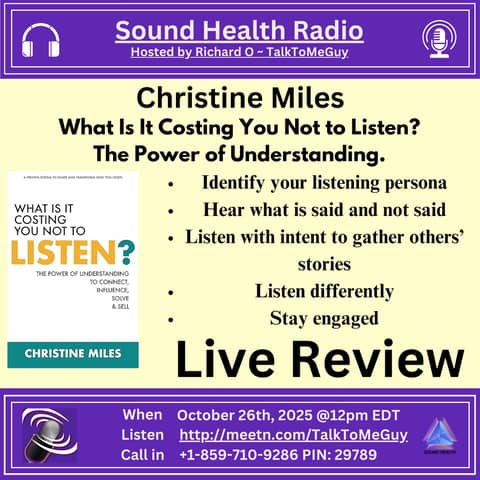


Christine Miles is an author, professional keynote speaker, consultant, executive coach, thought leader, entrepreneur, and radio show host.
She is the Founder and CEO of EQuipt, a training and consulting company that helps leadership teams grow sales, develop people, and create cultures of understanding. She developed The Listening PathTM, a transformational workshop on, listening to understand, which has been taught at various Fortune 100 corporations, universities, law firms, and privately-held companies.
Christine states: It is my mission to create a listening movement that transforms the way our society communicates, so that we have deeper connections with those around us and a greater effect on communities at large.
Christine Joins us to talk about her latest book: What Is It Costing You, Not To Listen: The Power of Understanding to Connect, Influence, Solve & Sell
Tell me more...
•Please sign up for the email list for future notifications•
If you would like help starting your own show or podcast, as well as help selecting a microphone and setup for your voice; Please tap the microphone and leave me a message with your contact information and I will get back to you.
Or you can email: talktomeguy@gmail.com
More information at: SoundHealthOptions.com
TalkToMeGuy: Greetings everyone, this is a Sound Health Radio Show where we talk about the crossroads of the environment, our health, and longevity with Richard Talktomey guy and Sherry Edwards' off working on the Sound Health Portal. I would suggest going to the SoundHealthPortal.com, scrolling down just a bit and clicking on the Watch How button. You'll see a short demo video explaining how to record and submit your first recording. Then go back to SoundHealthPortal.com, scroll down to current active campaigns such as cellular inflammation, stem cells, or Parkinson's, and choose one that is of interest to you. Click on that campaign and click Free Voice Analysis and the system will walk you through submitting your recording. You'll receive an email with your report back usually in one to two hours.
I suggest sitting down with a cup of tea and reviewing that and seeing information that you can take out of it. To hear and share replays of this show, 30 to 40 minutes after you hear the outro music, go to Talktomeyguy.com, scroll down that page and you'll see this show at the top of the episodes page. There are also hundreds of shows available there as well. There's a microphone icon at the bottom right corner of all the show notes.
If you'd like to leave me a voice message with a question for a guest or a guest idea for a show, you can do that directly from the site and I will be notified.
TalkToMeGuy: With that, Christine Miles is an author, professional keynote speaker, consultant, executive coach, thought leader, entrepreneur, and radio show host. She's the founder and CEO of Equipped, a training and consulting company that helps leadership teams grow sales, develop people, and create cultures of understanding. She developed the listening path, a transformational workshop on listening to understand, which has been taught at various Fortune 100 companies, universities, law firms, and privately held companies. It is my mission to create a listening movement that transforms the way our society communicates so that we have deeper connections with those around us and a greater effect on communities at large. Christine joins us to talk about her latest book, What is it Costing You Not To Listen? The Power of Understanding to Connect, Influence, Solve, and Sell. Welcome, Christine.
Chistine Miles: Thank you so much for having me, Richard. It's a pleasure to be here.
TalkToMeGuy: I so want this to be like I have questions about how I do what I do. I want like a I need answers, but we're going to contextualize that into a show. We can do both. We can do both. Great. Great. Yeah, you're multitasking. I believe that. I want to start with
TalkToMeGuy: when did you discover that you had the ability to listen to understand people in a different way?
Chistine Miles: Well, it started pretty young actually. I think I started to have language around it when I was about 17 or 18 years old. My senior year in high school, but I learned to listen. I remember as early as five when I looked back. Pretty young.
TalkToMeGuy: When you were getting, in reading a bio, you were getting a degree or you got a degree in psychology. When you were getting that, did you consider becoming a therapist? Did you wander through the like maybe I should be a therapist?
Chistine Miles: Well, that started before I entered school. The reason I started listening differently was because I had a mother who had psychological issues. We had a lot of language in our home around therapy and psychiatry and those kinds of things because my family talked about it a lot. She was very warm and charismatic and loving.
She lit up the room. Most people did not see the pain beneath the surface. It was my job to really understand that pain from a pretty early age. The dichotomy of what I saw, which was this woman who really had a way to connect and also like I said, light up the room, but the depth of pain below the surface was so great. I started to pay attention to things very differently from a young age, seeing that contrast.
It was also to go into the therapy realm. It was a little bit of my job to understand that because my mom lost her mom from being born. Her mother died from childbirth.
That set her up. As the girl in the family, I was kind of the anointed one to be the female that understood her in a different way because she never had that growing up. While there was some burden in that, as there often is with those kinds of situations, there was also this great gift that I got, which was how to listen differently. The reason I realized in high school was I wanted an award that I didn't know why I was at the award ceremony in high school because I knew it wasn't math and I knew it wasn't science.
I didn't pay, but I'm not great in those subjects. Even though I was a pretty strong athlete, I knew that award was going to my best friend at the time. When I showed up, it was this good citizenship award.
I didn't even know that existed. I wasn't the kid that went out and raised money for causes and did those kinds of things. I was recognized because of the way I treated my classmates and understood people and even teachers and interacted with them. That's why I was considered a good citizen. That's when I started to get language around this.
TalkToMeGuy: Was there a tipping point of some kind that moved you to create the listening path? As you went through all of this and you gathered all this information in your bio-observe, or I'm not sure what the word is yet, say that it seems obvious to me that you were an observer from a young age and that you watched adults probably interact and have conversations or issues or whatever, and you were taking that in a different way because you were actually observing.
Christine Miles: My father was a businessman as well. He also was quite a good listener. He was trained. This was back when organizations really trained sales reps. He started his own business ultimately, but he started in life insurance. I remember him telling me they taught him how to understand every aspect of his clients in order to differentiate and really to be able to serve them. He also was really very good at listening.
When I married those two things together, it was a little bit of a superpower, even at a young age. You're right, I was observing and I could interact with all different types of people and ages very easily and assimilate. The natural evolution was, I did study psychology. I did think I wanted to be a therapist. I spent my first five years getting trained in systems therapy. My first job out of college, I was a home-based family therapist. Ironically, I didn't want to go into sales. I went to help people, so I went into people's homes to try to convince them at 22, I should be their family therapist.
Never more selling than I do than in that job. The only reason I did well was because I was able to listen. I didn't have the answers for the families. I learned those answers over time and had a really structure of the therapy sessions, but what I was really good at and I was again recognized for was my ability to what they call in the therapy world, join with the family and really understand what was beyond my scope. That earned me the right to be in the room with them and to try to help them. Over time, I did that work and then I realized my father was a businessman. I watched him and I loved business. I started to translate what I had learned in my therapy training in the systems world into organizations. It's been an evolution over time to deconstruct what I've been doing and how to help other people learn how to do it in a simple and effective way.
TalkToMeGuy : That has to do with as I'm hearing you talk about your story. It's making me think about my own story in terms of I had an herb store and I was a master of listening. I'd already been doing body work for 10 years and I don't mean pounding cars. Body work and I had taken a year and a half of actual dissection anatomy. I'd done a lot of studying by the time I was in the herb store and people thought I was some sort of miracle worker because I would gather a tremendous amount of information all the way from just watching them walk into the store because I had been trained to observe people's physiology in motion and how they were breathing and how they were holding themselves and they had a stick in their hip or they had a site gimp or and I mean very subtle things but I was trained to observe all that as a body worker. Along with the anatomy when I would do an intake or I'm just talking with somebody just like you and I are talking now. Then I asked them a question about oh is that shoulder been bothering you along and they're like that doesn't bother me at all and then you realize oh no that shoulder is actually bothering you. They'd have that aha and it seemed like and I was going to add this is a very long way around to ask you did the point you wandered through thinking maybe you're just a really gifted intuitive.
Chistine Miles: You know for a long in a lot of ways yes I did I thought and really when you asked me when I created the ListMePass so like I said it has been an evolution I would say it's been over the last 10 years that it's really I call it a Broadway show right really honing it so that it you know everybody thinks they show up on Broadway and the show was that to begin with as we know it takes a lot you have to workshop it and see what works and doesn't work and work and that's what that you know I and my team has done to really make this doable but as I've had to deconstruct what I'm doing it's made me realize that it looks like I'm very intuitive I'm just doing it at a speed that most people aren't used to and so I always say there's a difference between a weekend athlete and an Olympic athlete and most people say what's the number of hours of practice and while that's true it's really the speed and proficiency with which you can do the skill. I mean Tom Brady and I can both throw a football but I have a feeling he can throw it better than me so those 10,000 hours have gotten him to the point where he can do it with speed, proficiency, efficiency, etc. and certainly some natural talent so that doesn't hurt but and I think it's more that I grew up in a family where we had language around emotions around understanding around what we didn't see more than being an intuitive person.
I think that's less so. I see my nieces doing the same things in terms of how they interact that they don't stop where most people do. They go further and deeper into the conversation because they also have just through being around my family members seen the same things so it's not an accident just like you paying attention to the shoulder, the knee, it's just unveiling the magic trick right? How do you learn to pay attention to things you're not used to paying attention to?
TalkToMeGuy: It's early in the show for me to jump to talk about wolves. This will make sense that in nature I spent a lot of time as a kid with a group of people hiking in the Vantana wilderness which is the part where a big sur country is, big sur to LA. We would go out hiking in nature and I'm talking about real backpacking going out for four to six weeks. Hardcore out in the woods for four to six weeks.
Now there were campsgrounds but campgrounds meant a flat face with a rock though. You learned a lot by watching animals in nature and wolves are in this category where I think wolves in particular, I like them as an example because they're so very smart and so very pack oriented. They really care about the pack. When they're in nature their first and foremost thing they're doing is listening. They're listening to everything because everything is a marker of something in nature. Whether it's a wounded animal that they might go eat or it's a fellow pack member that's in trouble or if it's a sound of a stick breaking it might be a dumb person coming out to try and shoot them.
They're really paying attention. I really like animals for observing and learning. I learned a lot from a dog that I hunt out with a lot. Watching the dog listen and smell and hear and just observing that.
I think that this leads to, it's a sideways leading into this question but it fits into this. What is a listening persona and how might it get in the way?
Chistine Miles: Okay so let me take a step back because what you said is super important in terms of your analogy and your experience in the woods and wolves. This is how we treat listening as humans. We just expect people to have the instincts to listen because we go, alright you're born with two ears unless you have some sort of hearing disability. You have the ability to hear therefore you have the ability to listen. Hearing and listening are two different things. We're told to listen from a very early age but we're never taught. So there sets up the problem that we are, you know, we are not, there's zero years of education in our educational systems from grade school through college and into business executive programs by the way that have no listening training whatsoever. Only 2% of people have any kind of listening training and usually it's pretty short lived. They did an listening exercise or they spent a half a day maybe on it, not much.
So we are not prepared to go hiking in the woods. That's an interesting analogy and one I use in the book because we are going into conversations without preparation tools or knowing how to do this and then we're wondering why we're failing. It's really not anybody's fault. We're not taught. So what happens to go to your question which is what's the listening persona is that there's so many enemies of listening. We, you know, our brains are in overdrive even without technology and the brain becomes the enemy of listening because it tells us to do everything but listen. And so we kind of describe the brain in two parts. We have a defense attorney that shapes the story and we have a curious detective that allows the story that come to you because when
TalkToMeGuy: you're listening to a show, you're like, well, I'll move this into, this is in the same area of, I heard or read, by the time we get to a show, I can't remember which one it is. It's all just information now in my brain. That we are teaching people to tell, talk and know. We're not teaching them to listen. How is that possible? Well, we've survived. That's a side question because listening is so important but we're teaching people to tell, talk and know.
Chistine Miles: It's crazy. I mean, we think about our educational system that we, you know, we go through school. It's about what we know, what we can say, how we can position it and articulate it and then we're not spending any time on the other side of the equation. And by the way, listening is, and this is so important to what you do all the time, which is, it's not just about listening to others. It's also about listening to yourself. It's listening to your body. It's listening to your instincts.
It's listening to your own story. You said that as well. You said, my story reminded you of your story. Well, when we learn to listen to our own story, we can learn a lot as well. So this is both self-awareness, listening to yourself and listening to others, other awareness, which is why listening differently, listening to understand, really develops our emotional quotient or our EQ. So we all have, most of us, not all of us, there are listening impaired or hearing impaired, but we have the ability to hear, but listening is not hearing. They are two different things and we only retain 17 to 25 percent of what we hear. So we're not wolves in the wilderness. That's for sure. We are not achieving what they're achieving.
TalkToMeGuy: We're not even the dog at home who hears the can open.
Chistine Miles: That's true. Although I will hear a meal. I will smell a meal and go down to the kitchen.
TalkToMeGuy: We've talked about that. Yeah. We've talked about my chef experience. Yeah, I can bring people into the kitchen. You can be out of the garage and you come to the kitchen and kids go, I heard that. I know what that means. Yeah. Yeah.
Chistine Miles: But we do change that. So that's part of the listening problem is that we tend to chase what's important to us, not necessarily what's important to the other person. So that's what also interferes and how the unhelpful persona shows up, because our own story impacts or it contaminates the story of others.
And a pure listening moment is really when you get the story from someone else uncontaminated. Now, we focus quite a lot on the business impact that that has. But the beauty is that we have not only transformation in business, but also in personal relationships. So that's the most wonderful side effect that we get. Well, I had, I got an unalisted hug from my daughter who's 16th for the first time in three years after, you know, one workshop and practicing the new tools that helps me get the story. So it's just amazing to hear, to be part of that transformation is just a gift.
TalkToMeGuy: And in, I don't remember what chapter, well, no, I know the chapters. I'm going to combine two of your chapter headings, because I think these are interesting and I'll call them tricky areas. One is in chapter five where you talk about becoming an expert in empathy. In combining that with chapter seven, which is overcoming bias. Yeah, I think bias can certainly make listening very tricky, very tricky. So can you talk about those? How are we?
Chistine Miles: Yeah, yeah. So here's one of the things that so Chris Voss, who's a, he wrote the book, Never Spote the Difference. Some of your listeners may have heard of him. He, you know, he talks about if you want to get something done, become an expert in empathy, you know, he basically went and flipped how the FBI did hostage negotiations.
And instead of telling, he said you need to first empathize and again, join with the hostage takers to get the results you want. So it's, you know, it's all based on psychological principles. And the problem that I have with empathy is we expect people to show up and be empathetic. And everybody has different levels of empathy, depending on their experiences and how they're wired a little bit. And we're not taught to be empathetic.
We're shown sometimes. So the beauty is that listening differently, transformational listening leads to empathy. You don't have to show up to be empathetic and just know how to do it.
We give you the tools so the empathy comes to you. It's almost like you're, you're watching a movie differently. So you were connected differently and you're drawn into the experience as a listener. So it becomes easier to pay attention. It becomes empathy follows because you kind of create this world around you and the person talking. That's very different. So what happens in when we try to, what's usually talked about is something called active or attentive listening, which is just pay attention, show people that you're listening.
Empathy is expected, but our own story, our own bias is what interferes with that. That gets in the way. It's one of those major listening inhibitors. It could be bias about race, age, gender. It could be bias about, you know, where you grew up.
It doesn't matter. There's, we tell ourselves stories all the time. And so that story can contaminate the story of the listener. So again, let's speak to yourself first, knowing what story you're telling yourself about the person or the situation then helps you become a different kind of listener.
TalkToMeGuy: And are there exercises that we can do to develop? I mean, I know that there are, but in your context develop and exercises to have empathy, to develop empathy, to be aware that we might have empathy, but we've stuffed it in our sock because I don't think it pursuits us, particularly in the business world. Yeah, I taught it to you. I taught business at a university that I'm confessing now. This is me. Okay.
I taught business communication at a university and discovered that's not my world. Why not? Tell me more. Thank you. I really enjoyed the work.
I enjoyed dealing with the students. I dislike the bureaucracy and the bad words of the system. Those are my bad words that I can't say. It was that part that I disliked.
I liked the doing part, but it's like all the like, oh, papers and files and people. You're wrong because you're not in the department or I don't like those shorts. You shouldn't be wearing shorts.
You're a professor. It's like, right. And certain bad words. So that's why. But how did you learn empathy? Right. And as school in business, there was none of that taught. It was dominating crush.
Chistine Miles: Mostly. Yeah. The world, I mean, I think that goes into the telling, talking and knowing, right? So when we go in, the expectation is we need to solve the problem. And so, and, you know, selling is one way we solve the problem. I believe most people want and try to be helpful even when they do dominate. I mean, this, you know, depending on where you are in business, there is a competitive nature to it. I was an athlete.
I'm a competitive person myself. So there's nothing wrong with wanting to get the results. But telling, talking and knowing is how we go in rather than trying to understand.
And that's the flip, right? I had a sales guy once say, you know, what if I just don't give a crap about, you know, he was 300% of plan and we were doing a workshop. And he understood the storytelling part of how to do life, but the story gathering was harder.
And he said, what if I just don't air? I know. All right. Well, you're 300% of plan.
So I guess you don't need this. And then I looked, did he go, you know, he was very smug and happy that I said that. And I said, but what are you leaving on the table?
And he went, oh, that now I'm interested. So, so we have to figure out what's in it for us. Sometimes it's just giving the gift of understanding by listening. Sometimes it's to get to an outcome that's beneficial for you and hopefully for the customer. But it's a different way of, it's a different approach.
It's a different approach than, than crush, as we say, but you can still get the results to the good, the good news. So, so the exercise is to answer your question. So again, if there's six tools that what we call in the listening path to use your hiking analogy, your backpacking analogy, again, you need tools when you go in the wood to survive.
So, same with the conversation. So there's six tools that we metaphorically have you put on your, in your backpack so that when you're on that conversational path that you can get to the other side with the teller safely. And those tools help you become more empathetic. But one of the things as a precursor to that is, is just using your imagination rather than trying to think you have to have feel the emotion. So you can just say to yourself, well, if, if I were them, I could imagine how they might feel. I don't have to be right, but I can try to imagine what that would be like rather than trying to step into and go, oh, I don't feel that. Why can't I feel that to the same depth? Because, because maybe you haven't had that experience and it's hard to identify with that level of emotion. So just using your imagination as a step towards empathizing differently.
TalkToMeGuy: And I will say for the gruff guy who didn't want to care about empathy, I'll say that's my view of him, is that we talked before, shortly before the show about I had been a chef. And I'm thinking about a particular kitchen crew.
I was a line cook for a number of years and I became a sous chef and then the head chef. And at some point I didn't, it was the ah-ha while reading and studying your work that I realized, oh no, because I knew my crew. And I knew their personalities and their foibles because I needed to know that so that when crunch time came and we were about to serve 350 meals in an evening without throwing things at each other too often because it was an open kitchen. I had to know, it really benefited me to know the personalities of the one guy that was, you know, there was always, everybody had a thing that was going to make him be pissed off or cranky. Something wasn't going to happen. The guys working the sautee area, the griddle are going to be doing one thing and the guy who's working the fryer or cooking the meat, it's all a ballet.
It really isn't, doesn't seem like it is. And it all has to come out on the plate at the same time. You can't go, oh, I'm cooking that steak, it'll be another three minutes.
No, now is when we need it. So you really are watching, and imagine this is, I'm not a competitive athlete, but I imagine this is true of team athletics where you have to know your team so if they have a weakness, which is not a, it's a judgment, but it's not a negative. It's just a good to know.
Chistine Miles: It's really helpful. Yeah. That's right. So, so that's part of why I overachieved in this area of my life as well relative to my abilities. I assure you, I was not the strongest athlete, not the fastest, many of my coaches could attest to that, but I was able to read the game. And my teammates really well and know my own limitations and develop skills based on those limitations. And so when I did that, it, it, I was really, I really went well beyond where I ever should have.
And, and even with this sales guy, it's, you know, here's what I believe from talking with him. He was, he was so, it's almost like you, you only use one muscle, right? More than others. Like I'm right handed, so I don't use my left that much. So if I said, we have to eat all day with just your left hand and only right with your left hand, that's really frustrating.
But I'm so much stronger with my right hand. He just had, he was more, he was more interested than he was admitting and he was better at it than he thought. It's just, he was so good at the other thing and he was getting the results that why should I flex this other, why should I use this other hand?
And when he had a reason, then he was really anxious to start using it and then he was dynamite. So I think one of the things we have to do is understand that this is a whole different muscle, a whole different arm that people aren't used to using. And they come into the, because we don't teach them, teach this earlier, people come into a very late in the game and it can feel frustrating at first. So as we coach and teach this, we have to help people be patient with themselves and find out what's in it for them because it's worthwhile. And we make sure that they have results really quickly so they want to keep going because that's important for change as you well know.
TalkToMeGuy: Well, I love the, I have to scroll back up to look at this note because I had written this down to talk with you about this, this idea that you have of, oh, it was in your bio that I read. To help transform society.
That's not how you said it, but that's what you're saying is communication could really help transformation in community. And for God's sakes, string of bad words, dialogue, over-credited dialogue. I may not agree with you, but we can talk about it. Well, I think that, I love that.
Chistine Miles: Yeah, I think, well, when did we start saying let's just agree to disagree? That's one, that's a bad one for me. I don't, I don't like that one. No. Why don't we agree to understand? Oh, shocking. Right. But, but again, we're not taught how so, and it's emotional.
This is our bias, right? And so our own story in our, in what we call our subconscious brain goes off. And that story can take over and we can feel frustrated by the opposing way of thinking. And so when we shift though what the outcome is, is what let's agree that I'm going to understand you and you're going to understand me. Then we're in a place of understanding and alignment, even though we don't agree on the issues. So how many times have we heard in the, in the aftermath of these incredible tragedies that we are more aligned than disagreeing about even where we are on laws and safety and those things, no matter how politicized it is, the majority of us agree about some fundamental things, right?
She's lead a case of conflict. We tend to agree more than we disagree. The problem with conflict management is we go to think about our marriages and our relationships.
We go to the area we disagree, not what we agree about. I remember as a young therapist, a couple came in handsome couple, you know, at this time I'm in mind. I've worked for an employee assistance program, so I always did some counseling. I probably in my early 30s and they were in their 40s and they said, we have nothing in common. They started the session with we have nothing in common. And I was like, okay, and then two kids, two houses, this, that, 20 years together plus. I go, wait, I thought you said you had nothing in common. I said, I hear a few things in common. And they looked at me. I said, you have a lot in common.
Let's talk about what else you have in common before we talk about where you disagree. That's a reframe that we can all go to. And I do hope, and I am on a mission to try to transform how we at least pay attention to listening, teach listening, and hopefully put more time and effort on it because I know it fundamentally can change our personal relationships, our business outcomes. And like you said, remove some of this polarization.
TalkToMeGuy: Well, I love the idea, having been an academia long enough to realize, no, this is not really my world. That the idea of teaching, as I say, I taught business communication, but that had to do with, this is how long ago I was, overhead projectors. How to do a flip chart design, to, you know, for that kind of thing. I mean, that's how old I am.
Christine Miles: And the idea of that, by the way, I remember the overhead.
TalkToMeGuy: Exactly. The overhead, the dreaded overhead.
Chistine Miles: Whoever thought of PowerPoint, I don't know.
TalkToMeGuy: That's another story. No, that's a whole, no, that's a whole separate show. Excessive amount of PowerPoint, you know, just because you have slides doesn't mean you have to use them all. That the idea of teaching, actually having, my favorite part about being in school, both as a student and in teaching, was the symposium classes, were basically this meant you sat around and talked. Yeah. And I really enjoyed that. I learned the most in those classes because it wasn't just somebody standing up there, reading their notes from, that they wrote 10 years ago on this area of economics.
Yeah. But it was actually sitting and talking about real world issues, having disagreements, and then recontextualizing for all of us so we'd come back together. And the professor in those classes or professors in those classes weren't necessarily the ones giving the answers all the time. They were really wanting us to learn how to think, to listen, radical, to listen and think and have conversation and be in that work. And that was always my favorite part, was the listening and dialoguing with people, sometimes being argumentative, but sometimes that was fun. That's my most competitive thing is like sometimes I'll set somebody up to be a little argumentative. All right, let's go. And then we're fine.
Chistine Miles: Well, that can also flush out some of the issues. It's how you argue, not that you argue. Say more about that, please. Well, again, I think what happens, and I see this happen so often in meetings where people are talking at each other, not with each other. That's the shift. I say something and then you say something that has nothing to do with what I just said. Just a counter. So there's no, that's a monologue with two people. So the shift is using some of what we call the tools to kind of make sure we're aligned before I counter.
Make sure I get before I counter. So again, we understand and then that earns you the right to say something different. So I was with a friend of mine at dinner a couple weeks ago.
She's gone through a difficult situation with an ex-boyfriend. And so I listened and I understood, but I didn't just say I understand. What I did was I used some of the tools that I've been using all my life with more language around it. I asked her to tell me more. That's one of the most powerful questions you can ask somebody. I asked her, how does that make her feel? And then I said, I made sure that I understood by saying, let me see if I get you. And I reflected what I heard and throughout the conversation. And I gave her no advice.
This went on for 30 minutes in this case. And we talked about other things intermittently and I finally said, would it be okay if I tell you now what I think? And she says, I'd love to hear what you think.
Are you sure? I asked permission before I went into telling her what I thought. I said, I don't know if you're going to like what I'm about to say. And I prefaced that and she said, I would appreciate if you would. So I gave her some frank feedback and she said, I really appreciate your candor.
That's really helpful. But I didn't just tell her that right off the bat. She needed to feel that I understood her emotions and the situation before I could tell her a different point of view.
TalkToMeGuy: So you made her feel comfortable by empathizing with her. And then she was able to receive what you were really kind of saying back to her from what she told you with your thinking around it.
Chistine Miles: That's right. That's good reflection. And that what you just did is what I'm talking about is that you put what I said into your own words with some understanding. So you didn't just repeat the exact words.
You actually reflected the meaning of those words and said, right? That's a do I get you before we go to the next thing. That's missing in most conversations. We go right to the next thing. And then we that's when conversations become competitive. So people often say to me, why don't I mind it when you tell me something I don't want to hear? And I said, well, probably because I spent a little bit of time up front making sure I understood you and made sure you knew I understood by confirming with you that I understood before I dare tell you something you don't want to hear.
Chistine Miles: And I want to talk about the six powerful questions. However, I want to I want to I have a setup question because I want to ask you about how I can use this as a tool. And what I'm my question has to do with I'm primarily an educator.
I'm a lot of things, but I think that's what I do, particularly in the future. And no, it's a lie. Even as I'm reflecting on myself, no, that's a complete lie.
You totally want to change people's mind. Let's say that I have a subject such as glyphosate or roundup. It's toxic. It's destroying our microbiome both in the planet and in the earth and in our guts. It's bad. Our government keeps saying, no, no, you can use more of it. It's a bad, bad product.
TalkToMeGuy: So how can I use the listening path to I don't really like the word enroll. I know you'll have a different word for that, but get people to hear that and take it in versus just pushing it off because I sound like some environmental hippie. Okay, now. Yeah. Yeah.
Chistine Miles: So first of all, one of the things that in terms of listening to yourself is knowing your own story. And so I love the word educator, because my words understand we say if you had one word to describe why you do what you do, what would that word be? My word is understanding. I believe that when you understand yourself and others, it's a key to success in life. So your word may be educator to really make a difference and help people live the most healthy lives, right? So it's for a good reason that you want to educate. You're not just trying to shove your opinion at them for no reason.
You're beyond wanting to be helpful. So I think that's one thing. I think people probably know that about you from listening, but it never hurts to remind them of that is that this is why I care so much in the platform to get the most reach to do that. But I think the other thing is, and you do this in your own way, and you use one of the six most powerful questions very well, which is may not feel like a question, but you've done it frequently, which is, hmm, right?
That's one of the six questions. It's almost imperceptible when you're in a conversation, but it is a keep going, tell me more kind of a prompt. And think about the number of times throughout the day that somebody actually wants to hear more and not less. Even that is just an amazing experience when you're in a conversation.
So that is one question. And the other, the verbal version of that is tell me more. So it's a gift when somebody starts to talk and you say, tell me more. It opens people up. They will tell you more, by the way. It works.
TalkToMeGuy: It reminds me, it takes me back to being in the herb store all those years and consulting with people on the phone. They were all, I think, part of, I dealt not primarily, but a lot with women because I was empathetic and they could talk to me about stuff that guys don't want to hear about, like their cycle or texture of something they don't want to talk about or all that. I was fine with all that.
I've done body work. I'm fine. So there was some people, women that would come in and they'd come talk to me about what was going on and then their husbands or boyfriends would come in and they're like, this guy's flirting with you. He's like, oh, you're like, no, this is just who I am. I'm asking a bunch of questions. That's why you think I'm flirting because I'm interested. That's what it was. I was really interested, genuinely. There's a lot of hmm.
Chistine Miles: That's right. And so I want to demystify empathy because and I, you are empathetic. I hear that. But how you get to empathy is what you just described. So I want to unpack that because it can feel like magical. You're asking questions. Tell me more. Hmm.
Lots of them. Right. And you're also reflecting and creating alignment with me. That is what that's a gift and that does draw people closer to you.
I talked about in the book. I got a divorce in 2012 and when I hit the online dating world, I was like, wow, you know, this is interesting. First of all, after being married for a long time. So when I was out on date, I got a lot of second dates and I thought, I'm fabulous.
Like, look at me go. And then I realized, wait, they didn't ask anything about me. They don't know anything about me. They like how I'm making them feel because I'm listening.
Doing a lot of things, right? And I went, let me, I know, like big revelation. So I thought, let me experiment with this. And so I purposefully always listened, but I made a point to talk about who I am and a little bit, even if they didn't ask.
And guess what? I didn't get as many second dates. It was interesting. So I always say, it's great to be interesting, but it's even more powerful to be interested.
It was quite a lesson. So I'm not surprised the boyfriends chopped it up to you flirting, but being interested is a powerful pull towards people. That's why the movement of listening differently could transform how we are as a culture that we're not so divided because when you listen to understand, you give that gift. And even if I don't agree with you, I can feel connected with you.
TalkToMeGuy: Can you picture that out a little more? That's a slightly mind-blowing concept of the idea of feeling, I'll call it intimate, in a way of feeling a connection with somebody. And yet, I disagree with you. How's that possible that we can be friends and still disagree with you? What's that? How's that happening?
Chistine Miles: Well, I think, first of all, this is happening all the time anyway. People just aren't talking about it. They're just talking about it on the way home from dinner instead of at dinner. And if we only surround ourselves with people that see everything the way we do, we're going to be very lonely very quickly because fundamentally, we all have our own ideas and thoughts and opinions. But it's a different way of accepting and understanding. So, look, there's certain issues that are going to polarize us so much that that might not be possible, right? But if I'm an animal activist and you don't care about animals, that could really be polarizing and maybe we're not going to hang out. But for the most part, we're more aligned than not. So, if we can just say, let me see if I understand the way you think what it is and connect, I don't have to agree with you. We're allowed to be separate humans and have the same, be in the same space and not see everything the same way. But if we think we have to come to an agreement, we're done because sometimes it's not possible.
TalkToMeGuy: And I've been in environments where everybody's, let's say, a meditation group with 400 people or some kind of event like that, where everybody is very groovy and cool and peaceful and at ease and meditated and transcendental and vegan and wearing Birkenstocks.
I'm not opposed to any of those things. But I'm judgy. And yet, I find it really annoying being with everybody that feels the same because there's no, where's the juice? If we're all so groovy, there's no juice, at least for me, when we get too transcendental. And again, I'm not opposed to that. I like it, but in limited doses because we're all just jello.
Chistine Miles: Yeah, well, and there's interest, right? And then there's belief. And so I think, you know, if you're meditating and those things, I mean, I agree with you, by the way. I played field hockey when I was younger and I thought I wanted to be a US field hockey player because if you said like 20 minutes down the road, there's going to be hockey at four. I'd be there in heartbeat back in the day.
But when I got to US field hockey trials, I went, should all they do is play hockey all day. I think that I was born with that, right? Who knew?
To be that good, you have to play like a lot of hockey, a lot of hours a day. So I think that's part of it. I think differences are interesting. And look, we live, we are a mixture of everything. There's difference all around us. So we're not going to be able to water it down to the point where we live in a diverse culture of a belief, of thought, of race, of age, of families, all of it. We are a melting pot and we should be. And so how do we embrace that? We don't need to agree.
We don't need to agree. We just need to understand the experience. And frankly, I think this is what I worry about in terms of diversity in the workplace and so forth is we're still afraid to say anything that we say nothing.
And that I think that has to shift. Help me understand what your experience is like rather than I don't want to say anything that will offend you. I might offend you.
Tell me if I offend you because I want to understand that, you know, I might step in it and please be the first to tell me if I do because I need to learn.
TalkToMeGuy It takes me back to being in the kitchen where you might have somebody who had come in and had a particular sauce that you wanted to finish a dish with. And you would teach them how to make the sauce.
I mean, they had a basic understanding of what you were talking about. But okay, now let's make the sauce together. And they'd make it differently and go, we'll try this and it would be better. However, it's not what's on the menu. It's not what people are coming in to get. And that's a tricky thing.
That's when you have to kind of crack the whip or growl in that wolf-like manner to get the line cooks to produce the food that is on the menu. Yeah, because people come in to get that and we might feature that. Let's save that and use that sauce on a special.
That's really great. That'd be great on that back to that pirated salmon on a bit of salad that we talked about. It might be appropriate somewhere else, but it's not appropriate here because people coming in to get that.
And that was just a thing. And I ran into that with a bunch of down to the years of managing kitchens and being on the line where, no, we do it this way, here. You can do it that way, there. And we can agree that that's different, but it's just about the agreement of, no, this is how we do this here.
Don't be being creative because you think it's more clever. And it probably is. But this is what the restaurant owners want. And they're the people paying our bills. So just do this, please.
Chistine Miles: Well, the difference that I hear there is that most people would just say, this is how we do it here versus there. What you said is, let me help you understand our audience, our customer. They have an expectation. So you're meeting the customer where they are telling the story of the customer to the line chef, which is why that helps them make the shift, right?
So I don't go out and do a talk, a keynote, without understanding the audience and making sure that they feel understood, even if they never utter a word back to me because it's a large audience, they need to feel that they're part of the conversation. So what I think, what I hear you did is you brought the customer into the kitchen and said, this is why we do it differently here. Not just do it different. People don't like to be told what to do and telling usually doesn't work. If you help them understand or feel understood, then tell them it usually works a lot better.
TalkToMeGuy: And the customer is right, even though they're wrong sometimes. I had customers who would come in and want to stay cooked until well done. It's like, why are you ordering that expensive cut of grass-fed beef and then destroying it?
What is with you? And I knew some of them well enough after a couple of glasses of wine. I would tell them that and they would laugh and go, but that's the way I like it. And I'm like, okay. Right.
Chistine Miles: And that's part of the, it's okay. That's the part of understanding rather than having to convince, right? It's like, that wouldn't work for me, but I can make that work for you. Pick your battles in life, right? That's an easy way to please them is to overcook the meat.
Even though it's painful, I'm sure as someone who's really well-versed in food and what the best practices are. This is where we don't understand the story below the surface. Like how sometimes somebody got a piece of rare meat, they got sick, right? Or we don't know what the backstory is. We just never know, right?
Yeah. Or they weren't socialized to eat meat that way as a kid or whatever it is. So we take, we meet people in the middle of the movie and they usually, we don't get the backstory and then we operate from the middle. And just like going to a movie when we don't see the beginning, we're usually confused. So you said this also a couple times, Richard, you said, take me back or let me take you back. And that's another one of the most powerful questions of the six is take me back to the beginning or take me back to where this began is really a helpful context center to make sure when you're listening, you're getting the beginning of the movie. Because otherwise people tend to start in the middle and we move forward, not backwards when the real meaning is what happened first. It's usually where that's covered.
TalkToMeGuy: And I will say that when I did body work, again, not pounding cars, actually working on people, that when you're working on someone's body and you're watching their breathing and you're just, and it's, you know, it's just a thing you do sort of casually. It's not like you're just staring at them going, Oh, you're breathing, you know, you're just watching what's going on with their body as you're working on muscles. And you can have that conversation with them while they're laying there going, when did you start? Do you remember an injury was a thing? And once you get to know a client, you then can go, Oh, don't you remember that you did the thing with a thing and it was too heavy and it pulled on that.
Do you think it's a result of that? And you'll take them back to there. And going back to the point of origin of the story, oftentimes in body work will help the body go, Oh, wow, I don't need that anymore. And it can really. Right.
Chistine Miles: Because it was functional during the injury. It's not functional. That's why I say the word functional is in the word dysfunction. We continue things for our physically and emotionally for after its usefulness.
So this is again the part of listening to yourself. I happened to I was in an auto accident when I was 28. That's so I had three years of chronic pain and then went to a cute. So I have I had quite the medical saga. And one of the one of the greatest gifts in that experience was I had a physical therapist that taught me how to listen to my body differently so I could survive the acute pain until I got it resolved. Whereas I had an athlete's mind set. No pain, no gain.
He said, uh-uh, no, no, no, no. We're going to start to listen in a whole different way to what pain means. There's productive pain and there's negative pain. And so listening to yourself physically is also so important because we ignore so many signs and symptoms.
I know I'm preaching to the choir here. So so it's listening is it's transformational and we have to listen to ourselves first in order to overcome our biases to overcome and to pay attention to things that matter to us as well as to others.
TalkToMeGuy: All right, I'd like to go back for a moment. We have to listen to ourselves. Really? I'm kidding. Kind of like what? What a radical idea you want people to learn to listen and you want us to listen to ourselves. I talk a lot. I really have to listen to myself. Talk about that where I mean I love the idea of these things being taught in school.
Can you actually listen to the words that are falling out of your face? How about that? Let's start there. It's an amazing concept and listening. It's a radical thing that I just feel could be so transformative in an age of I'll pick on TikTok because it's an easy target where people are learning or I don't know that they're learning. You'll have a comment on this. I know learning the idea. They think that they're learning from watching a six second video. Then their brains get used to that dopamine bump of like ooh, ooh, ooh. Pretty soon when you talk with your peers because I see this with younger people who spend a long time, a lot of time on those kinds of short term social medias.
Where their attention span then develops into that. Well, they want to hear you quit back. Now I am an old guy.
I have grandchildren and they look at me and go, oh, he's old. Is he dead yet? No. So how do we, it's back to the listening and listening to yourself. Do you observe that you're old enough? Yes.
TalkToMeGuy Very well said by the way. Thank you.
Chistine Miles: Thank you. Well done. I do have come up in the same age as myself for a similar time zone of pre-social media. I don't mean just the dreaded Facebook. I mean things that are just this short term what in Max Headroom world, which is a great series, which is gone, they would have blipverts and they would do this thing. It's a quick flash of information within the context of a film. And it's just like it's subconscious, but it goes in there because our persistence of vision, which is how the eye sees things, will retain it. And our brain will probably put it away somewhere. So when we learn to, or we think we're learning by doing that kind of learning, how does that change how we can communicate or can't communicate?
Chistine Miles: So I believe that that's okay. No, I saw a couple of things. One, social media, I believe has like most things a negative and a positive, right? So I don't see it as all negative or all positive. I think the problem is we don't realize how addictive it is. And so it's kind of like we're like you use the word hit. We're getting a hit. And so I think that's the danger. And that has led to, we know that anxiety and depression within teens and younger people are at an all time high. And it's because when you are getting this hit and you're not, it can be very vacuous and lonely.
So that's a problem. I also believe that it's not just the younger generation, by the way, it's us too. It's the exers, it's the boomers. All of us are in this realm, even if we're not spending time on Tik Tok, we are inundated because technology is a necessary evil and necessary, you know, gift because it connects us in very powerful ways and is creating a disconnection.
So it's this oxymoron. What I know is that people still hunger to be connected conversationally. And I, why I decided to write the book last year, and I had this epiphany was the world's ready to listen because we thought like who thought house arrest was going to be as hard as it was like no all total, total respect for Martha Stewart right. It's not easy, even when you have everything, Netflix, food, comfort, it was lonely and deprivating and we're still seeing the consequences of that because we are wired for human connection, which is why we have to, I believe, teach human connection and how to do it. When I, our workshops are half a day to multi days, and we did them virtually during the pandemic and, you know, it was quite a shift for organizations to put, you know, people on computers again with with cameras during the pandemic because they were worn out. And the experience was so connected that we just kept getting sign up, sign up, sign up, even when it was voluntary, because they missed the way that we help them connect.
So we just have to, we just have to lead them to the water and show them how to drink. And the world loves it. They people say I wish I had learned this years ago, or I understand now why my spouse, my wife feels like she sometimes wants to divorce me like it's very eye opening. Because we haven't been taught how.
TalkToMeGuy: Mike drop. It's, it's so powerful. We're going to do another show because there's so many directions we could go with this realm of social media. It's just all I think it's very difficult. It's a very difficult time. I see a lot of people I spent a lot of time alone because of what I do, because I bring events for others and doing shows. So I'm okay. And even when we first tried to connect, I just picked up the phone and called you.
That's how I, that's how I'm wired. Can we talk? That's me. I'm like, can we talk guy?
Right. That should actually be my website instead of TalkToMeGuy. It should be, can we talk guy? And I think that's not, I know a number of people are like, can we get on a Zoom?
And it's, I don't need to see you to talk with you. I think it's about the voice. I think this, the side benefit maybe that we get to see each other. But I think it's really about us having the voice and listening to the voice. I think the voice is the powerful thing. And I think that's how we connect.
Chistine Miles: I think you're more equipped than most to know how to navigate that if I, if I'll do respect. You're welcome.
TalkToMeGuy:Thank you.
Christine Miles: You're welcome. I think you're right. I mean, look, we can, we're listening with our eyes even when we're only in conversation and we don't have the camera. But for, for many of, for most people who haven't been trained or haven't used this in the way you have throughout your life and career and, and are as you described an observer of things, it is disarming. So I'm not suggesting you change anything. It's just, I can appreciate why and understand why that extra Q is helpful to people because we talk about it all the time. What I'll say is that even in social media platforms, we can be better listeners. So it's while I think the human connection, even text messages, emails, the number of conflicts I've helped at businesses with two people next to each other in a cubicle pre pandemic pre work from home, where they're throwing email bombs back and forth at each other. This is not just the, you know, a new generation thing.
It becomes a habit. And so how do you even an email or text or in these platforms seek to understand versus just to again throw it out there. So I think we have to bring it into all worlds to listen differently.
And it's what we pay attention to. It can be done. I'll always, you know, I'm a believer in that this is that the conversation is the most important thing because it's the fastest way to get there. But I think we can do it in other forms as well.
TalkToMeGuy: Okay. Okay.
Chistine Miles: I'm going to give you one. And I'm going to throw this out for your listeners as well. And it's, this is just, I'm scratching the surface, but it's that thing I said it's tell me more, rather than just start, you know, when someone says something, just your spouse, your child, the person at the grocery checkout, if something's mentioned, hey, tell me more, watch what happens.
Watch how people in that moment connect in a different way, in a different way. Last night I was at a, I took a bike ride, went to a restaurant. I had, I just got a new little kitten. She's only nine weeks old. Her name's Izzy.
She's sitting next to me. And I was so excited. I said to the waitress, I got a new kitten and I showed her a picture and she smiled and she said, I lost my cat a year and a half ago.
And I didn't go, isn't Izzy cute? I said, tell me more. She said, I still hear him down the hallway. I still this, you know, I said, you must really miss him reflected. And she's like, I really do, you know, so sometimes it's just about being there for a moment for somebody rather than being focused on my own wonderful news.
TalkToMeGuy: I look forward to the listening path merch with the baseball cap that says, tell me more.
Chistine Miles: We have some listening matters t-shirts as well. Okay, all right. That's very close. Very close. And one great. We consider coming more.
Chistine Miles: Great. I'm stunned to find that now is the time that I have to ask you, where do people find out more about your work, where they can get your book? Do you teach classes online now still yet? All of those.
Chistine Miles: Well, I appreciate you asking people can find us at equip dash people.com and I'll spell it. It's EQ, because we build the human skills or the emotional quotient. U I P T dash people.com. The book is available in Kindle audio and softback and hardback.
All the usual audible.com Amazon Barnes and Noble all the major sites. And we do teach workshops virtually for organizations and in person. So we will one thing we don't do is a hybrid. We either have everybody in person or everybody on one on virtually and we're high touch.
So we have we have a team of 30 will have, you know, six coaches because we're behaviorally based. We're teaching you how to use the tools and transform how you listen from moment one so that it can be applied right away to your business and personal life.
Chistine Miles: Wow, I'm ready. Sign me up. Time me down. Shoot me up. I'm ready. I like it so much. Thank you. That was wonderful. Christine. I knew it was going to be good. It was really great. Thank you.
Chistine Miles: Thank you. I appreciate your questions and thank you.
TalkToMeGuy: Who knew hmm could be so powerful. Powerful. It's powerful. Now I know that it's powerful. I've always used it and I'm not trying to pick anybody up. This is just I am interested. Hmm. I don't know. I'm not going to give you the like if that hurts. Don't do that. I'm going to try to figure out why it hurts. Whatever. Right. Right. All right. Thanks so much. And everybody else have a great rest of the weekend.
Speaker 4: Bye bye.


