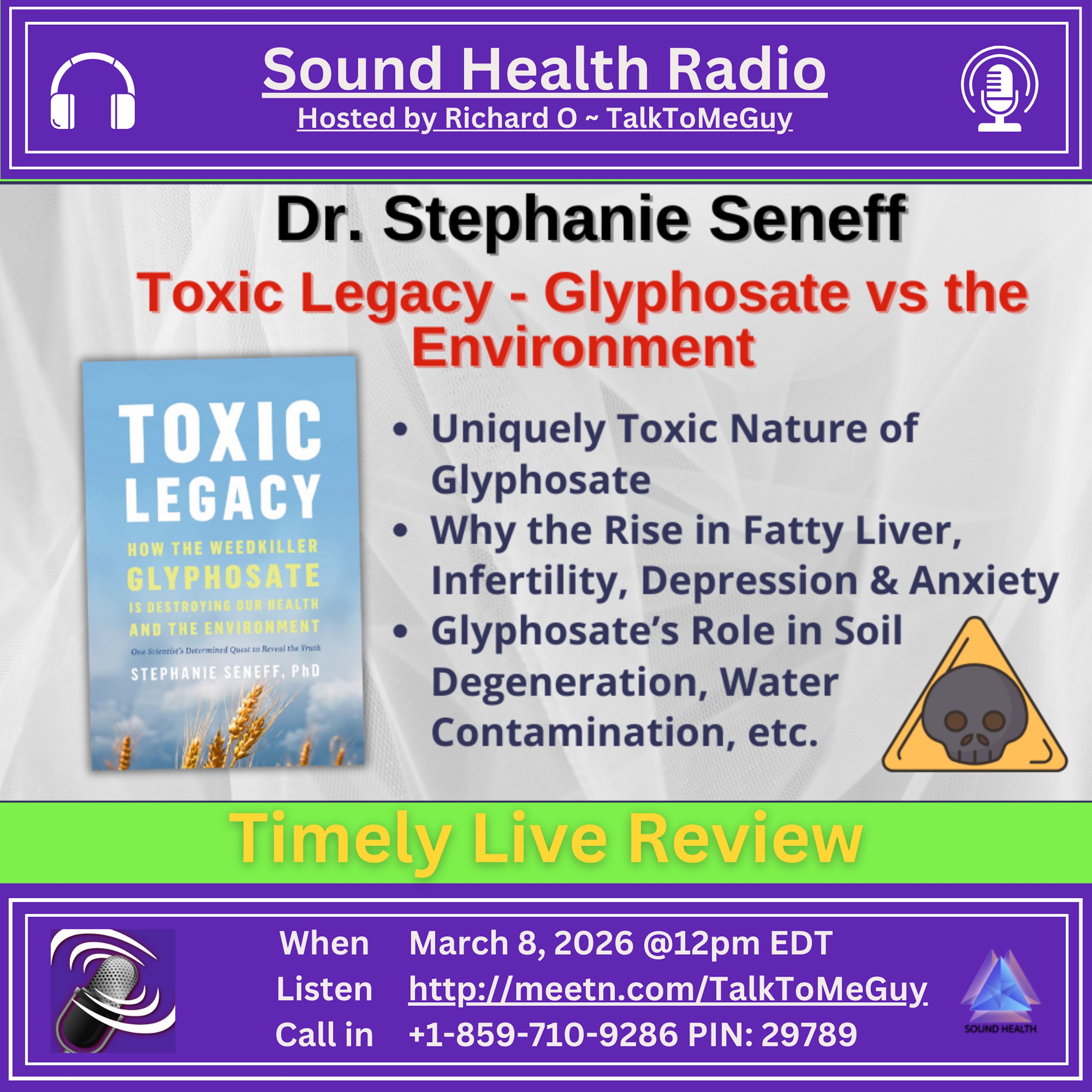
Toxic Legacy - Glyphosate VS The Environment

 PocketCasts
 Apple Podcasts
 Goodpods
 Audible
 Overcast
 Castro
 RSS Feed
 Dr. Stephanie Seneff is a senior research scientist at MIT’s Computer Science and Artificial Intelligence Laboratory. She has a bachelor’s degree in biology with a minor in food and nutrition, a master’s degree, an engineer’s degree, and a PhD in electrical engineering and computer science, all from MIT. For most of her career at MIT she was involved in the development of technology to support natural human-computer communication through spoken language.
Since 2010, Dr. Seneff has shifted her research focus toward the effects of drugs, toxic chemicals, and diet on human health and disease, and she has written and spoken extensively on these subjects. She has authored or co-authored over three dozen peer-reviewed journal articles, on topics relating human disease to nutritional deficiencies and toxic exposures. She has focused specifically on the herbicide glyphosate and the mineral, sulfur. Dr. Seneff splits her time between Hawaii and Massachusetts.
~Dr Seneff joins us to discuss her newest book: ‘Toxic Legacy: How the Weedkiller Glyphosate Is Destroying Our Health and the Environment’
Links from the show:
‘Toxic Legacy: How the Weedkiller Glyphosate Is Destroying Our Health and the Environment’
Toxins Harming Florida’s Manatees: What’s Killing These Beloved Creatures?
Martha Carlin of Biotiquest; very well done, recent post: 'Glyphosate From Infrastructue to Every System'
~
Please sign up for the email list for future notifications•
If you would like help starting your own show or podcast, as well as help selecting a microphone and setup for your voice; Please tap the microphone and leave me a message with your contact information and I will get back to you.
Or you can email: talktomeguy@gmail.com
More information at: SoundHealthOptions.com
Music
TalkToMeGuy: Greetings everyone This is the Sound Health radio show where we talk about the crossroads of the environment, our health and longevity, with Richard TalkToMeGuy and Sherry Edwards' off working on the Sound Health portal. I would suggest going to the SoundHealthPortal.com, scrolling down just a bit and clicking on the Watch How button. You'll see a short video explaining how to record and submit your first recording. Then go back to SoundHealthPortal.com, scroll down to current active campaigns such as cellular inflammation, biodeit, neuroplasticity, or memory, and choose one that is of interest for you. Click on that campaign and click Free Voice Analysis and the system will walk you through submitting your recording.
You receive an email with your report back usually in one to two hours. To hear and share replays of this show, 50 to 60 minutes after you hear the outro music, go to TalkToMeGuy.com, scroll down that page and you'll see this show at the top of the episodes page. There are also hundreds of shows available there as well. There is a microphone icon at the bottom right corner of all the show notes.
If you would like to leave me a voice message with a question for a guest or a guest idea for a show, you can do that directly from the site and I will be notified.
TalkToMeGuy: With that, Dr. Stephanie Seneff is a research scientist at MIT's Computer Science and Artificial Intelligence Laboratory in Cambridge, Massachusetts. She has a BS degree from MIT in Biology and MSEE and PhD degrees from MIT in Electrical Engineering and Computer Science. Her recent interest had focused on the role of toxic chemicals and micronutrient deficiencies in health and disease with a special emphasis on the pervasive herbicide glyphosate and the mineral sulfur. Since 2008, she's authored over three dozen peer-reviewed journal papers on these topics.
She's the author of a book on glyphosate titled Toxic Legacy, How the Weed Killer Glyphosate is Destroying Our Health and the Environment, which was released by Chelsea Green Publishers July 1st, 2021. Welcome, Stephanie.
Dr. Stephanie Seneff: So great to be here. Thank you for having me.
TalkToMeGuy: All right, everybody, please just relax, take a deep breath, have a glass of water, and say goodbye because this is going to get, it's always exciting with Stephanie and I get to talk about glyphosate or, oh man, it's mind-blowing. But first, I just want to read a couple of comments by some people who've read the book and reviewed it because it really does give it many kudos. Toxic Legacy is both a scientific expose and a call to action. Seneff's work will change the way we all think about food, Mark Hyman MD. Important nutritional guidance for conscientious consumers who want to avoid glyphosate-contaminated foods and improve their health. Toxic Legacy will stand shoulder to shoulder with Rachel Carson's Silent Spring, not just defining the pervasive threat to us and future generations, but more importantly articulating what we can do right now to change our destiny. David Polamotter, MD.
And I want to ask you a foundational question. Is it still, I think I got this from you, perhaps at the last show, American crops about one pound of glyphosate per person per year is used. Is that still accurate?
Dr. Stephanie Seneff: Wow. That's right.
TalkToMeGuy: That's really, that's amazing. That's mind-blowing. One pound per person, we should all get out a one pound bag of something and think about how much that is.
TalkToMeGuy: It just is really blows my mind. And I think I'll start here. Was your research on glyphosate or was your world of, wow, glyphosate really sort of started by your research on ADHD? Our autism was autism.
Dr. Stephanie Seneff: I started out around, I was aware of autism from way back. I had a friend back in the early 1980s whose son got a DPT shot, had a bad reaction, had seizures a week later and was diagnosed with autism, later diagnosed with autism. And that planted a seed in my mind about autism to watch for it. And I saw the numbers going up in the 2000s, early 2000s, consistently going up every year. And there was kind of like, oh, we're just diagnosing it more, don't worry, type of messaging.
But I didn't think so. I thought there has to be something in the environment that's doing this. And I was determined to figure out what it was. And I did start with vaccines. I worked on looking at other things too, like lead and mercury in the teeth and all kinds of fluoride, various things that I could find looking for correlations, not seeing it really. The vaccines are correlated for sure. And I think they're a causal factor. But I didn't feel like the vaccines were the whole story. After about five years, I happened to be at a conference where Professor Don Huber was speaking about glyphosate. He gave a two-hour presentation and I didn't know what glyphosate was.
I'm embarrassed to admit this was in 2012. I didn't know the word. But I was like, well, that sounds interesting. Let me check it out.
You know, another chemical. Let me take a look. I was blown away. I mean, that was a game changer for me.
I heard that two-hour presentation. I walked away convinced that I had found my answer. And it was really because I had been researching autism.
I understood a lot about the complexities of autism. It's not just a brain problem. You know, there's a lot of gut issues.
There's various mineral toxicities and deficiencies. I mean, there was a lot going on with the autistic kids not really managing things very well. There was something weird about their metabolism, I felt, you know, that they weren't able to handle exposures the way other kids were. And it was causing, eventually causing brain problems.
But when he talked about glyphosate and specifically what it does, it fits so well with what I was seeing from autism. I was looking for something in the food or something that was upsetting the gut. You know, I knew there was a really big gut problem with the autistic kids. And I also knew there was a mineral problem, like they couldn't handle minerals well. Manganese could be both toxic and deficient at the same time. You know, they were messed up with the minerals.
And both of those were home run with respect to glyphosate. Also the sulfur problem. Autistic kids, they release sulfate in their urine. And yet they have sulfate deficiency in their blood and in their brain.
So they're shedding sulfate for some weird reason. I mean, the whole thing is just so screwed up. And you're like, what is going on with these kids?
Glyphosate explains all of it. And I talk about it in my book. I talk a lot about autism because that's really been my passion. I feel like I know, I understand autism and I feel like if we banned glyphosate, tomorrow we would see the autism rate start dramatically dropping.
TalkToMeGuy: Mic drop. And that was a great show. Thank you so much. That really blows my mind. You've heard it, but you've said it before and each time it blows my mind as a kid, although I'm old enough that I was exposed pretty regularly to DDT.
And that scene in North by Northwest where there are crop dusters flying across the field, it was cool as a kid driving to the Salinas Valley to stick your head out the window and get crop dusted.
Dr. Stephanie Seneff: Seems like a thing you do. Oh boy.
TalkToMeGuy: Yeah, exactly. Oh boy. And so I had some people wouldn't believe it now, but I had some autistic characteristics as a kid and dyslexia. And I always had a gut feeling that it was part of that was the toxic load from the glyphosate.
Dr. Stephanie Seneff: I mean, sorry, not glyphosate, DDT. And I grew up around the Salinas Valley. So there was just tons of chemicals. They were a mouth of bromide in the fields and oh my lord. Yeah.
So yeah. Well, glyphosate is interesting because it's, you know, we've been led to believe very strongly led to believe that it's a wonderful chemical because it kills all plants except those that have been engineered to resist it. And it's completely harmless to humans. That's the message. And people are convinced that the government regulators know what they're doing. That's the big mistake that people make because they don't. And the industry knows how to fool them. And they get fooled. They probably want to be fooled because they want to believe that glyphosate can be so miraculous because, of course, it does help reduce the cost of growing food because you don't have to get people out pulling weeds.
You can't do manual labor. You just pour the poison over the crop from the airplane. Your crop is resistant because you've engineered it to be so. So it's a tremendous boom to agriculture until it isn't because what happens is over time the weeds develop resistance to glyphosate. And then you have to use more and more glyphosate every year, which is what happened.
The rate of glyphosate usage went up dramatically in the first 10 years of this century as a consequence of the introduction of these roundup ready crops. Corn, soy, canola, sugar beets, alfalfa, these are sort of core crops, you know. Many of those crops end up in the processed foods because you get the corn, of course, is the sugar. High fructose corn syrup is sugar. And then you've got the sugar beets are also sugar. And then you've got the soy protein bars. Those things are really toxic.
TalkToMeGuy: And the impossible, impossible burger.
Dr. Stephanie Seneff: The impossible burger.
Dr. Stephanie Seneff: It's so disgusting I would never touch it. And then it's been tested by Zen Hanukkah. And she found you know, glyphosate in it at pretty high levels in the burger. I would never eat one of those things. Not to mention just the way it's made, you know, with putting genetic engineering, I think it's E. coli or yeast or something and growing them with this plant like heme. I mean, it's just disgusting to think about in my opinion.
TalkToMeGuy: And I've never known a vegetarian or a vegan who is looking for their meat substitute burger to bleed.
Dr. Stephanie Seneff: I don't even want that right? No, they don't want that. They thought that was a cool saying like what?
Dr. Stephanie Seneff: Yeah, I guess they're hoping to draw more people in who want that who want that meat flavor to get it to draw more people into the vegan mentality.
TalkToMeGuy: So this leads so perfectly into the bigger question I was going to ask after that. Can you talk, I don't think we have a real grok or understanding of all the ways that we can be exposed or consume or inhale glyphosate. Could you and I'm going to sort of steer you in case you go a different direction. I'm really interested in the output of in Brazil, they do a lot with corn to make biofuels.
Dr. Stephanie Seneff: So that's all right, I can go with that one for sure because it's really been an eye-opener for me and that's something that I didn't really become aware of until just when COVID hit. Once COVID hit, I started to get curious because I saw that the first three places where things kind of lit up, you know, the of course, Wuhan and then Lumberdy region of Italy and then New York City, sort of three places where you became aware, oh my god, this thing is real, it's serious and it's coming at me, right?
That was really an eye-opener when it came to New York City. But all three of those places have heavy air pollution. All three of them have biofuels and they use a lot of glyphosate on the crops. So that was kind of an interesting thought to me and I hadn't even been aware of biofuels really before that.
I hadn't really looked into it at all. Once I started looking, I was like, holy cow, because if you think about the wheat crop, they spray it with glyphosate, in wheat, not a GMO crop, but they spray it with glyphosate to kill it and to bring, you know, to synchronize the yield. The going, the crop, when it gets hit with glyphosate, it goes to seed. So you get all the crop uniformly producing seed at the same time. So when you harvest, you get a greater yield that way. And it also dries it out, so it's easier to clear the crop for next year. And of course, also the glyphosate kills the weeds, so you get a head start on next year's weeds. So people think, oh, that's great, let's just do that. Spray the crop with glyphosate right before harvest.
And that's why we have an epidemic and see the act disease, I suspect. But that's a detour. Getting back to the biofuels, then they take this double after they've harvested the crop and they throw it on a barge, take it down to a city like New York City, process it through a processing plant and out comes biofuels. And that's biodiesel, bioethanol, biogas, you know, all these different biofuels, they even have biohome heating oil, which is required 5% in New York.
Anyone who uses heating oil for their home heating has to use 5% bio. So and they've got the biogas, you know, biogas can leak out of leaky pipes under cities, that happens in lots of old cities. The biogas leaks out and you're going to have glyphosate leaking out with the gas. So that comes to be glyphosate in the air.
And that was extremely interesting to me when COVID first hit, I had been looking into a condition that I suspected was being caused by glyphosate right before COVID hit, which is this vaping, you know, people who vape and they had this weird lung disease that was showing up and I was reading about it and I was like, this is so strange, I bet you glyphosate, just a hunch, you know, I bet you glyphosate. And I started to look and I found out that the base of this e-cigarette is glycerol. And glycerol is the major byproduct of the biofuel industry. When you get done making your fuels, what you've got left over is lots of glycerol. So the market's flooded with glycerol because they've really been heating up. The biofuel industry has been blossoming in the last few years, really growing fast.
And of course, there's this whole concept of saving oil, you know, all the good stuff. But the fact is when you put glyphosate in that biofuel, it becomes extremely toxic, I think. And so the glyphosates are getting into the air in the cities where these, now they've got these, and Brazil in particular, they have designed these trucks to run on practically pure biofuel, like 70% biofuel.
You have to design the engine especially to make it that work. But they've got these big trucks in Brazil spewing out, you know, I suspect, spewing out glyphosate. Now, if it gets to combustion, it'll be broken down. But that's going to also produce nitrogen and phosphorus in toxic gases in the air.
You know, even if it gets broken down, it's not going to be a free ride. But the glyphosate that's left over, I suspect, that survives and doesn't get into combustion because of a poorly tuned engine or, you know, when it's idling. I mean, there's ways in which the glyphosate can escape, evaporate into the air before it gets to combustion, I suspect.
And that's all sort of theoretical. But Brazil did a study a couple years ago, where they looked at glyphosate contamination in nanoparticles in the air. And they looked in the areas, agricultural areas where they were heavily using glyphosate. And sure enough, they found it. Then they looked in the city where they weren't, there was no agriculture looked in the city. And they found almost the same levels in the city.
They were surprised. So I think it's getting into the air through that process of the biofuels. This disease, this lung disease looks a whole lot like COVID. The disease that people get from smoking e-cigarettes, it looks a whole lot like COVID. You know, it's kind of a lung toxicity. It's a pulmonary, what's it called? See, I lost the word. I'm sorry.
TalkToMeGuy: I know that there's pulmonary edema in each of the lungs. In more than an infection, there's a toxic response, damage, pulmonary damage, you know, which happens with COVID as well. But I think the people who get really bad COVID, I bet you you would find a tremendous, if you looked, you would find a strong correlation between the level of glyphosate in their urine and the degree to which they can handle COVID. I suspect.
Dr. Stephanie Seneff: And I talked a little bit about it in my book. In my book, I have a whole chapter on glyphosate and the immune system. It's quite fascinating. And I think that glyphosate is causing severe disruption of the innate immune system, the innate system, not the adaptive. The adaptive is where you get the antibodies. And our whole program on COVID is geared towards getting people to produce sky high antibodies to the spike protein, you know, through the vaccination program. That's the goal.
And it works really well. The vaccine is producing incredibly high antibody response, typical of what you would get with severe disease. People who get a mild case hardly even develop any antibodies to the spike protein in a normal situation. But it's a severe disease that produces super high antibodies. And that's what you get with the vaccine. It acts like your body reacts as if it's been exposed to severe, a severe case of COVID.
And you need the antibodies when the innate immune system isn't working. And I wrote a lot about that in my book. It's quite fascinating because there are these proteins that are very special, that are several different proteins that are in a class that it has a characteristic collagen like stalk.
This gets a little bit technical, but it's very interesting, I think. And the collagen like stalk is an amino acid sequence that looks like collagen. And collagen has this especially unique property of having long, long sequences of what's called GXY, GXY, GXY, GXY, where every third amino acid is a glycine residue.
Tremendous levels of glycine in collagen. And collagen itself is the most common protein in the body. 25% of the body's proteins are collagen. Collagen's the glue, you know, it's in the joints, it's in the bones, it's in the brain.
It's like the thing that holds the body together and cushions the joints. And collagen has this beautiful triple helix crystal structure that depends on those glycines every third amino acid. Glyphosate goes in, I believe, and this is the big argument in my book, substitutes for that glycine at random places in the molecule and prevents the collagen molecule from folding correctly into this triple helix structure, which then messes up its properties in a big way. So it does the same thing to these collagen-like stalks on these proteins that are very important for the immune system. And a group of them are these surfactants that are produced in the lungs. And those surfactants grab viruses and trap them. So when those things are broken, the virus can't be trapped. It goes into the lungs and it has a field day because it can't be trapped.
TalkToMeGuy: Wow. And so that makes me jump to asking about we have an elevated rate of liver, fatty liver issues. Right. Is glyphosate in that mix? Is glyphosate one of the factors in there? Absolutely.
Dr. Stephanie Seneff: And that's another chapter in my book. I have a whole chapter on the liver. I had a lot of fun with the liver. Every chapter was a challenge. I'll tell you, the gut chapter was the hardest one to write, but I was pleased with the outcome. It took me a long time to kind of work that story out.
But that's a very complicated story. But the liver, very, very interesting. And I believe it has to do with, there are several things that glyphosate, there are several enzymes that glyphosate disrupts. And some of them are really critical in the mitochondria. So there's a succinate dehydrogenase is an enzyme that's super critical in the mitochondria.
It links together. It works both as part of the citric acid cycle and as part of the phosphorylation. So those are the two big things that mitochondria do. And this enzyme plays an important role in both of them. And this enzyme is suppressed by glyphosate.
That's been shown in multiple studies and I gave the references in the book. But there's another enzyme that I think glyphosate is suppressing that hasn't been studied. It's called PEPCK, phosphoenolpyruvate carboxykinase. It's a very, very important enzyme everywhere. But in the liver, it plays a super, a super role. And it basically is essential for being able to process fats through the mitochondria and turn them into sugar.
And so there's a whole process. The liver can actually kind of reverse engineer and make sugar out of fats. And it needs this enzyme to do that. And this enzyme has a characteristic structure at the place where there's a critical glycine residue that binds phosphate. And I talk about in my book, it's exactly modeled by the enzyme that glyphosate famously disrupts in the plants called EPSP synthase.
So there's some, you know, biology, technical biology behind this. But when you study, people have identified EPSP synthase, how glyphosate disrupted. That's been the argument that's the enzyme that the plants totally depend on to make critical aromatic amino acids. Glyphosate disrupts that enzyme, the plant dies.
That's the basic story of how glyphosate kills the plants. And then the good, the happy, happy line is that, oh, we don't have that pathway, we don't have that enzyme, therefore, our cells are safe. That's the argument that's used to say this is a great chemical, because it doesn't affect our, we don't have the enzyme that it affects in the plants. But the problem is we have other enzymes that are lookalikes to that enzyme.
And you can find those enzymes and you can see that, if glyphosate were to cause the same problem for those enzymes, you would have the very things we see that glyphosate causes. So it's all a big puzzle that I've worked out in the book in great detail. I'll tell you, I tried to make the book as light as possible. So don't be too scared away by the biology. There is some biology in there, but it's, I tried to kind of buffer it with some explanations and some help for the people who don't have a biology background.
So I'm hoping that it can reach a lot, a larger audience than just the experts. But anyway, getting back to this PEPCK, really, really fascinating, because if that enzyme is disrupted, you're going to get fatty liver disease because mitochondria can't process fats. And you're going to get high blood sugar because the body needs to depend on that enzyme to turn other things into sugar when the blood sugar drops low. So what, you know, if your blood sugar goes too low, you end up in a coma.
And you have mechanisms that say, Oh my God, we've got to do something here. The blood sugar is too low. Let's make some sugar and let's deliver does that for you. It makes the sugar and dumps it into the blood to keep it from being too low. So if you're exercising vigorously, the blood sugar is dropping, you can go into a coma unless you have the facility with this enzyme to make more. And when you don't, your body says, Oh my God, you got to raise the set point for sugar because we can run into trouble. It will sort of observe through experience.
We need to raise the set point. So then you get this kind of elevated blood sugar that's a precursor to diabetes. And eventually it becomes full blown diabetes because of this enzyme being broken, I think, you know, so fatty liver disease, I mean, that's been shown. They did a rat study fairly recently where they exposed the rat to rats to levels of glyphosate that were below the regulatory limit over a period of time. And those rats developed fatty liver disease. So you could see that even at very low levels, glyphosate causes it. And then there was a study on people who had fatty liver disease, they had three groups, the severe cases, the more benign cases and the people, the controls who didn't have fatty liver disease. And they found statistically significant differences in the amount of glyphosate in the urine among the three groups, which was really quite remarkable, in my opinion, that you could show through the urinary test, the connection between, and it's correlation, obviously, that they didn't explain how it caused it, but I can explain how it causes it.
TalkToMeGuy: Of course they didn't. And I just, as an old, for the new people listening, I, years ago in the early 80s, had an herb store in a national miller to catalog. And so I'm always amazed when I talk to you how I think of many conditions that people have or imbalances, you know, like the liver is only like the organ that does so much for our bodies and breaking things down and making it happen, as well as our gut. And so far, glyphosate is kicking them both in the head hard. And so it explains why I, and back to also the collagen thing, I know that the technology has made it in vogue.
However, I think that what you're talking about with what's happened to the collagen is why there are so many hip and knee replacements. That's my opinion. Absolutely. That's just my opinion. That's all I'm saying.
Dr. Stephanie Seneff: It is. It's my opinion as well. And I wrote about it in the book. And I think it may also be connected to the opioid drug crisis, because I think a lot of people are in pain. You have so much back pain and neck pain and, you know, lots of foot problems. I mean, people have some, you see all these people hobbling around these days. I feel like people expect, you know, as soon as you're 60 years old, you're going to just fall apart, you know, people almost expect it now, it seems like.
It's not true. You shouldn't have to, you know, you should still be very agile at the age of 80 or 90, I think. If all goes well, and you avoid all these toxic chemicals, but the glyphosate is a real killer for the joints and the bones. And then you get a lot of pain. And then you get stuck with opioid drug crisis, you know? I think the companies are despicable, but they're being blamed totally. And no one's saying, well, how come all these people are in so much pain?
No one's asking that question. You know, when they say, oh, these companies are so despicable because they gave people all these drugs and they got so hooked. But the people were in agony, they needed the drugs, you know, and that's what the companies actually argue. We're doing a service for these people. They can't stand living if they don't get these drugs, you know?
TalkToMeGuy: It's really, it really blows my mind. I have my grandmother live to be 106. Wow. Congratulations. Well, she was, this is, she died in the 70s. And she had come across, she was old enough that she actually came across the United States in a wagon from Michigan to Salt Lake City.
Dr. Stephanie Seneff: Wow, so impressive. And the thing that always blows my mind that is a theme for me is that in those times when they grow their own food, my grandparents ate organically. They just ate that.
Right, exactly. They had no idea that like, oh, we eat organic. That's what they grew. They grew their own food. They fed their own pigs. They grew their own cows. They did everything. And she lived to be 106 and she was completely vital until she was 98 when she broke a hip because she fell cleaning the snow off her front step.
Dr. Stephanie Seneff: Oh, wow.
TalkToMeGuy: But until that time, but at no time until then had she ever had a health issue or a thing. She'd always worked. She worked in her up until her late 80s, still baking pies for the drink. I mean, it was, and I mean, she had a cafe, not just like baked pies, like hundreds of pies.
Dr. Stephanie Seneff: And she was totally vital. That's a good example. And I think it's really kind of interesting to me. It feels like people very quickly adapt to the new normal. You know, when we see all these kids with autism, and of course ADHD and all the eczema and asthma, all these autoimmune diseases, you know, the celiac disease, all kinds of food intolerances, peniology, all these things. And somehow this generation of parents are comfortable with that.
Oh yeah. I mean, you know, my kids got asthma. Oh yeah, mine's got eczema. I mean, it's just like, oh, yes, of course, you've got something if you're a kid, right? You're just sick.
You get colds all the time. I mean, it's all normal now. It's just not normal. I know it's not normal when I was a kid. You know, in grade school, I remember in grade school, one child who was a year behind me that had a lung problem. She had asthma, you know? I don't remember any peniology. I don't remember any autism.
There was nothing. Everybody was healthy. So it's weird that we very quickly adapt to a new model for what's normal. And I think it's the same for the old people. I know when I go to the airport and I see all these people in wheelchairs or walkers or there, you can tell they're an agony as they're walking even without any support.
You know, so many people are just hobbling around. And it breaks my heart because I think we're all being poisoned by glyphosate. And this is happening to us and we're not noticing it. Why are we not noticing it? It's not the same as it was then, you know?
TalkToMeGuy: I always find it amazing when I, the few times I do go to doctors and I have a very smart, what I would call hippie doctor, but not really. I mean, she's fully degrade and went to swanky school. And I know that when the nurses do an intake, they're always, well, are you still on any of these medications? But because about 10 years ago, I was hospitalized for a while and I had some major just physical surgeries, not involving anything we're talking about. But the doctors are always amazed when I come in and I'm careening in on 70. I'm on no meds.
And that creates everybody in the office to like, oh my God, you're not, how is that possible? Are you lying? You must be on something. You're on nothing. I'm on nothing. That's my level of medication is nothing.
Dr. Stephanie Seneff: That's awesome. Same for me, by the way. Nothing.
TalkToMeGuy: Yeah. I just can't I'm like you. I can't imagine it any other way. I'm not, I'm not interested in being on meds. And I also know that it is really surprising to me how many of my friends are in pain. I mean, but not like I have to be on a walker. I have two friends that one had a hip replacement and he's only in his early sixties and another friend who had bilateral knee replacements and still is well.
Dr. Stephanie Seneff: I talked about the statistics on those things in my book. I was quite shocked to see when of course one thing is they claim they're getting better at it. And so they'll, you know, they make money off it. I mean, it's various pressures for doing more, right? That are happening right now, but the rates have gone up astronomically in things like hip replacement surgery and knee replacement surgery. I mean, many people are routinely getting these things now.
TalkToMeGuy: Now it's a thing. It's like calling a part. Yeah, it's like cocktail conversation now. Like, oh yeah, you know, my husband added a hip replacement. He's great now.
Dr. Stephanie Seneff: I'm like, it's amazing to me. I find it really interesting that people don't notice, you know, and also that people are have so much faith. I mean, they've gotten used to the fact that you can just go down to their local garden store and buy some roundup and kill your dandelions, you know, and it's been touted as being so safe. And people have a hard time wrapping their brain around the idea that this stuff is actually really toxic, you know, and it's dangerous because it's insidiously cumulatively toxic.
It doesn't blow you over. So you don't notice right away that you're being poisoned happens solely. And that's part of the problem. And of course, it's all over the food supplies in the air.
You can't avoid it. So everyone's being poisoned, you know, to varying degrees, some worse than others. And then people, some people get horrendously sick and they have no clue why. And I think if they just got off that glyphosate, they'd find remarkable improvements in their health.
TalkToMeGuy: And I'm always amazed how there are a number of people that I see that use something like Roundup, the over the brand name, and they have the, oh, I'm not using that much. Right. That kind of thing.
I'm just killing the weeds in the driveway. And I'm like, how about you just to hold them out? How about you just scrape them out of place? Or how about they grow through the cracks? They're, you know, they're just plants.
So it really amazes me how people take that on. And I remember many years ago, I interviewed Dr. Marion Moses, an MD who wrote a book called Design or Poisons. And that was in the, I don't know, man in the 80s, maybe because I was doing radio then. And she was stunned to find that the amount of toxins, and this was in the 80s.
Dr. Stephanie Seneff: So people were looking at it like they're now. And compared to now. But compared to now, but the amount of toxins at that time, the highest level of stuff getting dumped into the atmosphere or into the waterways, I'll say, but really
TalkToMeGuy: by
Dr. Stephanie Seneff: nd how do you get rid of it?
TalkToMeGuy: nd how do you get rid of it? nd how do you get rid of
Dr. Stephanie Seneff: it? nd how do you get rid of it? nd how do you get rid of it? nd how do you get rid of it? nd how do you get rid of it? nd how do you get rid of it? nd how do you get rid of it? nd how do you get rid of it? nd how do you get rid of it? nd how do you get rid of it? nd how do you get rid of it? nd how do you get rid of it? nd how do you get rid of it? nd how do you get rid of it? nd how do you get rid of it? nd how do you get rid of it? nd how do you get rid of it? nd how do you get rid of it? nd how do you get rid of it?
TalkToMeGuy: nd how do you get rid of it? nd how do you get rid of it? nd how do you get rid of it? nd how do you get rid of
Dr. Stephanie Seneff: it? nd how do you get rid of it? nd how do you get rid of it? nd how do you get rid of it? nd how do you get rid of it?
TalkToMeGuy: nd how do you get rid of
Dr. Stephanie Seneff: it?
TalkToMeGuy: nd how do you get rid of
Dr. Stephanie Seneff: it? nd how do you get rid of it?
Dr. Stephanie Seneff: nd how do you get rid of it? nd how do you get rid of it? nd how do you get rid of it? nd how do you get rid of it? nd how do you get rid of it? nd how do you get rid of it? nd how do you get rid of it? nd how do you get rid of
TalkToMeGuy: it? nd how do you get rid of it? nd how do you get rid of it?
Dr. Stephanie Seneff: nd how do you get rid of it?
TalkToMeGuy: nd how do you get rid of it?
Dr. Stephanie Seneff: nd how do
TalkToMeGuy: you get rid of
TalkToMeGuy: it? nd how do you get rid of it? nd how do you get rid of it?
Dr. Stephanie Seneff: nd how do you get rid of it? nd how do
Dr. Stephanie Seneff: you get rid of it? nd how do you get rid of it? nd how do you get rid of it?
TalkToMeGuy: nd how do you get rid of
Dr. Stephanie Seneff: it? nd how do you get rid of it?
Dr. Stephanie Seneff: nd how do you get rid of it? nd how do you get rid of it? nd how do you get rid of it?
TalkToMeGuy: nd
Dr. Stephanie Seneff: how do you get rid of it?
Dr. Stephanie Seneff: nd how do you get rid of
Dr. Stephanie Seneff: it? nd how do you get rid of it? nd how do you get rid of it? nd how do you get rid of it? nd how do you get rid of it? Glyphosate has a very difficult CP bond that most species don't know what to do with. Which is why they argue, Monsanto argues that it basically comes through, your system goes out through your urine, it's all gone, and it gets converted to amper, which still has that CP bond. But other than that, it doesn't really go anywhere, and then the amper and the glyphosate go out through your feces, through your urine, you're all set. They're lying because their own studies have shown that it accumulates in the tissues. They say it all goes away, but it's not true, it accumulates in the tissues. And that's the form of protein, I suspect, tied up in protein, because of this problem of substituting for glycine. Yikes.
TalkToMeGuy: And I will too plant the flag in the ground of all things fermented. I'm a big fan of everything that you named.
Dr. Stephanie Seneff: Oh, good. I'll have kimchi with breakfast, I don't care. I'll have kimchi anytime.
TalkToMeGuy: Anywhere, any meal. Just hand me sauerkraut or kimchi, I'm happy.
Dr. Stephanie Seneff: There you go. It's got a developed taste, but it really, it's very tasty. It certainly has a unique flavor.
TalkToMeGuy: And the benefits. Now I can really think. Do you think that we can, we both agree we should get rid of glyphosate. Until then, until we can, because it's going to take a while, once we ever do stop using it in this country, eventually it seems like we've got to figure it out.
Other countries. In the interim, I'm kind of jumping to what chapter is that? There's a chapter 11 reboot today for a healthy tomorrow. Right.
We're sort of careening toward the end of the show, which I'm shocked. Can we, until we get to reboot after glyphosate goes away, do you think we can at least help ourselves besides fermented foods and of course your friend Sunshine and cholesterol sulfate and all of that? Can we keep our immune system healthy enough and vital enough to at least kind of ward some of the deleterious effects of glyphosate?
Dr. Stephanie Seneff: I would think so. I mean, certainly I try everything. I'm a great fan of the sun and I just think really such a simple thing to get outside. I think people should try to be outside as much as they can.
In today's world, you know, most of what you do is indoors. So you have to make an effort to go outside and make sure to get that healthy, full spectrum sun exposure and your eyes, you know, don't wear sunglasses. I never wear sunglasses and I'm 73 years old and my eyes are fine. I don't have cataracts. I don't have retina problems.
My eyes are fine, which I think is quite remarkable given that I've never used sunglasses because people think, oh, we got to protect the eyes of the sunglasses. It's the wrong way to go. But of course, the glyphosate actually goes into the eyes. Anthony Sampson has, you know, he's a friend of mine and we've collaborated and he's an interesting guy, but he's gotten a hold of a lot of documents from Monsanto that were their own early studies on glyphosate and he's seen that they've observed, you know, that it goes into the eyes and causes trouble there. So I suspect that glyphosate exposure and glyphosate also messes up the skin because the melanin, the skin tanning agent, comes out of that chikamate pathway.
We didn't talk about this, but many different vital molecules in biology come out of that pathway that glyphosate blocks in the gut microbes. So people end up with deficiencies in critical things and one of them is melanin. I have a lot of people say to me, oh, I can't get out in the sun. I just, I never tan. I just, I just burn, you know, my skin is white. I get red and, you know, and then I, it's clear that I'm being over exposed to the sun. I have to get out of the sun because I don't tan. And I think that means I don't have enough melanin in my skin. And this melanin is a product of the pathway that glyphosate blocks. You can imagine that it would be deficient. So I think the glyphosate is, and of course, glyphosate also causes mitochondrial damage in the, in the eyes.
It's going to cause inflammation, which is going to damage the retina. So I suspect that the reason why, you know, and sunscreen use has just gone up tremendously over the past three decades tremendously. And we're so obsessed with making sure we, we slobber ourselves with sunscreen. And that's also probably connected to glyphosate, just that people are more aware that the sun is causing damage because it is causing damage because glyphosate is disrupting the enzymes, all the, all the mechanisms that the body has to protect this, the body from sunlight, because, you know, sunlight is a gift, really a very big gift of energy source that plants use very effectively to turn, you know, carbon dioxide into the sun. And so we're going to get into, into, into biomass and animals use the sun, I think, for mobility and for thinking for the brain, the neurons and the muscle cells take a tremendous amount of energy. And they can really, the animals can afford to use that kind of energy because they get exposure to the sun. And so when we avoid the sun, we're really disturbing the mitochondrial energy supply that's going to cause all kinds of troubles, you know, things like chronic fatigue syndrome and various neurological diseases, like autism and Alzheimer's. So I think very, very important for all of, for the whole body health to get sun exposure to the eyes and to the skin.
TalkToMeGuy: Well, and I, not unlike yourself, I have never had anything done to my eyes, no cataract surgery, which I think is sort of the hip replacement of, you know, right now, also, because everybody's having cataract surgery. They're like, Oh, I know, I can't believe it. And I'm like, why? I, you know, I, it's amazing how we come up. We're fixing things that if we fix the main thing, which is polluting our atmosphere and stopping with a glyphosate, we might not have to fix all these things.
Dr. Stephanie Seneff: What a radical idea. I think for sure. Yeah, it's really interesting how we put up with it. And we just go along with the, you know, oh, yeah, of course.
Oh, yeah, I had cataract surgery, of course, you know, it's just like everyone does. It's just the normal thing to do now. And so it becomes normalized. And of course, autism too, I think becomes normalized. Now they're saying autism is sort of another way to be normal. You know, the kid can't speak, but that's not really a problem, you know, I mean, hello.
TalkToMeGuy: There's special, there's special, there's something. And I'm not dishing in any way autistic kids. That's not, it's not their fault, but it's like, we're trying to normalize this thing that is not.
Dr. Stephanie Seneff: Right. Yeah. And I just think that's messed up to be polite. Yeah. And even ADHD, you know, which is now total epidemic, I think something like a percent of the kids. Yeah. Yeah, it's really sad. Yeah.
TalkToMeGuy: I wish we'd all take diet classes, but like, you know, how to eat clean food. Let's just start out.
Dr. Stephanie Seneff: And it's so simple, really. And I do think people should value time in the kitchen more. I think people are so hung up on efficiency, right? They don't waste time cooking. So they just buy processed foods to stick it in the oven. You know, something very easy. People should really honor the kitchen and spend more time cooking and go back to whole foods and, you know, from scratch and all that kind of thing.
TalkToMeGuy: Just don't eat anything out of a box. Right.
Dr. Stephanie Seneff: We're not bad. Let's start there. That's the general policy that I have. Let's just shop the perimeter of the store. Right. That's really kind of the deal. Just avoid the middle.
Just go around the edges. You'll be fine. And, you know, you're doing this to keep yourself safe from COVID. This is something that I really wish the government would emphasize that people need to eat well in order to protect themselves from COVID.
TalkToMeGuy: You know, I look forward to your next book on that.
Dr. Stephanie Seneff: Yes, I hope we all have the energy to write something like that. It would be quite a show.
TalkToMeGuy: It would be quite a thing. I'd be happy to talk about that. There was the, in the way backstage, I did cook professionally for 20 years on and off in between other jobs, other lives. Oh, wow. And so I just think it's, I just don't understand the go out and get something in a box and heat it. Like, like the infamous macaroni and cheese in a box. Right.
Dr. Stephanie Seneff: You know, macaroni and cheese can be, macaroni and cheese can be such a delicious thing, but you can make it with a good, clean grain and the same thing cheeses. And it's like mind-blowingly wonderful. Right.
TalkToMeGuy: You don't get it out of a box and teach the kids how to nuke it when they're children. That's just, again, my opinion, I can get surly.
Dr. Stephanie Seneff: And it is true that kids today aren't even being taught how to cook. So they feel like it's kind of a foreign thing, right? So they really don't know how to do it, even though it's not really that hard. But it's, it can be a hurdle, I think, when they'd never get practiced with it as a child.
TalkToMeGuy: They have no exposure to it. Yeah. Yeah. Yeah. No, I won't. I was going to, well, I'll say this briefly. There's also this trend with the, because I live north of the Silicon Valley. It's a very big trend to have these things like Blue Box or these other services where they pre-back all your food. It's raw. So if you're making a recipe that has two cloves of garlic, that's all that's in the box.
Dr. Stephanie Seneff: But you get a meal for four. Right.
TalkToMeGuy: It's pre-raw. You know, everything's raw and you do have to cook it. But it's, there's so much, I have so many bad words about this because it irritates me so much. There's so much plastic in the packaging.
Oh, yeah. None of it's recyclable. It's just another thing of, oh, we need more waste.
Like really, really, what plastic waste? Are you kidding me? But the idea is that you can't go to the store and actually purchase your food because you're much too busy being important, I guess.
Dr. Stephanie Seneff: Right, right. Even the whole, even the thing of putting each bag, each lettuce in a plastic bag, you know, we don't, we somehow, I've gotten, you see, I mean, you can't just put the food out there, you know, and just pick up a bit ahead of lettuce with no plastic bag around it, you know, you would think.
TalkToMeGuy: No, it has to be completely wrapped. It has to be, no, no, those lemons need to be wrapped in plastic. Those limes need to be, like, they don't have a skin that protects them. Okay. I'm surprised to say that we're there, where I have to ask you.
Dr. Stephanie Seneff: We had a lovely conversation.
TalkToMeGuy: It was a great conversation. Very fast. Yeah, very fast. Where can people find out more about you and your work? And where should they look for toxic legacy?
Dr. Stephanie Seneff: Yeah, so I have a web page, a personal web page, definitely, center of .net. And under that web page, I have flash book where you can find pointers to various booksellers that sell my book. You can also just type, type toxic legacy. If you can remember toxic legacy, type it into a Google search engine and the Amazon link will come right up. So toxic legacy, how the killer life is destroying our health and the environment. That's the name of my book. And yeah, I have an MIT web page where I have a ton of information, all kinds of side shows and interviews and whatnot. Papers, all the papers, most of the papers that I've published.
TalkToMeGuy: Yeah, I put that link in chat with a warning of like, this is really for the hard nerd crowd.
Dr. Stephanie Seneff: It is exactly very nerdy looking web page. It's a kind of page I like at night sit up and watch, read like, wow, that's amazing. Look at this one. There's wonderful research available at that page.
Yeah, but it's not for the casual viewer. Yes, I will. Thank you. All right. Well, thank you so much. That was and I also put a link for the wonderful article about the manatees.
TalkToMeGuy: Come on.
Dr. Stephanie Seneff: Oh, great. Wonderful.
TalkToMeGuy: Please. Let's there's a giant example of a wonderful creature being in its life being destroyed because we just can't figure it out. It blows my mind.
Dr. Stephanie Seneff: It is so sad, isn't it? Because they're very special. And it's just a shame that we're destroying them. Yeah.
TalkToMeGuy: All right. Thank you. That note. Yes, exactly. I got no up note here. That was wonderful. It went faster than I thought it would. Thank you. Everybody have a great rest of the weekend. Bye bye.
Dr. Stephanie Seneff: Bye.