Using the Emotional Stabilizer to Balance your Health with Kathleen Nagy
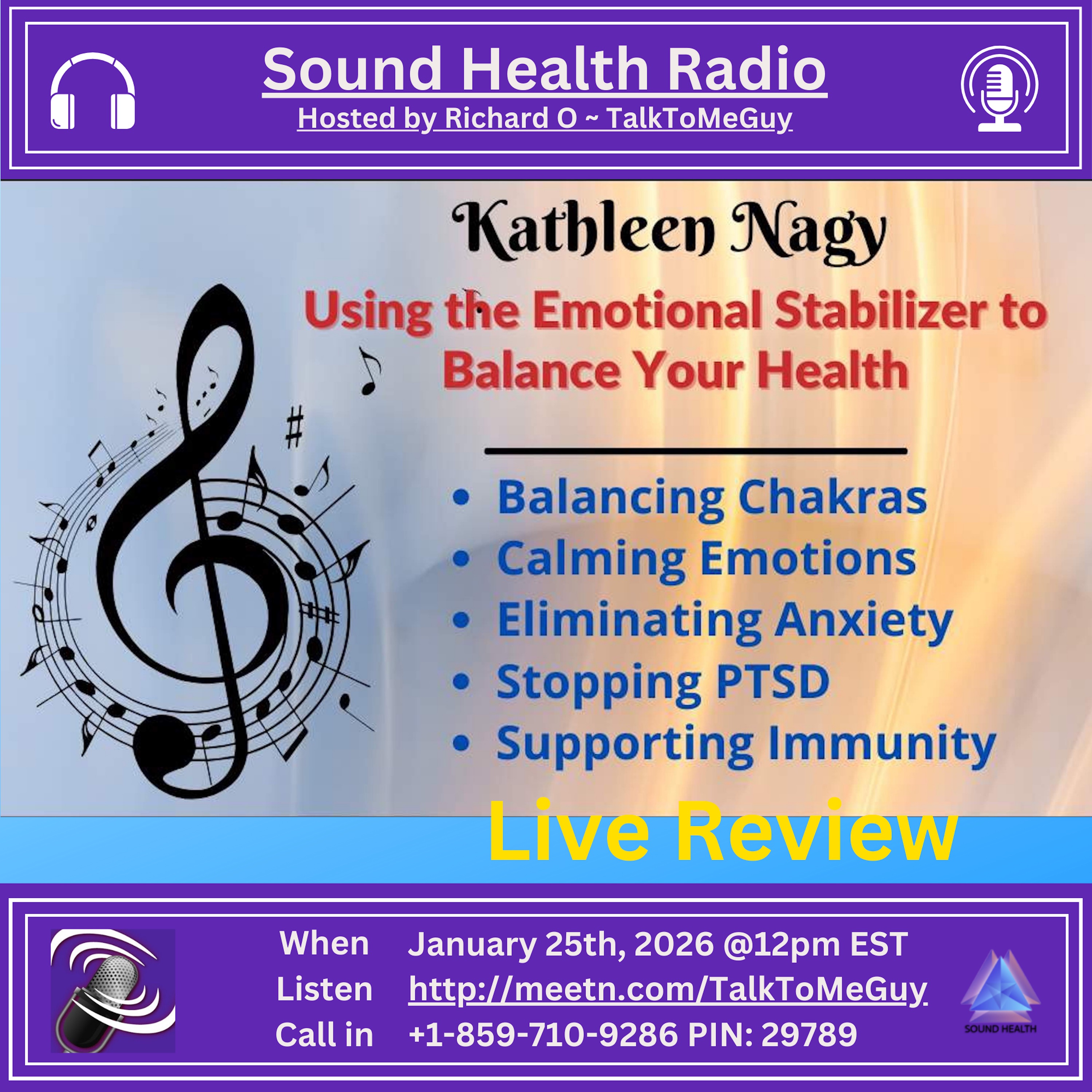


Kathleen Nagy AKA as The Sound Lady. Do you need a better way to manage your pain? Are you so sensitive that many pharmaceuticals give you bad reactions? Has a detox plan or new supplement sent you into a healing crisis? Is your immune system overtaxed? If the answer to any of those questions is yes, then I’d like you to consider Sound Energy as an alternative self care technique.
Sound vibrates not only the physical body but the emotional body, mental body, and spiritual body. If a physical issue has manifested, it may have began in the emotional body, and all the work you do on the physical body will not be lasting. Knowing the right sound/note can help you get to the root of the problem wherever the problem resides. Understanding more about your energy body is crucial to the health of your physical body.
Kathleen Nagy joins us to talk about her new 'Emotional Stabilizer' .
Show links:
Kathleen Nagy The Sound Lady
What is My Personal Chakra Song
Information on the Sound Health Portal
Please sign up for the email list for future notifications.
If you would like help starting your own show or podcast, as well as help selecting a microphone and setup for your voice; Please tap the microphone and leave me a message with your contact information and I will get back to you.
Or you can email talktomeguy@gmail.com
More information at: SoundHealthOptions.com
TalkToMeGuy: Greetings everyone.
TalkToMeGuy: This is a Sound Health Radio show where we talk about the crossroads of the environment, our health, and longevity with Richard TalkToMeGuy and Sherry Edwards is off working on the Sound Health Portal. I would suggest going to soundhealthportal.com, scrolling down just a bit and clicking on the Watch How button. You'll see a short video explaining how to record and submit your first recording. Then go back to soundhealthportal.com, scroll down to current active campaigns such as bio diet, memory, or cellular information, and choose one that is of interest for you. Click on that campaign and click Free Voice Analysis and the system will walk you through submitting your recording.
You'll receive an email with a report back usually in one to two days. To hear and share replays of the show, 50 to 60 minutes after you hear the outro music, go to TalkToMeGuy.com, scroll down that page and you'll see the show at the top of the episodes page. There are also hundreds of hours of show available there as well. There's a microphone icon at the bottom right corner of all the show notes. If you'd like to leave me a voice message with a question for a guest or a guest idea for a show, you can do that directly from the site and I will be notified. I would also suggest signing up for the email list for future notifications. With that, there's a hidden superpower in your voice.
You can give you the energy you need to feel better, sleep better, and live better. Kathleen Neggy majored in music education and applied music on French horn at Hifica College and did graduate work at Yale University majoring in French horn and minoring in orchestral conducting. She performed for 20 years as an orchestral musician and has taught music in both public and private schools from elementary school to adult education, both choral and instrumental music. After 20 years of performing in symphony orchestras playing the French horn, she forged through the ingredients of crafted classical melody, harmony, and structure and found the power, beauty, and healing properties of tone and harmonics. For the past 20 years, she's been a bioacoustic research associate specializing in voice energy analysis and acoustic biofeedback for sports and muscle injuries. As the culmination of her life's work and sound healing, she specializes in teaching people how to hum the sounds that are good for their bodies through online courses and private sessions. Kathleen Neggy joins us to talk about her news work, the emotional stabilizer. Welcome Kathleen.
Kathleen Nagy : Hi Richard, it's great to be with you and with your audience again.
TalkToMeGuy: It's always an adventure. You're already talking backstage. I'm going to jump right in and I'd like you to talk about this new very cool project you've done called the emotional stabilizer. Please tell us. I think this is so cool and radical in the best way.
Kathleen Nagy : Well, you know, for years now I've been teaching people how to hum their own chakra scales and not everyone finds it easy to learn that. Many people didn't really get the proper music education when they were younger and music is one of the five intelligences, one of the seven intelligences.
So when sometimes I find that people have a hard time matching pitches and so it's hard for them when I say hum this note and they go they can't find it and so it's hard for them to really get the full benefits out of humming along with their chakra scale MP3s. And I also wanted to get some emotional, you know, balancing going on in a couple of different worlds, one especially with the LGBTQ group and also with soldiers. People who are who have a good deal of anxiety and PTSD and I wanted to think of an easier way to allow people access to this feeling of being calm and centered maybe even without having to spend $100 to do a session with me to learn your personal chakra scale.
And so I went into a very deep meditation and came up with this emotional stabilizer idea. Knowing that what I was going to do was play on the piano which is tuned to A equals 432 hertz just up and down the scale basically just play all the notes that are possible to play in a couple of octaves going up and then coming back down again. That means everybody's chakra notes are all going to be sounding because we're using all of all the possible notes, you know, of the musical scale. So you might not, you know, hear it from you might not feel your chakra notes, you know, vibrating in the first three or four notes, but then you might feel your root chakra in the fifth note.
Some people might feel it in the eighth note. It just they're different sort of everyone has their own chakra scale and it just starts on a different note. So if I played all the different notes, all the possible notes of the scale, it said to me, well, that'll be covering everybody's chakra notes. And then I thought the way to balance the emotions of each one of these chakra energy centers and everybody's bodies is to use the the interval, the musical interval called the perfect fifth. Now an interval is simply music theory.
It means the distance between two notes. So if Do is one and Ra is two and me is three and Fa is four, then Sol is five. And the distance of a perfect fifth would be like from Do to Sol or on the C major scale from C to G that interval that sounds, let me just play it here. The fifth above the root note, the bottom note, is the emotional component of that lower note. It deals with the emotional energy field that that lower note will excite. So let's say the lower note is vibrating your heart chakra. Then a fifth above that note is going to really balance the emotions in that chakra. And you can do that for each of the chakras. So using the perfect fifth in this scale that I do in the emotional stabilizer just kind of goes up the scale and down the scale covers all of the possible notes and all of their emotional support notes.
Yes, the perfect fifth is the emotional support note for the root note. So but along with that, I utilized a couple of different rhythms, some basic sound to healing sound therapy rhythm information is a rhythm that has kind of two beats. It's like a one, two, one like a march. Let's say we're marching that one, two, one, two, one, two. That type of a rhythm disperses energy as opposed to a three beat rhythm one, two, three, one, two, three, one, two, three. That is a rhythm that gathers energy. So I created the emotional stabilizer not only with the right with all of the notes and their emotional support notes, but I put them in rhythms that first disperses energy. So it's to kind of clear energy out in that area and then to gather it the harmony back in. So it's a very simple little piano piece.
It's about 12 minutes long. And that's sort of the nuts and bolts of how I created it and why I chose the notes I did. But the good news is it will calm you right now that it just puts to me it puts your emotions sort of back to neutral. It's the people have told me it stops panic attacks. It stops PTSD. It stops anxiety. Certainly helps you go to sleep at night.
And just during the day, it will help you rebalance and get back to neutral and start again. And I know that Richard's had some experience with this because I made him listen to this before this interview. So we could get some great feedback from him.
TalkToMeGuy: And so I'm ready. My experience has been that it's we were talking about it before the show. I use the emotional stabilizer in the evening after a day of work. And by the end of the day, I've read enough stuff to make my eyes bulge because that's what I do or research or produce for people.
And by the end of the day, and oftentimes when I'm running something and I'm running well, for example, I did a an event on Saturday. And it was about 400 people in a zoom. And that's a lot of wrangling of sound and just keeping things organized. And even though it's not, I mean, it's hard just in the terms of wrangling and management. So by the end of the day, I'm a little rung out from holding a space is what I'll call it. And what I've observed by using the emotional stabilizer every evening, which I come in and I go right, I'm ready to shut down the computer. And that's the last thing I do is listen to the I might be sleeping a little better. And I've never had a great relationship to sleep. But I might be sleeping a little better. And my head is less filled with boxes and marbles rolling around when I do sit down and relax and to sleep.
So I've had I've I've really enjoyed it. It's very I don't know, it's so subtle in the sense of I don't mean in its effect. But in terms of you're just listening to sounds, I'm not demeaning it in any way.
I'm just saying it's not like there's a special, you know, like there it is. It's just really nice soothing to the soul, literally, and calming to the nervous system. I'm suspecting if I were to measure it or monitor it, it would if I were to use something like an heart rate variability device, which I'm a fan of. But I would suspect it would put me into good HRV space. Matter of fact, I'll be doing that this evening now that I've sat out loud. I'll be monitoring that just to see because it's that's how it feels. It feels like that's moving effect of HRV when your heart
Kathleen Nagy : rate and explain, explain, yeah, explain HRV.
TalkToMeGuy: Oh, no, I always have. I will ask you to you know, HRV better than I do in the sense of you can probably explain it. I just know it by using it.
It's based on heart mass research, who I've been a fan of for decades. And they used to have little devices that you put your finger on and it would make a tone. And when you would when you would be anxious or tense, and there was no you're not changing the pressure, it was reading galvanic skin response, an electrical charge going across your skin.
And it would the sound would go up, the sound would go down, and eventually you would learn to control the sound or make the sound change by just changing your mind by changing your attitude or by changing, you know, you might go into a slightly more meditative state, you might think about puppies and kittens or clouds in nature or you know, whatever the thing is that you find to be your quite happy place. And that's what HRV would do. But I don't know what their technology is now because I haven't used them in a number of years. Now they have it built. For example, my oddly enough, my Google watch has HRV built into it. As soon as I figure out how the heck to find it, I'll be using it.
Kathleen Nagy : Do you need a magnifying glass to see your clock?
TalkToMeGuy: Yes, that's the main thing, is made the magnifying glass to go what is that tiny little symbol there I can't tell. But I know it does it because sometimes it gives me a report of like, oh, your HRV was really good last night while you were sleeping. That's mostly what I'm using it for is to monitor my sleep. And that's what I find with the I'll be using the now I'll be consciously using emotional stabilizer looking at my HRV first, then using it and then looking at my HRV again, because I'm, by the way, it feels from the years of doing HRV work, I would say it's definitely having a benefit. The emotional stabilizer is having a beneficial effect on my HRV, meaning calming and soothing into a more quiet state.
Kathleen Nagy : Yeah, that's great. Thanks for sharing that. Different people have different responses and you're right, it is subtle. We're talking about energy. And there's a lot of people on the planet who don't even acknowledge that they have their own energy. So, but I know your audience is different.
Your audience is well aware of energy fields and the calm feeling that you get. And it's not all of a sudden it's cumulative, right? It doesn't you don't like in the first it's a 12 minute piece and the first five minutes you probably don't feel much of anything.
But by the end of the 12 minutes cumulatively, it kind of clicks and everything goes back to neutral. It's a way of getting into your heart space too. I mean, if people have, like you said, you know, thinking of puppies or, you know, your happy place and things that help you get into your heart space where your mind is quiet and your mind is subservient to your heart and the wishes of your heart and the experiences of your heart. That's where you want to be for any kind of healing really to take place. And it's hard to get there.
It's hard to stop the mind. And I, you know, I did badly. I had a situation this past week where I myself did really badly and I had to come go home and kind of say what the heck happened? That wasn't me. I was emotional in the way that I never am. And I mean, I eventually figured it out and it was an inner child sort of thing, but trying to get to a calm place when you're not calm is difficult. And everyone should have their toolbox of ways to do that, right?
And hopefully, you know, people are starting to figure that out. Well, this is just one of those tools for the emotional toolbox because you really can just kind of put it on in the background. It's even more powerful if you're just listening to it and humming along. But you can, like you said, put it on in the background while you're closing down the computer and still get this really emotional kind of, I don't know, is numbing the right word? And maybe that's a little bit too powerful.
TalkToMeGuy: But I don't think it's really numbing. Excuse me. To me, numbing indicates that we're either covering something up or trying to hide something. Yeah. This doesn't seem to do that. This seems to truly get me into that HRV or heart, as you're saying, heart space.
Like I think about, the audience has heard a lot about this. I was a chef for 20 years and it's a high stress job. I know these days it all looks like it's tweezers and butterflies and kittens, but it's really a high stress job. And especially when you're the lead chef, because it's a lot of, you know, you're only monitoring about 100 things at a time and trying to manage everybody with a firm iron fist, kindly, carefully, maybe sometimes not so much. But in those days, you know, it might take a bottle of Chardonnay in an hour in a hot tub to even get, blow off some of the chi of the day.
Sure. Because I could have been, if I'd had something like this, I would have been able to, because that was even back, that's what, that was some of it being a chef was one of the things that held me into looking into HRV because I saw other people around me or fellow chefs who were, you know, were stress bags by the end of the day and usually it's drugs or alcohol because that's a primary, you know, the alcohols are all around you and it's easy access. And you get that fault sense of I'm numbing things. That's actually numbing. Alcohol is actually numbing. I can still enjoy a good glass of Chardonnay, but it can be numbing whereas this is not numbing.
This is actually helping our own system come back into homeostasis of calm ease. Yes. That's how it feels to me.
Yeah. That's what I love about it. It's that feeling without, you know, I still like a good glass of Chardonnay, but it doesn't.
This is really soothing and calming. And I think about, I grew up in the era of Vietnam and had a bunch of buddies who went to war. And then afterwards we were all in college together. And I think about them and how incredibly they were the poster child for post-traumatic stress disorder. You know, the classic, you know, sound in a park, you know, where something would set somebody off and they wouldn't know why. And it was the combination of children in a park playing in a squeaky sound and then suddenly there was backfire and some guys suddenly like up in a tree yelling at people.
Yeah. And to have something like this where they could listen to this and actually soothe their systems and not numb, but actually soothe and bring them back into being heart centered because ultimately once you got to know them, they were stunningly heart centered people. As a result of what they had gone through and what they had seen, they really, when you, when they did oftentimes had to get fairly well hammered, I mean drunk, to be able to allow that part out.
Because they were so, it was so tightly constricted from the trauma that they had gone through. So the idea of having something like this where they could all sit in their group. And even if you just played it in the background, well people would chatting, I suspect it would have benefit. Is that true?
Kathleen Nagy : Well, I used it, well, I haven't really used it in the background yet, but you're saying it works for you. Usually I'm paying pretty close attention to it. I did do a guided meditation with it.
Yes. One, I was playing it in the background and just kind of talking people up and down and in and out and that sort of thing. But it works either way, you know, if you're more focused on it, it's going to be more powerful. But it works if you're just, if it is in the background, yeah, it does.
TalkToMeGuy: I think it'd be fun to work with a group. I don't have as many veterans around me now. For no apparent reason other than we're just old. But, you know, the interesting have a group of veterans around. I used to see veterans, a lot of them, particularly the Vietnam era veterans, at the Emerald Cup, which is in the old days, an event, a cannabis event in Northern California.
And they were just fierce in their caring for themselves and caring for their brothers and sisters about their use of cannabis to handle their own destabilized states. This is drugs. They weren't interested in more drugs. They were interested in using cannabis to manage your post-traumatic stress.
And they would go, you know, doctors would come in and do panels and talk about the drugs and the things and they were just so irascible in their like, no, I'm fine. I'm managing my stress using cannabis. It's not hurting me. I'm not hurting anybody.
It's keeping me managed. But the idea of if they would have this as a possibility instead, that's not a anti-canibacy. Just a lot cheaper. And you can do it in 15 minutes. You could probably sit down and I could see taking a group of people into my car and saying, okay, we're all going to sit here for 13 minutes and listen to this and hum. They think I was whacked, but they know that like, okay, you know stuff. We should try this. Yeah.
Kathleen Nagy : Well, which is why I'm thinking that that group of people who have been traumatized by war could really benefit by this. And if there's anyone in this listening audience who can help connect me with someone who could help, you know, get this information out to them, I would be very grateful. I've written to several, there's a couple of army bases here in Massachusetts and one of them even has a kind of a wellness center and I've written to the people, but they don't know me and I'm a stranger and I never even get a response. So if anyone has a connection, that would be awesome. We could get this to so many people who could benefit from it.
TalkToMeGuy: Yeah. I have somebody in mind. I have to pause and make note about that to connect you. Oh, great. I'm very, I'm very pro veterans. I'm very anti-war. I'm one of those people that's I'm extremely anti-war, but I'm very pro soldiers. And so could we could this is something that we could use in a group if I used to get together with a meditation group? If I wanted to, could I, we could do this as a group? Absolutely. Yeah.
Kathleen Nagy : And just have everyone's hum the low note. They don't have to hum the low note. So they're just kind of going up and half steps up the scale. And then and back to then hum the high note coming back down.
It really simplifies it. But when you're humming, humming, which I've put in my book, Coming for Health, humming activates the parasympathetic nervous system, which turns off the brain. And it's really difficult to think while you're humming. Matter of fact, I'm doing this humming meditation and regularly and about, oh, 10 minutes into it, I can't remember what I'm supposed to do next. My brain has stopped. And then I have to go where am I?
Okay, let me regroup. It really, it really slows your brain down and stops all that chatter. It's so itself soothing. So if you hum, along with the emotional stabilizer, it's going to be even more wonderful for your body. Your body's going to love it.
TalkToMeGuy: Well, it's funny, you should say that because that's sometimes what happens to me when I'm listening to it in the morning. And sometimes I do par, sometimes I change it up and listen to the guided meditation.
But that's not what I'm doing. When I do the guided meditation, I'm not doing email, I'm just standing here and doing it because I want to focus a little more on it versus when I'm just listening to the chocolate sounds. I have that in the background and I'm humming along and that I can do. But I can't, I can't do email and do guided meditation at the same time, which is good for my brain to probably stop. And it always does feel calmer. It does. Now that you say that about the vagus nerve, it feels the same way when I do. Ed Harold has a breath of breathing technique for calming the vagal nerve by nasal breathing. And it's lots of ways to come.
Kathleen Nagy : I'm curious as to how your body, I mean, were you, when we did our session with your personal chakra scale and you were saying that you were feeling certain things as we were just beginning, did you have any other kind of experiences of feeling any, did any emotions come up? Because I remember I warned you that there might be some emotions coming through that you don't know where they're coming from and they're just kind of getting shaken loose from the vibrations of these sounds in your chakras. I mean, did you actually feel your chakras vibrating? Did you see colors? What was that like?
TalkToMeGuy: I didn't see colors, but I did feel, I work with somebody, I produce for somebody who does a lot of toning work for chakra balancing. And so I spend a lot of time with producing for that person, but I'm also participating because I'm listening to what you're doing. And it's similar in that, I would say I feel the chakras vibrating. I don't, I don't, I'm not necessarily, I think by now the emotions have been released out of me from all the years I've worked with her. And so your work is similar, but I've already done the housekeeping. Gotcha. Not that I'm certainly not perfect.
Kathleen Nagy : There's always something in there we can sweep out.
TalkToMeGuy: There's always something in there hiding that'll maybe, you know, cry when I'm watching the voice later in the day. There are times, oh that's true. This is a true condition that I do watch the show, The Voice, where people are competitive singing. And there will be times when suddenly tears are streaming down my face. Because what the person is doing is so stunningly beautiful. It makes me cry. And first it sort of threw me off. It's happy tears. Yeah, it's just happy tears. And music of all the things people singing will do that to me.
Kathleen Nagy : And you'll find that there are certain keys of music that will do it more than others. For example, music that's in the key of your heart chakra note. Yes, those are the certain keys will do it too. But to me, the way I experience it and explain it is like the beauty makes the heart open. And for me, when the heart's open, the water flows. So if tears are streaming down my cheek, that's telling me your heart's open. You've made a heart connection.
TalkToMeGuy: Now, that's a great way of looking at it. Thank you. I didn't have a bad judgment. It's just like, oh, that makes so much sense why I'm feeling that way. Because it is very heartfelt.
Kathleen Nagy : It's tearing at your heartstrings, literally.
TalkToMeGuy: Yeah. Well, I think in this time, we don't have to dive into the ridiculousness of the world as it is at the moment. But I think more heart is good. I'm a big fan of being kind and saying to others, kindness is cheap. Give it away. Why can't we just start from being kind?
And then the rest will settle down. So if it's heartfelt, animals also will make me cry. The love of a dog or cats, not so much. I'm not anti-cat. I'm very pro-cat. But dogs are more willing to express their feeling. Whereas cats are more like, no, I don't know. Maybe. But dogs are much more willing to be, you know, show their emotions.
Kathleen Nagy : They just live there. Yeah. That's where they are. I'm there. Where are you? What are you doing? What are you sad? Come over here. Let's play. Dogs are great people. Dogs are the best.
Speaker 4: Go ahead. Go ahead. No, you go ahead.
Kathleen Nagy : Well, I have, after having hummed for years now, I find kind of new ways, new techniques to use that make it more fun for me. But recently, I have come across this idea which has just kind of upgraded the humming to another level. And it's instead of just closing your mouth, like if you're humming your chakra scale, you're humming your chakra notes, instead of just humming with your mouth closed, you can start the hum and connect, you know, to that sound and feel it. But then move it, move the sound to the front of the mouth and do an ah-oh.
Ah-oh-oh. The ah opens up your heart chakra really and it brings the sound out of you, brings your energy out of you and puts it out into the world. Ah-oh-oh with the ohm sound and as you're closing your lips with the ohm, you're pulling your energy and your sound back inside. And it's useful to know what it feels like to have your energy inside of you. Especially for extroverts. nd you bring it back inside of yourself.
You've shared your love with the world. What happens with this home in your energy field is it repairs, like tears and holes in your aura. Talking to a woman who actually sees how all this stuff interacts, and she said she saw the string theory of it all.
She saw the strings that had been broken apart, mending, and coming back together. My ah-oh-ming. So I figured I would just add the ohm to my daily hum, and boy, has it strengthened my aura even more. Because we should be able to walk through chaos and not have it affect us. We can pull our auras in. Now, I don't know, you're talking about being really fried at the end of the day, but managing your own sort of auric field is something that you can get used to doing. Just ask your auric because your aura knows how to do it. If you're in a room with a lot of people, pull your aura into like about one or two inches around your body so that you're not walking into everybody else's energy field.
That way you only have to balance your own. You can also put up reflector shields around the outside of your aura and reflect back negative energy, low frequency energy from whence it came with love. Just tell the energy shields, that's what you want them to do on the outside of your aura for the rest of the day. You can manage your auric field energy, moving in and out of spaces of crowded people, angry people, sad people. You don't have to feel all of their feelings.
The idea of managing the energy field and being able to pull your aura in and let it out when you're with a group of like-minded, like-hearted people, those are two tips that you could use every day to help with the saturation of all of the energy that isn't yours.
TalkToMeGuy: Period. Well, I'm uncertain. I don't know. I can't remember who's thinking this is exactly. It is what somebody else is doing with their auric field. I don't mean the intrusive, but if somebody wants to be in a bummed out mood, it's not my job to fix them. They can feel better or two. That's the dog's job.
Kathleen Nagy : Yes. No, you can pull your energy shield in. Yeah.
TalkToMeGuy: We should all be our own contained cells and manage our, each one of us manage ourselves. Start there.
Kathleen Nagy : And that is the chore of a lifetime.
TalkToMeGuy: Yeah, I don't see that casually like, oh yeah, I've got that handled. I'm all perfect now. No, no, no. But yeah, that's a great, great idea of walking through a room.
It used to be in many crowded rooms or events or whole life expos or expos in general, where people would come by all day long and you just be regularly slammed by somebody, you know, somebody would come in with giant energy and they would be like, have it be a wrestling match and I'm not the person that's going to play. Not in a mean way. It's just like, no, no.
We don't need that here. Go with the air. Yeah. But I love the idea of either having a shield or using the ohm to bring yourself back. Ohm, on the ranch, on the range. Ohm, ohm, on the range. Yeah. But just practicing feeling your sound inside of you.
Kathleen Nagy : Your sound is your energy. Feeling your energy, your sound inside of you and then letting it out into the world and blessing the world with your light and your sound and your love and then bringing it back inside of you like, okay, I did my good deed for the day. Yeah. Yeah. But it's great to give you a sense of control.
TalkToMeGuy: Yeah. It's amazing. There's so many people that I bumped into in all those kinds of events that I was talking about who get into that poor sad me thing, whatever the point of origin is. It ends up being a poor sad me. And in some people I have found can use that to be what in that crowd we would call energy vampires because they're looking for somebody to give them energy versus managing their own energy.
And I think we're all so much better off if we manage our own energy. Yes. I know you have a better way to express that. Well, no, I'm... I'm a little surly about that, but I think that's really true. It absolutely is true.
Kathleen Nagy : Let me add another little technique that we can add to the humming that kind of jumps it up a notch. And that's vibrating your teeth in your mouth. And you can play with your tongue. I mean, there's so many different things you can do with your tongue inside your mouth while you're humming.
Trust me, I've tried them all. Because my whole thing is playing with sound. I'm very experiential and I learn from doing. So playing with just putting the tip of my tongue in different places inside of my mouth, feeling the lower notes that you're humming that are... You're feeling that in the back of your mouth and the back of your throat. And as the notes come up higher, the energy starts moving up. The sound starts...
The vibrations start vibrating the upper parts of your body and you're feeling different vibrations in your head. But I've found that you can practice humming and just putting the tip of your tongue underneath your lower teeth. There's a ridge... Your jaw kind of ridge where the teeth go in. Just touch your tongue down there and hum. And feel all of the teeth in your lower mouth vibrate. Go ahead, give it a try, Richard.
TalkToMeGuy: Wow. My teeth are vibrating. I know. Never done that. That's great.
Kathleen Nagy : See? Oh, we're going to have some fun here. So now put your tongue at the upper teeth, the tip of your tongue at the top of your upper teeth where your upper teeth hit your gums there. And I'll have another note and see how that feels.
TalkToMeGuy: I've never thought of the tongue as an ally of humming or the voice. I mean, it obviously is because it moves around and makes us make words. But that's a very cool thing.
Kathleen Nagy : And each tooth is connected to a system of the body. And so you can really amplify if you're working with one particular... Let's say you're working with your solar plexus in your pancreas. You want to know what tooth is connected to the pancreas. You could put your tongue right on that tooth and hum.
But the best ones that I've found that have me really excited lately is everyone's been talking for years about how to decalcify the pineal gland. If you put the tip of your tongue at the top of your mouth just where you sort of... Your hard palate stops and it becomes soft. There's like a little bony thing there. If you're humming your pineal gland note, your third eye note, and you've got your tongue there in your mouth, you can feel your pineal gland vibration, which is wild.
And you can do the same thing. You put your tongue a little bit like away from the bone completely and just in the soft part of the top part of your mouth, the tip of your tongue there, then you can feel your pituitary gland vibrate. And it's kind of a weird sensation because it's in the middle of your head. But it's there and it's a way to really energize those glands. And one of the advantages to energizing the pineal gland is that it makes melatonin. And if you can't go to sleep at night and you know your third eye chakra note, you can helmet and you're telling your pineal gland to make more melatonin. In about 20 minutes you fall asleep.
TalkToMeGuy: Well, I love the idea of, I can't remember who the person is, but somebody I know, not just my acupuncturist, but somebody I know knows all of the meridian points in the T in each tooth. So the idea of using the tip of your tongue and humming, if you want to work on something and putting the tip of your tongue on that tooth that has that issue that's going to go into the meridian, that seems very great, powerful. Just have a little, you know, while you're driving or whatever.
Kathleen Nagy : Another way to do that is all of our meridians end on their fingertips. So if you're, well, I don't do this while I'm driving because I miss exits and I make wrong turns. I keep it very hard to sink when you're doing that. Like I said, your parasympathetic system is in charge.
But if you take the tips of your fingers and just place them on your lips, the outside of your lips while you're humming and you bring all the sound up into the front of your mouth, then all of that energy is not only, you know, staying in your body, but it's going down all the meridians of your body from your fingertips.
TalkToMeGuy: I think I'd like to pull over at a rest stop to do that.
TalkToMeGuy: That's a tricky one I'm driving because I can see totally getting like, whoa, wait, where am I?
Kathleen Nagy : Exactly. Do not do this while you're driving. Yeah. Also, as far as the teeth vibrating thing, if you have teeth that might have a little crack in them or do not vibrate that tooth, it will hurt. You know, if it hurts, stop.
You're on, get away from it. But just, you know, you can do all of the bottom teeth. You can do all of the upper teeth. You can find, I've got a tooth chart myself that I put together with some of Sherry Edwards' work, but there's all kinds of tooth charts that'll tell you what tooth is connected to, what notes on the internet. And you can, if you're working on your pancreas, maybe you have diabetes and you want your pancreas to make better insulin, well, start putting some extra energy in it, into it via the tooth or the tips of the fingers.
TalkToMeGuy: The tip of the tongue on the tooth is exciting. I'm going to have to find that chart and work on that. I also like the idea of the tips of the fingers. I've done a lot of work with light therapy, various kinds of lights, back since 7, 6, 6 nanometer red light used to be the thing.
So I have devices that are laser-like, that are really just powerful all these, and I use those on the tips of my fingers to run energy into meridian. And the idea of being able to do it, go ahead. Yeah, just comment.
Kathleen Nagy : Yeah. Just comment with your fingers. See, I'm always looking for what happens to the day when we don't have electricity and we don't have batteries. We will have our voices. And our voices live inside of our bodies, and the good Lord made us so that our voices heal our bodies. So I'm just always looking for simple, free ways to help myself and to teach people how to use their own body sounds to help them. That's my mission.
TalkToMeGuy: Well, it makes much too much sense. The idea that we're actually listening, our cells are already familiar with, like my cells are familiar with my voice. So it seems like they're going to be more receptive to my voice or my humming, because it's my sound and we already, everything here, the second water that I am walking around knows that sound, knows that sound, my voice.
God knows I talk enough. So my body hears a lot of sound. And so the idea of using that familiar energy to begin with, to do your work by humming on your fingers, now I have to go sit in the car comfortably and put on the heat warmer and hum onto my fingertips. Wash your hands first. Of course. It's a chef hand thing.
They're always playing. But the idea of using that as a familiar sound, because it's already, we don't have to educate our body about our own sound. Right. Because it's already familiar. I know you.
Kathleen Nagy : People have called me a practical mystic. I basically use systems that are already in place that we use unconsciously. When you use them consciously, it amplifies their effects. I even teach, like if I'm teaching a trumpet lesson or a trombone lesson of some of my younger students and we're talking about breathing, you've got to be able to get a lot of air quick. You're playing a musical phrase and you're out of air and now you got to take a breath and play another musical phrase. How do you get the most air the quickest?
And I just blew the mind of a sixth grader last week and I said, well, the body already has that system in place. It's called a yawn. Your body yawns when it needs oxygen. He's like, yeah?
Speaker 4: Yawning is not one of those things you think about doing. You don't say I'm going to yawn now. Your body yawns when it needs oxygen, period. And you can't stop it. So that's how the body gets oxygen in really quickly. So if you mimic that action, you open your mouth wide and you lower your tongue in the back of your throat and you can gulp in a whole lot of air.
And that's just a way of using a system that already exists. And it's going to engage the diaphragm muscle. It's going to allow you to control how much air comes out, how fast and how much. You have control over the breath once you get that kind of relaxed lower belly deep breath and a gulp in a yawn of air. That's just one of the ways, you know, I will use a system that's already in place that your body is familiar with.
TalkToMeGuy: Once again, dogs are great yawners. You know, they at the end of the day are, you know, the dog will plop down on the couch, often, you know, give a big yawn and then plop sideways and, you know, nod right out. Well, I'll watch, I spend a lot of time with dogs. So my best friends are dogs and they, they're very good at it. You know, the biggest giant toothy yawn or, you know, it can be a small dog, but do they just do the big yawn and then there I'm going under now. I'll be back. I'm taking a nap. Yeah. They know how to set themselves up. And plop, floppy lips and they're out.
Kathleen Nagy : Toning and humming. These are systems that already exist in the body that, you know, a sigh, for example, is a kind of toning. You don't think I'm going to sigh, but all of a sudden a sigh comes out of you, right? And it's your body trying to balance itself, trying to soothe itself.
Mimic a sigh if you're, if you're, you know, out of balance. It's just using these unconscious systems consciously. I think I have a chapter in my book about it that is, it just makes so much sense. And it's, it's easy and it's free and it's always accessible because you're always inside your body. Yeah.
TalkToMeGuy: And I want to jump for a moment to, because I want to remind people about this, talk about humming for killing any kind of airborne stuff that's wandering into your nose. We don't have to talk about any particular pathogen. It's just that time of year where people are just lazy and coffee and stressed and stuff is going on and is breathing that we can do and humming that we can do for our nasal passages. Would you talk about that, please? Because I think that is such a sleeper technology, especially this time of year when we're going to parties and hanging out with people that we don't necessarily see and possibly being exposed to stuff. How handy we can be humming to kill things in our nasal passages. Yeah.
Kathleen Nagy : I hum myself out of a cold a couple of weeks ago. After working my, my day job, I go to a music store and I teach music lessons to little kids.
It's, it's really quite wonderful. But I'm in a very small room with a piano and the kid and their mother and maybe their grandmother and, and it's all very close knit and one day three out of the four students came in with colds. And I mean, you know, nose dripping, cough and sneeze and colds. And I could tell what as I was leaving the music store, I could feel that sort of scratchiness in the back of my throat. And I said, I'm going to catch this.
And no, I'm not. So on the way home, which is about a 30 minute drive, I hummed all the way home. I hummed Christmas carols, everything I could think of. I just kept hum going for that 30 minute drive. And by the time I got home, the scratchiness in the back of my throat was gone.
My one, the last student that I had that day was out for two weeks. He was so sick. He should never have been in that music lesson. But he called it, he was concerned, had he gotten me sick too. And the store owners said, no, no, she, she hummed her way out of it.
She's okay. So yes, nitric oxide is the molecule that gets created when you hum in your sinuses. Humming and vibrating your sinuses creates something called nitric oxide.
It's a signaling molecule. And it's kills germs in your sinuses. And colds, you know, anything colds and viruses to take a couple of days to set themselves up in your body before you feel the symptoms, you can, if you are aware of that you've been exposed, you literally can hum your way out of it. But it's being aware enough to know that you were exposed and you need this now or having a practice of doing it a lot every day, just anyway, will help you not get sick in a lot of different situations.
TalkToMeGuy: And so we can actually create our own nitric oxide.
Kathleen Nagy : Yeah. And there is a study in the National Institute for Health. Yeah, we can create our own nitric oxide by humming and that will kill the germs in the sinuses before they can kind of set up shop in your lungs or in your, you know, your head. It's very possible to hum your way out of a cold. I've done it many times.
TalkToMeGuy: I have an older friend, meaning I think he's in his early 80s, and he still is avid hiker. And he started doing the thing where he was learning to, this is when James Nester, I believe was the name, wrote a book on breath and Phil started holding water in his mouth when he was climbing up hills and hiking. He was already in good shape, but just for a challenge and then forced him to start doing nasal breathing. And one of the things that he noticed was he could hike further, longer, and he was already hiking beast. And he also noticed that the amount of cold that he got went like completely away because he learned how to do nasal breathing from holding water in his mouth. I don't recommend holding water in your mouth.
It's not a great way to do it because it'll be gacking if you do that well. But it was just the idea that he's a well-headed in the best of ways and an experimental and he was amazed that that was the other effect that he hadn't even thought of was that the amount of cold that he got from people in winter, because he's hiking a lot in winter months, he's in Albuquerque where it's just cold enough. And it made a huge difference in his cold, the amount of colds and nasal stuff that he got. And it was all because he was doing nasal breathing as part of his daily hikes.
Kathleen Nagy : Sure. I mean nasal, whatever vibrates to sinuses is going to cause circulation, increase circulation and increase oxygenation. So humming is kind of the most vibration you can get in there. But just breathing, we do have a lot of mouth breathers in this country. Well, I guess I can't talk for the rest of the world, but I think there's all kinds of sinus issues with so many people. And you can hum your way out of them.
TalkToMeGuy: I look forward to your next book. You can hum your way out of it. Because that's so true. I do know a lot of mouth breathers. And I always thought it was weird. I've never been a mouth breather.
TalkToMeGuy: Well, you know, they have clogged sinuses. They have to, they do it that way for a reason. It's not the normal way to do things. So that's, you know, unfortunate. But, you know, there's all kinds of things to look into as to why their sinuses are clogged. But if your sinuses aren't clogged, breathing through your nose, yes, humming. When you hum, the sound comes out your nose. And so that's really vibrating.
TalkToMeGuy: That's very funny. It makes me think like that. It's not rocket science. When you hum, it's coming out your nose. That's excellent. I know. I've never been and I was never a hummer. I'm just not.
I was never a humming person. And so since I've learned more about your work and more about the nitric oxide and that I'm trying to make myself hum more. And I'm not great at it.
But I'm trying to get more into the humming. Because I know it's a powerful tool. I mean, I do nasal breathing, because I know the benefit of the nitric oxide and I am around people. And so I just think nasal breathing is a good thing to be doing. And I learned for me, it's also better breath work. It's better breath control.
For when I go to read somebody's intro or a bio, I want as much oxygen as my system as I can get so that I can read without having to suck wind in the middle of giving a presentation.
Kathleen Nagy : Yeah, how do you get it quick bunch of air quickly, you know, different from speaking, though, singing similar, certainly playing any kind of a wind instrument. You need to always have that air ready to go. And I but I find breathing, you can't you don't have the luxury of breathing through the nose in a symphony orchestra when you have to get, you know, a whole lung full of air really quickly. But if you're speaking and you're speaking slow enough, and you take that nasal breath, yes, that's going to also activate the parasympathetic nervous system, right? It's going to keep you calm, as opposed to your brain going like that, your lungs are going like that, your heart's pounding like that. Yeah, not good.
TalkToMeGuy: Yeah, not good. And once again, once again, dogs shake that off. You know, people think that when dogs are shaking after the, the bed in a fight or been frightened or something, people think that dogs are shaking because they're frightened. And really, their systems are smart enough that they actually shake off that cortisol dump. That's why they're shaking because they're dumping off that cortisol dump. And then they typically lay down and rest. Unlike humans, who are like, no, I'm tough, I'll just keep going. You know, dogs are like, I had a scary thing, and I'm shaking this off. And now I'll be on and rest for a while. I'll be back shortly, fully refreshed, ready to go. Where's that treat? They listen to their bodies.
They know how to run quite well, I would think. And I can't believe we actually, it's already here. It's time for me to ask you about where can people find out more about, I think people really want to know about the personal chakra song. But that you'll have to go to the website to find out about that. Yeah, yeah, and I find out more about you and working with you and all the good stuff.
Kathleen Nagy : Well, there's the website, which is thesoundlady.com. And there's a couple of tabs up at the top. One of the says private sessions, group sessions. And then there's a shop tab where you can get, find the emotional stabilizer MP3 and the MP3s of all the chakra scales. And also, under the shop tab, you'll find MP3s that I've composed, basically, just with my French horn, and playing my horn, humming a note at the same time into the horn that I'm vibrating a note with my lips, which creates a big chord and all the harmonics of that note. And I've done those some healing support MP3s, one for the lymph, to move the lymph, one for digestion, one for your colon, if you're having trouble with that, you can listen to this and the problem will go away.
Let's see, digestion and thyroid, if you have an underactive thyroid, you can get the thyroid support MP3. So there's four or five MP3s there also. You could also get my book there. There's a link to the book. There's a link to my CD, which is called Prayer Songs, where I have just all of the sort of meditation things that I used for years that I made up for myself.
I put on a CD. Also, the other thing that we were talking about, how your brain is familiar with your voice, one of the courses sessions that I teach is how to write a mantra song, I call it a mantra song, in your body's key. I mean, if you have some affirmation, I help you create your affirmation. And then we write a little piece of music to that affirmation in the key of your heart chakra. And I record it so that you can then play it back. I have you sing the little piece, it's in your voice, I record your voice, and then I create a little piano accompaniment to it, and I mail it to you, email it to you. And just the sound of your voice telling you that you're a good person is really powerful, as opposed to someone else telling you it. So if you write yourself little mantra songs in the keys of the different chakras that you're going to.
TalkToMeGuy: That's great. That's a whole other show. That's awesome. Because that makes so much sense. That's way back in the Louisiana days. All sorts of affirmations and positive things. But the idea of just what you said, taking them, writing them and doing them in your own voice, because it's a sneaky way of getting it into my system.
Kathleen Nagy : Yeah, and doing it in the key that your body will most receive it in. Yeah. Amazing.
Kathleen Nagy : It's again, it's just practical mystic. But your voice telling you to do something like, I mean, I've got a little mantra song I call, How Wide Can I Open My Heart? And I just, and I've recorded it just for me. But basically, it's just, it's in the key of my heart chakra. And I wrote a simple little melody and a simple little accompaniment. It's always very simple because it gets complex, your brain gets too involved. And I sing, How Wide Can I Open?
Speaker 4: How Wide Can I Open? How Wide Can I Open My Heart?
Kathleen Nagy : With a real simple piano accompaniment that goes along with it. Repeat it three times. And when the tears start rolling down my cheeks, I know my heart's open.
TalkToMeGuy: You know, you're there. That's amazing. Wow, that got me a little teary. All right. That is great.
Kathleen Nagy : Because it's all about open heart. It's all about love. It's all about conscious, open heart love. Yep. Yep. Mic drop. We are here to embody our divinity. Period.
TalkToMeGuy: Damn it, Yes! That was wonderful, Kathleen. I knew that was going to be fun, but that was really fun. Yeah. Thank you. All right, everybody. Have a great rest of the week and we'll see you next week. And thank you so much again.
Kathleen Nagy : My pleasure. Very much my pleasure.
TalkToMeGuy: Bye-bye, everybody.


