Stepping Though the Gate with Larry Freeborg
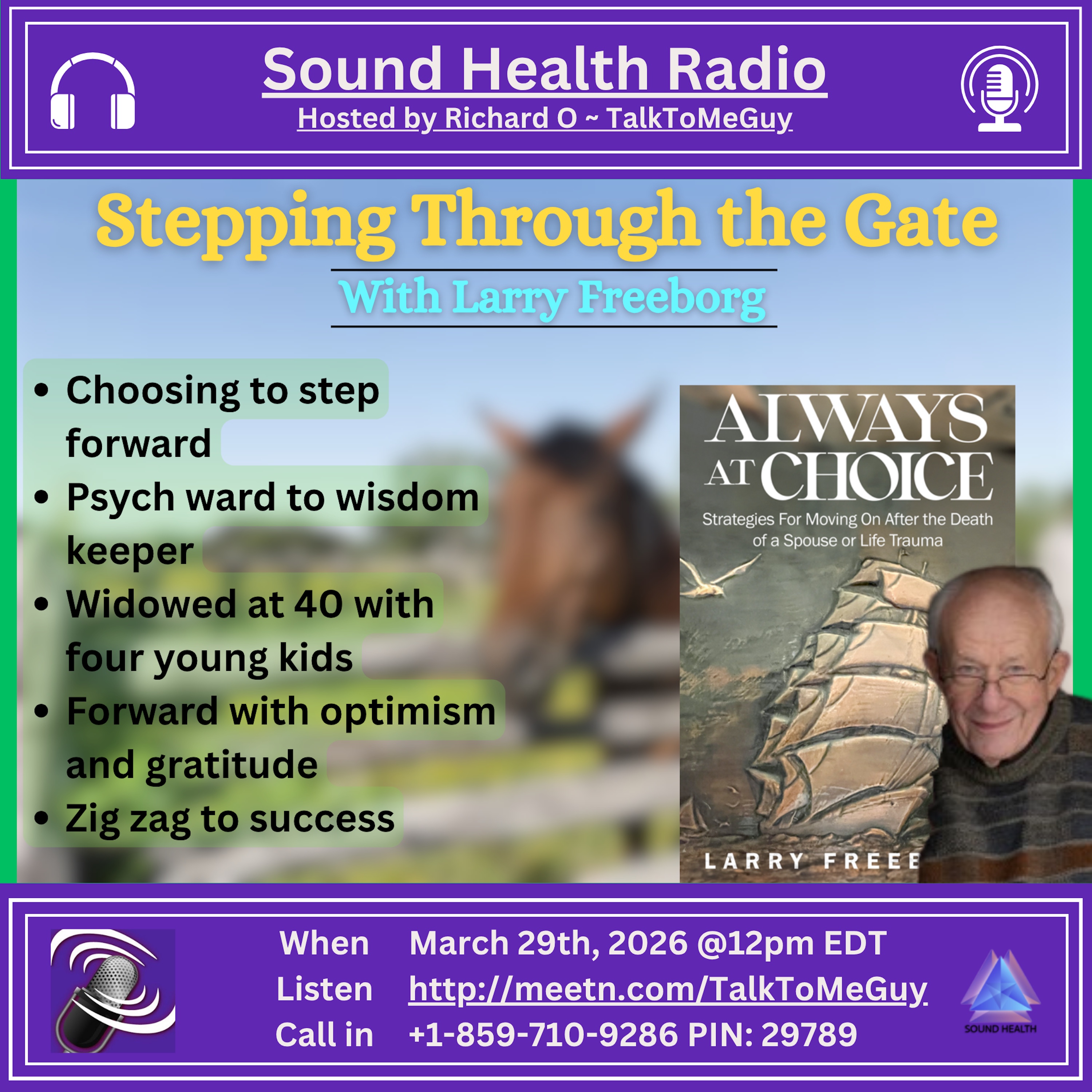


At age 40, Larry Freeborg's life as he knew it ended in a single week.
Just after Christmas 1979 his wife Shirley lost her battle with leukemia. Days later, his job of eighteen years was gone. In one brutal turning of the calendar he was a widowed father of four with no income... and no roadmap forward.
What followed - wasn't a quick recovery. It was a decades long journey into the nature of grief, loss, love and the remarkable human capacity to begin again.
Along the way in a psych ward, of all places, with a French knife in his hand and a chicken he couldn't figure out how to cook a steadfast nurse said something that changed everything.
You are always at choice.
Three words that became a philosophy. A practice. A life.
Today Larry is the author of Always At Choice and the founder of Stepping Through the Gate a wise elder coaching practice, helping people move from profound loss into healing, renewal and what he calls fully engaged life possibilities.
His message is both simple and quietly radical.
Loss changes everything. But it never takes away your power to choose, to heal, to grow or triumph...
And to live again.
Links from the show:
Please sign up for the email list for future notifications•
If you would like help starting your own show or podcast, as well as help selecting a microphone and setup for your voice; Please tap the microphone and leave me a message with your contact information and I will get back to you.
Or you can email: talktomeguy@gmail.com
More information at: SoundHealthOptions.com
Music
TalkToMeGuy: Greetings everyone.
TalkToMeGuy: This is the Sound Health Radio Show where we talk about the crossroads of the environment, our health and longevity, with Richard TalkToMeGuy and Sherry Edwards is off working on the Sound Health Portal. I would suggest going to the SoundHealthPortal.com, scrolling down just a bit and clicking on the Watch How button. You'll see a short video explaining how to record and submit your first recording. Then go back to SoundHealthPortal.com, scroll down to current active campaigns such as cellular inflammation, biodei, neuroplasticity, or memory, and choose one that is of interest for you. Click on that campaign and click Free Voice Analysis and the system will walk you through submitting your recording.
You receive an email with your report back usually in one to two hours. To hear and share replays of this show, 50 to 60 minutes after you hear the outro music, go to TalkToMeGuy.com, scroll down that page and you'll see this show at the top of the episodes page. There are also hundreds of shows available there as well. There is a microphone icon at the bottom right corner of all the show notes.
If you would like to leave me a voice message with a question for a guest or a guest idea for a show, you can do that directly from the site and I will be notified. With that, at age 40, Larry Freeberg's life as he knew it ended in a single week. Just after Christmas 1979, his wife Shirley lost her battle with leukemia. Days later, his job of 18 years was gone and one brutal turning of the calendar, he was a widowed father of four with no income and no roadmap forward. What followed wasn't a quick recovery. It was a decades-long journey into the nature of grief, loss, love, and the remarkable human capacity to begin again. Along the way, in a psych ward of all places, with a french knife in his hand and a chicken, he couldn't figure out how to cook. A steadfast nurse said something that changed everything.
You are always at choice. Three words that became a philosophy. A practice, a life. Today, Larry is the author of Always at Choice and the founder of Stepping through the Gate, a wise elder coaching practice helping people move from profound loss into healing, renewal, and what he calls fully engaged life possibilities. His message is both simple and quietly radical. Loss changes everything, but it never takes away your power to choose to heal, to grow, or triumph, and to live again. Welcome, Larry.
Larry Freeborg: Thank you very much. It's nice to be here. Nice to be talking about choices.
TalkToMeGuy: Choices. It's amazing choices. It seems so simple. As I was listening and reading, preparing for the show, because when I study for a show, it's all of that, something struck me. And it was the breakdown at 40 wasn't the end of something. It was a revolutionary doorway, an opening to your own gate first, before you could ever guide others through theirs. Right. It's really amazing.
Larry Freeborg: Well, I learned a lot just from that one experience in the psych word. I learned that if I was open and I was willing to change my mind, there were possibilities for me. But if I stuck onto my one belief system, I would stay stuck. And that helped me a lot through a lot of the other things that I needed to do. But it really helps me when I coach people, because the biggest barrier they have to get through is some limiting belief systems that are holding them back from having the possibilities that they could have if they just open themselves up to changing their mind.
And not everybody's wanting to do that. So my job, the best of my ability is to find some way to help them look at the process differently so that they can change their mind and have the things that they want.
TalkToMeGuy: So you really are in your coaching practice, you are well in life, you really are kind of the director to the doorknob. Yes. You keep pointing at the doorknob. You're like a dog who is like, I really want to go out.
I really want to go out. But you're doing it by moving people to have the vision of no, opening the door is not scary. Opening the door is your potential gateway to what can be next.
Larry Freeborg: Well, you know, a lot of us grew up as children where we got our belief systems from our folks, from our church, from the school system. It's hard to even know where we got some of the belief systems that we have, but we hold on to them like they're absolutely the truth. And until you challenge them until you challenge whether they are the truth, I like what Byron Katie does.
She has it is it true what you're thinking as it absolutely true what you're thinking. And sometimes people will actually hold on to it. Yeah, it's absolutely true. But most of the time when you ask people, is it true?
Is it really true? They'll challenge themselves and say, Well, maybe it's not really true. And then once you get them to admit that, then you can kind of look at, Well, what's a belief system that might work better if you had one that can fit into your life today?
And once you get them thinking about the possibilities of living life better, then you've got a possibility of possibly changing their life, making their life better, more satisfying, more fulfilling, and hopefully more loving.
TalkToMeGuy: And I want to jump back so people have the backstory a little more about, would you take us back to that Christmas? You already knew Shirley had leukemia. And how does it feel like to try and hold a family together while privately knowing what's coming?
Larry Freeborg: That part was difficult. The more difficult part was that I was, let's say, an overachiever at that particular time. I was very active in my community. I had taken on responsibility for certain organizations and had things that I wanted to do. And we'd already talked about how with the kids that mom was going to die, we knew that for sure.
So we laid out an action plan where all the kids could contribute and do the dishes and wash clothes and clean the house. But when the occupational therapist came by and asked me, well, what was I having trouble with? I said, man, cooking. I haven't cooked for, I cooked the first three meals of our marriage. Then I said, you cook, and I'll go out and make the money. And even though I had made money as a cook, I really didn't know how to cook anymore. I could do burgers. I could do pancakes.
I could maybe even make chili, but that was about it. And so that combined with the idea that all these responsible positions that I'd taken on, I wasn't fulfilling on them. I wasn't keeping my promises.
I wasn't, which is one of my important commitments. And that really caused me to just break down at the office, started crying at 40 years old. I'd ask my folks if they'd watch my kids for a few days. I just needed to get away and clear my head.
Well, my father was a little more adventurous than I was. And he still asked me if there was someone at the company that could be helpful. And so I called the psychiatrist at the company. He listened to my story and he said, would you consider going to the psych ward?
That's the old term that we used back in my day. And I said, yes, you bet. And I've often wondered why was I so eager to do that? One of the reasons I was eager to do it is because I always already used private consultants in my business life. In other words, I was asking people that knew how to do things better than me at that particular time. And so I didn't see anything nasty or bad of using a consultant in my personal life either.
So I went open minded that this was going to be a good experience. And it was, you say, how do I keep the children together? Well, which has really been interesting because maybe I did keep them together at that time, but I had to learn how to be a better dad. But now my second wife has passed away as of the first month of January in 19 and 2025. And now my kids are taking care of me. It's just an amazing experience to be on the recipient end of how they are going out of their way to take care of me in this journey. I can't tell you how much I appreciate and love them for it. Yeah.
TalkToMeGuy: Well, you came from, so Shirley passes the day after Christmas. Right. Then I want the audience to really grok this picture. Then 10 days later, you're in the office terminating 10 employees. Right. Then this is like a cinematic buildup. Then your own job disappears in the middle of a recession. Right.
Larry Freeborg: I mean, that's not really a recession. Unemployment was 7.4%, wow, which is even higher than it is today. That is what got me really scared. And some I'm going to feed my kids, take care of my kids and get a job. I'm very proud to say by the time I got through that ordeal, I had two job offers, which was pretty amazing, really.
TalkToMeGuy: Wow, that you strive, strove, or I'm not sure that's quite the right word, kind of, that you really pulled yourself up by the bootstraps and were able to turn that around. I mean, I could see that just that alone. Yes. Lifedying, suddenly like no job, no work, no anything. I think it was brave to go into the mental facility, especially back then. That was like, really? Wow. That's like a Jack Nicholson movie. Yes.
Larry Freeborg: Like, what is that one? What's the name of that movie that we're using?
TalkToMeGuy: The psych ward. Yeah, I just remember, you know, I'm back. I can't remember now, I can see the movie, but I'm good at remembering the visuals, but not the titles.
But I know exactly the movie you're talking about. Maybe somebody in chat can tell us. That would be good. Yes. But yeah, I mean, so you chose to go into a facility and there was the aha moment, that revolutionary moment where you had the aha of like, oh, I'm a choice. I can make a choice here. Was that your kind of aha?
Larry Freeborg: Well, actually, it was just a little bit kind of like that, but the, let's say, romantic side of the story is, well, when I'm in the psych ward, I can learn how to cook here. But you have to do it right. Was it worth the instructions? So that meant that I had to read a cookbook. Just decided what I wanted to cook first off, then read a cookbook, order all the ingredients in. And when the ingredients came in, then I was assigned to a room to cook my chicken. Now, anybody that really cooks a lot knows that we were talking about how many cooking shows there are today where people cook chicken.
It's really pretty easy. But I decided I was going to do it right because I'm an overachiever and I decided I was going to make my dressing instead of buying stiltop. So that meant that I was going to chop my onions, chop my lettuce or celery, rather, chop my liver, chop my gizzard and boil that broth. And I'm getting angrier and angrier and angrier.
But I've got this French knife in my hand. Well, today we would know that might be closer to PTSD, you know, but I didn't know anything. I just knew I was angry at my situation. And so they excuse me to my room without a knife, of course. And then this bouncy nurse comes in and she says, well, hi, Larry, how are things going? I understand you had a little bump along the road.
I said, yes. And I've just spent two hours on this GD chicken. And that's how I'm going to have to live the rest of my life cooking for my kids. She said, well, you could, what are you going to do with your kids? You know, what are you going to send your kids to your folks or your family or to school or to foster care? I mean, you really had a choice about whether you take care of your kids or how you take care of your kids.
I said, it's not a choice. I have to take care of my kids. You know, I know that you feel like you have to take care of your kids, but it really is a choice about whether how you want to take care of your kids. And finally, I got so irritated at her for constantly saying that I'm a choice. I said, all right, I choose to take care of my kids.
Oh, good. Well, now that you're a choice about how you choose to take care of your kids, we can choose how you want to cook for your kids. You can cook for your kids. You can have your kids learn how to cook.
You can take cooking classes with your kids. And I really, I got it. It's like a light bulb went on. I said, oh my God, I'm always a choice. And once I adopted that philosophy that I was always a choice, not that I always had a choice, but instead of having to and wanting to and needing to and getting to, I'm always a choice. What a difference it makes because in the moment that you're at choice, you get a chance to choose which way you want to go. Not all the choices are good.
I don't disagree with that. Some of the choices are really hard. But knowing that I'm in choice is really powerful comparing to I have to, I need to, I want to. And that's what started me on my journey. I'm always a choice.
TalkToMeGuy: Yeah, all those I don't have the word. Conjugations, that's right, I think. That of the word that way where it's not, as I said, as I was reading through your book and listening and reading materials, I really got the always a choice. That that's very different. That it's that there is a choice point because it's so in my language, it's so self winding in the best of ways that I am, you are actually making a choice each step along the way. It's versus you have to or you must or you know, you don't have a choice, you have to do this. It's just such a different feel to it.
Larry Freeborg: It is. And it's so then now I'm on this journey and I'm realizing that I'm really not an informed father. I don't know how to be a good dad at this point. So I start going on this learning journey. And one of the first things that I learned at a workshop that I went to is that I'm accountable and responsible for the choices that I make. In other words, I can't live as a victim when I'm making the choices. I'm accountable and responsible for the choices that I make. And I that really means that I'm not accountable for I'm sorry, Shirley's leukemia. I'm not accountable for Tosames and I'm not accountable for snowstorms and I'm not accountable for accidents. What I am accountable for is how I look at them. In other words, do I live like I'm a victim or do I live like I'm a choice? I'm not a choice about what happened. I'm a choice of how do I look at it and what action do I take to deal with what came up? That was also powerful.
TalkToMeGuy: That's very powerful. It makes me flash back. We didn't talk about this. I was a working chef for almost 20 years. And in the early days, at some point when I was working in a serious restaurant, meaning we sat 250 meals most nights, and the hours were long and everything was made in the house. And at some point there was the like making an omelet. There's a right way to well from the view of me, there's a right way or a wrong way to make an omelet. Well, you can make a lot of bad omelets and then once you make it right and you see the texture and the quality of that omelet being served and how people enjoy it, you can't not do it the right way or the way everybody likes it. And so that would always be the other thing that when when new people were coming in to cook on the line, and that might be the test where I would say, oh, make me an omelet.
And we could learn a lot about each other from that. I would never get angry with them. I'd just say, no, that's not right. You shouldn't be crispy on the edges and brown. That's not how we do it here.
It's soft and a little finished with butter. And so you you start there. And so it was always, I didn't know that I was living the always a choice life when I was a chef. Because it's this, it's about 100 million decisions a day when you're running a kitchen or you're participating in a big kitchen.
But it's always there is a choice. You can pick up that pan, but you know it's too hot and it's going to hurt or it's going to at least sting. Because at some point you you develop calluses or you develop the ability to pick up things that are so much much hotter than you should be able to pick up.
But your brain is turned off the pain response. Because you have to you need that pan now. And if you don't pull it off right now, that thing is going to be ruined and you have to start it over. And it's a whole cascade of things. And so I had not until just this moment realized that all those years I was living always a choice.
Because every moment in the kitchen is a choice. Do I do this now? Do I do that?
Do I do this? I need that. It's the dance. It's the ballet of getting it all on the plate and out to the table of six all together at the same moment. And there's a lot of choices in making that happen. Yeah. So always a choice. That's a baseball cap. I look forward to the baseball cap always a choice. That's a good idea.
Larry Freeborg: I should give you credit for the marketing idea. Yeah, but it's a good one.
TalkToMeGuy: And one of the things I made note here, and it is about a choice, is that it's you're accountable for what you create. You're the observer of the observer. For these, were these some of your foundational beliefs? Or am I just creating that amount of my own brain? It seems like it would help me.
Larry Freeborg: No, actually the observer of the observer you are came from one of the other courses that I took. Okay. The teacher would always open up the day with being an observer of the observer you are. And it took me a while to get a handle on, well, what is he saying? Being an observer of the observer you are. Now it's like that's a real stable question that I ask myself and others. Because a lot of times when you look at how you're looking at the problem, you are the problem. How you're looking at the problem. It's like we have a problem to solve. And we've got an opinion about how it could be solved based on our belief systems that we pick up from our parents, from our church, from our grandparents, from our school, from the media, whatever it is. We've got a belief system about what's right. And by trying to control all the events about what's right, sometimes I'm holding on to the wrong problem of out of the wrong right. And if I can open up my mind and recognize that if I shifted my mind about the problem, I could solve the problem a different way. And we almost use that today. Is that if I continue to say I couldn't solve that problem, you and I wouldn't be on the telephone today. Right.
TalkToMeGuy: I mean, I'd be here talking to myself. Yes. So that's an amazingly powerful shift. And was that something that you ahad along your own journey? Or was that something you learned a training or saw an example of in the training or it just floated to the top for you one day?
Larry Freeborg: Well, I took about, I took two years of training with this particular guy. And after a while after having him start every meeting that way, I said, what's he trying to tell me? What am I not getting here?
And I had a chance. It's kind of like you with the omelet. Finally getting it. What makes a good omelet is I'm finally getting that, hey, how this problem was being solved is how I'm looking at the problem. And it's not working really well. So, which brings me to another important thing.
TalkToMeGuy: Sorry. No, no, please, please. Well, Larry, did I lose you?
Larry Freeborg: No, you didn't lose me. Okay. Trying to shut this off.
TalkToMeGuy: Oh, okay. Oh, I didn't hear that. Whatever they are. I'm not hearing it. Good. But yes, please go ahead. I want to have any more about that.
Larry Freeborg: Okay. So there's another important step in this whole thing is that I realize that moods and emotions are predispositions for the action we take. So one of the things that I'm accountable for is my mood. And I can get a lot more done with a positive mood than a negative mood. But I didn't know how to really create positive moods until I came across the belief system about living in gratitude. And what I did is I shifted that to not living in gratitude, but appreciating blessings.
Now, that's just a little twist of words, but they're different for me. Blessings are things that come to me that I don't have any control over. Living life in gratitude is me making a conscious choice to be grateful. But if I live in blessings, that means that the birds that I hear, the warble of the cardinal, the color of the blue jay, the seeing the geese fly overhead, looking at the trees. And now that we're coming into springtime, seeing the seasons, they're all pretty important.
TalkToMeGuy: So... Well, it's taking it in. Again, I'll flash back to Sheffing, is that there could be times... I worked in a bistro in Carmel. And there would be times when I would get there first to roll out the make the brioche, make the biscuits, and make the baguettes. And sometimes the owner would come in and do it and then text me or call me and say, you know, don't come... you've got an extra half hour. But oftentimes, she would not text me or tell... I mean, call me or tell me.
She would just not. And then I would show up and then I'd be enraged or just, you know, moderately pissed off, perhaps enraged in there, that now I'm now an almost an hour behind because I have to then do all that, catch up and get that done. Then I get to start the rest of the prep, making the soup of the day and making everything.
And as the other crew came in, they'd help me. But I would be angry when I first started working on bread, let's say the brioche dough, which is a somewhat delicate dough because the way it rises, it's quite soft and spongy and has a nice texture to it. But on the days that I would be angry while I would be rolling out the doughs, like the brioche, I would notice I had an observable shift in the quality of the pastry.
I considered brioche a pastry. And on the days when I would be angry, as I was making it, it would not rise as well. It would not rise as much.
They would not be as fluffy to the texture when they were finished being baked. And it was probably a minute qualitative difference. But I would notice the difference. And so that in a certain way taught me to be, I was using your tool of observing the observer. And so when I observed myself being angry, making the pastry or making the brioche dough, it would not be as good as when I was just there being in the moment and making it as you should, even if you're in a hurry. Because once you do it a lot, you can do it pretty fast. But it's still a lot to work out and produce. That energetically, it was qualitatively different.
And all I did was shift my state of mind to like, okay, now I'm here doing this, so I should just do it versus grinding the gears in my brain of like, well, didn't she in that bad word and all that, that did nothing other than waste time and energy and make a less perfect product. I don't have a question there. I'm sorry.
Larry Freeborg: No, that's an excellent model. That is exactly what happens to all of us, really, is that if we focus on what mood we're bringing to the problem, we have a much better chance of solving the problem. Then if we work with negative or angry, we're resentful. And if you watch media today, you even see where, you know, all the anger and the resentment and the retribution and stuff that's part of our, our life today, it would be wonderful to have people be accountable and responsible for the mood that they're in and the emotions that they use to solve the problems. Life would be a lot easier for us. Yeah.
TalkToMeGuy: Well, I can, I'll refer back, there are other life experiences, but I'll stick with kitchen, that I worked with people who would get angry and they'd like, you know, you need to go outside, literally outside and go kick a box around them and come back when you've got it together. Because anger in a kitchen is nonproductive. Because something's either you're either getting it burned, I'm getting it burned, there's a lot of burning involved when you're on a full, you know, burner stove and hot plates, hot steel plates where you boil things and deep fryers and, you know, I mean, it's a, it's a hazard zone waiting for something to happen. And when somebody comes in who's angry, inevitably something happens.
Because they are, they're too busy being, they're not being in the moment, the anger is distracting them from, you have entered a hazard zone. Because really a functioning kitchen, I'm not talking about these kinds of kitchens where they're working with tweezers and it's delicate and they're playing Mozart in the background. I'm talking about a functional kitchen where you're going to serve 250 meals. Yeah. And if you get behind it any moment, that just cascades into everything else that's happening. When that souffle comes out of the oven, it needs to be served with the other five dishes. So it's always an orchestra. So when you have somebody come in out of cadence or out of that rhythm, it is such a bad word.
Such a bad word. How long were you to cook? 20 years.
Wow. And in a variety of restaurants, from bistro to, like I say, sit down 250. And or a restaurant where we made Thanksgiving every day along with a full menu. It's an amazing world. And even, you know, something is what seems to be, I'll put an air quotes, dumb, making biscuits. You know, if you have somebody who's making biscuits and they're angry and they've had a fight with a boyfriend, I used to have a pastry chef that was like this, she'd have a pastry, she'd have a fight with a boyfriend, then she'd come in to make the pastries for the day, the pies and the cakes and then whatever we were going to do. And then she'd make the biscuits. And if she was in a bad mood when she made the biscuits, the biscuits would be different. They'd still be great to most people, but to me they were like, because she was taking her anger out on the biscuits as she was pounding the dough down, that means it's flattening it, reducing the amount of air that's in there.
It's just a quality thing. So anger in a kitchen is just goes nowhere. And like I say, it's just a hazard zone waiting to happen.
Hot things and sharp knives do not go well with anger. So the idea of, I feel like now kitchens need to be, if I were to go back into the business, which I can't imagine at this point, but I could, that the first thing I do is like, okay, let's all get together and take five minutes together and just have a little moment's meditation, a little break's work, just a little, and it seems very, I'm in California. So it seems very California. I can see this very scene at Alice Waters in Berkeley, Chippin' Ease, where they would like gather together and like, you know, have a moment together and sip on some tea and be all, you know, but it's true. Taking that moment, taking a deep breath, setting aside all of that other stuff. When you enter the line, and this is also true of food servers, that if you bring your, whatever it is that you're to your people, your tips are not going to be as good as a food server, because you're not being in the moment with those people in their experience. And as a skilled food server, you have to do that with every table you're serving.
I can guarantee you that if you have that experience with every table, you're going to make better tips than you do if you're cranky and throw stuff on the table. Again, I don't have a question there. I'm sorry. But it's about being the observer and being in the moment. Be where you are and work with that.
Larry Freeborg: Well, what you've revealed though is, is one of the other lessons. When I first learned about coaching, the person that was teaching me said there's basically three ways to intervene. You can intervene with language, you can intervene with emotion, and the third is to intervene with the body. Well, this particular course did a great job on language and emotions.
But for me, they missed, they missed it in the body's portion. So then I took a somatic course, which is about learning about the body's impact on our moods and our emotions and our attitudes about how we got to get things done. And that was an extremely powerful course. It was taught by Richard Lider, and it was just, I wish it was a heckler, I'm sorry.
It was just a wonderful course. nd because it taught me to recognize that my emotions live in my body, that I can tell when I'm angry and resentful. That's actually where I recognize fear a lot, that fear in my body shows up in my neck and my upper shoulders and my stomach. I remember one time having fear so great that it felt like a kitten ball in my stomach.
It just curled me up. Once I got in touch with the fact that fear lived in my body, then I could begin to manage it with exactly what you're saying, meditation, breathing, exercise, certain kinds of somatic exercises. It really also was a breakthrough part for me of learning how to use somatic coaching to manage my mood, what was happening with me emotionally. But it lived in my body. It didn't live like the emotion was the problem, the emotion was being felt in my body and some of those emotions last for a long period of time.
I had one that lasted for 40 years before I took care of it. That just led me to probably the final part of the learning that I've done is equine guided coaching. It just happened that that particular course that I was taking, they had an equine person that came in and I watched, there's a small group of us, maybe about eight, and they were in that group taking the equine guided experience. I was watching women that were in the course and I could see that some of the women were having trouble in their relationships with males in just the way that the horse would work with them.
It would just walk through the space. It wouldn't give any respect at all to the people who were guiding that horse at that particular time, especially with women. And I thought, wow, that's kind of fascinating that, and then I found somebody that actually works with kids, young men and young women who are ostracized, left alone from their family. And of course, the boys way of handling things a lot of times is anger, and they have to learn how to manage their anger or the horse won't work with them.
It'll just, it's not what's known that, I would say, you're not for me. And at the same time, the women have to learn to find their power and their body so that when they make a request to the horse, the horse does what they ask them to do. That was really powerful. So I began to go on a quest, because at that time, if you said you were a coach or even a submit, a equine guided coach, nobody knew what that was.
It didn't exist in the world at that time. I began to travel around the United States and the world to talk to some of the names of equine guided coaching. It was pretty impressive. And to see where it is today, 20 years later, it's amazing. Yeah. I think equine coaching is really powerful.
TalkToMeGuy: I had the good fortune of growing up with a guy who was kind of your classic kind of red-necky, not so much in the political sense, in the sense of, you know, just kind of a tough guy.
I'm a tough guy. And he grew up out, not on a ranch, but he was in areas, he was out in an area called Carmo Valley, which was more rural and a lot of people had horses in their backyards. And so what we finally figured out about Chuck, and it took us, he was doing it when he was in high school, toward sophomore, junior year. We realized, now mind you, I grew up near Esalen, so there's some influence for Esalen as well.
Yeah. That Chuck was actually a horse whisperer. And it wasn't until we, I don't know, I can't remember that I was with him when he went, a psychic friend, actually, a counselor psychic, who said, oh, Chuck, you know, you're a horse whisperer. And he was like, Chuck was like, what? And because anytime Chuck would walk into an arena with a horse, even if the horse was huffing and puffing and was like angry and didn't want to be there, Chuck could hang out with that horse. And eventually that horse would approach him.
Yeah. And the ears would be leaning in like, so what's your deal, buddy? In a way, you know, they'd approach with their slightly head down. I don't know that much about horses. But I know from watching his body language and the horse's body language, that that's what happened. Eventually he would go to the, slowly the horse, the horse would back up a little, he'd, the horse would resist. And then at some point, Chuck would be Chuck and just get very quiet and, you know, be talking to the horse softly. And eventually the horse's ears would go down. And then slowly the horse would amble, literally amble over to Chuck. And the next thing you know, Chuck has his face against the horse's face and is talking into the horse's ears softly. And the, and the horse is completely calm down. The tension in the horse is gone.
Chuck has no tension. And it was just a miraculous thing to see. And then later in years, when Chuck would work with horses and people with various disabilities. And it would be that same kind of like process of getting the person with the disabilities past the fear of the horse. And it would be, Chuck would be the intermediary who was doing the translating.
Not really, I don't mean a sense of like any kind of communication, but just by his body language and the horse having a relationship with Chuck, that other person was able to like get on the horse and have some experience and feel calmer and better. And it was just, it was always transformational. It was amazing to watch because it was very subtle, but it was incredibly powerful.
Larry Freeborg: That was a very word said when I was finishing your sentence. When you said it was amazing to watch, but very powerful. That's how I already put those words in for you. Thank you. It is very powerful.
TalkToMeGuy: And it was often tears. Not tears of fear, not tears of anything, but like tears of release.
Larry Freeborg: E-Quine guided coaching does a wonderful thing right now with guides that have PTSD. And it allows them to release that. And in my particular case, the E-Quine experience that I had, I released an emotional pain that I'd been carrying on for 40 years. I never told my wife. I never told my therapist.
I never told anybody that that had gone on. And it was the only way that I actually found relief. And once I found that relief, it opened me up to doing a lot of other things that I couldn't have done if I hadn't had that E-Quine experience. And every time that I've gone to work on a problem, the horses are really a good feedback mechanism for me. I remember I was, one of my first experiences at this course is that you were supposed to take the horse out and get it to walk and then to cancer or crot and then to cancer. Nobody was getting the horse up to cancer. And I thought I'm really going to do this. So I got my energy up and got the horse to go up to a cancer. And then the coach is saying, now what I'd like you to do is bring that horse down to a walk and hold it at a walk. He said, you know, even the cowboys didn't cancer all the way to California.
Yeah. And I thought, what a profound statement because I had been a business coach, a strategic planner for business those and then also coaching them to take action to get the results. But I was kind of a hard driving master kind of a guy. And that made so much more sense is to back off and realize that, hey, the walk was an important part of that journey.
It wasn't just pushing for production all the time or trying to hit the sales numbers all the time. So I believe that there's help in lots of different places. You just have to learn how to ask for help. And it's critical for your personal and your professional development. And how do you get
TalkToMeGuy: people to that point of it's not surrender, well, in a certain way, it is surrendered to yourself. We have inner voices. And we have whether it's a dialogue, you know, particularly again, as someone who is a chef, you spend the weird thing about kitchens is you're on a team of sorts. However, there's not nearly as much communication as you might think.
Right. Because you're mostly focused on your, if you're the saute person, that's what you're focused on. Now, as part of your job is to have to evolve your cadence around what the head chef or the sous chef is kind of guiding you to. And at some point, there's very little talking other than is that ready yet? And the answer should be yes. It's not really a thing inquiry. Like, is that ready yet?
That's really like that should be ready by the time I ask you that question. Because you see what I'm over here doing, it's an open kitchen and we're all working on the same line. And you should see that the steak that I've been cooking that goes with that stuffed potato that goes with the, you know, beef steak tomato check stuff with baby peas, that that's all when the steak goes on the plate, everything else should show up on that plate by the other people in the kitchen.
Larry Freeborg: And it's, you've got some great stories to tell as a result of your experience.
TalkToMeGuy: It's, yeah, I observed, you know, I'm a what we were talking backstage as I was a photographer of young age. So I was an observer. And so a kitchen is a great place to be an observer because it's all about watching and some listening because you, well, once you become the head chef for the sushi, there's a lot of listening because you can tell by the sound of a pan, how fast something is cooking and there's a whole sort of dance of what's going on. But it is very much a team sport and people don't understand that it really is a coordinated effort to get that dish out. And part of that is so that the head chef is yelling at you like, why isn't that ready now? I need it now.
Don't tell me it isn't ready because it's supposed to be, you know, what's going on here. Right. But once the team is going, it's like being in a rowing competition. You're all moving the same direction.
You're all trying to row as fast as possible. And if we do this as a team, it works ever so much better. And I think that can, and I think a lot of that translates into the same lessons that I have learned. And I learned a lot from, like I say, making brioche.
If you're angry when you're making the brioche, it's not going to be as good as just give that all up, be in the moment with the brioche. And I don't mean there has to be burning incense. I just mean, pay attention to what you're doing.
Because it's important. And the idea of, you know, back to the equine for a minute, I mean, it's so powerful to be in the, I was never a person who was comfortable with horses. I just thought they were too big. They were jumpy. But later on, Chuck trained me to like calm myself down before I'd walk into the arena. And once that happened, the horse was like, Hey, I know you, you're a buddy of Chuck's. I like you. Right away. Didn't make me nervous at all. But early on, wow, they were scary.
Larry Freeborg: Well, I started my work with horses, afraid of horses also. Okay. And I had had a horse run away with me. I had a Glacier National Park. And I had dodged the bull, dodged the branches and all that other stuff and stayed on the horse. But then I got off the horse and I decided I didn't have the confidence to ride the horse back. Well, the ranger who let me ride that horse never let me ride a horse alone again.
Wow. So that added to the embarrassment of not knowing how to ride horses. And I loved horses. I mean, every break I'd go down to the, to where the horses were all hung up and then I would ride the horses out to the pasture that evening.
And that part went away. So I lived with that shame that I hadn't controlled the horses and I didn't have the relationship with the horses. So I decided that if I was going to do any equine coaching, I'd have to learn how to get along with horses. So I volunteered at a place to muckstaff. Wow. Water the horse and these were big. These are the big jumpers, the big warmbloods that boy, they had so much power. And if I didn't get into the muck or into the stall the right way, they just slamming up against the the area that they had for themselves.
Speaker 1: Right. It was a, but it was a good experience.
Larry Freeborg: But it really took learning how to be quiet with them, of not connecting up with them. And by the time that I finished, I just loved my relationship with horses and what we could do with them to help other people. It was just something. Yeah. I miss that in my life right now. I gotta figure out a way to get it back in. Yeah.
TalkToMeGuy: It was always amazing. My friend, that my horse whisperer friend's name is Chuck. And it was always amazing because from time to time he'd say, Hey, I'm going to go work with a horse. Want to watch it?
Yeah, sure. And so we'd drive to wherever he was going to go do this work and sometimes he'd walk into an arena. And I mean, it might not be, it might be only 50 feet wide, not like a real big arena, but just, you know, 50 foot wide corral. And he'd walk into a corral, he'd start at the gate and the horse would just be, for some reason, the horse is just enraged, you know, pissed off, snorting, walking fast around the paddock, you know, in circles, pacing is what we would call it. And, you know, he'd hang out at the gate, he'd quietly and casually unlatch the gate, he'd wait another couple minutes and then eventually he'd open the gate and sort of just walk in, close the gate and just stand there. And then it's, and slowly the horse would slow down, stop snorting, and, you know, wouldn't exactly become calm, but was not as angry as it was before. And slowly at some point, it always, always, always ended up, you know, at some point, if Chuck waited long enough, if we had enough time, he would sort of just wait there and eventually the horse would begin to approach him. Right. And part of it was, and Chuck was not a big meditator or a particularly transcendental kind of guy, however, whatever he did, whatever headspace he got into when he was getting ready to communicate or work with an animal, a horse, he also did work with dogs, but work with a horse, the horse would do that thing, ears down, approaching sort of curiously, and the next thing you know, they're standing in the middle of the ring having a little fest.
Right. You know, the switching tail, the bodies relaxed, it's no kicking of dirt, none of that. And it was always amazing to watch because I had no idea how he was doing it.
And years later, we would laugh about how he said, really, I wasn't doing anything. What do you mean? He said, that's really it, is you just, you just have to settle into being in a space of kind of nothingness.
Right. And at some point, the two of you get into what I would call a circadian rhythm. And you know, it's sort of, if you have that as images, they can be off and you know, it's kind of like tires that have one tire has a bump and the other doesn't, and it gets a little lumpy.
And at some point, the two of you are in a kind of alignment or cadence, it's a similar, I'm not sure exactly what it is, but I could, you could watch it happen every time. And it was phenomenal, because I mean, there's such big, powerful animals. And Chuck was kind of a big guy too, but even so it was still just, or to see him, same thing as I said, when he was working with disabled kids, to take them into the arena and they'd be terrified, not because of anything bad, but because holy, you know, they're kids. And the same thing at some point, Chuck would have that person, that kid on the back of that horse, and that horse would be casually walking around the arena and the kid would be laughing and having a great time. And sometimes this was bearback, which I find to be just like suicide on a horse. I don't even understand how that happens.
Speaker 1: What are you thinking bearback?
TalkToMeGuy: But it's such a soothing, calming experience to be around a large animal like that, and to watch it transition into a calm, I've been in that, you know, barn with animals, where again, with Chuck walking along and he'd stop and talk to every horse. Sure. And every horse would be like, Oh, I kind of know you, you're a cool guy. And I'd be there like, I don't know, they're awfully big. But also, you know, there would be times when a horse would, you know, bump into you.
And I think it was always intentional. I think, I think horses have a very good sense of self. And when they bump into you, they know they're bumping into it's not like oops. Right. Unless it's true, unless they're being a maniac, or they're kicking, or they're scared. I have been with horses when they've, you know, seen a snake and they go crazy. Sure. But you know, they can be brought back down. I learned some of those skills from Chuck, but I'm not going to walk into an arena with an angry horse. I'm not that far. That's phenomenal.
Larry Freeborg: Well, it's, it's learning, it's being curious and learning, being open to learning. I'm looking at one of my big other lessons along the way here, and realizing that I had two other life skills. One is I adopted lifelong learning as it being essential to me, my personal growth. And so I'm always curious for new opportunities for learning and growing.
And even listening to some of your podcasts, I realized my words, there's so much more that I don't know. But the other part is learning how to ask for help is that all that learning may be out there. But if I don't reach out and ask for somebody to help me, I don't get the benefit of what they could teach me. So I've learned how to ask for help sooner than later. And I've learned how to be a lifelong learner.
And it's really been useful for me. It's what I try to implore to other people, but it's amazing how somehow in our society, we've adopted the idea that if you graduate from college, you should be done learning. So a lot of people stop their learning there. And I, I find that a lot of my learning comes from outside of colleges. I meet young, I meet people that are gifted in their area of teaching. And I learned from them. And it's been a wonderful journey. I've learned a lot along the way that I didn't ever learned on my own, or learned by going to college. I find that college is a little slow with some of these innovative things. So I really look for the outside teachers.
TalkToMeGuy: Yes, I had been a chef for about 10 years. And then I thought, I'm going to stop doing this for a while. And I went back to college and I went to Sonoma State. And I was, it had been a long time since I'd been in an educational system. And I had the same response of like, I can't wait a whole semester to learn something in this class.
Yeah. Because again, as a chef and either, and to you become the head chef, even then you're still learning, if you've got a brand, you're always learning. So the idea of being in a class where you have to wait for some aldercock or to sit up there and read his notes from last six years and go through the pathetic steps of like, step one, step two, step three.
Okay, I appreciate some of that. But at some point, we have to actually get to like, how do we do this? How do we produce this? And again, in the restaurant world, in the kitchen, there's always something you're not always learning, but you're frequently learning a new way to do something or a different way or a faster way. Usually that's it, a faster way.
Or if you're unfortunate enough to be under the power of some stupid owner who wants to switch from butter to margarine. That ended badly. So yeah, I'm with you. I think that was part of what attracted me to talking to you on the show is I am also a lifelong learner. I can't imagine not learning pretty much every day something.
It doesn't have to be mind blowing every day. But I get to have these great conversations with people like yourself. And I learned something out of every show I've done. Every conversation I've had there's always learning.
Learning is a lifestyle for me, such as yourself. I can't imagine like, I'm not interested anymore. Really?
How's that possible? Yeah. And you chose, it's boring to me.
Exactly. And you chose, I'm surprised we're already kind of near the end, you chose to not retire. Whereas so many other people are trying, I'm sort of in that same boat of like, retiring, what is that? Why? I like what I do. Why would I stop doing that? But so you've made this conscious effort to not retire. You're just going to keep coaching until you can't or don't. Is that what that is?
Larry Freeborg: Yeah, it's a life choice, a life choice to be of service. That was one of the other things that I learned about that it was really important to be clear about my values. And for me, one of my core values was to creatively capitalize on my natural gifts and talents wherever they took me.
But to take, to be of service in what I give to the to my peers or find a way anyway to deliver something. So after Dodie's death, the big thing, of course, is you no longer have that partnership that you've been living with, but let's say the last 33 or 34 years. And I miss her.
But I also know that she's not coming back. So now I have to decide what am I going to do with my life? And I know that I could either spend it like I'm at choice, I could spend a lot of my life grieving. But my life doesn't go on forever.
It's, it's really quite a short time. And so I just have to decide where do I want to be of service. And I decided that I fortunately, I'd finished the book in about that time.
And I just made the decision that I'm going to share my story through podcasts to be helpful to other people. I'm surprised that response that I've gotten from people that have read the book and felt that it isn't really a grief book. It's really a life management book. So they've gotten ideas about how to manage certain parts of life like fear and, and mood and things like that.
So I'm grateful for that. But one of the things I probably miss so far is my learning is mostly experiential. It's, I don't, in other words, the ideas that I have in the book are things that I've tested that I've experienced.
The ones that worked I kept in the ones that didn't I left behind. So like the lessons of whitewater rafting or the lessons of climbing up a mountain or the lessons of working with horses, they all were really valuable lessons, but they were things that I experienced, not necessarily things that I read about. It's kind of like when you're telling your story, when you're telling your story, story of learning how to be a chef and cooking, you're really talking about the experience that you're having doing those particular things. It's not, you're not talking about your book learning. You're not talking about reading about it. You're talking about something that your body's actually experienced. And those lessons that you share are powerful because I can trust them a lot more than I can just tell you pontificating a belief system.
TalkToMeGuy: I'm laughing because it just takes me back to my academic attempt at being in academia again. I went back to college and I did end up teaching a film class and a video production class and a business communication class and I didn't ever enjoy it.
Yes. Enjoy that because it was just here are the notes, here's the thing, do the thing. Filmmaking and photography I enjoyed very much because I'm really good at taking people and walking them through technology, always have been. And that I enjoyed very much. But the academic part, I'm a lousy academic.
I'm just not a good academic of like, okay, read chapter one, come back tomorrow, we'll take a test on chapter one. Where's the making of the thing? That's what I'm looking for. I'm out to make something. I'm a maker of some kind. And that's part of what attracted me about your work and your experiences. You're very much a, okay, we're here now.
What are we doing next? Right. And that is for me, having been a chef. There's rarely a moment where you're just standing around doing nothing.
That's a fantasy in the restaurant world. You're always doing something. So it is, you know, we're here now, what are we doing next? Oh, that souffle collapsed. You have to start the moment something goes wrong in the kitchen, you can't stop and cry about it or be upset. You have to like, okay, that's bad. I have to do that again. And you just immediately do it.
There really isn't a choice. It's like, I think I suspect it's like correcting an action of a horse when you're riding along. You can't wait for you to go over the cliff. You have to pull on the reins and go, no, we're not going that way. I am actually in charge. You're much bigger than me, but I'm still in charge.
Larry Freeborg: Yeah. So I think you'll have a lot of fun learning more about horses.
TalkToMeGuy: It could happen. It could happen again. Yeah, it could be.
Larry Freeborg: You know, the question is, how do you deal with the fear that you have of horses?
TalkToMeGuy: Yeah, that is really the question.
Larry Freeborg: And it's amazing to just even have a couple of ideas about how to deal with fear. And I mean, I experienced fear when I was doing the ropes course. Yes. Yeah. The lesson that I learned is that fear is just false expectations appearing real. Yes.
Yeah. But I make them up and then I'm afraid. The other one that I liked with, the one that I got from whitewater rafting, because it happens all the time, you know, if I'm anticipating doing something and I have this fear of it, what happened to me is I got flipped out of the raft in the whitewater rafting trip in Costa Rica. And I mean, I was scared the next day because I got flipped out again. Yeah. So what I did is again, asking for help, there were some river guides from the states that were down on Costa Rica because the water was warmer.
It was during the winter time that they were running these white water rafting trips. And so I asked the guy, I said, I know that you probably have other people that have fear once in a while. He says, yeah, it happens all the time. People get flipped from one rapid and then they anticipate what the next one's going to be. And then they anticipate what the next one's going to be. And then they anticipate what the next one's going to be pretty soon that they have this huge wave that they need to go after. And what I suggest is you just take one wave at a time.
And that's the same way that Shrizzad teaches how to deal with fear also, one rapid at a time and to celebrate progress. The next one's next river guide that I talked to said, well, most accidents really occur on land where people are playing badminton or volleyball or something like that. It's not in the river. And if you're in the river and you get flipped out, you follow the rules. Go face down or put feet first as you go down.
Don't step in the river. That made sense. And then the third guy made a lot of sense. He said, you're here to have fun. So when you're in a river in a real flat spot, jump in the river.
The water's nice and warm. Yeah. And that is ironic. I have me, I have swum for the University of Minnesota.
I've been part of a really record-setting team. And here I am afraid of going in the water. Wow. I had a laugh at myself. That's amazing. From the mountain, I take one rapid at a time.
TalkToMeGuy: That's really good. That's your next book. I like it. It could be. It could be. Larry, that was fun. That was a really good thing. Thank you. Great. Thank you so much. Where would you like people to find out about, find your book and also find out more about your coaching practice?
Larry Freeborg: The easiest place to find the book is on Amazon at alwaysaddchoice.net. Thanks. And then the next place to find out about me and my coaching model, I modified it now to be consistent with the book, is at alwaysaddchoice.net or .com.
And in there, if some people think they would just like to chat with somebody but not start a program, there's a complimentary session where if he sometimes just getting some outside input gives you a couple ideas, that's all you need. I'm really happy to provide that if that's what's wanted. And that's on that website of alwaysaddchoice. Okay. Excellent. Thank you. I'm sorry. That's at alwaysaddchoice.net.
TalkToMeGuy: Yeah. Work with me. I'll put that link. I'll put all those links in the show notes for people who are watching. Okay. Thank you. All right. Thank you so much.
Larry Freeborg: Thank you for all your help today. Yes. To be here. I mean, this would not have happened if you hadn't been consistent and persistent to make this happen. So I appreciate that a lot. Not the brightest bulb on the tree when it comes to technology, but you walk me through it.
TalkToMeGuy: Technology is, you know, I'm sort of like the horse whisperer to technology. Like, okay, no, we can do this. We can do this. It won't bite you hard.
Larry Freeborg: Yeah. He did a nice job. Thank you.
TalkToMeGuy: All right, everybody. Have a great rest of the week and we'll see you next week. Bye bye.
Larry Freeborg: Bye for now.


