Mineral Secrets Your Body Had Been Waiting For
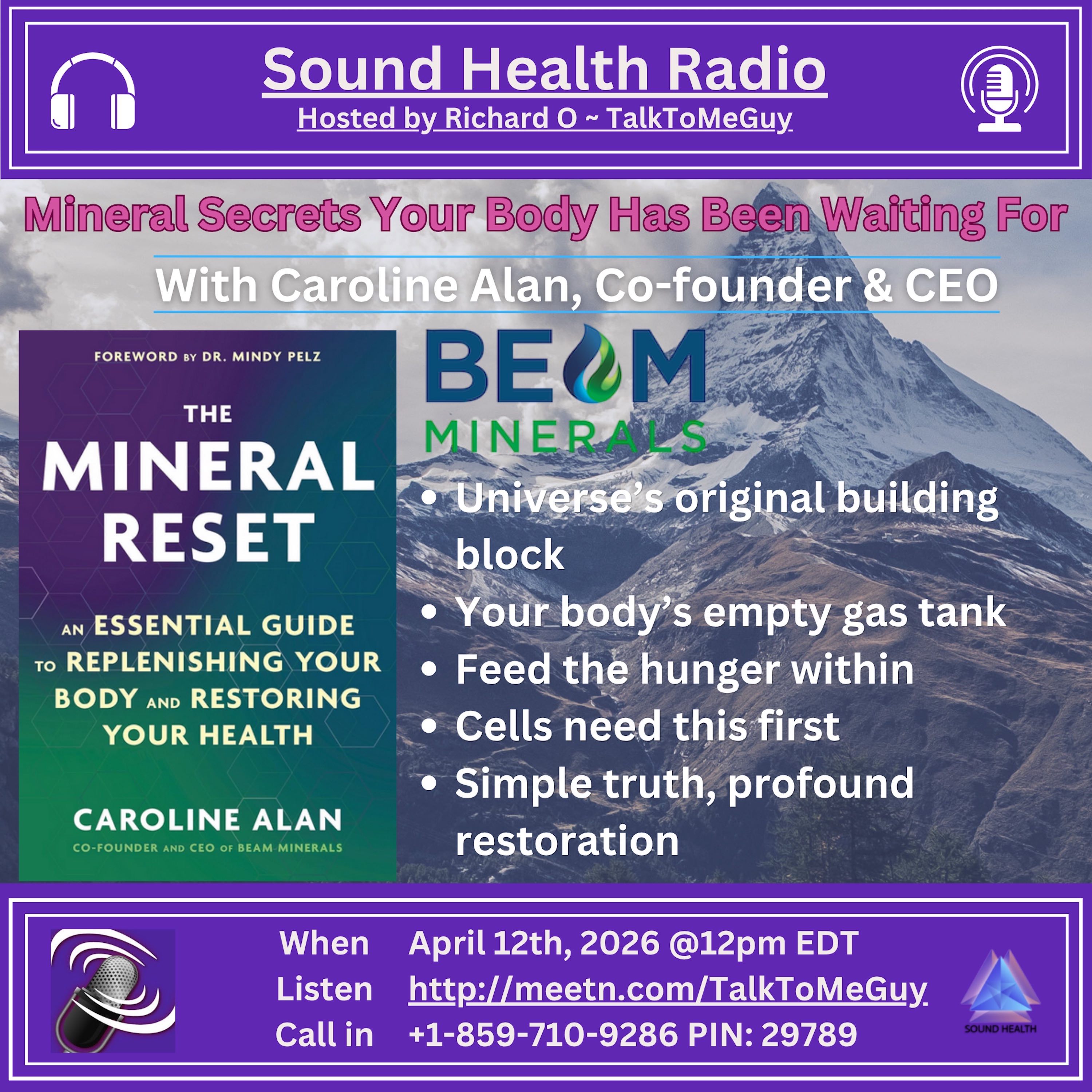







Every once in a while somebody comes along who takes something, hiding in plain sight... something so fundamental — we forgot to look at it... and just... lights it up.
Our guest today is one of those people.
She's been called The Mineral Geek... and she wears that with pride... because what she knows about minerals and what they do inside your body... will genuinely change how you think about your health.
Caroline Alan is a health survivor first... that matters... because she didn't arrive at this knowledge from a laboratory... she arrived at it from need. A demanding career in the high-tech corporate world left her physically, mentally and energetically depleted... and the path back— led her somewhere unexpected...
Deep into the earth itself.
Humic and fulvic substances... cellular biology... agricultural soil science... she went all the way in...
And what she found became — BEAM Minerals... and now...
The Mineral Reset.
Her brand new book.
and now she's back in our house...
Caroline Alan • Co-Founder & CEO • Beam Minerals
7 Common Side Effects of The Mineral Reset (link coming soon!)
•Please sign up for the email list for future notifications•
If you would like help starting your own show or podcast, as well as help selecting a microphone and setup for your voice; Please tap the microphone and leave me a message with your contact information and I will get back to you.
Or you can email talktomeguy@gmail.com
More information at: SoundHealthOptions.com
Music
TalkToMeGuy : Greetings everyone, this is the Sound Health Radio Show where we talk about the crossroads of the environment, our health and longevity, with Richard TalkToMeGuy and Sherry Edwards is off working on the Sound Health Portal. I would suggest going to the SoundHealthPortal.com, scrolling down just a bit and clicking on the Watch How button. You'll see a short video explaining how to record and submit your first recording. Then go back to SoundHealthPortal.com, scroll down to current active campaigns such as cellular inflammation, biodeit, neuroplasticity, or memory, and choose one that is of interest for you. Click on that campaign and click Free Voice Analysis and the system will walk you through submitting your recording.
You receive an email with your report back usually in one to two hours. To hear and share replays of this show, 50 to 60 minutes after you hear the outro music, go to TalkToMeGuy.com, scroll down that page and you'll see this show at the top of the episodes page. There are also hundreds of shows available there as well. There is a microphone icon at the bottom right corner of all the show notes.
If you would like to leave me a voice message with a question for a guest or a guest idea for a show, you can do that directly from the site and I will be notified. With that, every once in a while somebody comes along who takes something hiding in plain sight, something so fundamental we forget to look at it and just lights it up. Our guest today is one of those people. She's been called the mineral geek and she wears that with pride because what she knows about minerals and what they do inside your body will genuinely change how you think about your health.
Caroline Alanis a health survivor first. That matters because she didn't arrive at this knowledge from a laboratory. She arrived at it from need. A demanding career in the high-tech corporate world left her physically, mentally and energetically depleted and the path back led her somewhat unexpected.
Deep into the earth itself, humic and fulvic substances, cellular biology, agricultural solace, she went all the way in and what she found became being minerals and now the mineral reset, her new book and now she's back in our house. Welcome, Caroline.
Caroline Alan: Thank you so much. It's so great to be here as always.
TalkToMeGuy : Now, I'm going to start in a weird place because what I will first I'll let the audience know. Caroline designed this really great flyer about the side effects of reading the mineral reset and I just thought it was so clever and such a great way for people this particular audience who's very result-oriented. They study a great deal to get to where they want to go but they're really interested in the result of what their work is. All the health practitioners I pretty much talked to are like that in yourself. Our conversation is based on that flyer but the flyer is the result of truly the side effects of reading the mineral reset.
So that's where we're coming from. It's about the mineral reset but it's about the where you end up when you get through reading it because it's a great angle. I really like it.
Caroline Alan: Thank you. One of the sad things about books is that most people especially non-fiction books read about 20 pages and it's just in the nature of our world today. We don't have a lot of time. So we wanted to put something along with the book that would help people get the main points even if they only read those 20 pages and the piece that we created is kind of I call it edutainment. That's perfect because it pulls out the main points in a way that's very easy to grasp and gather and then hopefully it will make you want to actually dive into the book to learn more. Yeah.
TalkToMeGuy : Yeah it's a great, it's really good. It's such a clever flyer because I think it is a great booklet or is a great hook because by the time you get to the end of the booklet you're going well I need to know this now. Exactly. And that's really very smart marketing.
Caroline Alan: Thank you so much. It was a I think inspired piece.
TalkToMeGuy : Yeah and the design is really good too. I mean it's really it's a visually interesting piece. That's what I run into a lot is I see a lot of material that's really interesting but that's because I'm a nerd but it's not necessarily visually interesting. The flyer is really nicely done so it leads you down a path in a fun way.
Caroline Alan: Thank you so much. I really appreciate that.
TalkToMeGuy : I have a foundational question because I was listening again listening or reading and the and the foundational question is I heard or read you use the term sustainable loop. Yes. Would you talk about the sustainable loop?
Caroline Alan: Yes I will so there's something I call it the sustainable loop that nature relies on and the way that the earth works is that for cellular life is it cellular life grows in soil and most cellular life what either it grows in soil or it eats things that grew in soil and when things grow in soil the way that they grow is they take minerals and amino acids some amino acids already in this in the cellular life but some of it comes also from the soil and it takes those nutrients minerals amino acids from the soil and out use utilizing that nutritional content it creates its structure and it also generates energy for all of the processes that it that are required to help it grow so whether it's a small little pea shoot or a huge California redwood tree the way that it grows the way that it first of all the way that creates all its structure is with minerals because all the minerals I mean all the structure in the universe is minerals and then most of the energy in the cellular in cellular life is created with using minerals as fuel now in nature plants grow and at some point they die and when they die they fall and they decompose and as they decompose they deliver their mineral and nutritional content back into the earth and it's through this process of decomposition that nature designed these molecules called humic and fulvic and and what I say is that humic and fulvic molecules which are these incredibly mineral rich complex molecules complex molecules that carry all of the minerals the body needs the cell that cells need it's really the way that earth stores energy for future use by cellular systems whether it's a plant an animal your body so these are their storage systems but they also have other capacities so the sustainable loop is the plant grows it takes the energy and nutrients from the soil it dies it decomposes and it rest and it returns that content back into the soil in the form of these mineral rich complexes that are absolutely ready to support future cellular life
TalkToMeGuy : and in the process of decomposing I spend a lot of time I live in northern California near redwood trees and I like walking in the redwood trees because why not that's the other thing I have a bazillion photographs like church yes and so nature I admire nature because it has a it does such a good job at what I would call self-winding you know something dies something falls on the forest floor it gets covered up the molds and mildews the productive eaters come in and eat it and digest it and break it down and it turns back into nature we're walking around on that all the time and that would freak people out it freaks people out every time I talk to them about things have died we're walking now they're like no no it's good that's how it works in nature yes and so when they hit that surface and they begin to break down how long is there a timeline in which humic and fulvic begin to form out of those materials it seems like it's got to take time because minerals are hard to break down in a lab so it can't be easier in nature I mean it does it are we talking thousands of years are we talking
Caroline Alan: no okay no we're we're talking about years so for something to completely turn back into this into these humic and fulvic mineral complexes but it's what it is is it's actually a microbial process that happens during decomposition it's like one one micro metabolizes some plant matter and then it excretes some sort of material and that material is is then taken up by another microbe and excreted and then another microbe actually may actually take that whole microbe you know it's a it's a it's a multi-stage process that results in these humic and fulvic complexes and you know we tend to think of this kind of decomposition process is happening at the surface and the that decomposition process is happening at the surface but the storage of these humic and fulvic molecules can last for millions of years and this is why I say it's earth's way of of storing energy for future cellular life so even if there we had a devastating event on the earth like we did 65 million years ago the end of the dinosaur era and all these rainforest died and decomposed in the same way and they deposited a whole strata of earth like eight to ten twelve feet below the surface that is this incredibly mineral rich humic and fulvic substance called humate and that's and now we can use that humate as a way to restore the sustainable loop by getting it into humans
TalkToMeGuy : and have ancients uh let's just go back a couple hundred years we don't have to go back to cave people i'm suspecting that cave people knew something because they they lived in the nature really lived it so they knew cycles and they knew weather and they knew everything and i suspect they knew the water that they wanted to go and drink might be called the healing waters because people would go and drink that water and be better and it was probably minerals
Caroline Alan: yes exactly and in fact humic humic substances have been used by many many ancient peoples for healing with it because of this healing properties you know ayurvedic and you know so thousands of years old technologies have have utilized humic for healing of the human body and and in fact you know cave people you know if you want to go back that far you know they were getting humic and fulvic in the water and when they ate food they you know it didn't get washed perfectly it had some humic and fulvic on it you know they were constantly their bodies were replete with humic and fulvic substances just from the foods that they eat and the water that they drank
TalkToMeGuy : and are some of the and are some of those substances i don't know which category this goes into but it makes me think of shila jeet which is a mineral form it's been around for i used to have an herb store and so it's been around since the 70s and it's been around way before that yeah i was one of those it was one of those that people would come and go have you can you do have any shila jeet what do you know they'd all of a sudden get excited because of this ancient mineral
Caroline Alan: that's exactly right so shila jeet is a humic substance and and a very very powerful one yes
TalkToMeGuy : and is it because it's so concentrated yeah well so humic um is all around because 65 million years ago in this you know this meteor hit the earth there were there were rainforests as far north as canada you know so very far very far away from the equator and when this when this um meteor hit the yucatan it created a winter on the earth and all these rainforests died and decomposed so you have humic substances on every continent in the world and in their different some shila jeet peats something called terra preta forgotten the word for the one in african the african continent we have humate leonardate there's there are many many humic substances yeah and oh this is a whole other show has anybody ever compared the various forms let's say the african form of shila jeet or you know they're so they're different in different cultures they're called different things but are they all leaning toward being the same compound or are there regional shila jeets
Caroline Alan: yeah well certainly there are i mean even even in the humate which is a dry sandy kind of crystalline substance that we use you know we get it from a very very um rich source and you can go miles away and find another source it's not as not as strong so um in the same way that this forest over here has this kind of tree and these kinds of you know in this forest more you know maybe on the fringes of being really a rainforest so it's maybe not as rich you know it's it's all it depends on what plants died and decomposed in that particular area the interesting thing about humic though and i'm just talking about humic and we can talk about what we can get into why i'm just talking about humic because humic and fulvic are two different molecules and actually humic incorporates fulvic and fulvic is extracted out of humic and it's extracted out for particular reasons because it has different capacities which we can talk about but across the board these humic substances which includes fulvic um they all have all of the minerals that your body needs and they have them in natural ratios and this is a this is a why i call the pre-formulated molecules because every single cell on earth requires minerals to function every absolutely every single cell and the interesting thing is the redwood tree in the forest that you walk in and your body at a mitochondrial level like the very very like the energy production level in your body requires the same ratios of minerals your body and the redwood tree so at a mitochondrial level cellular life works very very pretty much the same okay so as a result nature had to determine how it was going to get this natural ratio of minerals into these into all cells and again after the research that i've done i i really think that humic and fulvic were an evolution of a delivery system for this natural ratio of minerals into cells so that cellular life would thrive
TalkToMeGuy : well and so let's say something bad happened there's so many bad things happening but let's just say something bad happened and humic and fulvic went away would we fall apart in a certain way because we need i think the part that people often forget is we all you know they're all sorts of now they have people drinking i'm not dishing directly uh pdl they have adults drinking pdl because it's the news because some marketing person basically thought we could rebrand this and make adults drink it and they did and it's it's a salty liquid it's a it's a mineral compound i can't call it a compound because i don't think it's really a full spectrum of minerals i think it's probably just salt and water yeah but i mean it's really without electrolytes we're we the human body is in trouble yes yes and is that one of the reasons why when well for example when you at day 73 you refer to this in this great flyer yeah you know something shifted by day 73 of you consuming these minerals yes you had a i don't know the light bulb went off you had the aha you had the what was your feeling of having consumed those minerals going from being i'll kindly use the term stress bag from being in a corporate world which can be mind-numbingly stressful it's a whole other show everybody in america in a boardroom should be drinking humic and folvic today that's all i'm saying and what did you notice what was the shift for you at that day 73
Caroline Alan: yeah um there were there were several shifts that happened to me and because they all kind of coalesced at that time i started paying attention and i had no idea that i was mineral deficient and and you know if we we tied us back to petiolite you know petiolite has salt in it maybe it has potassium and i don't know it has magnesium potassium and sodium maybe um and um that's just two of the 18 to 22 minerals depending on who you're talking to that your body absolutely has to have not maybe someday a little bit here and there absolutely has to have to complete all its processes so for many many years my body had not had enough of of really any of the minerals probably i had i probably i i didn't tested but i had many many deficiencies and deep depletions so as my body instead of fighting to find the mineral content that it needed for hormone production all the enzyme production protein production bone you know generation um you name it everything in my body every biosynthesis process in the body requires minerals so without minerals without this full spectrum of 18 or 22 minerals my body was really struggling in lots of different ways so but around that that day 73 what started happening is i started to be able to sleep at night you know so going from waking up three or four times a night i started to sleep i started to have a sense actually before that i i had had such a hard afternoon crashes so major afternoon energy crashes and i started to be able to go through till five or six a night and go wow i'm still going this is amazing i had bad inflammation in my gut and that that inflammation by day 73 had really completely cleared so i didn't have my constipation or bloating issues that i had had for years um i also had that was about the time that i went to my dentist appointment and i had very bad periodontal disease and she looked in my mouth she's like oh my god what happened you know your your tissues are pink and healthy your your gums didn't bleed when you were being cleaned like what is going on so all of these things put together made me pay attention because i had changed nothing else with my health other than taking the minerals taking these mineral complexes so i had literally no idea about my body and how it worked i had no idea about how you know um uh my body was powered i i say i was kind of like one of those people most of us we wouldn't buy a car if we didn't know how to put gas in the tank but most of us are walking around in a vehicle our body that we really have no concept of how it's powered how energy actually is generated and if we knew which is what the book the mineral reset helps people do is just connect all the dots so they go so it's it's the most empowering information to actually understand i mean a simple thing like being able to change the not even change the oil but check the oil in your car it can be very empowering if you've never done it and now imagine if you knew actually how your body is powered so you wouldn't so when you started to have a craving for something you go oh my body needs minerals not my body needs sugar or my body needs salty crunchy snacks
TalkToMeGuy : oh but come on salty crunchy snacks are so fun
Caroline Alan: i'm not saying you can never have them but you'll you'll crave them less if your body is is replete with minerals right yeah
TalkToMeGuy : and i could spend we could spend the entire show on this next segment i'm gonna ask you about it is the mineral reset side effects uh and where you talk about getting angry at the food system yeah is side effect number one so i spent i just realized i'm closing in on a thousand shows but i'm certain that probably 850 of those shows there's some conversation about this issue right here getting angry at the system and and i use as my example and i know the audience is sick and tired of hearing about them but i have to use them as the example my grandmother lived to be 106 my grandmother came across america in a wagon not a travel choice a wagon from illinois to utah wow and she was active baking pies for the Mormon church until she was in her late 90s until she fell and broke her hip but she lived still years on and my grandparents unintentionally never knew the word organic they didn't know what that was i used to talk to her about this you know like well you know do you know organically like what's that mean what are you talking about because their entire lives they grew their own food mm-hmm they had chickens they had cows they had beef they had pigs they had and it wasn't a huge they didn't have a huge farm they just kind of had this in their backyard it was a big backyard but even they grew their a lot of their own foods in that backyard so they completely unintentionally completely uneducated and i don't mean that they weren't smart they were smart in their own ways yeah eight an organic diet right that they grew and ate and slaughtered and did all the things and probably had amazing soil because they had the chickens and the cows wandering around in the fields you know doing the thing and so this is why i could get hung up at the you know diet and our system it just blows my mind i was going to save it till later but i can't help it you know it just blows my mind that we have an administration that is advocating for glyphosate yeah it's just disgusting we'll just say disgusting i'll say yeah and yeah so i that's why i could live i kind of live at the side effect you know number one of anger at the system you know glyphosate school lunches i mean i can just keep rattling on and on yes and there is hope this is a question i just can't make it one there is hope i'm i'm thinking and from listening and knowing you with the use of regular usage of humic and folic there is benefit to reducing the body's relationship to glyphosate along with i think generally it makes the body and the system the immune system and all the firing in the system stronger yes
Caroline Alan: so this is the this is the really cool thing about humic and folic as well and and i also want to just say the beautiful thing about the story of your grandparents is that you see they were connected to that sustainable loop that nature relies on that's why they were so healthy for so long because they they were just naturally constantly connected to it and and that's a beautiful thing but that so the other piece about humic and folic is it cellular systems they need to get replenished they need nutrition nutrient nutrients minerals etc to get into the cells but they also need an ability to clear out when there are toxic things that occur whether it's you know a concentration of any particular mineral or substance that's too powerful too strong or whether it's a truly a toxic substance that's trying to literally kill them like something like glyphosate so nature in its incredible infinite wisdom because there's always been substances that were and areas and in things that occurred that that were that created toxicity for cellular systems so for cellular life to thrive nature had to develop something to remove those toxins and that's what humic represents so humic is this incredible poly electrolyte molecule it's it's got all this surface area on the outside kind of like a sponge and different parts of its surface will be will have different polarities positive or negative so it can pick up both positive and negative substances which is like acting like a magnet it also has heavy metals in the molecule but those heavy metals are completely bound in the molecule and they act also like magnets for other heavy metals so they this molecule just travels through water systems your body through soil systems and it picks up these toxic substances or these substances that are in too great of a concentration it's it's actually amazing and being studied around the world the humic molecule like let's say you take a pill of magnesium and your body suddenly has a huge amount of magnesium that's floating around and maybe it's too much it's thrown the balance of your magnesium potassium or magnesium phosphorus or magnesium calcium balance off so what actually happens is that the humic molecule will gather up magnesium molecules all the way up until the point that that balance is reached and then it will stop binding to the magnesium this this just this alone is I mean they they really literally don't know how it knows when to stop they think it has some things something to do with pH level but a very very micro nano level of pH awareness so these are just things that they observed they don't really know how it does it but ultimately this this molecule has all these things bound to it and then it falls out of solution and it leaves your body or the water system or the or a soil system by just precipitating out the way precipitation is like if you mix some powder into a glass of water and over time those the the powder will end up at the bottom of the glass that's called precipitation and those when it does that it leaves the system leaving a system that's in better balance and also less toxic
TalkToMeGuy : that's toxic that's good yes so when it so when it exits when it exits the body let's say that there is a glyphosate molecule wandering around our body and I'm taking humic and folic does it what is the action that it can have on that molecule of glyphosate my my question has to do with what is the state of it when it exits my body
Caroline Alan: yeah you know that's because it's actually a huge problem so you eat food you've got glyphosate and you you you you know defecate urinate and the glyphosate goes through you now it ends up in the water table right yeah but here's the interesting thing about glyphosate that excuse me the humic molecule in the way it gathers it actually sequesters the molecule it builds a film around that glyphosate molecule and now no matter where that molecule ends up the glyphosate no longer can have its effects so if the humic ends up in the water table humic ends up in the soil it's actually fine because it's sequestered in the humic molecule
TalkToMeGuy : that is awesome part of my part of my question comes from having done a couple of shows with Dr. Steven SEMF SEMF who way back before we were talking so much about glyphosate but wrote a book and has done more research about this this is really scary thing that happens where we collect our waste we purify it we extract out the water put it back into the water table we add 900 bazillion chemicals to cause that action to occur and then we take the solids and we dry it and we put it in a bag and we call it fertilizer and so that's why i'm very specifically looking for okay that fertilizer that's now be put on our food crops because there are no provisions like that for waste only goes no place concentrated in the city yeah so they've concentrated the our poop and everything that was in that and put it into a bag and put it on our food crops so i'm always interested in how can we make that fertilizer less toxic nd so the humic is sequestering away those molecules. That is awesome.
Caroline Alan: Yeah, and it does work on soil also, so which is a cool thing. So it works in in many different environments. It's very, very cool. Yeah.
TalkToMeGuy : Wow. Okay, that's another mic drop. I'm about to do a new show with Dr. Senth. So that's very exciting. I can talk to him about that very action and see what he thinks. Yes.
Because that would be great. And one of the things that people, I don't know, people, people think it's about willpower when it comes to craving. That we have some sort of weakness because we don't have the willpower. And it's not really at all about willpower. Please talk about that. This is all from the wonderful booklet. Yeah.
Caroline Alan: You know, people try, you know, we have these cravings, whether many times it's sugar, many times it's salt, it could be, it could be alcohol, all sorts of addictive behavior as well can be driven from mineral deficiency. In fact, we've been doing some work with addiction clinics, helping people come back when they're trying to heal from addiction, because there are the recidivism is absolutely tied to the body not having this nutritional foundation available, which causes things that you wouldn't expect like anxiety, like depression.
Now, why is this? If you think about your cells and the way your cells work, and cells are fueled by mitochondria inside them, and those mitochondria, excuse me, they're powered by the mitochondria and the mitochondria are fueled by minerals and amino acids. Now, your body makes a lot of amino acids, all the minerals have to come from outside. Now, if you're somebody who's who doesn't eat very well, and many, many people, you know, they eat processed foods, or they eat fast food, or, you know, they're, especially when you're younger and you don't have a strong impacts on from eating crap. You'll, you'll have a wider variety of things that you eat. And the problem is that these don't these you can eat a lot of content without getting the actual nutrition you need the actual minerals, and then those minerals delivered into your cells.
So what does the cell do? It sends a message to your nervous system at an electrical level in it says, I don't have what I need. I don't have what I need. We got to have something more we need something you should go looking we what I need something I don't have what I need. And that's literally going 24 seven, and it raises your cortisol levels, and it makes it hard to sleep, and it makes you literally open the fridge at night after dinner, open the cupboard looking for that thing that you're missing. I know everybody that I've ever talked to has had that feeling of like, wait, just a dinner, right? Just, I just need that one other thing.
This is yours. What I say is this is at a very, very micro level. We all talk about macros nowadays. Everybody's counting their macros doing diets with, you know, where they count their macros. And I'm like, well, the macros are great.
That's a that's a cool thing. But that will fail. If you do not focus on providing the micronutrients support that all of those macros rely on the processing and the creating energy out of all of those macros requires. Micros all the micronutrients. So it's really the first place to start. And if you start with minerals, then go to your diets or your ways of eating your, you know, maybe you're going to go carnivore, you're going to do low carb or you're going to do keto or you're going to do, you know, whatever special eating program that focuses more on those macros.
If you start with the minerals first, your cells are going to start sending a message that says, I got everything I need. Everything's good here. Things are fine here. And when you get that message 24 seven, your cortisol levels drop, you start being able to sleep through the night, your bandwidth for dealing with the stresses of life gets wider and and you find yourself responding more than anything. And that's certainly been my personal experience as well.
TalkToMeGuy : So in my thinking that I will say that it indicates to me that it's immune, immunosupportive, because you're reducing that low level of anxiety in the body. That can be the foundation of illnesses. I don't know why Candida floats up into my brain.
But if you but if you reduce that low level of anxiety in the body where it's like always looking like I'm not feeling right, something's wrong. I need this. I need that. What about this?
What about that? So if you have a foundation of humic and phobic in your system, you're taking the edge off of, you know, a little tiny amount of edge off of anxiety and the body can take a breath and relax a little bit. Exactly.
Caroline Alan: So we tend to think that stress is coming from the outside, that the world is a very stressful place, which it is. But what I'm wanting people to begin to understand is much of the stress you're experiencing is coming from your cells, 37 trillion cells in your body.
TalkToMeGuy : Well, and I can't directly apply this to inflammation, but I've always had a thing about when we have inflammation, let's say we we bump our hand or we, you know, I don't know, something, we cause some information on our body, a bump on our on our arm or something, we bump into something.
But that's really the inflammation to me is the body going, hey, hey, hey, hey, hey, hey, it wants you to pay attention to that area. Yes. It's the bodies like you should look at here and do something. Yes.
Which makes me think the next time I bump into something which I sometimes do when working in the yard, it just happens that I should spray it with fullic or humic water as nearby and wrap it for a half an hour and let it be calmed down. I suspect it would have a benefit.
Caroline Alan: Yeah. And this is this is part of learning to be, you know, we've we've been taught that our bodies are parts and pieces and that, you know, if something's broken, we go to the doctor and the doctor will fix it. And we're also taught that we should try and affect our body. You know, we should, if we have a weight issue, we should, you know, have enough willpower to stop eating so much or, you know, all that kind of thing.
And this is this is actually from the work and the research that I've done. I really think this is this is the thinking that has to change because in reality, our bodies are part of the Earth's ecosystem. Our body is an ecosystem, a natural ecosystem. It's a lot more like a forest than it is a car. And we've been taught to think of our bodies more like cars, you know, when something broke, we take it to the doctor, you know, or and we particularly, you know, you go to the transmission guy for the transmission, you go, you know what I mean. And when actually our bodies more like that redwood tree, and what are you going to do if the redwood tree is not looking healthy, you're going to, you're going to look at it, you know, hmm, you're going to actually create a relationship with it. And that's how I talk about it in the book about, we call it the green thumb perspective, you know, if you have a houseplant, and it's not thriving, you move it around the house to find the place that it likes the best.
And then you try and figure out how much water does it wants. You know, you don't look at the other plants because the other plants need something totally different than this plant. And that's how you are, you know, each one of us has very complex health histories, genetics, epigenetics, ways of eating, lifestyles, all sorts of all sorts of pieces that are impacting our needs.
So we can't actually look at something like a minimum daily allowance of minerals and go, oh, that's how much I should take because that's it's not, it's actually antithetical to the fact that our body is a natural ecosystem. And we have to have a, an awareness relationship with it and begin to respond to it the way it's responding to our actions.
TalkToMeGuy : Well, also in the same vein, I've always maintained that given the opportunity, the body will heal itself. Now I don't mean if you're in some terrible accident, or I've been in kitchens, I was a chef, I've been in kitchens where people cut off some section of a appendage. That's all I'll say. And I'm not at that point going to go, let me spray some folic on that.
It's going to be better. Sometimes we need Western medicine. Western medicine is very good at putting parts back together. Right. Very skilled, and I admire them for that.
It's really amazing. Yet, we have this other side where their idea is more medications. They don't seem to look, I mostly see Dr. Dio's or chiropractors or homiepaths or herbalists or that's more my world. And so when I have, back in the Sheffy days when I had to throw that appendage in a bag of ice and take the person to the ER, it was always amazing to me how it was, the experience was they were hyper focused on getting the thing back together, which is great. But what about the body is a system?
We are walking sacks of water, which I think is still a miracle that we get, I get up every day and go, wow, here's another day. Because it's very complicated, but very few practitioners, particularly in the Western medicine world, look at us as a system. I'm old enough that when I grew up, my doctor was the family doctor and he was everything. I didn't go see an endocrinologist and a urologist and whatever. I had no olysters, just a general practitioner. And now most doctors are so hyper specialized that they are, if you go and I had some heart issues last year, or they thought I had heart issues. And so they looked at that, but they didn't look at my system. They just looked at, you know, we're looking at the heart. That's all we're looking at. What about lymphatics?
What about anything else? And so, and this is a long way to open her to the side effect number three about particularly in nowadays, there's just so much push on supplementation. The newest magical, amazing supplement you've never seen before. And here it is.
And we are offering a special three for, you know, whatever it is. Everybody's got a supplement that is the magic thing, but without the foundational benefit of having a full spectrum blend of minerals like your products, we're still just sort of throwing things around because we don't have the electrolytes in our system. I didn't mean to go into this. The electrolytes in our system to make everything work as it wants to work. And so that's the supplement, you call it the supplement graveyard in the booklet. So, yeah, talk about that. Sorry, I took so long.
Caroline Alan: No, no. No, it's what you said is great. You know, one thing I really wanted to do with the book is I wanted people to have a method for looking at the supplementation they're using and to evaluate it because I've talked to so many people. I've talked to people who take, you know, 40 or more.
I've talked to people who take 80 pills a day, especially in the older population, they're taking all sorts of pharmaceuticals as well as all sorts of supplementation. And this, I mean, it's not how ecosystems work. It's just not how ecosystems work. Taking all these concentrated compounds and putting them in your gut every day. What do you think happens to a gut that's that is actually working more like a forest if you took a wheelbarrow of all these different supplements and you threw them on a forest floor, maybe once in a while, it might all line up and do the right thing. But most of the time the body is just going, oh my gosh, what am I going to do with all this stuff?
I got to get it, get rid of it. And so it's pulling water from your body is pulling other balancing minerals if you're taking single minerals and it's sending them out into your urinary tract and your feces and getting rid of them as quickly as possible, because it does not know what to do with them. Natural ecosystems like small incremental balanced amounts of nutrients provided regularly over time.
Ecosystems don't like intense situations of any type, whether it's intense weather or intense concentrations of particular substances or lack of things, not lack of substances like water. So it's really just a big misunderstanding that's come because of scientists and also because of companies wanting to sell products. Somebody learned that magnesium is great for sleep. If you take magnesium, it will make you sleep. But the problem with taking magnesium on a regular basis like daily, particularly for aging women, is that it's not good for your bone health because when you put a lot of magnesium in your gut, your body tries to balance that amount of magnesium by pulling phosphorus and calcium from other places in your body. And that is your bones. So when you do that regularly over a long period of time, it will affect your bone health. And in fact, I've had trainers come and talk to me about their aging athletes, triathletes who are struggling with osteopenia.
In some cases osteoporosis because of the amount of salt based magnesium supplementation they have used. So it's just this misunderstanding, first of all, just to think about it from an ecosystem perspective and then also to think about we are not like a computer, input, output. It doesn't, the complexity of the way the systems work of replenishment, meaning getting nutrients into your body and into your cells is incredibly complex. And to think that you can just hack it by throwing a whole bunch of stuff in your gut is it's mostly just a confusion, a misunderstanding.
TalkToMeGuy : Well, one of the tricks, I'll call it a trick with magnesium also, particularly as we get older, we produce less and less hydrochloric acid in our gut for digestion. So you throw magnesium in there, which is going to nullify some of that HCl because of the pH relationship.
Yes. So you're taking something that's going to, I'm pro magnesium, but I'm in a whole spectrum way. But you're knocking out your digestive system and you probably ate three to four hours before you go to bed, if you're lucky. And so you're eating food and then you're wondering why you wake up being bloated. And it's because you're taking your magnesium because you think it's going to help you sleep better, which is there are other things you could be doing.
But ever since I interviewed Jonathan Wright almost 100 years ago, it seems like, and he wrote a really wonderful book, an MD up in Tacoma, Washington called Stomach Acid is Good for You. That's great. I love that. It's just very, that's what I love about it. It's just like, here's the book. All right, great.
Thank you. And I, most of the elderly around me, I'm in my seventies and most of the elderly around me are taking hydrochloric acid, at least one with a meal. And they come back to me like it's a miracle. Right. Just like, oh my God, I'm not bloated for the first time in the past 20 years.
Caroline Alan: You know, I do want to mention though, and this is just because I'm a mineral geek. So I is the thing you have to recognize is in the production of hydrochloric acid in your gut, it requires minerals. You see, so if your mineral depleted and so there's two parts of requirements for minerals in the body. One is just energy production like ATP, these tiny units of energy that are generated via the mitochondria inside your cells. But there is also in every biosynthesis process, like the production of hydrochloric acid in your stomach requires minerals. I don't know what they are off the top of my head.
We could find out and put that in the notes. But it's not like you can just go take that mineral and suddenly expect more hydrochloric acid because what your body is just saying is it wants that foundation in place. And if as you get older, minerals mineral replenishment different than supplementation. So mineral replenishment is providing very small amounts of incredibly bioavailable full spectrum minerals to your system on a continual basis every single day.
And that it will create an experience in your life of having like all boats lift off the sand. You know, we talked about Western medicine and you know, it's great for acute situations, but it really knows very little about chronic situations. And so it doesn't recognize that chronic situations are about an ecosystem out of balance. They are the symptom of symptoms of an ecosystem out of balance.
So if you first start at the foundation level bringing the ecosystem into balance by providing that foundational support, now the ecosystem becomes very powerful. You stop getting sick. You feel the tickle in your throat. You have some minerals, you know, and the body goes, oh, no problem. I got this.
TalkToMeGuy : Given the opportunity, the body will heal itself. Yes. I think the minerals are an opportunity. Yeah. And I want to jump. I'm surprised to find that we're careening around. Oh, wow. Yeah, exactly.
It happens. I want to jump to side effect number six. This, the title of this is, you'll understand why you're not getting the health outcomes you want. Yeah. And it really is about the body.
One of, I'll say this very short piece. I would really like it if we could stop calling it diets and call it lifestyles because there is so much derogatory from all the sides about diet. If you mentioned you're on, I just think it would be better languaging if we said we were choosing a paleo lifestyle. Yeah.
Because as soon as you use the term diet, that's going to tweak people out because there's so much bad press about diet, whereas lifestyle is another thing like a paleo lifestyle or a keto lifestyle or a whole, how about a whole foods lifestyle? Wow. What a radical idea. Bring back my grandparents.
Caroline Alan: Yeah. I particularly use diet in the, in the work, in the piece that I did because people tend to think that they've done all these things, all these diets and they've failed. Yeah. And, and what I wanted to communicate is it wasn't that you failed. Yeah. The diet was failing you because you didn't have that foundational support before you tried to do carnivore or low carb or paleo or keto or et cetera. Yeah. Yeah.
TalkToMeGuy : And I mean, I've done, I'm old. I've done all of the, I forget who the guy was that had you eating a baguette a day of refined carbohydrate French bread. There was that diet, the carb diet. I almost had it at McDougal or something like that.
And he has a clinic or had a clinic up in Southern California. All the way from that to the Atkins swing. So that's like Atkins is almost all protein and fat. Yeah.
And whereas the McDougals, not quite right, but it's close was, you know, all carb. So, I mean, we've had the swings. Just thing. How about we just strive toward sort of, you know, my grandparents thinking, you know, you go out, you've got a lot of things. You get eggs, you make breakfast, you've had bacon from your pig. You eat that you're cooking, you know, maybe you're making a super stew. You have bones from those animals. You're getting all those micronutrients. You're getting all the benefit from the marrow that's in there, little and all the minerals that that these are whatever.
Caroline Alan: You're getting.
TalkToMeGuy : You get all those, all those micronutrients. Yes. I think micronutrients lifestyle is the next one. I think let's talk about the micronutrient lifestyle.
Caroline Alan: That's a great idea. The micronutrient lifestyle. Yeah.
TalkToMeGuy : Put that on a baseball cap. Would you all wear that to conferences? That's great. Because it really is true. It is. It really is about the micronutrients.
Caroline Alan: It really is. It really, really is. None of the macros are going to help you if you don't have the micros. That's where you have to start. Yeah. Yeah.
TalkToMeGuy : You know, the people that go full metal jacket. I'll talk about Dave Aspie as an example. I remember when he was like, Mr. Protein, I eat a T bone steak every day and rah rah rah. Now, because I know his history, if he's eating a T bone steak, it's probably grass fed grass finished.
Right. So it's the most not micronutrient rich thing you could possibly have. It's a beast that lived its life outdoors. There's some friends of mine who grow and produce grass fed grass finished beef. Say, you know, these are cows living on the coast of West Marin. So they're walking around outside all day long eating grass. Right. That's their life.
That's what they do. They poop, they eat, they poop, they eat, they walk around, they make the earth beautiful. They chew a little. They chew a little and they have one bad day.
That's how he would define them. And when you're eating that as a burger or as a whatever, that is an intense concentrated micronutrient flavor bomb. Right. Because it has all that stuff in it, all the earth.
It's got high levels of everything good we could possibly get. Right. And I just think the micronutrient lifestyle and your work is what we need to lean into because we seem to forget that it isn't just about I'm eating grass fed grass finished.
A lot of people eat grass fed, not knowing that if you see that on a menu, the term grass fed without grass finished often means that you have grass fed and then grain finished because it fattens the cow up before the grass fed is the truth.
Caroline Alan: Yeah. That's the thing. And then they're brought into the feed lot and they know about that.
TalkToMeGuy : The dreaded feed lot. Yeah. That's the bad thing of the chef world. But you know, it's also, it really blows my mind. It's like homeopathy. It's about the little tiny infinitesimal micronutrients. And I think we're so lucky that you fell into that world.
Caroline Alan: I feel lucky. I really do. I feel that. First of all, it changed my life. I'm so healthy and vibrant now compared to where I was 10 years ago. And I also feel that I truly have a purpose that is, I mean, it literally gets me up every day because I want people to understand this. I want people to get it. Yeah.
TalkToMeGuy : Well, and that's why I'm always happy to talk with you because I just think this is such a, this is still a sleeper. It's just starting. Just barely almost when I mentioned it now, people don't go, what? It's almost there. Yeah.
Caroline Alan: Like maybe I, oh yeah, I know I need minerals. They'll say. Yeah. No idea what or how to get them into their body. And again, that's why I wrote the book because it's so confusing that, you know, I've spent time with people in the health food stores, you know, the mineral aisle. It's a wall of bottles of pills. Yeah. What are you supposed to do there? Yeah.
TalkToMeGuy : I've always taken up until I started using beam. I've always taken liquid minerals. Yeah. Because I know that minerals are hard to break down. Yeah. So why not give the body the advantage of taking them in liquid form? Yes. Exactly. Because I've seen too many.
Caroline Alan: People don't like that is because most liquid minerals taste bad. Oh, really bad. So if you're going to, most people who have tried liquid minerals, in the past are like, yeah, no, I don't want to try it. Yeah. Just water really. And they're like, what? Yeah. So, yeah.
TalkToMeGuy : Well, and there's, and I'm excited that you're in the world of rehab, in the drug world, because that could help so many people come out of that world and come out from, neutralized. Yeah.
Caroline Alan: We've had, we've had actually several deaths from drug overdoses and, and drug abuse in our family. So it's very close to home. Yeah. And it's, it's one of my personal missions is to help, help that whole world of recovery. Yeah.
TalkToMeGuy : Yeah. Besides drinking bad coffee and smoking cigarettes. Like fiends. Right. I've had a number of friends be in recovery and it's always like, cigarettes and coffee out of a styrofoam cup. No. Exactly. No. Not my world. Recovery. Exactly. Recovery into what?
That's very exciting. And I would think the same thing is true of, I've know a lot of chiropractors. And I just think this, you know, the, the bean minerals are such a perfect adjunct to seeing any kind of what people call alternative practitioners, whether it's an acupuncturist to a chiropractor to an osteopath to a whatever. Right. Because it gives your body the greatest opportunity of homeostasis.
Caroline Alan: Right. Yes. I don't have a question there. I'm sorry. That's fine. That is totally fine. It's so true.
TalkToMeGuy : We really are at that time where I want to ask you where can people, and I'll get a link for you from you for this, where can, where can people find the mineral reset book and or where can they find it about more about bean minerals and your work?
Caroline Alan: Yeah. Well, to find the book, they can go to mineral reset book.com. And that you can just, I'm sure that you can go right through there and order either online or from, from us. We're actually putting together some really great packets of that include the book and the, and this side effects document.
So you can get that as, you'll get that as well. So please go to mineral reset book.com. We actually always suggest you get three books, get one for yourself, one for a friend, and then also get one for somebody who's really lost hope of feeling better in their life, because it could be so easy for them to feel better.
Just a small glass of liquid minerals every day. They start feeling better and they're going to tell you that you did that for them. Yeah. So, yeah, that's it. If they want to find me, they can go to Caroline Allen.com. And if they would like to try beam minerals, just start getting replenished. I recommend you go to beam minerals. That's like beam of light, beam minerals.com.
And I suggest everyone start with the advanced set. It's two products, electrolyze and micro boost. You take a half an ounce of each of them every day. They taste like water. It's the easiest, simplest solution to start feeling better that you've ever tried.
TalkToMeGuy : BeamMinerals.com. And they really do taste like nothing. I've had people a lot of things to drink, not telling them, and they've hated me for months. These truly taste like nothing. They're the simplest things to consume I've ever had.
Caroline Alan: Oh, yeah. And I think we're going to also put the link to that, to the side effects document. Side effects of reading, the mineral reset. I know it sounds funny, but we thought it would be kind of fun. Yeah. So, you'll be able to download that and read it yourself.
TalkToMeGuy : It's a great read. I mean, I think the book, I know the book is a great read as well. I just thought this was such a very nicely designed graphic that people can kind of read on their phone. Well, not on their phone, and that would be horrible. But on a tablet or a computer with great bullet points and just a really great synopsis of the benefits of reading the book with a lot of educational material. Yeah.
Caroline Alan: It'll really get you there quick. Yeah. Awesome.
TalkToMeGuy : All right. Well, this was fun as always.
Caroline Alan: As always. I always love having our conversations. I wish you were in my backyard so we could just go and have lunch.
TalkToMeGuy : Yeah, that would be great. I would even cook that lunch. I'd be happy to do that. Oh, that would be better. Yeah, I'm popular when I'm out in the world. It's like, oh, you want to come over? Sure.
Caroline Alan: I'd love to come over. I'm going to be texting you like, what are you doing for lunch?
TalkToMeGuy : Yeah, absolutely. Oh. All right. Thank you so much, Caroline. That was a blast as always. And Rudy and Alts, we will see you next week. Have a great weekend.
Caroline Alan: Thank you.
Caroline Alan: Bye-bye.