Beyond Management: Reversing Diabetes Type 2
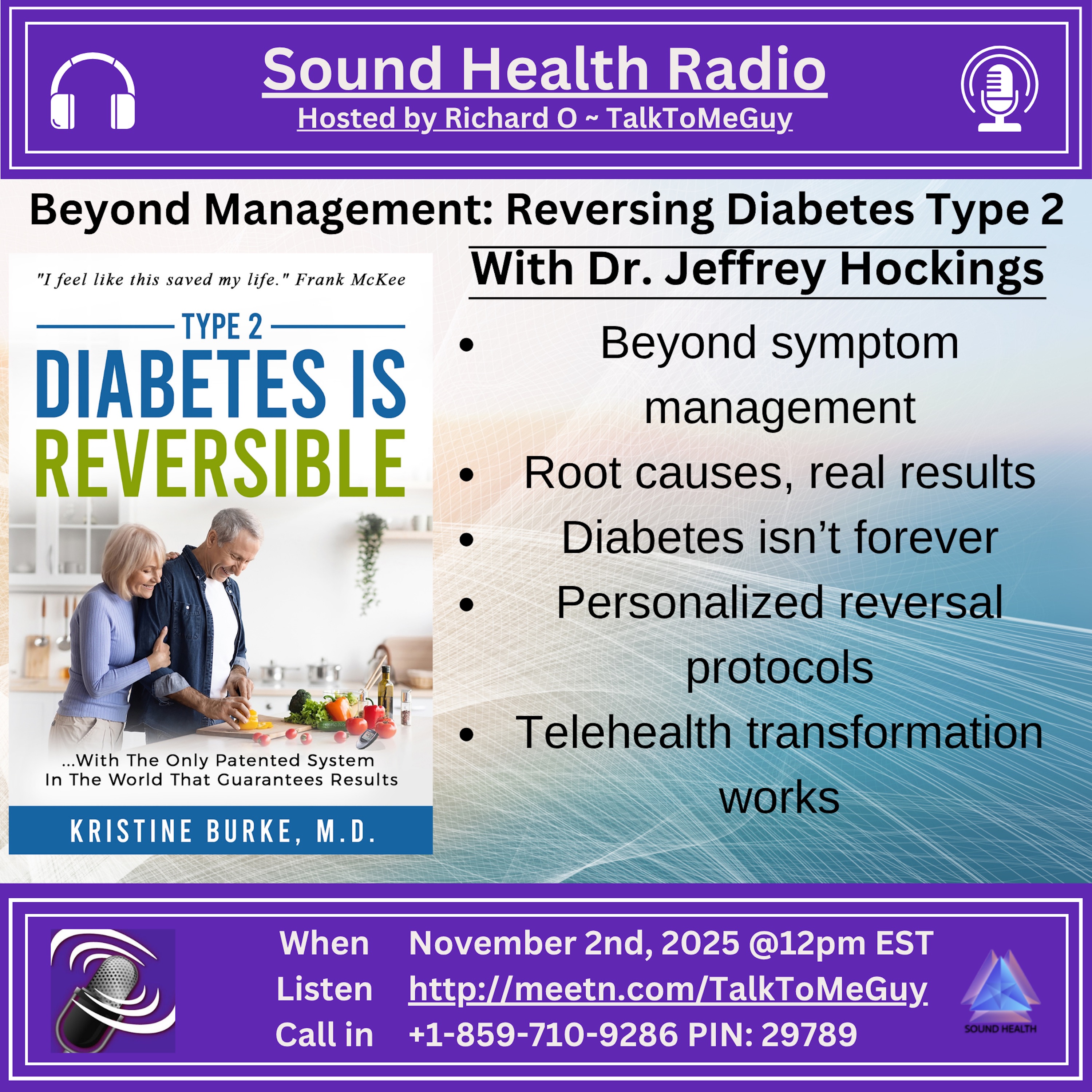


Every eight seconds, someone in the world dies from complications of Type 2 Diabetes. But what if that diagnosis isn't a life sentence? What if it's actually a pivot point?
Dr. Jeffrey Hockings, founder and CEO of Diabetes Reversal Group a telehealth company proving that Type 2 Diabetes can be reversed through personalized, evidence-based care. With 35 years in functional medicine, Dr. Hockings has developed patented protocols that help people address the root causes of diabetes, not just manage symptoms. Dr. Hockings will talk about how diabetes is not one disease with one solution. It's a spectrum of metabolic dysfunction, influenced by everything from diet and sleep to stress, inflammation, and hidden food sensitivities.
He's the author of two books on metabolic health, a lifelong athlete, and he's passionate about challenging the over-medication narrative and empowering patients to take control of their own health.
Links from the show:
Dr. Jeffrey Hockings
CEO/Founder
•Please sign up for the email list for future notifications•
If you would like help starting your own show or podcast,
as well as help selecting a microphone and setup for your voice; Please
tap the microphone and leave me a message with your contact information
and I will get back to you.
Or you can email: talktomeguy@gmail.com
More information at: SoundHealthOptions.com
Music
TalkToMeGuy: Greetings everyone. This is the Sound Health radio show where we talk about the crossroads of the environment, our health and longevity, with Richard TalkToMeGuy and Sherry Edwards off working on the Sound Health portal. I would suggest going to the SoundHealthPortal.com, scrolling down just a bit and clicking on the Watch How button. You'll see a short video explaining how to record and submit your first recording. Then go back to SoundHealthPortal.com, scroll down to current active campaigns such as cellular inflammation, bio-diet, neuroplasticity, or memory.
And choose one that is of interest for you. Click on that campaign and click Free Voice Analysis, and the system will walk you through submitting your recording. You receive an email with your report back usually in one to two hours. To hear and share replays of this show, 50 to 60 minutes after you hear the outro music, go to TalkToMeGuy.com, scroll down that page and you'll see this show at the top of the episodes page. There are also hundreds of shows available there as well. There is a microphone icon at the bottom right corner of all the show notes.
If you would like to leave me a voice message with a question for a guest or a guest idea for a show, you can do that directly from the site and I will be notified. With that, every eight seconds someone in the world dies from complications of type 2 diabetes. But what if that diagnosis isn't a life sentence?
What if it's actually a pivot point? Dr. Jeffrey Hawking, founder and CEO of Diabetes Reversal Group, a telehealth company proving that type 2 diabetes can be reversed through personalized evidence-based care. With 35 years in functional medicine, Dr. Hawking has developed patentant protocols that help people address the root causes of diabetes, not just manage symptoms. Dr. Hawking will talk about how diabetes is not one disease with one solution. It's a spectrum of metabolic dysfunction influenced by everything from diet and sleep to stress, inflammation, and hidden food sensitivities. He's the author of two books on metabolic health, a lifelong athlete, and he's passionate about challenging the over-medication narrative and empowering patients to take control of their own health. Welcome, Dr. Hawking.
Dr Jeffrey Hockings Great to be here.
TalkToMeGuy: All right, I'm taking a deep breath because as we discussed backstage, there are so many possibilities. But I'll start here. Why do you think that the medical establishment focuses on managing diabetes rather than reversing it?
Dr Jeffrey Hockings: Well, they focus on it because that's what they're trained to do. And so in defense of the doctors, they literally are trained in med school three things. How to diagnose disease, how to prescribe medications, that that doesn't work, do surgery.
That's it. They're not trained in wellness and chiropractic and acupuncture and nutrition. That's just not how they're trained. So that's the main reason why when someone gets diagnosed as a diabetic, their doctor never tells them, hey, Mary, did you realize that if you did this, this, and this, you can actually reverse this disease and get off these medications. And they don't tell their patients not because there's any sinister intent. That's the thing I want to make sure people realize that doctors literally just don't know. Like, I don't know how to fix a car, right? But guess what? People fix cars all the time. Right? I just haven't been taught. And it's the same thing with doctors. They literally don't know that it is reversible. And that's really the most common question we get when someone joins our program is they say, how come my doctor never told me this? And I say, well, they just don't know. It's simple as that. And it's hard for the patient to believe that. But that's the truth.
TalkToMeGuy: And I was going to say this for later, but it's so relevant to what you just said. How much do you think your original education is in chiropractic factor into how you think so differently about diabetes? And I'll qualify this by saying, in my experience of chiropractors, they're much more whole body oriented. Yes.
Dr Jeffrey Hockings: Yeah, 100%. You just hit the nail on the head. Like we are trained. See, if you look at med school and chiropractic school, the first two years of both are pretty identical. That's when we learned about the human body, right?
The physiology, the anatomy, due dissection, etc. All the chemistry, we learned all that. And then the last two years of where we divert, right? The last two years of med school, that's when they get into the pharmaceuticals and surgery. And we get into nutrition, chiropractic adjustments, wellness care, etc. Exercise.
So that's the difference. So in chiropractic college, we are trained that metabolic disease like diabetes, it's reversible when you change your lifestyle. And so we didn't invent that you can reverse diabetes.
It's been reversible forever. It's just when we started our company 16 years ago, there was nowhere someone could go to actually join a program like ours. That's why we created it. But yeah, we learned this back in school that, you know, we got to look at the cause, like what's causing this. Let's address that versus just take this pill to cover up the symptom, which is pretty much all of medicine.
TalkToMeGuy: Yes. A couple years ago, I had a run in the healthcare world in that I had a bunch of surgeries. I was mad. Bad. And at some point I was in healthcare facility for a while because I was recovering from those surgeries. And at some point, all I was trying to do was a friend was dropping off vitamin C so I could add it to my water. That was it. And the receptionist said, oh, you have to run this by your doctor first. And I had a string of bad words for her. And said, well, and the doctor and I actually got into a fight about it.
And at some point she looked at me and she said, okay, I get it. You know what you're talking about. You know what you're doing. Just do it.
She didn't want to talk to me about it. And I was just, I mean, I was doing my own protein shakes and a bunch of stuff. But that was the thing that really blew my mind is we're in a, you know, get well clinic air quotes. And we had to fight over vitamin C.
Dr Jeffrey Hockings: Yeah, it's, yeah, it gets kind of silly. I'll give you one example. My father a law, sadly passed away a couple years ago from diabetes complications, but about seven, eight years before that, he was actually in a hospital for a ruptured appendix. And so he's, again, he was been a diabetic for 30 years, right? So this guy is a diagnosed diabetic, just had post surgery. And guess what they fed him for breakfast the day after the surgery.
I literally wanted to vomit. He had French toast with syrup. He had milk, which has lactose in it and mashed potatoes. And guess what?
A chocolate chip cookie. Wow. And this guy is a diagnosed.
Wow. That's what they had on his plate. But that's where you realize they literally have no clue on nutrition or they just really believe that doesn't matter what you eat.
You know, your body is your body. And it was just like, wow, it just, there's one of those hitting my head, hitting my head to my head kind of V8 moments like they really just don't get it. It's amazing.
TalkToMeGuy: Wow. I thought mine was bad. That was bad. That's bad. They would have, I almost said he'd be better off having a shot of heroin. At least he'd be trippin'. Wow. Yes.
Okay. I can't top that. But mine was bad. Mine was bad. I was in a healthcare facility for almost a year. And yeah. Okay. Which this is perfect thing, which leads me to ask about the American Diabetes Association role in perpetuating managed focused advice. What, what are they thinking? The same thing?
Dr Jeffrey Hockings: Well, again, I would just say this, if you look at the track record, right, they've been around 75, 80 years, raised hundreds of billions of, I think it's like a billion, 10 billions.
Let's just say that, right? In those 75 years or so. And there's more people getting diabetes now than there was when they started.
So that kind of tells you everything, right? Whatever they're doing, it's not putting a dent in people getting diabetes or when they get it, how to reverse it. They're all kind of in the management game. Same thing with these hospital classes that doctors will send their diabetics to, hey, you got diabetes, go to this class in the hospital. They'll show you how to eat better. And again, the whole concept through your point in the beginning is all about managing the diabetes. And okay, maybe some of the stuff will kind of help you plateau and maybe slow the progression. But it's never, they never say, hey, do this, and you can get off your med to reverse this disease.
That's never even in their vocabulary. And so yeah, the American Diabetics Association is really just a management arm, great at fundraising, but really they don't do anything to help the condition. And last thing I'll say is look at their monthly magazine, they send out to members and look at the ads in the magazine. And it's about 85% of them are drug ads. So that kind of tells you a lot there as well.
TalkToMeGuy: So I used to have a degree as a master herbalist and in the 80s I had an herb store on the Monterey Peninsula. And I would have many groovy people come in because that's the kind of people that come to herb stores. They were very groovy, particularly in their own minds. But I knew a yoga instructor in her not even 40s who was regularly taking insulin.
And we used to fight about it. Her dad was a doctor. And she just couldn't, I mean she was fit and healthy as you could possibly be because she was a yoga instructor. And I just tried to, I had a chiropractic friend who also did the Kelly Protocol nutritional program for anti cancer. And I kept trying to direct her to her and eventually I did get her to go for an adjustment and then he began to educate her like, you know, you don't have to be doing this.
We can work you a different direction so you can be healthy and be healthy. And it took several years. But I mean eventually she came around, but it was just, it blew my mind that she was, you know, ate a pretty clean diet, a little too vegan for my thinking.
Because I think vegan is extremely difficult to get all the nutrition you need unless you really know what you're doing. And it just blew my mind. Eventually she came in one day years later and like, you know, hugged me and cried because she couldn't believe that she'd done that to herself all those years. But that's one off. It just blows my mind. I don't think I have a question there other than the observation of like, oh my God, really?
Dr Jeffrey Hockings: Well, again, I'll also go back to the ADA kind of like, you know, doctors what they're trained in school. I think the people that work at the ADA, I think their heart's in the right place. They are trying to help manage it because again, they're not trained as reversible. So their whole company is all about management, right? And so I think they're trying to do the right thing, a lot of them. But I think that people maybe higher up the chain.
I would have to imagine unless you've been living under a rock, you got to know that it is reversible. It's been getting more and more popular. It's not just us, you know, that are saying it. And there's, you know, we have a couple dozen medical references on our website that shows diabetes is reversible with proper lifestyle changes.
So again, it goes back to the doctors. It's not trained. You know, you don't know what you don't know. And so you kind of just stay in your own little lane. And we're in the management game, the management lane. And yeah, we have these tools in this and the lawyer carbs, blah, blah, blah. And so again, for some people that aren't really willing to dive into a program like ours, where you have to be a little bit more strict on what you eat and not eat to reverse it.
I think again, the American Diabetic Association provides some tools for people that just want to manage it and are not willing to do what's necessary to reverse it. So that's kind of where, you know, that's where I'm trying to sort of defend them. I try to be an optimist, even though I've been in this game a long time and it's hard not to be cynical. But I try and be optimistic and say, you know, I think the people there are really are trying to help people. It's just, you know, when you're going, when you promote the wrong thing, it doesn't matter how much you promoted it's still the wrong thing. Right. Like if you want to get to California, but you're in Dallas and you're heading east, you're not going to get there.
TalkToMeGuy: So it's a long drive.
Dr Jeffrey Hockings: Yeah, exactly. A lot of water. Yeah, a lot of water.
TalkToMeGuy: I'm going to jump ever so slightly. Are we fatter now than let's say 20 or 30 years ago? 100%.
Dr Jeffrey Hockings: Is it just me? 100%. Oh my gosh. 100%. Obesity levels are getting higher. And of course, you know, I think from my experience, the majority that is, I mean, the food, it's so good. It's so high in all the sugars and everything else, the whole food industry.
That's a whole nother thing we can get into, right? Just how they, the foods are designed to make you a lot of salt and sugar and almost like addictive properties to where you want to keep eating it. And it keeps putting weight on. One of the biggest things is, you know, the advent of the iPhone and the androids and, you know, basically video games. Now kids, I said to somebody the other day, I'm like, you drive around neighborhoods now. It's like, where's the kids outside playing? It's like this kid apocalypse. Like there's no kids anymore. They're all inside on their phones, on your video games.
Nobody's out playing and climbing trees and riding their bike and playing baseball and hockey in the street. All this stuff that we did when we were kids, you know, so we could eat not that great of a diet when we're younger, but we're burning off 10,000 calories a day. So we never, nobody was fat. Like you might have one overweight kid in your class of like 40 kids. Now it's like we're getting kids that are 14, 15 years old that are type two diabetic because they're obese.
Then their parents are feeding them happy meals five days a week and fast food and they're letting them sit at home on video games. It just, that's what's happening right now. And it's getting worse and worse.
And yeah, so we're 100% a fatter society than we were 20 years ago. And again, the parents, I gotta blame the parents, right? Cause I believe there's no bad kids. There's only bad parenting. And if you're a parent letting your kids sit at home six hours a night after school on video games and a weekend is to get your butt out there and your video game is outside. Go climb a tree, go ride a bike or the car.
TalkToMeGuy: I was told that often. I grew up near a forest. I grew up in a small coastal California town and the option was either go outside and play. And there was a forest behind us. So I had friends in the neighborhood and we'd go do stuff in the forest. What's not to like a forest
Dr Jeffrey Hockings: and or I got some chores around the house. You can help me watch the floors and definitely I'm outside.
TalkToMeGuy: No, I'm outside. Well, my mother liked to garden. So I'd work in the garden with her. But just as you say the same thing. And also I, this is not a like, I walked to school in the snow.
None of that. I walked to school and it was, you know, it was downhill because we lived on top of the hill. And the bad part, the easy part about riding a bike to school when it's downhill is, wow, you go fast. The bad part is you have to push your damn Schwinn, which waged a ton back up the hill.
Yeah. However, it gave me the legs and the calves of when I did start working out in my mid mid twenties. Guys would come up to me in the gym and ask me like, man, your calves are great. What'd you do to do that? Well, I grew up on a hill.
Speaker 3: That was what I did. But that was it. We went out inside and played. We had a TV. I know, as I said before the show, I'm in my seventies.
TalkToMeGuy: We had a TV. It was black and white. So that wasn't very exciting. And it really didn't come on until about the time this will date me when Walter Cronkite came on. There was not, it wasn't on in the daytime. And if I was inside, my mother was going to have me doing something. So outside was great.
You know, outside is good and playing in the forest or running around and playing with other kids or just outside was it. And again, it was a small town. So even if I was down in town, you know, the worst thing I might get into is like buying a Coke. Yeah. And that was real Coke. And you know, but that was about it. You couldn't really get in much trouble. But we were all out running around doing stuff. Facing.
Dr Jeffrey Hockings: And yeah, I was an athlete growing up too. Right. So all sports you name it I played. So I look back in the quantity of food I ate on a daily basis, breakfast, lunch, dinner, and I couldn't keep weight on. I was still really, really thin in all the way through high school. I'm like, how much food do we got to eat to put some weight on? It was crazy.
I ate that much food now I'd weigh 400 pounds. I mean, it's like, oh my gosh. Yeah, that just shows you right just again the activity is a big factor. Yeah.
TalkToMeGuy: Well, I think also I'm going to jump back ever so slightly. There was a gentleman who wrote a book called Sugar Salt Fat. And I can't remember the author's name, but he won't talk to me because I really want to do a show with him. And that book is the foundational work of the fast food industry. And he taught them chemically how to make the perfect, craveable combination of those ingredients so that they are designing the food so that you want more so that when you get your happy meal. I don't, I haven't had a happy meal in 100 years. When you get your happy meal, and you get the extra giant fries that they design those fries to taste and such that you crave them after you're done eating them and need another one. And the same thing with the rest of the food. It's all about that combination that magic crossroads of sugar, salt, fat. Yeah.
Dr Jeffrey Hockings: Yeah, try and eat one Pringle, right? See what happens. I mean, again, that's all intentional. And again, like let's look at it, right? I mean, take away the sinister part of it, but everybody who sells a product, you want to sell as much as you can. Yeah.
Right? Whether you're tobacco, alcohol, whether you're a crack dealer on the street, whether you're a pharmaceutical company, you know, so hey, they're trying to do what they can to maximize sales and everybody needs customers. Like if everybody, you know, live the right way like my family does, I wouldn't be in this profession, right? Because people wouldn't need me to help them get off their meds.
Yeah. But, you know, so I'm trying to obviously help as many people and grow my company too. I just happen to be a little bit more altruistic and we're trying to help people get off the medications, not stay on them, you know, but there's still, there's an exchange of, you know, people's investment capital, whether you want to take the meds and pay through your insurance, or do you want to do a portal like ours and get off the meds? So it's, I get the need for that in that because everybody wants to grow their company, right? It's just, it's sad when you're making profit in something that's really making people sicker. That's where the bad part comes in. Yeah.
TalkToMeGuy: Well, I think as we, you know, as I said, I'll quit harping about being over 70. The thing is there's some, I don't know, there's some movie I'm certain where some guy looks at the other guy and says, I would have taken better care of myself. And it's that time as I get older, I'm glad that I did all that walking and bicycling and stuff that I did because, well, for example, I have a standing workstation and I produced some online event when I'm not doing this kind of thing, I'm producing online events for the people. So I stand all day. Mm hmm. And I stand all day by choice.
Yep. Because I feel so much better. I'm bouncing up and down ever so slightly on my legs and moving around as I'm standing here. And I do think I can't find the person who started this phrase that sitting is the new cancer in that I see people who I have friends who sit all day and they're complaining about their back aching and their thing and their stuff.
And I'm thinking, you're sitting. How can your back ache? You need a better chair. But it's just, I feel so much better standing than I do sitting. And it's just that kind of thing. Like if we all just had standing workstations, that would be an amazing difference.
I know a few broadcasters who actually have treadmills under the desk so they can walk all day. Yep. I'm not quite there because that's coordinating a little too much activity for me.
Yeah. But just being healthier doesn't end well is what I'm getting at. Doing the kind of work that you're doing, educating people to where they're... It really leads to longevity.
I was going to save this for later, but I can't help it. That really doing what you're doing and teaching people what you're teaching and helping them get off of their medications, they're going to live longer. Isn't that true?
Dr Jeffrey Hockings: Absolutely. And ultimately, I think if you were to ask somebody that's taking 6 or 7 meds, would you prefer to not have to take any medications every day? Most people say, yeah, I'd prefer it, but I don't have another option, right? My doctor put me on these. I've got high blood pressure, cholesterol, I'm a diabetic, so I need to take these. That's what they're taught.
They are not given the other side of that coin from their doctor to say, hey, if you did this, this, and this, you know, you can get off these meds. Now, all I'm all about is, hey, there is an option. Now, if you choose, hey, I don't want to change my diet.
I don't want to have to exercise more. I would just take my chances and take my meds and live my life. Okay. Well, at least you know, though, there's an option. If you know there's an option and you choose not to, I'm okay with that.
But right now, the problem is 99% of diabetics I've seen have no clue it's reversible and you can get off your meds. No clue. That's where I think the issue is. That's why we're doing, you know, interviews and podcasts and getting the word out nationally because people need to be aware of it.
TalkToMeGuy: And when either people come to you at first when they come to you or they get in your world, I'm certain many of them come and say, well, but my doctor told me that type 2 diabetes is a chronic progressive disease. Yeah. What's your on-camera response to that? Yeah.
Dr Jeffrey Hockings: And that's exactly what I said before. That's the most common thing we get from our patients. It's like, why didn't my doctor tell me this? That it's reversible, you know? And, you know, but to the doctor's point, it is a chronic, you know, progressive disease if you don't change your lifestyle, right? If you don't change your lifestyle, it's going to keep getting worse, you know, develop more symptoms and it's eventually going to be the thing that takes you out. Whether it's a complication like the heart attack or a stroke or it's an amputation or whatever it is, right? It'll be or kidney damage.
It's going to be the thing that kills you if you don't reverse it. So, so it is. So to the doctor's defense, they're not lying when they say it's a chronic, you know, progressive disease.
But what they're not taught, as we said, is they're not taught, hey, but Mary, guess what? You can do this and reverse this thing, put it into remission, stay off your meds the rest of your life, and this is how you do it. So that's why, again, we're sharing this with a lot of doctors across the country and rolling out a distributor show program where doctors can offer this. And so it's all about getting that word out so that these patients do have an option. But you're right. They're not given that option and by the doctor at all.
TalkToMeGuy: And was there, I'm stepping back every so slightly, was there a tipping point or some patient that you worked with that you had the a-ha of deciding to create a structured reversal program?
Dr Jeffrey Hockings: No, I really just came after my first 18 years in business, my wife and I, we built and sold four wellness centers in Southern California. They're kind of pain management wellness centers with chiropractors, medical doctors working together, and very high insurance reimbursement. And I just got, we just got tired of that whole game after 18 years of it. Okay, we let's sell these clinics. Let's do something else because we felt like we wanted to be, have a little more impact than just helping somebody with neck pain, back pain, which is fine. Like we enjoyed it. But there's a lot of people in that space. A lot of people do really well at that. We decided to tackle something different and because it runs in our family and my father-in-law was a type two diabetic, I had an ant to die of it.
So it was a very personal mission to us. And when we looked around 16 years ago, there was no program that somebody could join that said, Hey, this is exactly what you should eat and naughty with no BS. Here's the supplements to take and why here's the exercise to do.
We're going to provide coaching and training and accountability and we're going to guarantee results. There was nothing out there like that. So we created it. And here we are 16 years later.
So that was really what it was. We just decided to tackle it because it's a very personal mission to us. And we saw firsthand that this disease is no joke. This thing will eat you alive from the inside out similar to cancer. The only difference is diabetes takes longer to kill you. Cancer typically kills you quicker. But man, it's just a nasty disease. And we've got the solution.
TalkToMeGuy: And I can't remember if I read or heard you say that your average patient age is 65. Yes. Is that because we wait so long that are you a last ditch effort? I don't mean that in a negative way to you. I just mean, is that kind of what happens? People get to that age ago.
Dr Jeffrey Hockings: Yeah, I would say like 90% of our patients for sure that join. They join because they're scared. Because a lot of people will see our program like five years ago. Like, yeah, I'm not that bad. If I get worse, I'll give you a call. Then five years later. Yeah, I saw your program five years ago.
I didn't join. But I'm getting scared now. I got neuropathy in my feet. I got some kidney damage. My doctor's talking to dialysis already.
I've already had a heart attack. Like, so they're scared. Like, okay, I got to stop screwing around.
And I need to do something. So that's just unfortunately the way it is. Like a diabetic who's late 40s, early 50s, who just got diagnosed, taking one pill of metformin. And that's it with no symptoms. Those people, most of them will never join our program because there's no urgency to join.
And they don't have to change your lifestyle. That's when they say, hey, if I get worse, I'll give you a call. That's why our average age is 65 because people sometimes have to be a diabetic 10, 15 years before they make that decision.
The only ones, only time when a younger person will join like 40s, 50s is if they had an aunt or relative or a mom or a dad who they saw had an amputation from diabetes or heart attack or dialysis. Like, hey, I don't want any of that. So they've seen it. So there's a visual, visceral emotion to it. And they will join even though they don't have symptoms yet. But yeah, unfortunately, it's human nature, right? People just say let their health decline until it almost gets to that crisis point. Then they're like, oh gosh, please help me. So that's kind of what happens.
TalkToMeGuy: Yeah. And what are the potential long term effects of metformin or insulin as a lifestyle?
Dr Jeffrey Hockings: Well, like with any medications, Richard, the biggest thing that all medications have in common is they put stress on the kidneys. And so it's like, you know, when you smoke two packs of cigarettes a day for 20, 30 years, what do you think is going to happen? Right? Something's going to happen to your lungs, right? So it's common sense physiology, right? So let's go to the medication. If you take five, six, seven medications every day for 20, 25, 30 years, what do you think is going to happen?
Right? There's going to be some kidney damage, some liver damage because the medications are toxic. And the more you take, the more stress on your kidneys. So no one's going to disagree with that.
Ascender phrologist. Like it's, you know, so that's the deal. But so the goal is, okay, how do we change my lifestyle so that you don't have to take as many medications or none? And that way now the stress is off your kidneys and your body is fine. So that's the game plan. But that's the long term effect. That's the one thing that all medications have in common is putting stress on the kidney and the liver. Makes sense.
TalkToMeGuy: And I have to throw this out while it floated to the top in my mind. There's been a trend. I have friends who now have blood sugar monitors and they monitor it with their phone. And they have some sort of patch or device, you know, on their shoulder, typically. And they will either about to be eating or they'll measure it right before and right after. And A, I can see that they're measuring too much just because I don't know anything about it. But I just think that's, you don't have to measure this much.
It's not really what it's doing. Blood sugar is a long termish kind of thing. And do you think that's been beneficial for people for monitoring their blood sugar? Or it's kind of a gimmick and it'll pass.
Dr Jeffrey Hockings: Yeah, I mean, I kind of have a love hate relationship with those continuous glucose monitors. I mean, you know, the ultimate goal with us is reverse your diabetes is not necessary to have that thing stuck to your arm 24 seven, or it's not necessary to poke your finger once a day and use your old glucometer. Right. So that's the ultimate goal.
Okay, so having said that, that's the ultimate goal with us. But if you don't want to change your lifestyle, like the majority of people like we discussed, then having that there, especially if you're taking insulin on a daily basis, I can see the benefits of it because it does show you, hey, you just ate something. Look what happened your blood sugar. It's instant feedback like, okay, I better not do that again because I saw it cause a spike in my blood sugar right away. So that I'm okay with the feedback for those kind of people. But again, to your point, if even if you're managing it, you should just be able to like use your old glucometer, just poke your finger once a day in the morning, see what your blood sugar is.
That's it. You shouldn't have to take it multiple times throughout the day. Okay, again, unless you're on the fast acting insulin, and that's when you need to know, hey, my blood sugar is this, so I need to take 12 units, you know, and at night it's this one up to take five units, you know, so I understand that part of it. But again, you obviously can guess from my, my answer is that the ultimate goal is to not need either one of those the continuous glucose monitor or poking your finger because you've reversed your diabetes. That's the goal, right. Right.
TalkToMeGuy: So there was an interest, I have a bank teller who a couple of times when I've seen her, she's talking to me and her phone, I mean her phone, her wristwatch will ding. And so it led us to a conversation about is, what is that? What's going on? You get text messages, and she says, no, I'm monitoring my son's blood sugar. And so she gets a notification when his blood sugar gets too low, so she can text him and say, hey, you need to take some insulin or you need to, you know, change your diet and get a life. No, she doesn't say that. Yeah. But you know, just, I think that little jump in the technology was amazing.
Dr Jeffrey Hockings: For sure, especially for children that are type one diabetics where you can't reverse that. Right. I think that's good for them as you gave that example. Yeah, because man, if you're type one and when you're a kid and you're now you're outside active blah, blah, blah, and like, you know, before that there be kids passing out and yeah, you have to go grab some orange juice or like a candy to get the sugar back up because it went too low and you see, yeah, this is that that technology for that is great. 100%.
TalkToMeGuy: So as a kid, I had a buddy who was a we were Boy Scouts. And from time to time, Jerry would faint. And at first we didn't know what it was and eventually they figured out that he was a type one. And so I was the guy who anytime Jerry began to get a little wobbly because I knew him. We grew up together and I'd watch him and anytime I got wobbly, I'd go get him some juice or something and then tell his mom and not like, oh, Jerry, man, and not like that.
Just let her know that he was getting wobbly and it was like way before any of this technology was was even invented. Yeah. And so I think that part of is very cool. But again, could we change? Can you could your diet benefit a type one diabetic? Yes.
Dr Jeffrey Hockings: So we've had type ones that, you know, have the pump, you know, attached to them because they need to have that throughout the day that have done our program where they can get rid of the pump and just do it, you know, inject it a couple of times a day. So, again, what does that do to kids life to not have that the social negativity of, oh, you got this thing and you know how kids tease and are just cruel and, you know, it can be a little more on the down low when you don't have to have that thing stuck on you. So yeah, but again, it's a restrictive diet and kids have to want to do it and it's a challenge when you're a 12 year old and your parents have been feeding you crap.
All of a sudden say, hey, yeah, you got to start eating like this now. Yeah, but it can definitely help reduce the amount of insulin a type one has to take. But again, type one is not reversible. So they will have to take some kind of insulin every day the rest of their life for sure.
TalkToMeGuy: It is there a not a phrase I use often, but I'll use the term side effect. It was actually Andrew Weil that taught me there is no such thing as a side effect.
Dr Jeffrey Hockings: Ask is the husband to eat the same way because there's no downside to it except increased health. But a lot of time it's difficult when, the one spouse is well, I'm not gonna eat like that.
If you need to do this diet, that's fine. I'm not going to. So I just can't even imagine that. I've been married for 33 years and I can't imagine like if I got sick and I had to go on a special diet that restricted things and my wife's not gonna sit there and eat donuts in front of me when she knows I can't have that. You know, really, at least you're gonna do it.
Go in your bedroom or go with your girlfriends and like don't do it in front of me. So we've seen, we've had married counselors a lot of times when we see that dynamic where stuff doesn't wanna support them to even do the program and invest some money. It's like, oh my gosh, what if you were the diabetic?
How would you feel if your husband didn't support you? It's amazing, but yeah, so we definitely encourage it. And it's as we can get into later on, it's really not as restrictive as people think. So there is no downside to people eating the way that we teach. It's not just for diabetics. It's the way that everybody should eat to maximize their health.
TalkToMeGuy: Yeah, yeah, yeah. In my long life, I was a working chef for 20 years. Nice. And so I had some people, this is again, actually down in Carmelo. I was a chefing. And I had people who would hire me to come in and teach them how to cook. Not in the way of the chef, but just in the way of like, you know, I wanted like, it happened to be the Anka family of Paul Anka.
We're old enough to know who Paul Anka is. And it happened to be his family. And they had me come in and just do cooking demos for them because they wanted to basically have their housekeeper learn how to cook this way for them. And it wasn't anything complicated. It was just I knew enough food-wise to cook anything. But I also knew enough to eat a high quality protein, lots of greens, lots of vegetables, and how to make the, it's less about the protein in a certain way. Cause that's kind of easy for people to either cook or botch actually, both of those. But it's the vegetables. You know, it's making the vegetables kind of interesting or creative or adding a little garlic or a pinch of cayenne or you know, just something to do it.
And so they would have me come in for maybe a month, come in once a week and prepare some food ahead, but also at the same time cook with their housekeeper so she could learn to prepare the food that they were looking for. And I wasn't doing anything magical. I was just making money.
I mean, I wasn't, I hadn't reinvented anything. I was just doing really what your work is, which is preparing clean quality protein foods and pick your protein. Their protein might be lobster, not my choice.
You know, it could be something high end or you know, Monterey Baker Ab or something like that. But how to just make food good and have it be nutritious. But I would just never talk about the nutritious side cause they didn't really want to talk about that. They wanted healthy eating cause he was a nut job about healthy and exercise.
And that spread to him and his five daughters. And so it can be, I mean, it's not to cook the way that I think that you think about food is not like, oh my God, I have to, you know, just stop eating stuff out of boxes. Let's start there. Is that one of your guidelines? I don't know your guidelines other than there. But that's sort of my thing is stop buying stuff in boxes.
Dr Jeffrey Hockings: Yeah, exactly. Yeah, it's mainly fruits, veggies and meats. You know, those are the main things that we want people to have them. Get rid of the dairy products, get rid of all the grains and the pasta and the rice and the pizza and all that stuff. You gotta get rid of all that, the breads. So it's not that challenging. Now, as you said, it's how do you make the vegetable portion of it more interesting where you add the spices, some cayenne, some garlic, something where it's not, you know, they're not eating, you know, carrots and celery, you know, three times a day for the rest of the life. That's, you know, that's not what it is. And that's why we've had people do our program every day for 16 years now because it's not that restricted.
You can eat out in restaurants, just have to know how to order, can have a social life. It's just again, eliminating a few things and make it interesting. Like you said, where people actually like, wow, this is actually pretty good. And it surprises them when they actually see that. It is as restrictive as they might have thought in the beginning.
TalkToMeGuy: Well, and I'll toss in one last of culinary thing, that it blows people away when you serve them something like, let's say cauliflower, many people are not a fan of cauliflower, but it's amazing how when you take cauliflower, steam it just slightly and then finish it in a pan, chop it up in big, you know, nice sizes, in a pan of olive oil with some garlic and toss that around. Now serve that and people are like, wow, that's amazing.
I've never, that's great. Cauliflower is amazing. And that's it. You don't have to bread everything in deep fry it.
Exactly. You know, making vegetables cooked nicely is a big difference than the household I grew up in, where vegetables were like, I remember we would go out to Mid-Germavalli and pick our own green beans. And my mother would take them home and put them in a pressure cooker and cook them for what seemed to be an hour. These beautiful freshly picked green beans. I think this is why I went into the food world. And she would just beat them to death and where they were like mush when they were done.
And it never made sense to me. And so I tried steaming them and preparing them that way. And I was like, wow, if you just cook them just enough, they're really good. So it's just a, I think people's palates can be evolved out. And particularly when they stop eating things that are so salted because somebody preserved or fast foods are salted into the next century because they want to crave that craving for that big gulp. Because you need that liquid to wash that salty food down.
Dr Jeffrey Hockings: It's MVGA, make vegetables great again.
TalkToMeGuy: Really, is that a thing you have? I love that. If you had that as a baseball cap, I would silver with it. MVGA. That is great. That is really good. I'm writing that down right now.
Because that's the way I feel. I mean, I think veggies are underrated. Yeah, I agree.
Yep. You can do so many great things. I mean, yeah, yeah. I, yeah, if you want recipes, just ask me. And back to the monitors for a moment. I've again, read or heard you talk about that the normal ranges for blood sugar change over time. Yes.
Dr Jeffrey Hockings: Yeah, well, when I got out of school, almost 35 years ago now, normal blood sugar was between 80 and 120. That was normal. And then magically, like, it was eight or nine years later, all of a sudden now normal blood sugars, depending on the lab you go to, is between like 65 and 99. So they wanted under 100.
So what does that mean? Anybody who was 100 to 120, that was before normal, now they're abnormal. And you need to take some medications because your blood sugar is too high. And the same thing happened with cholesterol. When I got out of school, it was like 240 or below was normal for cholesterol. And then magically they changed it. Now it's under 200. So anybody who was 200 to 240 abnormal cholesterol got to take a statin medication. So it's amazing how these lab values that are, I put in quotes, the normal, they change over time. And it always goes in the other direction where now it's normal is lower.
And if you're high, you got to take a medication for it. So I don't know when the next one's gonna go. I don't think they can skew it any lower now, but it's, yeah, that was a dramatic thing that happened. And a lot of us are like, what happened? What's going on? That doesn't make any sense.
TalkToMeGuy: But it does, somebody with a spreadsheet, I always blame it on the spreadsheet people. There's somebody in a room creating a spreadsheet right now to figure out a way to rationalize skewing numbers of something. Yeah, I agree. So- And what, and I was gonna try and avoid this, but I can't about the influence of, you don't have to jump into this conversation.
I'll just say this and then we can move along. The appalling influence Big Pharma has on our educational system between research grants and funding coming through either lobbyists or whatever the pathway is, just at how much influence they have over the education. So the doctors, as you say, doctors don't know because they're not told, well, I think that's exacerbated by that influence. That's my opinion.
Dr Jeffrey Hockings: Yeah, I mean, I will say this, it's not an oversight in my opinion. I'll say it's my opinion that in med school, they're not taught nutrition, chiropractic, acupuncture, wellness, how to cook better, vitamin supplements. Like they're not taught that.
I don't think that's, I don't think it's an accidental thing. It'd be nice if positions, they get out of med school and they're like, hey, you know what? You come in, you've got, just say for example, high blood pressure, right? You can take these medications or you can do this.
What do you wanna do? I'm educated, I can help you with either option, right? That would be nice if they were trained on that, same with diabetes, okay? You're diabetic, you can take meds over here, door number one, or you do door number two, do these changes and you can not have to take meds. What do you wanna do, Mary?
And I can help you with both, but that's not what's happening, right? Obviously they're just trained, you gotta, hey, you're diabetic, here's these medications, and they're basically told to tell their patient, yeah, just watch what you eat, do a little bit of exercise, kind of avoid the carbs, you'll be fine, I'll see you in six months and we'll see how you're doing. And they minimize the severity of how bad type two diabetes is, because that's how they're trained to educate people.
It's just, like you said, it's a chronic progressive disease, nothing you can do, and again, these poor doctors have no clue. Like we've got two board certified in medical positions on our team, and both of them learned after they got out of med school by taking functional medicine training on their own that it's reversible. And I kind of showed them our system, how it works, and they're like, wow, I was not taught this in med school. I'm like, I know, you know, so it's not like it's a hidden thing, but I agree with your initial point that it's, there's a lot of influence, and I don't think it's accidental that they're not taught these other avenues, so.
TalkToMeGuy: I'm excited by the, we talked backstage a little bit about my years of talking to people, that I'm excited by the number of medical doctors that I see now going back and getting their functional medicine degree.
Or possibly acupuncture, or possibly, you know, just something that opens, they're like, ah, and they come out the other end going, they're excited by what they're doing now. Because like yourself, you are helping people. And isn't that why most of the healthcare practitioners go into it initially? Is because they really do wanna help people?
Dr Jeffrey Hockings: Exactly. Again, the medical physicians, they're doing it because they wanna help people, and they're trained that, you know, the best way to do that is with some medications or some surgery. And I'm not saying that, you know, for the majority of people, Richard, and we can agree on this, as we talked about just the urgency factor, if someone does not want to do our program, they do not wanna change your lifestyle and do what's necessary, then man, it's like my father-in-law. It's a good thing the medications were there for him because he still lived to be 83, 84 years old.
Now his last 10 years were not very great because his health was deteriorating, but he didn't die like in his 70s, early 70s, like he probably would have if the meds weren't there for him. So that's where I, again, I have the love-hate relationship that, and I'm a realist, I know that if 100 people that see our program, maybe 15, 20% might wanna do it, maybe less. And so the other 85, 90%, it's a good thing that those meds are there for them because it is going to extend their life.
Maybe they can see their grandkids, see their, you know, et cetera, even though they're not gonna be as healthy as we know they could be. So that's where, you know, I feel like I'm gonna, I'm a realist now, and I've changed my stance on that, you know, but 15 years ago, I was a lot more hardcore, like, ah, everybody should, ah, I can, I'm like, hey, you know what? I saw how my father loved, great, beautiful man, raised a beautiful daughter, that's my love of my life, my wife, and he just did not wanna change his lifestyle, you know, I was just his decision, he knew it was possible, obviously. I mean, his son-in-law, me, he's got the only patented system in the world to reverse type two, and he still didn't wanna do it because he wanted to keep eating what he wanted, and he was okay taking his meds. He still got to see his granddaughter get married, you know, even though he's in a wheelchair, when it happened, but again, it was his choice, and it was a good thing those meds were there because he would have missed a lot of things, and so that's again, where we have that love-hate relationship with the medications, because I know they serve a purpose, and same with surgery. I mean, again, you have something happen, you know, and you let yourself go, or you're in a car accident, man, I'm glad that there's the best educated surgeon in the world or in the US, I'm happy for that, but it's just a lot of those surgeries are unnecessary if you follow the lifestyle that we teach.
TalkToMeGuy: Yeah, yeah, it's like when I got sick and I had to be hospitalized, I had surgeries, and I'm a fan, is that correct? Yeah, I'll say fan. I'm a fan of the technology of Western medicine. I just don't like the way they think, or that limited chunk of the fight I had with the doctor over vitamin C. Are you kidding me?
Vitamin C. So that just blows my mind. So I'll not go there further. Are there studies yet on your work, your group, your patented process, where it is showing people that their longevity is increased? Not just the quality of life is obviously better, but that they actually might live longer from this?
Dr Jeffrey Hockings: We don't have that on our program. Again, we were kind of a small, scrappy little startup 16 years ago, and we never got 20, 30, $40 million injection of outside capital where we could really spend some money on a lot of these long-term studies. But I'm just a realist too with this, Richard. Obviously, if you reverse your diabetes and are not taking meds, you're going to live longer than someone who is a diabetic. It's not, you know, not only the study to prove what's obvious, right? If we can both agree on that, there are some studies out there that says that being a diabetic, it decreases your lifespan by five to 10 years.
So that's out there. And it not just decreases your life, but again, my father-in-law, again, perfect example, his last 10 years of life, it was very, very bad with all the things he had wrong with them, then she knew wheelchair, and you know, what's the quality of life? Yeah, you live 10 years longer, but what was that quality? And that's the issue. So, but yeah, we do have an independent study proving the effectiveness of our program. And then once you reverse your diabetes, yeah, again, you don't need to be a doctor to realize that. No, taking no meds and having your diabetes reversed, you're going to live longer than someone who's not.
TalkToMeGuy: Yeah, it does fit in. I'm trying to remember the name of the book on the blue zones. And, because I did a show with them, several shows. And it just makes sense to me, you know, what they ultimately found out that the people that lived the longest were the men of Sardinia, which threw everybody off because they researched everything from Loma Linda University down in Southern California, which is very much a vegetarian kind of culture.
And they were a close second, but the Sardinian men lived the longest. And eventually I said, well, oddly enough, because of the chef thing, that I was like, yeah, they're out hurting their sheep all day long. They drop, walk up and down hills all day long, hurting their sheep.
Dr Jeffrey Hockings: And breathing fresh air, drinking fresh water, eating cold foods.
TalkToMeGuy: They're eating a lot of really good lamb. And I mean, that's not a kind way to sheep.
Dr Jeffrey Hockings: I mean, no antibiotics, no pesticides to grow it.
TalkToMeGuy: No, so many of the cultures where they don't have drugs like antibiotics and all that stuff, or maybe they have some scrappy, Cure and Dereho comes out of the jungle and hands them a handful of roots and says, boil this down and drink it five times a week.
That, but just the idea that they're physically active, the Sardinian men, physically active, eating a clean diet, and they lived longer than anybody else. It's not rocket science. I'm not dishing your work at all. I'm just saying, to me, from everybody I've talked to, your work seems along the same idea of longevity. It was one of the hashtags I used in socializing this show that it just seems like this is leading to longevity. Yep. Exactly.
Dr Jeffrey Hockings: I mean, again, eat the right foods, take the right supplements, exercise, guess what? You stay healthy and you can get off a lot of your meds, if not all of them. It's like, wow, what a concept, right? But it's getting people that are willing to do that when they've been almost addicted, I would say, to these eating the same way for 30, 40, 50 years, it's very challenging for people to change the way they eat because it does become a habit. And dare I say an addiction, right?
They're addicted to certain foods. And man, to give some of those up, it's a challenge. But when your motivation is strong enough and they're like, okay, either I do this or I'm gonna die, okay, I'll do it. And unfortunately there's still people that, I know I'm gonna probably die, but I don't wanna change who I eat. And he can't help people like that, right? Yeah, yeah. So.
TalkToMeGuy: And I like to say to some of my friends, please back away from the five pound bag of pita chips from Costco. Why don't we just start there? Let's just try that. And I'm not picking on Costco, I'm a fan of Costco, but just that.
Dr Jeffrey Hockings: Well, you probably heard this too over the years is, when you go shopping, make sure you go shopping after you've just eaten and you're full. Never go shopping on empty stomach. And that'll, number one, save your grocery bill, probably 20% or more.
And it's gonna make it much easier not to grab those, you know, sugary, salty, whatever things. Like, oh, I'm full, you know? It's like when you're full, it's like having one of those commercials on TV, showing the cheese being pulled and a down those pizza slice, whatever, doesn't look that appetizing. When your hunger is like, oh, I can eat that whole pizza. So, you know what I mean?
TalkToMeGuy: Yeah. And there is, I can't remember their name right now, but there was a couple that they teach and then wrote a bunch of material about, the bottom line was shopping the perimeter of the store.
Yes. Stay out of the middle of the store. That's where all the boxed, weird, creepy foods are and the things that you throw in the microwave when they're ready to smash into your face.
Dr Jeffrey Hockings: Yeah, all the GMOs and the, yeah.
TalkToMeGuy: Yeah, eat, just eat. There's another guy, again, another name I can't think of, that has the acronym, Jurf, just eat real food. And that's part of, you know, yeah. All right, I'm gonna jump to two things. Yep. One, is A1C the best metric, or should we be looking at other fasting insulin levels instead?
Dr Jeffrey Hockings: Again, you can overcomplicate the whole lab thing in a really big way. And again, our 16 years of doing this, the A1C is totally fine. If again, with us, we wanna get people's A1C to be 5.9 or lower when they're on taking no diabetic meds. You get to that point, you are good to go, we're not gonna have any issues.
And that's the goal. So yeah, that's still the gold standard, from my opinion, they can do the insulin, the adi-ya, all that stuff. But if your A1C is 5.9 or lower taking no meds, guess what? Your insulin sensitivity, insulin resistance, all that's normal anyway. Otherwise, your A1C would be higher.
So I don't think we have to overcomplicate it. It's a very easy test to get. And our patients are getting that done as a diabetic at least two or three times a year already from their doctor. So it's a very easy thing to do. We don't have to go out and have them do any special lab tests for this or that. So I've seen that be totally fine, with what my experience has been.
TalkToMeGuy: What are the biggest food culprits that spike blood sugar? And what really surprises people the most?
Dr Jeffrey Hockings: Yeah, well, as far as the biggest ones, we kind of touched on, right? Any of the grains, so the pasta, the rice, the cereals, the pizza, the crackers, chips, tortillas, all of that's gotta go. And then dairy products are a big one, cause it's got lactose in it. Plus it's very high in fat. And when you need the more fat you take, the harder it is for your insulin to get utilized. And so that can create more insulin resistance.
So those are the two biggest things that people have to give up, but you go to the American Diabetic Associate or the hospital classes, and they say whole grains are fine, dairy products are no problem. They'll say artificial sweeteners are okay. And another big surprise that a lot of people aren't aware of is caffeine. Caffeine's a big no-no for diabetes. But again, you go to all the experts and they say that's fine. And that's why when you listen to those recommendations, those people never reverse their diabetes.
They're in the management game, not the reversal game. So yeah, so those are the four biggest categories. So again, it comes back to fruits, vegetables, meat, eggs are okay, nuts and seeds, beans, those are all good. Everything else, eliminate it. Obviously drink a ton of water. You can have herbal teas as long as they're caffeine free.
Those are fine to have. Some almond milk's okay, but not a lot of it. You don't wanna be drinking a whole thing of that either. But so yeah, those are pretty much what people can eat in our program. And we give them 240 recipes to choose from. So they're never gonna get sick of eating the same thing over and over again. It's very easy to cook those things and make it very interesting with a lot of spices and make it zippy and that kind of thing. So it's good.
TalkToMeGuy: And how does the, there's a one on one coaching part of your program, which sounds powerful to me. Could you talk about that a bit?
Dr Jeffrey Hockings: Yeah, and that's critical, right? Once somebody joins our program, they get assigned a health coach that walks them through the whole process. Our patients get unlimited coaching from their coach five days a week.
You can call them five times a day if you need to. And they're there to monitor to you, our patients sign an agreement where they have to check in with their support coach at least once a week. And we wanna know their blood sugar, their blood pressure and their weight. So at those three things, and they've gotta send in a daily food log once a week as well. So now their coach knows what they're eating.
And of course on the food log, I can't say Haganas ice cream and Domino's pizza. It's gotta be following the program. So that's where the monitoring comes in because when they're checking in once a week minimum, if their blood sugar is not consistently coming down gradually, we know they're cheating. It's just physiology.
So that's when the coach kind of gets on them and says, hey, Richard, what's going on? Sugar's are staying stable. Fess up, what's happening?
Ah, yeah, I had Mexican food last night. So they'll admit it. And we gotta get them back on track. But that's where the constant monitoring is so critical because people need that accountability. It's like going to a gym.
It's way better if you have a personal trainer who knows what they're doing to teach you how to exercise the right way to get better gains faster. And that's what our coaching is for. So it's a critical component of that. Like we encourage people when they're doing great and we give them a kick in the ass when they're falling off the wagon. So that's what good coaches do, right?
TalkToMeGuy: Mm-hmm, mm-hmm, yeah. And what are your minimum exercise recommendations?
Dr Jeffrey Hockings: Yeah, we want people to walk 30 minutes a day, minimum of five days a week. That's the minimum. So again, that could be on a treadmill. They could be stationary bike, elliptical machine, but to get their body moving 30 minutes a day, five days a week minimum.
That's who we want them to do. So luckily the success of our program is not dependent upon someone going to a gym an hour a day with a personal trainer and all of that. The majority of the success is from eating the right foods, taking the supplements we provide. That's the secret sauce, really, that gets 95% of the success. And that's also what we got patented, was what you can eat, what you can't eat, and the ingredients and dosages of our nutritional supplements. And there's 87 different nutrients in our supplements.
So it's very robust. It's not just cinnamon and chromium and a couple of things, like four or five different things, there's 87 different ingredients. And so that's what really is, as our secret sauce, when we crack the code on, predictably reversing type two. And that's when we got patent approval back in 2020. So it's very exciting. Wow.
TalkToMeGuy: And this is more of a personal question, although I am a fan. What are your thoughts about two things, stretch bands, and or the idea of using rebounders?
Dr Jeffrey Hockings: Yeah, rebounders are great. I think my wife has one in her office and she goes on that every day. So it's fine. Definitely helps the limb to help your body. It helps with, again, getting some kind of a gravity pushing down to help keep your bones strong, muscle tension.
So love the rebounders and stretch bands are great. It's good for at home. So we give people home exercise to do as well. So with our program, you don't have to join a gym. Everything that we recommend you can do at home.
So it's pretty, very simple. So again, average age 65, just getting that demographic to eat the right way and take our supplements is a Herculean effort. We got to like add a ton of exercise on top of that. Then the compliance goes down quite a bit. But yeah, the exercise bands are phenomenal. I love those.
TalkToMeGuy: I have a rebounder in the living room because anytime I have 10 or 15 minutes, I go balance for maybe 15 or 20 minutes. And again, because I stand all day, I used to have leg cramps, but then I started rebounding and that helped stretch out my thighs, which are still pretty beefy to this day and my calves. And so it feels really good. I love what it does for the lymphatics, but I do it just as a, it gets me out of my head for a few minutes because I live in there too much. And I just find it to be a really great way. I used to have an exercise bike, but it made too much noise and got complaints.
Whereas this, I can just stand there and bounce up and down while watching something stupid on the TV. And it's right there. I even, I actually interviewed the guy who wrote the book on rebounders. And he actually has one that he does consulting. And he actually has one that he stands on and gently bounces up and down. That's a silent model that he does it while he's talking to somebody on the phone, just a little bit of, you know, up and down the whole time. And he has a great, you know, his lymphatics are great.
He's, you know, he still does other exercises, but I think rebounders are a sleeper. I've always felt that way. Yeah, fantastic. And I see we're moving while we're at the exit, but I have to ask about this and I'm sorry. Right, I'm already sorry. What about this latest amazing craze with the GOP one drugs? What is your thought on that?
Dr Jeffrey Hockings: Yeah, you can probably imagine what my thought is, right? It's just another medication that's out there. You can, your old nuts remember the, you know, the GOP ones of the 90s was Fen Fen. Everybody took Fen Fen for weight loss. Celebrities are taking this the greatest wonder drug ever. Yeah. And guess what happened? After two years off the market, causing too many side effects, class action lawsuits and so on and so on.
So again, I see the same thing with the GOP ones. It's nothing magical about it. It's just another medication that helps you lose weight and artificially and drops your blood sugar artificially.
And so, yeah, I think it's going to go the way of the dodo here two and a half, two years. What I've seen with some of these really popular meds, and it's happened in the 35 years I've been, you know, out of school, is eventually if it's got caused a lot of side effects, right? The class action attorneys get on board, they start suing. And once enough payments, lawsuit payments have been paid out. And it's now it's no longer profitable to sell the drug. They take it off the market, right? It's happened with the Vandia, a couple of other different medications that are out there. And so did it with Fen Fen. I think the same thing is going to happen here because they're already started class action, a lawsuit for last year.
Because of the side effects of digestive and intestinal issues, etc. So, yeah, I just get. And the funny thing is people say, oh, well, is it really affecting your business? No, whether it's GOP ones, insulin, metformin, doesn't matter. It's still a diabetic med.
And the people that want to take those medications aren't going to be good candidates for our program because they're the ones that want to keep doing the shortcut and they don't want to change your lifestyle. So it hasn't affected our business one Iota. We're basically marking ourselves as the anti GOP one. Like you don't have to do our program. You don't need to take the GOP ones.
TalkToMeGuy: Yay. I could jump on that bandwagon and bounce hard on it, but I'm not going to. Yeah. I have somebody in chat who's asking, are the normal blood sugar numbers you quoted fasting numbers?
Dr Jeffrey Hockings: Yes, always fasting. OK. We just have our patients take their fasting blood sugar once a day in the morning as soon as they wake up before they eat or drink anything. That's the number we want to see. That's the most consistent number you want to be tracking. It's kind of irrelevant if you take it at one o'clock in the afternoon. OK, that's a really good reflection of really what your blood sugar is. So the fasting reading is always what we want. OK.
TalkToMeGuy: All right. And my last question, we could go so much longer. What percentage of people actually complete your program and achieve reversal?
Dr Jeffrey Hockings: Yeah, here's the numbers. And this is the reality check that we've seen for 16 years. For every 100 people that join, we have about 65 percent that actually complete it. There'll be about 35 percent that just drop off. They just ask, I don't want to do any more. Blah, blah, blah.
They just stop. Now, of the 65 percent that complete it, about 70 percent of those completed as directed, meaning they checked in at least once a week with their coach. They sent them the food logs like they're supposed to.
Nothing was wrong on the food log. And so that's where we have about 50 percent or so of people who start that actually end up reversing it. And we're obviously doing everything we can the last 16 years to keep increasing that number. But again, any kind of a lifestyle change program, you know, it's we're pretty happy with those results because it's not easy to change lifestyle. And go to any weight loss program like a Jenny Craig or a Weight Watch or somebody else and ask what their success rate is of people achieving the weight that they want. It's going to be a lot less than 50 percent. So, yeah, those are the numbers we see.
TalkToMeGuy: And you have, I have to ask one more. You have a very interesting guarantee. Would you talk about it? Would you explain that a bit? I list I had to. I think I read it and I had to read it a couple of times to get the why what. But what is your guarantee?
Dr Jeffrey Hockings: So, yeah, we actually have what's called a better than 100 percent money back guarantee. OK, so here's how it works. When someone joins our program, they follow it as directed, meaning they check in with their coach at least once a week, right? They send in the numbers, the food logs are good. They follow the program as directed. If they're not reversed at the end of the program, OK, with the A1C of 5.9 or lower taking no diabetic meds, they will get 100 percent refund plus a thousand dollars just for trying our program. So we make it better than 100 percent money back because we don't want to have anybody have any excuses about, I don't know if I should join as a guarantee. What a blah, blah, blah. So we have that better than 100 percent money back guarantee to get those fence sitters to say, you know what, I might as well give this a shot.
I got nothing to lose. And that's why we have that. And it's been very successful and it helps us kind of like make sure we're walking our talk and we can deliver on what we promise, which is reversal. And if it's not reversed, money back plus a thousand dollars. So that's that's the guarantee we offer.
TalkToMeGuy: That's amazing. I liked it very much. I think that's great. OK, we're stopping now only because we have to. That was great, Jeffrey. That was great. I know it's going to be interesting because I like the direction of what you're doing. And the the success rate, I imagine is, you know, is surprisingly high. As you say, compared to Jenny Craig or any of those, I've known so many people that have gone into one of those regular sort of mall weight loss things. And in six months to a year, they're right back where they were. Yeah, absolutely. It doesn't really teach them anything.
Dr Jeffrey Hockings: Yeah, that's why, you know, we have again for people to kind of check out our program that's why we offer free webinars throughout the week where they can go to and register and check it out. So it's, you know, pretty easy for them to actually find out more about it by they go to reverseurediabetes.com and then they can register for one of our free webinars too. And that's the first step, right, is to kind of see if it's something that resonates with them. Yeah, yeah.
TalkToMeGuy: All right, that was very informative and I'm, you know, keep up the good work. Appreciate it. Thanks, man. That's great. Thank you. And everybody have a great rest of the week and we'll see you next week. Bye bye. Take care. Bye bye.
Speaker 3: Bye.


