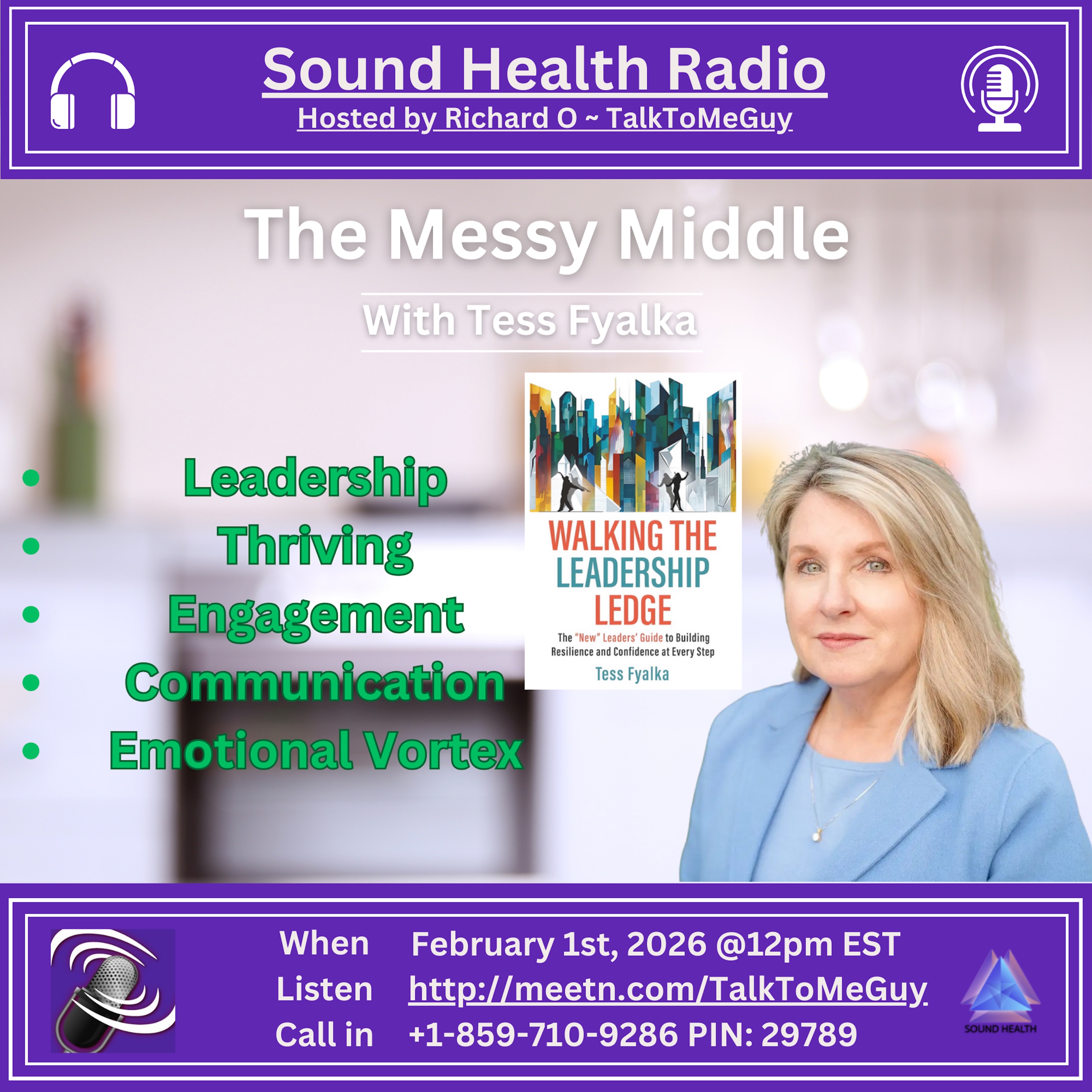
The Messy Middle with Tess Fyalka


You got the promotion. You earned it. You were the standout, the go-to, the one who always delivered. And then... you stepped into leadership. And suddenly, everything you did so well... doesn't quite work anymore. The skills that got you here? They're not the skills that keep you here.
Welcome to The Messy Middle.
Today's guest knows this territory better than almost anyone.
Tess Fyalka is an award-winning author, leadership development coach, team coach, corporate trainer, and speaker, bringing more than 25 years' experience in leadership, management, corporate training, and organizational development. She is one of only 247 professional leadership coaches in the United States - and 1,100 worldwide - to have earned the International Coaching Federation's Advanced Certification in Team Coaching.
She is the author of the recently released book Walking the Leadership Ledge; The “New” Leaders Guide, to Building Resilience and Confidence at Every Step
Tess is the owner of Angle Coaching & Communication, LLC, a private coaching and consulting practice specializing in leadership development and team effectiveness.
Her passion? Helping leaders at all levels develop the essential core competencies to lead successfully and equipping organizational teams with the tools they need to cut through challenging team dynamics and achieve their full potential.
Links from the show:
~
Please sign up for the email list for future notifications•
If you would like help starting your own show or podcast, as well as help selecting a microphone and setup for your voice; Please tap the microphone and leave me a message with your contact information and I will get back to you.
Or you can email: talktomeguy@gmail.com
More information at: SoundHealthOptions.com
Music
TalkToMeGuy: Greetings everyone. This is the Sound Health Radio Show where we talk about the crossroads of the environment, our health and longevity, with Richard TalkToMeGuy and Sherry Edwards is off working on the Sound Health Portal. I would suggest going to the SoundHealthPortal.com, scrolling down just a bit and clicking on the Watch How button. You'll see a short video explaining how to record and submit your first recording. Then go back to SoundHealthPortal.com, scroll down to current active campaigns such as cellular inflammation, bio-diet, neuroplasticity, or memory.
And choose one that is of interest for you. Click on that campaign and click Free Voice Analysis and the system will walk you through submitting your recording. You receive an email with your report back usually in one to two hours. To hear and share replays of this show, 50 to 60 minutes after you hear the outro music, go to TalkToMeGuy.com, scroll down that page and you'll see this show at the top of the episodes page. There are also hundreds of shows available there as well. There is a microphone icon at the bottom right corner of all the show notes.
If you'd like to leave me a voice message with a question for a guest or a guest idea for a show, you can do that directly from the site and I will be notified.
TalkToMeGuy: With that, you got the promotion, you earned it. You were the standout, the go-to, the one who always delivered. And then you stepped into leadership and suddenly everything you did so well doesn't quite work anymore. The skills that got you here, they're not the skills that keep you here.
Welcome to the messy middle. Today's guest knows this territory better than almost anyone. Tess Fiolca is an award-winning author, leadership development coach, team coach, corporate trainer and speaker, bringing more than 25 years experience in leadership, management, corporate training and organizational development. She is one of only 247 professional leadership coaches in the United States and 1,100 worldwide to have earned the International Coaching Federation's Advanced Certification in Team Coaching. She's the author of the newly released book, Walking the Leadership Ledge, the New Leaders Guide to Building Resilience and Confidence at Every Step. Tess is the owner of Angle, Coaching and Communication, LLC, a private coaching and consulting practice specializing in leadership development and team effectiveness.
Her passion, helping leaders at all levels develop the essential core competencies to lead successfully and equipping organizational teams with the tools they need to cut through challenging team dynamics and achieve their full potential. Welcome, Tess.
Tess Fyalka: Well, thank you so much, Richard. I am really excited to be here with you and chat with you for the next 45 minutes to an hour.
TalkToMeGuy: Or we could go a few minutes over if we need to. We don't have a hard hour.
Tess Fyalka: Awesome. Great.
TalkToMeGuy:I want to start by congratulating you on when does your audiobook come out?
Tess Fyalka: Actually, I'm not sure when your show airs, but it should be coming out the week of February 2nd. So we are right on the cusp of it. It's been uploaded to Audible, to Amazon. So it's coming out shortly. The paperback and the Kindle have been out for a few months.
TalkToMeGuy: And how was it managing yourself doing an audiobook?
Tess Fyalka: It is an interesting experience. You probably have had other authors who talk about you have to find basically a closet in your house when you are not going to an actual studio and hang up all kinds of blankets and put pillows on anything that's going to bounce the sound around.
And then you're in there for about two hour, two hour chunks at a time. And I had fabulous producers who helped me to do this. I didn't do this by myself. I worked with a team of excellent folks at Twin Flames Studios. And, gratefully, I had their wisdom and their guidance and their instruction.
TalkToMeGuy: I'm laughing only because it's always, I've talked with other people and worked with other people in helping them get that very setup. Find a big closet, line it with everything down you have, then talk to me. I'll tell you what the sound issues are. Or how it will work. Or get a setup. All the stuff that you figured out. You get a music stand, you get a good light, you get big printed pages, or you read it electronically. And it's a lot harder, I think, than people think it is. To many people it just sounds like, oh you're just reading the book out loud. Yeah, but you're doing it into a microphone, which most people are not used to talking into. And it's just a whole kind of different way of thinking. Recording yourself alone in a room.
Tess Fyalka: Yes, absolutely. And I think the other thing too, Richard, is I wanted the audiobook to feel like what I hope the actual book feels like. And that is much more conversational. And not just me reading text that I wrote, but actually talking to the listener in a way that maybe they can hear the passion and hear the care and hear the compassion.
TalkToMeGuy: And it really is, yeah, I will call it this, it really is a dramatic reading. You know, the audiobooks that were the people that I worked on, is you have to be, it's not just reading, but it's exactly what you said. It's really communicating the feelings and the, you know, getting that, enrolling the person in your story. Because you're really telling a story. It happens to be in the form of a business book about communications and teams. But it's still you're telling a story. Absolutely.
Tess Fyalka: And there are stories throughout the book. And so wanting, you know, to capture the feeling of those stories. And, you know, they were, you know, at one point in the book, I talk about the, oh, the, you remember the Challenger accident, because those of us who were around at that time will never forget it. And I, you know, I remember trying to get through that piece, that paragraph. It was just a paragraph, but it was like every single time.
And I still do to this day, I choke up when I, when I, when I think about that time and, and I had trouble getting through it in the book. But that's human. Exactly. Yes. And that would be the point. Exactly. Yes.
TalkToMeGuy: Well, that's exciting. I can't wait to listen to it. I listen to a lot of books because I'm usually trying to do something. And I listen to a lot of stuff. And it's fun to listen to books like yours will be, because I've already talked to you enough to know that it's going to be filled with all that juicy goodness of, you know, your own voice telling your story. Because it really is your story in the form of a training manual or a book to refer to.
Tess Fyalka: Indeed. Indeed. Yeah. And like you, I love audio books, you know, I'm a voracious consumer of books and mostly audio books. And, and I love to hear, I love to hear the author and the author tell the story.
TalkToMeGuy: Well, I love it because this is a whole other show. I love it. Let's say John David Mann, he's authored. I have no idea at this point. Over 100 books. He's, he's ghostwritten a lot of books. And he's a professional author. And from time to time, he'll read a book for the author. And it's so interesting to hear the texture of adding him to this. I know him, not directly personally, but I've done enough shows with him that I will really know each other. And it's so interesting to add the author's voice to it. I just think adding, using your own author's voice is such a powerful way to deliver the material versus having a professional read it. Yes. If you can turn it off.
Tess Fyalka: And I think especially in nonfiction, you know, in fiction, it's a different story. But in nonfiction, you know, that, that authenticity of the author speaking their words, I, I find to be very impactful. Whereas conversely, when the author has someone else read it, it almost, it feels contrived to me. That's maybe, perhaps a little harsh, but, but there's no substitute for the author reading their words in a nonfiction book, in my opinion. Yeah, I agree.
TalkToMeGuy: Okay, we've got that resolved. Check. All right. Check. So by now, I have read and I've listened to a lot of either interviews or things that you've written. So I don't necessarily, the flow is not necessarily just from the book. The flow is from information that I've gathered. So this first question I'm going to talk about, I'm not sure where I got this, but I read it, I think somewhere.
Okay. Or heard it. And it's, it's something from the book about the promotion, the promotion didn't come with a manual about being great, you're great at your job. And then the next thing is, and we were talking backstage for the show about my world of being in the chef for 20 years. I've had this very thing occur and that made me snort out loud when I read this about, then you get promoted.
And they, and they shake your hand and slap you on the back and go, you'll figure it out. Right. And there you go. There's your new title. Yeah. Well, what's that? How does, how do people even think that's going to work? That's, what is that? It seems like a setup for failure.
Tess Fyalka: It is. It is indeed. And, you know, and a lot of that is it, it's rooted in, you know, 20th century approach to leadership is, you know, if you think about the factory line, you would work your way up through the factory line. And so by the time you got to leadership, you knew how the factory line worked. And so, but, you know, we, 21st century leadership is it that is indeed a recipe for disaster.
The wheels fall off the bus. It's a completely different set of competencies because, you know, as an individual contributor, you're rewarded for things like expertise and speed and what you are getting done. And then all of a sudden you're in leadership and you have to get work done through others. You have to build a team. You have to create a culture where people actually want to show up and deliver and they're invested in not just their own success, but in the success of the team. And what is the team together going to create that is going to have impact impact on the clients, the customers, the community, the larger society. And now as a leader, you have to set forth that vision.
It's not about just, you know, cranking out the work. It's about how do you set forth the vision? How do you build the team? How do you walk in integrity? How do you have actually, how do you have the difficult conversations?
That's one piece of it. But you don't have to be worried about difficult conversations if you're creating a culture of conversation and daily conversation. And you're creating an environment of psychological safety. And there you've got, you have empathy, you have compassion and you have accountability and that it's not driven through command and control and fear. So that's my long-winded answer to your question.
TalkToMeGuy: The fear, I fear lit up for me because in the old restaurant world, I don't know that it's like this now, I haven't been in the restaurant world for over 10 years, maybe 15. There was fear.
You were on the line. Well, let's say we talked backstage, but the first restaurant I worked in where we would serve maybe 350 to 400 meals in an evening. And might have an outside catering happening concurrently. And there would be three of us, three of us to four of us on the line cooking. And all the food is being produced by those people. Yes, you have a salad station where the waitresses can make their own salads, they get their own coffee, but everything else that goes into the restaurant is coming off that line. And from the moment you open the door to the moment you stop, there are no times to pause or like, I'm going to grab a smoke breaker.
There's none of that going on. And there is some, there are people who are built for that kind of stress and there are people who are not. And that's not a judgy thing, that's just a, you don't want to be on the line producing food at that speed, at that quality and pace and speed and have somebody snap on you because they can't handle the pressure. And I've been on that line when you've had somebody who has snapped and it's really such a bad word because it stops the flow of everything and then you have to make up for that person instead of four people on the line, there are then three people on the line. So it's really tricky, there is an undertone of, and I mentioned Anthony Bourdain backstage on his book, Kitchen Confidentials, and in his, and the shows that he did for years talking about food, there was a lot of alluding to that and the use of drugs and all sorts of stuff. It's a harder world then.
I think it might be a little nicer now. I've never worked in a kitchen where there are tweezers used or that kind of fanciness, the French laundry up in Northern California kind of high end. I mean they were high end but not that level of fussiness. So there is a low level adrenaline thing to it and there have been times when I've had to talk somebody down from the, you can see, when you do it for a long time, you can see or almost smell somebody who's going to crash if you don't grab them. Sometimes you do actually literally grab somebody by the arms, by the shoulders, shake them a little bit and bring them back into their body because it's an odd mix.
I mean in a factory situation, because it is a factory of sorts, it's just that there is flames, boiling liquids, hot food, things that will burn you, things that will scar you, sharp knives. It's like juggling with clowns in a certain way. It's a tricky world. And there were times when I would have to talk somebody down. So I don't know, that's a long preamble to how do I, how could I have, or I guess actually the question is for me first, about getting clear on my own motives. You talk about this. This is another, I'm not sure where I saw this, but I know that I read this someplace about the road to hell is paved with good intentions. How do I get clear from my own intentions or motives and how do I help others with that same thing for higher functioning on the line?
Tess Fyalka: Yes, yeah. And that's such an important question. And it really speaks to, in my opinion, really the fundamental, the root of what I'll say is high performing, good leadership. In terms of the, it's knowing yourself, it's the self awareness. And if I am clear on my intentions, and I am actively working every day to build my own self awareness, knowing what are the things that trigger me, that bring out the worst leader in me, or the best leader in me. And how am I intentionally practicing on building those strengths and capacities so that in that moment when the person next to me might be getting triggered and they may be getting going off the rails. If I'm not real clear on my intentions and the leader that I need to be in that moment, it is very easy for me to react from a place of what is, you know, the reptilian brain, right, the amygdala where I get hijacked because they're getting hijacked. And so how do I set forth regular practices where I'm reflecting on what are my values as a human being, as a leader, as a co creator on this team, as a team member.
And how am I paying attention to what those values look like in action, so that I am also, but a I can when that person is getting hijacked who's in front of me next to me whatever, and so that I'm not reacting, but I am able to coach them as a leader, as you have talked about what you did in those moments where you had to bring them back to, here's where you are now, we're in the present, we're going to focus on what needs to happen in the next step. And so that we're grounding ourselves, if you will. And because the stuff in your example of the kitchen is a perfect metaphor for what is happening in our world today and in our organizations. Stuff is coming at us all the time, we don't have the luxury of being able necessarily to plan or to predict. And so how are we showing up in the moment where we are prepared for the ambiguity and the uncertainty and the wheels falling off the bus because maybe it's not going to happen today, but it probably will.
It's going to happen because change is happening all around us all the time, so that knowing what are your values, and how do I lean into my values and how does that what does that look like and how how am I building my, my self awareness so that I understand what happens to me under stress and I can I can mitigate that I can get grounded in that whatever whatever your daily reflection is whether it's daily meditation or whatever so that you are rewiring your your trigger responses so that or your trigger reactions so that you can respond in a way that builds the team rather than breaks down the team builds the relationship rather than destroys the relationship.
TalkToMeGuy: The last restaurant I worked in this isn't the show about restaurants it's just my reference point everybody or a reference point the was another place where we'd serve it's at 125 people but we do double that on a Friday or Saturday night so that means 250 covers. And I had four line cooks and that restaurant I was an executive chef, which is all other show. I hated being an executive chef because you don't really yes you produce all the specials and make the sauces and do a lot of the pre work.
Like when the guy shows up with three salmon for you fresh off the boat, you're the guy that has to bone out those fish because they cost a lot of money so it has to be done correctly. And but by the time we opened the restaurant. I'd already been there for six hours seven hours and I would be an expediter I would be the person on the other side of the window where the people are putting up the plates to watch all the food, not actually cooking it. And anytime there was a problem or an issue or a situation in the kitchen, because at the window, which is the metal box you sort of look through and see some of the kitchen it was not an open kitchen, but it was also the position where I could see everybody in their positions cooking. And the one thing they never wanted to hear me say and they would all get really quiet when I could say this, don't make me come back there and fix that.
And it was never said loud it was never shouted it was just leaned into the kitchen with like X-ray deaf eyes. And they knew that that was bad if I came back there and I only did it a couple times. And since none of them had never really seen me cook, they didn't know that I did know how to do the stuff that we were serving. They didn't they just said I mean they saw what I did but they never saw me actually on the line. And I don't know that I always handled that the best way, but I know it got the response I wanted in the moment.
And the few times that I did have to go into the kitchen, I'm the kind of person that when I'm angry, I'm not shouting, I'm quieter. And so they knew that it was bad that I would come in there and just tell them to get out of the way and I would fix what they were doing wrong and show them as you know I would do they just watch. And I would show them again how it wants to be done and then I'd walk out. And in that moment there was never any like I was yelling I wasn't anything maybe I would often talk to them at the end of the shift. And I always had the feeling that I could have handled that better but in the moment it gave me the result I needed which was to get the food out to the customer. I can't make that into a question. I'm sorry.
Tess Fyalka: Can I ask you a question? So, so I'm curious as you look back on that time. Would you have done anything differently?
TalkToMeGuy: No. No, as I say that one of the jobs as the executive chef is that everybody in the restaurant is happy. And they're there to have the food the way the food was supposed to be prepared. And that's my job. I'm the guy at the end of the line in the factory checking out that the car door closes correctly. I know other chefs would hate that metaphor but it's kind of it especially as an executive chef.
Tess Fyalka: So that was your reality that you were facing every day. So here's the thing that I heard a couple of things that I heard as you were describing that. First of all, I heard that and I don't want to sugarcoat this. All right, because but what I heard is that you went back there and you were showing. So that in my world is you're showing what good looks like.
All right. And that's one of the areas where leaders, especially new leaders struggle is helping their team members to understand what good looks like. The other thing that I heard is that in that moment while you may have been internally very upset and but you were able to bring in that room. You were able to bring a sense of calm and control. You weren't throwing things.
You weren't yelling. You were in and yes, of course they knew that you weren't happy but you weren't pouring gasoline on an already volatile potentially volatile situation. You came in.
You showed how it needed to be done. And sounds like there might have also been something of a debrief at the end of the evening so that again, you know, this isn't sunshine and gummy bears. You were in a very high stress situation. You're responsible for ensuring that the clients have a wonderful experience. And also what I hear is that you were able to balance creating something of a sense of calm back there in a state of high stress, high intensity. The stakes are very high for all of you.
TalkToMeGuy: Yeah. And those we talked about this backstage and this was one of those restaurants where the restaurant owner happened to be a chef. But he had other restaurants. So he would just wander in like Bonnie Prince Charlie and, you know, gussie up the patrons and come in and glad hand the line cooks and me. But it was, yeah, it was high. I mean, it's performance art. It's like ballet with knives and hot liquids and food.
Tess Fyalka: Yeah. And also, I suspect that if your if your restaurants were typical of the industry, there were always new team members, new employees coming in and out the turnover. My understanding is that in the restaurant business and please correct me if I'm wrong, it can be as high as 90%. Oh, yeah. Yeah.
TalkToMeGuy: Easily. You know, one of the advantages, the one of the benefits of standing where I was standing is that food servers are just a step below wild dogs in the sense that when the window fills with plates, they will come and grab any plate that they know that that's something they need to serve to one of their people, whether it's their turn or their table is up or not. So the reason that you need an expediter is to manage the plates and manage the food servers so that they don't just run rogue. Grabbing whatever they want because they will.
And that was part of what I did is I managed them in kind solid words. Or I would call the manager over and go, you got to talk to, you know, surely because she's, you know, grabbing stuff that isn't hers. Because that screws up the flow because the table comes out, a table of food because from out of the kitchen, for the most part, tables come out. That's how we prepare the food. We're preparing the food for this table and then the next table. But sometimes when you're working on a dish that takes longer or is done quickly, it may appear in the window sooner. So it's the job of the expediter to wrangle the plates and make sure that the food server comes and gets you press their vibrator and they should come within 30 seconds to come get that food. Because again, it's all about the experience.
I hadn't thought about it this way. I'm the project manager for the quality of the restaurant. I mean, yes, I'm in a chef and blah, blah, blah.
But that's really kind of at that time. My job is to make sure that the patrons get the food in the best way it possibly can be served to them, which means the moment it hits the table to me, I want it on the way to the people. Because it's about maintaining quality.
Tess Fyalka: Right, right. And the servers, they're also in high stress mode. And so they're in, you know, what we refer to as, you know, five flight or freeze, right? So they're not necessarily, they're just in a state of reacting. How do I get this out there fast enough because this is going to be reflected in my tip? And I'm the front end of the business. And so they're operating from a place of fear, if you will. I got to do this or otherwise this is going to end badly. Yeah.
TalkToMeGuy: Well, also they have the other modifier for them, the servers, the line cooks are always all making a fixed wage. The people serving the food want the experience to go as well as possible because that adjusts their tip.
Yeah. And I can almost guarantee you that food servers are always making more than people on the line. I know food servers who make, who worked on the Monterey Peninsula or other mechas who made amazing amounts of money and they weren't doing anything wrong.
They were just really skilled food servers because it's more like performance art. You know, it's the personality, it's the charm. It's knowing what your clients want, what they like, when they become regulators, if they want to double scotch when they sit down. I mean, it's all that kind of little subtle things that a food server can adjust. The line cooks have none of that.
Tess Fyalka: And I think you speak to a really important point there in terms of the food servers are creating relationships. Yeah.
TalkToMeGuy: They improve the increase in their tip. It's a very simple motivation. The nicer they are, the more they can work that room to get that tip up.
Tess Fyalka: And yet if the food isn't up to the standard, that will affect the tip. And so again, I come back to, you know, it's very much, it has to be a team sport and there have to be systems and processes in place. It's such a good example for how do you back each other up when the stuff happens because I would, and this is, you know, clearly an assumption on my part, but stuff is happening all the time. You know, things are not going according to plan. Never.
TalkToMeGuy: Exactly. You can almost be guaranteed. Oh, wait, that happened. Wow.
Tess Fyalka: Yeah. And is that we can expect that? Yeah.
TalkToMeGuy: And at some point, the other, again, the only advantage for me, as I say, being in that position was not my happiest place in the restaurant world. I liked cooking. I enjoyed being more on a line where I was part of that team, even if I was the lead chef or the sous chef. I like cooking.
I'm not wild about management just because I really like the art of producing great food. But there would be times also when a waitress would bring, because for them, since I was standing there, they'd bring something back and ask me like, you know, they're not happy with this dish and blah, blah, blah. And I would be literally poking at it with my fingers to see if the steak was cooked correctly, if there was something wrong. And if it was wrong, I would just tell, you know, Jose, cook another of those and tell them that it, and oftentimes it would come in the window and I would bring it to their table and be gracious and say, you know, you're not an idiot.
That's the way steak should be eaten. I would not say that in my mind. I might, you know, when it comes to well done things or, you know, how something is cooked if they didn't like it or if they just didn't like it. It was my judgment call to say, no, I'm not, no, you can't send back a crab souffle. That's a no.
It's cooked perfectly. You don't like it. That's your fault.
Not mine. But I was telling that to the food server, unless it got really ugly and then I had to go in the dining room and have a conversation with a customer.
Tess Fyalka: You know, I'm wanting to ask you, but I know that you're the, you're the one who's, you know, because when you talk about being a chef, my, you know, of course, the first question is, what do you love to prepare? What are some of your favorite dishes?
TalkToMeGuy: I've always cooked in California. So I've always cooked a lot of, particularly well, like at the restaurant, the Bistro and Carmel, there was a lot of people who would, do you know the, the company earthbound farms? Does that ring a bell?
I do not know. They invented baby lettuce in a plastic bin in the box. They were the first people to distribute nationwide baby lettuce, you know, perfectly washed organic lettuce in a plastic tub.
nd They invented that idea and sold their company for a $1,000 ,000, 15 years later. Well, the Bistro and Carmel, they were my produce suppliers. And all of the food that we cooked with were like that.
My eggs were pastured eggs. Before that was even a word, people understood what that meant. Butter was local. Everything was as local. And I had regular deliveries from fishermen again who would show up off the back of the boat and would have salmon or have a halibut or have some beautiful rockfish. So I got to cook fresh California food. And that was my favorite, you know, pick it, whether it's a seafood or a grass-fed beef.
In Northern California, we have the people who threw a variety of vendors who produce true grass-fed, grass-finished beef who are out as we speak grazing on the grass on the beautiful coast of California. So that's really, it's a bigger answer for me in that I love taking a fresh product and honoring it. And presenting it and cooking it in such a way to enhance what it was like a fresh salmon steak, grilled perfect crispy skin on one side, cooked just to pink perfection, served with some kind of, you know, maybe a beef steak tomato carved out and stuffed with butter sauteed peas and maybe a root vegetable mash, mash potatoes, parsnips, turnips, and maybe a yellow-finished potato mashed. And that's the meal. And so it's creating visual food. So each piece is in a certain way art. And having people react to that art. That's what I love to do.
Spectacular. I mean, we could do a whole, you and I, anytime you want to talk about food, I can get much more specific. But I would say that's more my lean is to take the best product I can get my hands on.
And in some of the restaurants I worked in, that was not as true. But in that one, I was allowed to run wild in the sense of the best products we had, the people from Earthbound Farm would walk in with a tray of blackberries or blueberries or any berry that they had just picked. And I would then do something with those. I would make a possibly a surveyor, maybe just serve them with a perfectly whipped cream or so, you know, just any kind of things. Serve them with a biscuit with a bit of sour cream as a smear.
Honor each piece of food. And it wasn't like I spent time doing it. I just thought I would see the food and I would have an idea of like, oh, here's a way to feature it.
Tess Fyalka: I hear the passion for what you were creating there in the art of creating something that was beautiful and delicious.
TalkToMeGuy: Yeah, I think that food, I didn't know we were going to do, you were going to do a show with me. I think food is transitory art. I think when a plate is put down in front of a person, they should suck a little wind because it's pretty enough that they're, and I don't, you know, this is not, there's no, again, like I said, I've never worked in kitchens with tweezers or any kind of like, too fancy, fancy, it's just perfectly cooked. Fish or poultry or whatever it is, or grass fed beef with a side that is appropriate for it in a perfectly cooked vegetable. So it's to take the products that are at their peak and prepare them in an honoring way to them, whether it be a grass fed steak or the potatoes or the or when we were, we also served breakfast at that same restaurant where I was a made, I made a Benedict on a crepe 7000 times a day. But each time it was still perfectly cooked pastured eggs served with biscuits that were made that morning by me and possibly a preserve that I made that morning with sweet butter. That was from grass fed grass fed cows. That was, you know, that was cooking. Really. And I guess.
Tess Fyalka: Yes, yes, I'll just, I'll just, I'll just pull us over to, you know, I want, I wonder around the, no, that was. It's lovely. And you're making me hungry because it's almost lunchtime.
Speaker 3: Yes. Oh, no, no, it sounds wonderful. But what I, what I appreciate there is the, the respect and appreciation that you have for, for what is in front of you and whether it's the blackberries or the steak or the salmon or whatever. And, and I think as we, as we think about this in terms of coming back to our responsibilities as leaders and you know, and I consider all of us are leaders, whether, whether we hold the title or not, but in, and having that same appreciation for the person who is in front of us and the, the human being who is there and
Tess Fyalka: whether we agree with them or not, or have challenges with them or not, how, how can we as leaders bring out the best in them, much the way you are able to as a chef bring out the best in, in the beautiful, you know, food that you created during the time that you worked as a chef.
TalkToMeGuy: Well, I think because in, in reviewing your book and listening to other interviews and reading just a bunch of material, I have been thinking about that's why the restaurant thing is such a, in my brain because I was thinking about my time in that world. Of the four restaurants, I had five people out of the various restaurants go on to have their own restaurants. And I feel pride in that I think part of they weren't chefs or restaurateurs when they started working with me. And I was always willing to help anybody learn who wanted to learn or teach them or show them.
And, and a lot of what I did was show by doing. I was not much of a talkie like this done this, you know, I would teach them how to, I come from the era of where you didn't use thermometers. Today, everybody's sticking stuff in the meat to see how it's done. You learn to do it by touching the meat and you would learn how the meat felt, let's say a steak, how it felt, how it resisted your touch was how done it was. And you, you learned that by doing, you would, we'd cook a steak and see that, you know, the well done steak feels this way.
A medium rare steak feels this way. So it was a very hands on experience or how to, I'll say this just because it's always amusing, how to make a hollandaise with six egg yolks and two pounds of butter in two minutes. Because that's about all the time you had and that was done in a cuisine art. And it's not for the faint of heart because it's very fast and you have to know all the exact moments to teach them all these things. Just by watching me do it, then they could ask questions. I wasn't going to like hand anybody a recipe and say, oh, here go make this. I was going to show them. And then, so I had about five people who went on to have their own restaurants from after the time they worked with me.
They'd learned enough skills that they felt that they could then go cook their cuisine in a restaurant. And that's very rewarding to have that in my, in my head. And that was always my style of management as well. Less talking and blah, blah, blah.
Just show, just show, you know, watch how I do this. Or like teaching somebody how to make an omelet, the perfect classic French style omelet, which means a little softer. Never any color on the eggs. And how to flip it and how to do the things. And at first it's just awkward and bad and there's a lot of eggs on the floor. But at one point, once you get it, it's so simple. I have no question there. I'm sorry.
Speaker 3: You led me down the food path. You led me down the food path. I'm sorry.
Tess Fyalka: No, no, that's it. It really is. It's, it's a perfect metaphor. And then of course, you know, I'll go back to leadership in that as we're growing and developing as leaders, we break a lot of eggs and there are a lot of messes. Yeah. Yeah.
TalkToMeGuy: Yeah. Yeah. Well, and then that was one of the sections. I again, I don't remember where I saw this, but I made me laugh. Kill a team or fire myself. Yeah.
Tess Fyalka: Yeah. That's, that's, yeah, there, there are two chapters that's, there's part one and there's part two. And it talks about, you know, the, the, the concept of team and how challenging that can be for leaders because especially new leaders because they're used to doing it themselves. And, and so often, first of all, you know, the, and, and organizations will throw people together. And, you know, expect to them to be a team, you know, and it's, you know, my joke is if, if you've, you've been on a team, if you've watched a team, if you've rooted for your kids team, if you can spell the word team, then oftentimes organizations think that you can come together and simply be a team. And in fact, and, and if you can reference the Tuckman model, well, you are an absolute team genius and that is the performing, storming, norming and performing. So, but the teams require a, I refer to it as, as a team pact. And I like the word packed.
It's not a contract necessarily, but it's a pact and I like the word packed because packed is rooted in the word piece and pretty much every team that I have ever worked with could use a bit more piece. But what happens is every team wants, every team wants trust accountability. They want communication and they want respect. And so, in fact, but the team members rarely talk about what does communication look like to Richard versus tests. What does accountability look like to test versus Richard.
And so they make these assumptions that my, my interpretation is the same as your interpretation when in fact they're almost always quite different. And so if the team can come together and talk about, you know, what, what is a really high quality, high functioning team look like. And if you could create that, what would you do. And, and also what is, what is a really lousy team feel like and what happens and what are the risks of that. And you get the juxtaposition there around, around, I guess everybody's been on a horrible team. And if you've worked in, in, in the world of work for any time at all, you know, you've most likely been on a really challenging team.
And so that comes to mind very quickly. But there's most teams know what they don't want, but they don't set out to really create what they do want. And so getting that clarity around what do we want as a team and what does it's not just words, you know, that we throw around, but what, what are the behaviors, what does that look like an action. And how, how are we going to be intentional about creating that because, you know, we may create the team packed, but we've got to check in on. Okay, we agreed that, that communication looks like this, we agreed that trust looks like this, we agreed that accountability and respect look like this. And our, are we living up to those agreements. And so, you know, as part of that whole process when, when the team, when I work with teams and we're aligning as a team, and we're creating the pact. And then we're talking specifically about what that looks like in action.
And, but it can't stop there. We have to come back to periodically the, you know, the, the checking in on that pact, and where are we crushing it as a team and really living what we said was important to us. And where are we tripping up, you know, if we agreed that we would do 15 minute huddles in the morning, but we haven't done one for the last four weeks. And so, so there's miscommunication there that resetting. And, and it also, when there's a pact, you're more likely to avoid the pointing of fingers and the assigning blame and the assumptions that, well, so and so just doesn't care, or so and so isn't competent.
All of those things that, that undermine the team's ability to work most effectively together. So I'm going to pause there and let you ask any questions because you know you got me started and sort of like you in the restaurant business and, and the kitchen and cooking. Well, I can just go off on a tangent. Well, and how do we.
TalkToMeGuy: Well, this is back to that last kitchen. I hate, I hate, I do not enjoy, I'll put it this way, I do not enjoy confrontation. It's just not my thing. I'm not a scrappy fighting kind of person. So, but there have been times when I've had to, and particularly in that restaurant, because again that was the restaurant to her owner who just wandered through he was really there, but he just come by when you know things were happening.
That at some point or another, he would say to me, I think we need to, we need to fire Jose, which would mean I need to fire Jose, even though he was the person who hired all the original line cooks. And so I had to have a conversation and I just, I never found a way. I mean, I in my style, it was kind and gentle, but it was the classic it's just not working out.
I think you have to go elsewhere. Don't come back, said nicely. And I didn't, I didn't want to give him like a critique or a review, because that wasn't really something I wanted to do. And he didn't really ask any questions.
He knew he had not been performing well. And because it's very quick to see somebody not, this isn't like a large corporation where you could sort of fall into an invisible zone for a while. You're on the line producing food. I'll know if you're not doing it right. And that's my job. And so firing people, how do we fire people solidly, but kindly? I don't know how to even form the question. I'm so uncomfortable with firing people.
Tess Fyalka: Well, and, and here's the thing. Yeah, most people do not enjoy firing people and most people do not enjoy confrontation. And so the in, in an organization, whether, whether it's a kitchen or whatever the type of organization is, if there, if there is a culture of communication and a culture of coaching. And I think you alluded to this in terms of there was enough communication there and enough feedback for Jose, that Jose knew that he was not, he was not meeting the standard that the position required. And that, that is the reality of the world of work in terms of I, if I am not meeting the expectations and the standard, then this, this position is probably not a good fit for me. And it's not, it's doesn't make losing a job or firing someone easy. But it is, it is the point at which when that conversation happens, there has been enough that there have been clear expectations, there has been coaching, there has been feedback on on a regular basis, so that when that conversation comes, there is there is a recognition that we have done what we can together to make this work.
And it's not working. And then, Jose, or Richard, or Tess is invited to pursue the next opportunity that might be a better fit for them. And in, and in organizations where someone is allowed to continue, and they're not meeting the standard, and they, they're, they're not being coached and the expectations haven't been set. But that is so disrespectful to everyone else on the team, who is stepping up who is, is not just meeting but possibly exceeding the expectations and looking at it in terms of what are we here together to do. We are here to create a fantastic experience for the client.
And everyone else on the team is indeed stepping up and delivering on what it is that looks like for their individual role. And it's, it's the we can't achieve that as a team. If, if we are not inviting that person who either doesn't want to or, or isn't able to perform to the level that we need them to. Now, there's also the, okay, in the case of Jose, would it have been an organization or a situation in which Jose could have stepped up.
And with a bit more training with a bit more coaching with a bit more mentoring that in that he could have been able to to meet those expectations. I don't know. You know, it's, it's a very nuanced for sure.
TalkToMeGuy: And for some reason this leads me to the question. And again, by now I don't know where I got this but I wrote it down. What about leaders who fail out loud? How does that vulnerability show up differently when someone first steps into leadership, because I feel sometimes like I was failing out loud when I first started being an executive chef. Absolutely.
Tess Fyalka: Yes. And every leader fails out loud, because everyone everyone is watching the leader and the, you know, the folks around the leader are, you know, earning their PhDs if you will studying the actions and the reactions of the leader and they're taking their cues from the leader in that in that, how, you know, what's what's going to set the leader off what what are the what are the the trigger points for the leader. How does the leader operate or not in integrity and how does the leader build or break down the team members. How does the leader thinks strategically how how does the leader show up under pressure and so the the leader especially early on because because they're figuring out who am I as a leader. I knew myself as an individual contributor, but who am I as a leader and this this brings us back to where where we started early on in terms of the leader has has to be a student of themselves, and they have to be a student of what how did they react under pressure. Who is the leader that they need to be who is the leader that they want to be when they think about alright the impact that I'm going to have on this team on this organization to those that I serve. How do I want to be experienced as a leader and that intentionality around. I am going to shape and create the leader that I would want to work for and that that acknowledgement of yes they are going to fail out loud and how good is the leader at acknowledging.
I screwed up I made a mistake that was a bad call and I'm working on doing better. Will will you sit on the same side of the table as me and you know I'll take something something like alright my team members are not challenging me they're not speaking up they're not disagreeing okay so that then create creates an environment of learned helplessness because they're looking to me to give them all the instruction. I can't scale my team or my leadership if I'm the one who is directing everybody what to do all the time and so they're not critically thinking and problem solving themselves so I need I need to recognize when I am doing that when I'm going into. I control mode and that is essentially set shutting down my team members so that they are not stepping up because they're afraid to step up and so I'm failing out loud alright they're seeing this is happening and I can't scales capacity because of my behavior as as a leader. So how can I engage my team members to help me grow and it's not and it's that vulnerability piece. This is something that I as leader do not do well and I need your help trusted team member or to. To call me out when I am going into command and control mode and when I should be getting going into curiosity mode will you please raise your hand and say hey Richard tests whoever. And we explore curiosity mode for a bit.
How can you engage your team members because you will fail out loud and we all do in helping you to grow as a leader and to develop as a leader. Long answer to your question Richard.
TalkToMeGuy: It just makes me think if I were ever to do a restaurant again. I would insist that you were on the team. I'm a lousy cook. No I know that but I mean in terms of the well I don't know that but I mean yeah yeah that's a separate issue possibly we can talk about that there's ways. But in terms of actually having as you're talking and when I was talking about that earlier experience. The person who owned that restaurant was the executive chef as I said was a successful restaurateur which means he was a very good chef and had a top rated restaurant on the coast of California.
Just because you're a good chef does not necessarily mean you're a good manager. Precisely and that was kind of his thing is that he would come now he had three at the time. The third the Elco Cojo which is the restaurant I was in was his third restaurant. The other two were sort of on the autopilot at that point he would just walk through them. And his idea of management was to come in and sort of joke with the guys in the kitchen.
Maybe slide me some money so that I could then do some little Betty thing with them. He was trying to build some sort of to me what seemed to be very fake camaraderie. Which I detested because it was a waste of time and I'm not I don't want to don't. There's so many bad phrases just don't. You know I'd rather have somebody like the very first I trained under who would get up right in your face and shriek at you at how you made something wrong.
And when you're doing a sit down catering for a thousand people and something is wrong that's really bad. And those are not kind words he was yelling. I would rather have that expression versus this subtle low level manipulative I'm your friend. Because that was not my position as the executive chef my position was is their boss.
I happen to be many of their friends but that was not that was a side effect. I was not out of my way to trying to manipulate them and doing good by like having fake camaraderie and they would all roll their eyes when he did it too. So as they as the chef how do I communicate to the owner get that blank out of here in a much nicer way than that because it was always just time wasted because he would come in when we were prepping for the evening.
Tess Fyalka: Yeah and I you know to your point the and people see right through that you know it is that there's spidey senses is far more tuned in than we give them credit for and so that it did him no favors it did the team no favors and to your point it was a waste of time. And the other thing too as you talk about you know that the the chef who was extremely hard on you. And as you said you learned a lot from them but what I think while you didn't appreciate their delivery you appreciated that you knew where you stood and I think I think you mentioned this be maybe before we went on air backstage that you knew that he cared about you.
Yeah. And so there was there was the sincerity and the genuineness and and yes it you know there's there's all kinds of issues there but in terms of of you know what what the right way to handle that but in terms of the what you were getting besides you weren't just having getting it having an experience where he was screaming at you all the time there were the the other the other other you know facets of the gemstone that you were getting. And that was the other one that was this person and that was a perhaps darker side of them, but you had enough of a relationship there, where when they did that to you, you, you could view it through a lens of seeing more the whole person, rather than just that part of them now I'm making some assumptions there based on some other things that that that you have talked about and the other interesting thing even though that feedback was harsh when he gave it to you the interesting thing is that that.
And I'm not condoning that by any stretch okay but the the interesting thing is that team members are nine times more likely to trust their manager leader boss whatever when they get feedback. When they don't you knew where you stood with him. It wasn't pleasant, but you also had enough of a relationship with the whole person that you could see that that was not all of him that perhaps that was when he was in at his worst and he didn't have the tools. He hadn't developed the tools to have those conversations in a more productive way.
TalkToMeGuy: Well I also eventually learned I did not come from a family that had expressed their emotions very much. So if he was a shock in that he would come back from a catering you know something got to him late because I held it to you know I did something. I didn't ruin anything I just held something too long and he was like, don't ever do that again with a lot of other bad words. But the thing about him his name is Leo Leo would come in and blow you off just blast you.
And then that was it. He never held a grudge. He didn't hold it over your head. He didn't bring it up again.
He was over it. You know at the end of the night he's inviting me in the back room to chat and have a beer and have some salami and cheese. Of course as all chefs do what do you have for dinner?
Salami and cheese and a beer. So I understood that once I adapted to that his delivery style I didn't enjoy it ever. However I respected in that he did it. He blew the charge.
That was it. Whereas the guy where I was the executive chef I always felt this low level of manipulation that I did not enjoy. You couldn't trust him. I couldn't trust him. I knew he'd turn on a dime.
And eventually he did. He fired me out of the manager of the restaurant and myself just like we're fired like gather your things now. Out of no good excuses. We got him all his top ratings and got top ratings on the peninsula and all gold forks and all the stuff and it was like get out.
And I think it was all because they didn't want to pay us the bonuses they promised. But that's a separate show. So it was very different styles. I didn't ever enjoy Leo ripping me a new one.
But I did learn that once that was over he was over. That was great. Well great.
Not exactly right. But it was okay. And I did screw up.
It just that I left him standing in front of 500 people with something while he had to like tap dance because I didn't send it soon enough. All right. I get it.
That was bad. But I understood the reason I did do it. I made a mistake and he taught me his style of teaching was a little harsh. But I learned. I learned.
I can't believe that we could do this for another hour pretty casually. I'm at the point where I want to ask you where can people find your book? Where can they find the audio book which that's very exciting that that's coming out possibly tomorrow. Maybe. And how do people work with do you work with individuals or only organizations?
Tess Fyalka: I work with both organizations and individuals and people can find all three versions of my of my book on Amazon. You can find me at angle coaching.com. And that is my that's my my main website. Angle coaching.com. And then there in my other my book website is walking the leadership ledge.com. Okay. And I'm on LinkedIn. I'm not on any other social but I am on LinkedIn so you can connect with me there.
TalkToMeGuy: And I have one last comment. So, and again, I don't know where I got this. Chat GPT recommended you to somebody. What is that? How did that happen? What is what did you who do you slip a fiver to make that happen? That's a miracle.
Tess Fyalka: That was crazy. I know I couldn't believe that the yeah, that was that was the client that I'm actually working with and doing a lot of corporate training and coaching for them.
And I don't know evidently they put certain criteria in and chat GPT spit me out. And I was like, whoa, like have I arrived or what? Yeah, it was hilarious. I know.
TalkToMeGuy: That's amazing. I've worked with a lot of AIs and I do get the masking me questions about stuff we've talked before. And but I've never had anybody come to me and go, oh chat GPT told me to talk me guy should be the one to help me with that thing.
Tess Fyalka: So that's probably will, you know, that's coming. That's coming.
TalkToMeGuy: It's all going to be chat GPT. That's exactly. Yeah, that was a really great conversation test. Thank you so much.
Tess Fyalka: My pleasure, Richard. I thoroughly enjoyed it. And like you said, I could chat for hours about the restaurant business and your experience there and feel
TalkToMeGuy: free just, you know, we can meet up again anytime and you can I can talk food forever. Yeah. Yeah, next time I'll do the interview. Feel free. I'm happy to talk about food always in the in the world of the restaurant business, the illusion of it. The delusion of it. The mind blowing part of people who buy restaurants who have no skills.
That still is my number one. We talked about that backstage that that just blows my mind that people buy a restaurant with no skills. So that means they're subject to the mercy of whoever is cooking for them blows me away.
Tess Fyalka: Indeed.
TalkToMeGuy: Indeed. All right. Thank you very much. And everybody have a great rest of the week and we'll see you next week. Bye bye.
Tess Fyalka: Thank you.


