Regenerative Health with Martha Carlin Founder of the Biocollective & BiotiQuest Probiotics
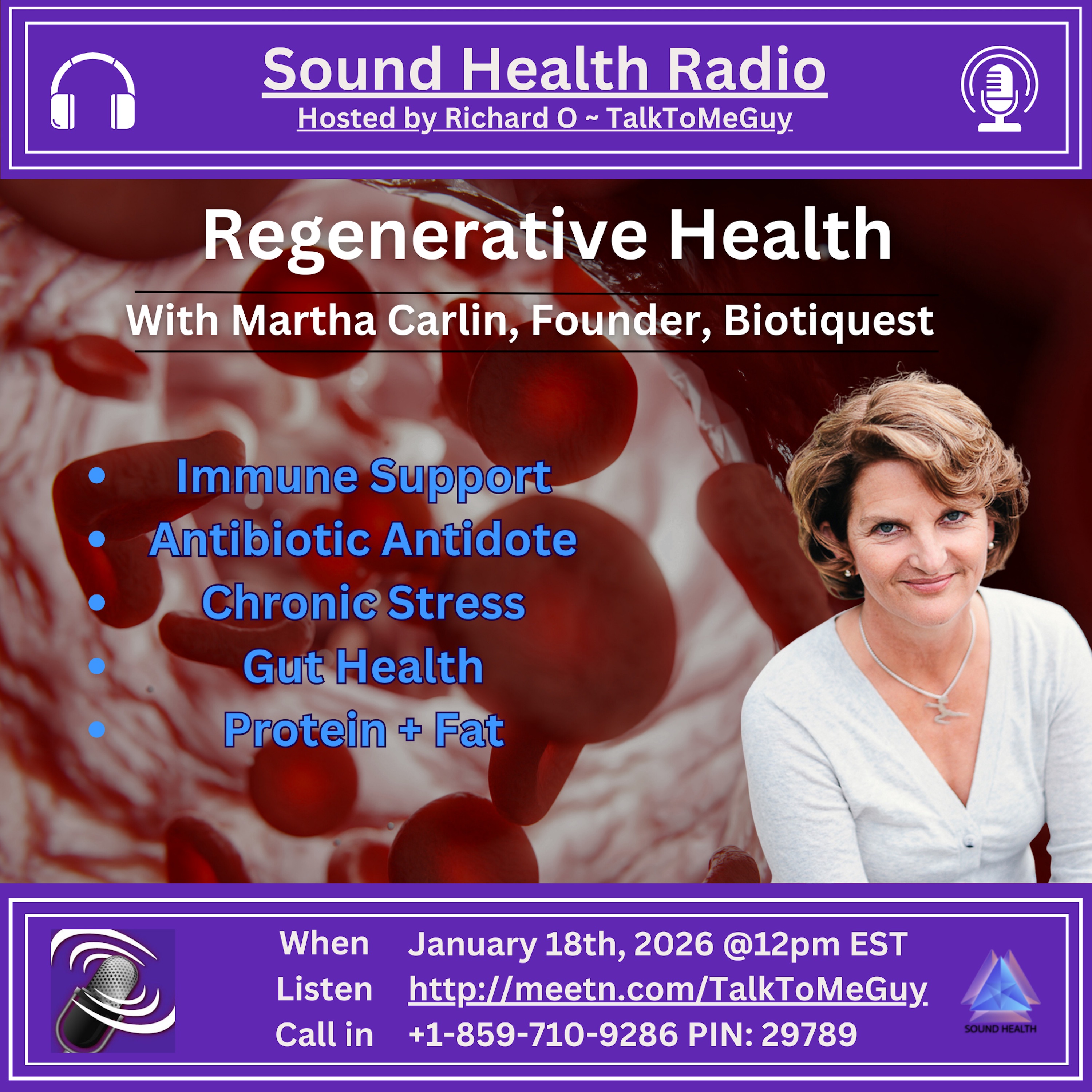


Martha Carlin Founder of the Biocollective and BiotiQuest Probiotics is a microbiome researcher, entrepreneur, and systems thinker focused on regenerative health and the hidden factors that shape human well-being. Her work, bridges gut health, environmental exposures, and everyday lifestyle choices that quietly influence metabolism, immunity, and resilience. She is especially interested in how modern risk factors—such as household cleaners, antibiotics, diet, and chronic stress—interact with the microbiome and the body’s natural repair systems. Martha brings a practical, curious, and solutions-oriented perspective, helping people better understand how small, often overlooked choices can have outsized effects on long-term health.
Links from the show:
Martha Carlin Founder of the Biocollective and BiotiQuest Probiotics
Martha Carlin on Substack *Great articles
Previous show 080325
Martha Carlin's quest to research The general ledger of our Health and Longevity
Please sign up for the email list for future notifications•
If you would like help starting your own show or podcast, as well as help selecting a microphone and setup for your voice; Please tap the microphone and leave me a message with your contact information and I will get back to you.
Or you can email: talktomeguy@gmail.com
More information at: SoundHealthOptions.com
TalkToMeGuy: Music Greetings everyone.
TalkToMeGuy: This is the Sound Health Radio Show where we talk about the crossroads of the environment, our health and longevity, with Richard TalkToMeGuy and Sherry Edwards is off working on the Sound Health Portal. I would suggest going to the SoundHealthPortal.com, scrolling down just a bit and clicking on the Watch How button. You'll see a short video explaining how to record and submit your first recording. Then go back to SoundHealthPortal.com, scroll down to current active campaigns such as cellular inflammation, bio-diet, neuroplasticity, or memory.
And choose one that is of interest for you. Click on that campaign and click Free Voice Analysis and the system will walk you through submitting your recording. You receive an email with your report back usually in one to two hours. To hear and share replays of this show, 50 to 60 minutes after you hear the outro music, go to TalkToMeGuy.com, scroll down that page and you'll see this show at the top of the episodes page. There are also hundreds of shows available there as well. There is a microphone icon at the bottom right corner of all the show notes.
If you'd like to leave me a voice message with a question for a guest or a guest idea for a show, you can do that directly from the site and I will be notified.
TalkToMeGuy: With that, Martha Carlin, founder of the Bio Collective and BiodiQuest Probiotics, is a microbiome researcher, entrepreneur, and systems thinker focused on regenerative health and the hidden factors that shape human well-being. Her work bridges gut health, environmental exposures, and everyday lifestyle choices that quietly influence metabolism, immunity, and resilience.
She is especially interested in how modern risk factors such as household cleaners, antibiotics, diet, and chronic stress interact with the microbiome and the body's natural repair systems. Martha brings a practical, curious, and solutions-oriented perspective, helping people better understand how small, often overlooked choices can have outsize effects on long-term health. Welcome, Martha.
Martha Carlin: Thanks for having me, Richard. It's good to be back.
I'm delighted to have you back. I will preface this by saying that I will put the last show Martha and I did about a year ago in the show notes, the link to the show notes, so we'll be diving directly in versus all the background. But I will put that link in the show notes so that you can have reference to that as well as what we're going to talk about today.
Martha Carlin: Great.
TalkToMeGuy: I want to start here. We all seem to agree that gut health is the foundation. Now the question is, do we lean toward the synthetic rebuilding or do we go regenerative health? What are your thoughts?
Martha Carlin: Well, we were having a sidebar before we got on here about synthetic versus natural in terms of drugs and the geometry of drugs, and the same holds true for anything you're putting in your body. So for me, you want to rebuild the system in the most natural regenerative way you possibly can. And that's not saying that sometimes you don't have to use some other tools, but I think most of the time when we're trying to restore an ecosystem, which is what our gut is, we're much better off using natural processes and allowing the natural healing processes to take place by removing those things that are harmful first and letting the body's own intelligence do what it can do to repair.
TalkToMeGuy: Well, to me, the synthetic side seems like it's dismissing the... I have a thing that I say frequently is that given the opportunity, I believe the body will heal itself. And I mean products such as your bio-dequest or eating organically or all the things that we can do to support the system. So I feel that the body will heal itself given the opportunity. I just don't think synthetic gives the body its own... it doesn't really acknowledge the body's own capacity for that. Am I reading that wrong?
Martha Carlin: No, I would agree with that. And the more synthetic things you put into the body, the more the natural systems have to kind of battle the imbalance created by those to try to understand what it's dealing with.
TalkToMeGuy: I don't think the body needs more onslaught. That's just a personal comment. Right.
Martha Carlin: I would agree with you. In fact, I was on the quitsugar summit this past week and Mike, who's the founder of that, was talking about... he is writing a book on... I don't know if it's actually called supplement abuse or something, but just the number of people that he's worked with who are taking so many synthetic vitamins, products, different things to try to recycle. They restore the system or make themselves feel better or optimize their health or whatever it is. And that he's had really good success by removing things, saying, okay, let's stop this and just give the body a chance to reset itself.
TalkToMeGuy: There's something to be said about going into a tent or a teepee in my case and having a sweat and walking around and being quiet in nature. Or maybe not quiet in nature. But I just think we have... I think the body really knows a lot about how to manage itself. We just need to supply it with the good quality products.
And it will... I'm not saying we don't get into a state of imbalance. I don't really have a closing thought there. It just... I just think what you're leaning toward with... I've heard you say or read you say, you know, real whole health.
Martha Carlin: Real whole health, real whole food. I do have a good friend who... her whole family was living in... they were on a farm. I think it was in Montana or might have been Idaho. And it turned out that there was leaking pipes in the... it was a fairly new home. But anyway, they were all exposed to a tremendous amount of mold.
It took them a while to figure out what was going on with their health and all of their health was suffering. And, you know, when they finally figured it out and got out of the house, she spoke to... I can't remember who suggested this for her. But, you know, you say she would like go to a tent. I mean, they actually went somewhere where somebody had a little... almost like a little tiny island, no house, nothing off the coast of Florida. And they basically took tents and went there and lived, I want to say, she said for a couple of months and actually, you know, living outdoors in that type of setting where they were away from all of the factors that had originally contributed to the health problems and just allowing kind of nature to take its course. They all healed.
TalkToMeGuy: I'm not laughing at you. I'm just laughing at like, yeah.
Martha Carlin: Yeah. Yeah. There's that. I mean, but like who's got a little island they can go to off the coast of Florida and, you know, take two months off of work. Yeah.
TalkToMeGuy: And just lay around on the beach and eat fish that you caught that afternoon. I don't have that.
Martha Carlin: I love the idea. Yeah. Not very practical.
TalkToMeGuy: But I can see that I've been in the arena of health for a long time and I had an herb store with partners in the Monterey Peninsula in the, let's just say early 80s, because too much further back is too much further back. But there was a lot of people who would do these, you know, amazing cleanses or there was a program called the Kelly program, which was a very complicated, well, that was pretty complicated. It was mostly intense, high volumes of vitamins, lots of juicing, coffee enemas. It was a good protocol, but it was rigorous and it was expensive because of all the supplementation. And you're consulting, oftentimes it was a program run through a chiropractic clinic versus going to see an MD because there was too much old thinking in the realm of Kelly.
Right. And it had amazing results, but it was limited because it was people that it was only people that could afford to do it. Not because, you know, it was just, it was amazing to me and that's not dissimilar to this idea of like, sure, I'll take two months off and go live on an island.
Martha Carlin: Or even, you know, kind of, I certainly do a fair amount of talks and appearances with people in the biohacking space and that's a pretty expensive space. And it's, you know, some of it is natural, but some of it is synthetic. And so, you know, it's a, it's a very different approach. And it's also an approach that's outside the means of, you know, the average person. Yeah, that's a whole different show.
TalkToMeGuy: That is, that is a whole different show. I have a lot of commentary about that. Okay, let's, I have to because it just, I find this so fascinating. I had never really heard of glycocalyx until I started reviewing more of your material again. And if you, you have called the glycocalyx probably the most underappreciated organ of the body.
Martha Carlin: Yeah, it's amazing.
Martha Carlin: Well, I hadn't heard of it about a year and a half ago. Well, maybe a little bit before that. I had just started learning about it before my husband, John, passed away. I have been working with a scientist in Australia, Dr. Barry Ninnam, who has, he's a physical chemist, founded the department of applied mathematics at Australia National University. Arguably the world's leading colloid chemist and expert in self assembly, like all these different things.
And he had been writing several publications around about this glycocalyx. And we had been working on looking at the actual physical chemistry of Parkinson's and what's happening in the body. And, and looking to sort of merge his deep understanding of all these pieces of the puzzle in the body and my deep understanding from 20 years of 22 years of digging through all the details in Parkinson's and using his knowledge to explain what I knew about Parkinson's, the connections in the gut, the what was going on with neurons, etc.
And after my husband, John passed away, so John had a pulmonary embolism and most of the time people don't connect cardiovascular problems to Parkinson's. You know, we know now that a lot of that is damaged to the cardiovascular system, but what it actually is is damaging this organ called the glycocalyx. So what is the glycocalyx?
Well, for about 30 years, Dr. Hans Wink was the pioneer in studying it inside our blood vessels. So it's, it's a gel like coating. The glycocalyx is a layer that's about, well, 50 nanometers thick, most people won't really know what that is, but it's tiny. And then it has these little hair like structures that are what are called sulfated polymers.
They're made of keratin sulfate, heparin sulfate, and chondroitin sulfate that sort of stick out like seaweed, if you will. And that seaweed type structure in the, in the blood vessels, when that's healthy is what is allowing oxygen and nitrogen little nano bubbles to get into the blood, carbon dioxide to get out of the blood. It's a filter for nutrients coming in and out, and it is impacted by different electrolytes. So something called specific ion effects, which sodium and potassium being two that behave very differently. Potassium will stretch it out and sodium will shrink it down. And so when you get damage to this glycocalyx, that's also where, you know, the body starts to try to repair.
And that's where you can get clot formation because the red blood cells will come to the area of damage and then cholesterol will kind of form a layer over top so that they can actually turn into stem cells and rebuild that endothelial layer. So I don't know if that was like too much or not enough.
TalkToMeGuy: All of you above. So we can actually, instead of going and getting our stem cells pulled out and injected back in, we could actually support the glycocalyx and it will help produce new stem cells. We have our own factory that's producing stem cells.
Martha Carlin: Well, actually, this work goes back to some work that was done by an orthopedic doctor named Robert O. Becker, who was kind of a pioneer in the electrical currents in the body.
TalkToMeGuy: And also, that's amazing. Yes.
Martha Carlin: And one of the things he discovered is that red blood cells can de-differentiate and turn into a stem cell like stem cell. And so, you know, I've just kind of started digging into that from reading.
I just finished reading a book called The Clot Thickens. And it's a, you know, he's talking about like sort of busting the cholesterol myth of it's kind of like the fire truck who showed up and like it didn't start the fire. And so he does talk about the glycocalyx throughout that book. He just doesn't understand, well, first of all, you know, I talked about it in the context of blood vessels also, but it's actually everywhere. So it surrounds every cell in the body. There's a glycocalyx around every cell in the body. The gut is lined by a glycocalyx. So when people talk about leaky gut, that is the gut's glycocalyx that's having a problem. The blood brain barrier is the glycocalyx. And in our Parkinson's paper, we are putting forward a hypothesis that most of the organelles like mitochondria are actually folded layers of the glycocalyx.
TalkToMeGuy: So how can we kind of, how can we be, it seems like it seems to me that it would behoove us to be kind to our glycocalyx, to neutrify, how can we, what can we do to help support our glycocalyx? It seems to be not everywhere, but it's certainly.
Martha Carlin: Oh, it's everywhere.
TalkToMeGuy: It's okay. So a neural network in the body, which is how signals can propagate so quickly, but to be kind to it. So that the glycocalyx layer, that part that is 50 nanometers thick, that, you know, one of the primary components of that is hyaluronic acid.
Martha Carlin: And hyaluronic acid sounds like, doesn't sound like a fiber, does it? Well, it's actually a fiber. So hyaluronic acid is an animal fiber. So all those connective tissues, everything. So when you eat nose to tail animal, you're getting a much higher level of hyaluronic acid. If you look at a lot of skin products now, use hyaluronic acid as an ingredient because it's, you know, very supportive of collagen, which is another structure of the body that takes a lot of energy. So that's a lot of hyaluronic acid.
So that base level is hyaluronic acid. Then the, you know, the polymers coming off that are like seaweed. Actually, seaweed is a very beneficial food for supporting those sulfated polymers.
So, and we've actually been doing a little study with, with Hans Bink, and he has a product called RIVASCA, R-E-V-A-S-C-A, that it has a few coid in from seaweed. It has aloe, excuse me. It has aloe vera from the inner leaf of the aloe vera plant. So the other thing, hyaluronic acid also is, it can hold a lot of moisture like a sponge. So, and you think about seaweed or aloe vera, those are plants that can de-dry. They deal with a lot of osmotic stress. So seaweed in the ocean, it's dealing with a lot of salt stress. It has a high level of actually the sugar alcohol mannitol, I believe, as well. And the same thing like aloe vera or any of your plants that are under a lot of water stress, like a watermelon, a cactus, anything like that has more of these things like that are, can hold water basically. And so you want to be properly hydrated, but you want to be eating foods that are sort of feeding those sulfated polymers. I don't know if I've told that very well, but it's sort of like a mucous-like layer, if you will. That makes more sense.
TalkToMeGuy: Well, I think for the most part, when we use the word mucous, most people freak out because usually when it's talked about, there's something wrong with it. I mean, your mucal surfaces, the lining your mouth, there isn't a lot of conversation about it until something goes wrong.
Martha Carlin: Well, yeah, if you're overproduced. So, you know, mucous is formed as a way of trying to get rid of things often. So in the body, you know, irritants, mucous will form and capture the irritant and try to move it out, you know, whether you cough or you, you know, comes out in your bowels or however that is.
Yeah. But it is a protective coating and this glycocalyx is a protective coating and bacteria also have a glycocalyx around them and this protective coating, which, you know, in the last several months have been looking deeper into, you know, one of the things I had noticed with people with Parkinson's was that often in their childhoods, they had been exposed to a lot of antibiotics, you know, maybe had a lot of ear infections or strep infections or taken antibiotics for acne. And that had disrupted their guts. Well, many of those antibiotics actually target the cell membrane of the bacteria, which is in many ways targeting that glycocalyx. Well, you know, if we all have a glycocalyx, you know, we really have to think about some of the things we do sometimes because we think of ourselves as separate from everything and everything is really connected.
TalkToMeGuy: Well, and I would also toss in, I, we tend to think of when we have an illness that that illness is a separate thing. Like, oh, I have strep. I'll pretend, oh, that's a bad one because that's aggressive. But some we have an illness and we we think that illness is out to get us. And then we take some drug like an antibiotic and then that kills the illness. But it does not the not in the conversation.
I'll use this term because it's harsh, but it's the only one I got at the second after antibiotic. At least a lot of shrapnel in the field. This is my view.
Martha Carlin: That's actually so that is a perfect. So one of the one of the doctors who he passed away at 94, like probably two years ago and was still publishing papers. His name is Isaac Ginsburg.
And he did a lot of work on what he called. This is a mouthful, but post infectious sequela of bacteria lysis. So what that really means is that that shrapnel you're talking about the flotsam and jetsam of those dead bacteria. Yeah, which is what bacteria lysis just means like the popping or the breaking open of the bacteria. And so then you get all the insides of those bacteria spilling out and then you also get the cellular debris of their cell walls. And what happens with that cellular debris is because they're made of lipids and our cell membranes are made of lipids, they can actually incorporate into cell membranes and sort of muck up the ability of our own membranes. And so that's what membranes to be flexible and move or signal or pick up immune signals. And so, yeah, shrapnel is a great, great word.
TalkToMeGuy: Who would have thought. And so back to the, how can we. Is there any other nutritive that can we give to the to targeted for the glycocalyx or do we just really need to eat a better diet?
Martha Carlin: Well, you know, it's multiple it's multiple things. You do need the nutrients that feed the glycocalyx. Most of us are not eating seaweed or anything like that anymore. I do wonder if sometimes when we look at how longevity is better in the Japanese culture, they do eat a lot more seaweed. So, you know, that's an instance where, you know, something like this revascular product or there's also.
I think it's called CMOS, but you know, CMOS, that's a comes from a kelp. So those types of foods can be beneficial. But one of the things we really need to look at is all the things that we're doing that are damaging it. And, you know, in many ways, I think that's a worse problem.
So. When I was talking last week to my group, one of the things I was talking about was cleaning products, because cleaning products are they're damaging to our cell membranes. They're damaging to the glycocalyx. Also, I've been working on a book and one of the sections in that I'm talking about endurance exercise. So exercise is great for our health, but pushing our body to extremes.
So my husband was a marathon runner and endurance athletics. What it does is it as you're doing a long run, whether it's a training run or an actual event, you're pulling all the blood supply away from your body's core from the digestive tract. From, you know, all everything there and taking it out to the muscles where it's needed while you're doing this exercise. But when you stop the exercise, the blood comes rushing back to the areas where it hasn't been, you know, the stomach area and intestines being one of those areas. And there's a lot of vasculature in there and you get something called reperfusion injury, which is when that blood rushes back in there and causes sheer stress to the glycocalyx and kind of almost like mowing down the little hairs.
And so that's a way you can get damaged that, you know, people definitely would not be thinking about how that that could damage. But that's one of the things that contributes to leaky gut and the inflammation that endurance athletes almost often feel after a major event for a week or two after. That's because that glycocalyx got damaged. Indotoxin, the shrapnel from the bad bacteria crosses over into the blood and causes inflammation.
TalkToMeGuy: And for that specific kind of inflammation, could we be dosing up on proteolytic enzymes to help remove some of that inflammation? I know the idea is to remove the cause of the inflammation, but when we do have inflammation, either work out too much or move a house or, you know, whatever we're doing. Could we be taking some things such as proteolytic enzymes to help reduce the inflammation?
Martha Carlin: Yes, I do think those could be beneficial in that situation.
TalkToMeGuy: Okay. And also such a thing as natokinase. Now, I know that's more of a vascular beneficiary, but natokinase is a fermented natto, is fermented soybeans.
Martha Carlin: Have you ever eaten the fermented soybeans? Oh, yeah. Oh, yes. Speaking of mucus.
TalkToMeGuy: Frequently. Yes, I know. It's an acquired taste. I admit it. When the white guy sits down at the sushi bar and orders a natto roll, they all look at me like, who is this dude? Because it is definitely some weird stuff. Yeah.
I take it in capsules on a daily basis. Don't look at it. No, no, it's creepy.
It's creepy. But it is so good for you. It is so good for, you know, really to the arterial system.
It's phenomenal. Plus, it tastes really good. Once you get past the weirdness, it has a very ancient, well, I'll call it an interesting taste. Yes. It's not always, most people's flavor.
Martha Carlin: Maybe it's a, is it a umami taste? Is that what they call it?
TalkToMeGuy: Yeah, I'd say the finish of the umami and the nice thing about having it in a roll so it's all contained is you don't deal with the slimminess. You just are eating a flavor and it is a nice flavor. In Japan, they actually would have for breakfast, they would have a bowl of rice with some freshly caught fish chopped up and a big dollop of natto for breakfast. That would be a standard Japanese breakfast, which is probably why they're so healthy and live so long. Probably so. It tastes good. Really? I promise you. It does look weird. Yeah.
Martha Carlin: Well, another interesting proteolytic enzyme is um, lumbrokinase. Have you looked at that before? From the earthworms? Yeah.
TalkToMeGuy: Yeah. See, that's from earthworms. That's not creepy at all.
Martha Carlin: Well, you know, it's interesting because I have a friend whose background in training was in Pakistan and his father was an ayurvedic doctor. And one of the things he had recommended to me for John was to go out and collect earthworms and dry them and put them in a mortar and pestle and put them in a capsule or something. And I did not do that because I thought, okay, this sounds a little bit crazy.
And this was before I knew about lumbrokinase. But I had this friend who actually had this beautiful patio in her modern house that was these big tall glass doors. And right after he told me that, I went to visit her one day and these earthworms were just like crawling out of the ground, crawling up the glass windows. And I'm like, maybe that's a message to collect those worms and do this. And then later I learned about the lumbrokinase.
TalkToMeGuy: I think I recently saw a shark tank where somebody was promoting earthworms, something, powder, bread? I don't remember. But something which involved earthworms, which always sounds weird, but nature, you know, an earthworm and a fungus are not that far apart in terms of, you know, they come from the forest floor. There's a lot of micronutrients in that forest floor.
Martha Carlin: Well, so since we're on the subject of worms for a moment, somebody, a friend of mine, sent me a short clip this morning about flat worms and it was related to stem cells. And they were studying the flat worms because you can chop a flat worm up into pieces and it will regenerate the entire, you know, the brain, the whole thing. And in that research, they essentially found that, like, it was an intestinal cell, I think, that was communicating, like, body wide with this whole worm to reconstruct the whole thing. So, you know, that to me kind of drives back to the importance of this lining, you know, and perhaps that's where a tremendous amount of intelligence sits, except, you know, we're just at the edge of starting to learn about it and talk about it. Yeah.
TalkToMeGuy: So the, so glycocalyx is everywhere.
Martha Carlin: So it's actually, it's 60 miles, 60,000 miles end to end. So just like, think about that for a minute, 60,000 miles, because I was thinking about this last week, how do you pack 60,000 miles of something into and inside a body? Inside anything. Inside anything. It takes, you know, it goes back to Dr. Ninom's, you know, the physics and he has a book, I think from the 1980s called the Language of Shape, which is about how shapes and structures fit and pack together. And because the body is just packed with stuff. But, you know, imagine it's packed with this and then it has all this other stuff in there too.
TalkToMeGuy: That's amazing. Well, it makes sense. Many years ago, before I'd interviewed Bruce Lipton, I saw him lecture. And one of the things I really got from him was that hormone receptor sites are just hanging out, kind of with almost antenna like instructor, you know, structures on the south side of their cells waiting for messages. And hormones.
Dr. Justin Marchegiani. Don't really have a system in the sense of they don't have tubes they go through to get to where they're going. They just get squirted into the system and they're somehow magically get to the correct cell.
Martha Carlin: Well, that I could tell you that actually works inside the glycocalyx which is a shape shifting structure. Dr. Justin Marchegiani. So, you know, it's outside that cell. The cell membrane itself is only two to three nanometers six. So, back to the glycocalyx is 50 nanometers and then the little hairs are up to a thousand nanometers. So, most of what we have been told happens in the cell membrane doesn't really happen in the cell membrane. It's too small.
It's actually happening in the glycocalyx which maybe this analogy will work for people. It's like suppose you had a city that was able to change its infrastructure on a moment's notice if they got a phone call and they said, hey, tomorrow we have a bunch of ships coming in to deliver stuff and it would change its shape to put a big port and canals in to be able to handle that sort of traffic and then they say, oh, well, now we've got a bunch of airplanes coming in. Can you shift that and turn it into an airplane runway and it can shift and turn it into an airplane runway? And so, I mean, it's hard to describe it without a visual but essentially it can shift and change and make these structures that basically form tubes that will allow things to get in or things to come out of certain sizes and it knows what size it needs to be and what it needs to do to filter and make sure that red blood cells don't come out so we're not leaking blood out of our vasculature. I mean, once you start to look at this work, this body of work of the scientists who've been looking at it and working on it for the last 30 years and then you put Barry's understanding of the physics of structure in the body, I mean, it's just marvelous and I think we'll eventually turn around the way we think about biology and physics and chemistry because a lot of what we've sort of made up to explain things doesn't make sense.
TalkToMeGuy: Wow. So it totally makes sense that glycocalyx is in the communication system in the body because it's very responsive but it also does the glycocalyx send out signals of its own or is it all receiving information and doing as a result of receiving a hormone suggestion? I'll call it. Is that clear?
Martha Carlin: It does it send out. That's a really good question. I so what I would what I would recommend for the super nerdy for the super nerdy people, I would recommend reading Dr. Nenum's paper that was published last January or no, actually was in April. It went in for publication in January, but I got published in April and it's called the endothelial surface layer hyphen glycocalyx hyphen universal nano infrastructure is fundamental to physiology cell traffic and a complimentary neural network. How's that for a mouthful?
TalkToMeGuy: That is seriously nerdy. Okay.
Martha Carlin: But there's there's actually a graphical abstract at the beginning that kind of gives a pretty good idea of, you know, some of the concepts visually for somebody. But it's a lot. It also ties in and explains the phenomenon from COVID-19 where they called it happy hypoxia. And when they gave people oxygen, it didn't improve the situation. It actually made things worse. And part of what he has another paper on pulmonary surfactant and COVID-19.
And that's essentially showing how this glycocalyx and pulmonary surfact the damage in the lungs and the damage to the pulmonary surfactant makes it so that these oxygen and nitrogen nano bubbles can't get where they need to go.
TalkToMeGuy: Wow. I actually understood all that. That's amazing. That's amazing. That's on another show.
Martha Carlin: I mean, he's a really he's a really fascinating. I mean, I I learned something new from him every day. He's going to be 90. I think in April. And I mean, he is still going a hundred miles an hour.
TalkToMeGuy: Yeah, they're out there. They have a lot. You know, it's like they came in with the mission of, you know, doing it. And that's what they do. Yes.
Martha Carlin: And that, you know, Dr. Gensburg's work was a lot like that. And, you know, I think his work is underappreciated on the larger scale for the body of work that he's put together, you know, connecting kind of low grade chronic inflammation, chronic infection and all these downstream impacts that it has on our health. And, you know, his work is really fascinating. He was a dentist and he did several sabbaticals in the U.S. But he was at Hebrew National University for most of his career, I believe.
TalkToMeGuy: Wow. Those dentists are a number of dentists. I think that Kelly was the Kelly protocol was started by a dentist. That's who Dr. Kelly was a dentist.
Martha Carlin: Well, in West, you know, Weston Price. Yeah. You know, who started, who basically saw the changes in physical facial structure from the crappy diets we were eating. Yeah.
TalkToMeGuy: Yeah. Oh, Dr. Kellogg. Yeah. That's a whole, that's a different show about the Kellogg. Oh, well, don't, yeah. Yeah. Don't go there. Exactly. Don't go there. I'm going to pole vault over quats.
But we're going to bring it back. Okay. Because I want to talk about my, this is a long preamble to where we're diving into. I've done four or five shows with Stephanie Seneff. I interviewed her before she wrote Toxic Legacy and I was the first to interview her about Toxic Legacy, her book. So I've had a lot of conversation about both vitamin D and glyphosate with Stephanie. Then I've also interviewed Zen Honeycutt, the founder of Moms Across America. And her volunteers, a couple of years back, her volunteers nationwide went out and got school lunches and took them and had them tested for glyphosate.
And 90% of those school lunches came back positive for glyphosate. Oh, sure. Right. Oh, sure. Oh, that. Yeah. We're giving our kids, you know, get them, get them and doctorate it into glyphosate right out of the gate. Right.
So what's that doing to developing microbiome? All of that. And the, and quads are in there.
I, we just don't have time to develop the full thing about quads, but we'll get back to them. So what is that doing to developing microbiome? I mean, these are kids, kids, not even in high school, who are getting glyphosate on a day, five days a week. Well, so glyphosate was also patented.
Martha Carlin: Well, first of all, glyphosate originally was used as a pipe cleaner because it key lates metals. So, you know, metals that would stick to the inside of pipes. So it was used to bind and remove metals, but it's non-selective, I'll say.
So glyphosate key lates minerals because many of the minerals are metals, but it key lates minerals like copper, manganese, zinc, boron, you know, all of these elements that are necessary as micronutrients for both the microbiome and our body to build itself. So I've, I've talked a lot about a book. I love this book. It's called The Life Bridge, The Way, Way to Longevity with Probiotic Nutrients. And it talks about how microbes take these minerals and transform them into bioactive compounds that we use in our bodies. So first of all, glyphosate is contributing to making us even more nutrient depleted than we already would be in a couple of ways. So first of all, by in the soil binding up minerals, so the plants that we get that are grown with glyphosate are less nutrient dense, and we already have an issue with our soils not being as nutrient dense. And glyphosate is also killing the microbiome in the soil, which is part of what helps the plants take up nutrients. But then, you know, when the residues are left in the foods and it goes into the gut, it's destroying a lot of the beneficial microbes. And its antibiotic effects, I think in the patent actually show, it kills more beneficial bacteria than it does pathogens. So it will sort of leave a more pathogenic microbiome in place.
And then a third way that's damaging, so those bacteria in the gut. So there are three amino acids that we do not make ourselves. And that is phenylalanine, tryptophan, and tyrosine. And those are, we either get them from plants that we eat, or we get them from bacteria making those in our gut.
And that's actually, you know, a foundation of some of the products we make is, you know, helping to support putting that function back. But the pathway that makes that bacteria and plants make these amino acids and all the downstream things that come from that is called the chikimate pathway. And that is disrupted by the binding up of these minerals and the targeting of, you know, a step in that particular chikimate pathway that's at the top of the pathway. So pretty much everything downstream gets disrupted in that process.
And so any of your secondary metabolites that would require tryptophan, phenylalanine, or tyrosine are also going to be disrupted in that process. So there's a lot going on with the exposure for young people, and for older people too. But, you know, now it's happening younger and younger. The back in 1997 when I think is when about 97% of this corn and soy had been, had was in this roundup ready, or, you know, however they classify the names, but these seeds of plants and soybean and corn that are designed to be able to tolerate the glyphosate and still grow. Now, you know, fast forward from 1997, those were the, back then there, those were the main crops that were using it. Well, today over 60 crops are dried at the end of harvest to accelerate the drying process. So that's going to be, you know, all your grains, your beans, legumes, things like that, they do that to accelerate the process. So the combines, the combines can come through and harvest, you know, really fast in one day and move on to the next farm.
And so these sort of conveniences of farming have actually introduced a lot more of this toxic burden into the food supply in places that, you know, people might think they're actually being healthy, but they're not.
TalkToMeGuy: And then I'm trying to shorten this down from a, to a small rant. And then we, we have that going on. And then we add in what I will call the dreaded dryer sheets phenomena or the, you know, just a myriad of toxins that are going into these young systems. On top of that, they're probably eating factory farm beef and factory farm poultry, which means that they're getting antibiotics into the systems unintentionally. And glyphosate. And glyphosate. So we've got glyphosate, we've got antibiotics, we've got hormones probably being given to both the poultry and to the beef. So unless you're eating grass-fed, grass-finished beef and pastured, raised poultry that are never given anything, you're getting all those things.
So we have a kind of, not a kind of, we have a constant exposure at a low dose level, but it's constant. Toxic soup. Toxic soup.
My favorite hashtag is, total toxic load. So we, we have all that happening. And it seems like everyone would benefit from at least a round of sugar shift and a round of antibiotic antidote. Could we add school lunches? Could we add one capsule of antibiotic antidote to every school lunch in America?
Martha Carlin: I would love that. You know, what, one thing I have started doing, and of course I buy organic, but organic also, I think we might have talked about this on one of the other talks, I can't remember, but organic farming uses manure from conventional cows. Right. So there is, it's, it's definitely not typically as much as you get in conventional food, but organic foods can also have glyphosate residues.
And I think, you know, Stephanie has talked about it being in the rain. So what I have actually started doing is if I'm going to have, you know, I made some quinoa this week, I actually soaked the quinoa overnight, and I opened a capsule of sugar shift. And, you know, for people who haven't heard me talk about this, sugar shift has a strain of planterium that can break down glyphosate.
And then the whole eight-strain consortium breaks it down, doesn't even better job of the whole team together breaking it down. And so I let it soak with a capsule of sugar shift overnight before I cooked it the next day. And I have done that with steel cut oats. I mean, I don't eat a lot of grains because I know of these problems. But I did call, I called Bob's Red Mill and ask him if their farmers were using it at dry down. And they said, well, you know, it's a, it's a requirement that they don't, but you know, they're not physically going out to every farm and monitoring it.
TalkToMeGuy: But And so then I used to do a thing where I would, it's called sprouting oats overnight, you soak them and then you leave them in the cabinet and you do that. So I could sprinkle the sugar shift over that and let it ferment over, or supposedly sprout overnight. And so by morning, I'm eating a much cleaner oat than I have been.
Martha Carlin: Well, that would be the idea. That's my concept. I can't, you know, I can't say to anybody that I have actually sent off a sample of before and after the liquid. I have done, you know, we have done the testing in the lab to show that it does break it down in a, you know, a lab setting where we used a pretty high level of glyphosate. But I haven't done it in a food like that. It just intuitively to me, I was like, oh, well, you know, I mean, fermentation helps with a lot of things. That's, you know, because the bacteria are pre breaking down things for us. And, you know, in a lot of cases, soil based organisms, which is, you know, in the old historical way of fermented foods, I mean, you're pulling carrots out of your garden, and they're a little bit dirty. And so you're getting those soil microbes with that, even if you're scrubbing them off, you know, with water.
But those are going to break down some of those toxic byproducts, if you will. So I think that's also another reason why fermented food is so good for you, because, you know, you've got the worker bugs coming in to kind of bat clean up for you.
TalkToMeGuy: I've always, I've eaten for years, I've eaten, I eat a lot of kimchi, because I like the spiciness, but it's a great agent. So there's often a wad of kimchi or some other kind of fermented food on my dinner plate. This is a lifestyle.
And it seems like it's not a bad idea. Something with fermentation. You know, I know that the trend is, I must use the bad word, the trend is to be, everybody's drinking kombucha, like crazy, like, wow, like crazy drinking kombucha. And not all of them are organic.
Martha Carlin: Not all of them are organic. Also, a lot of them have a lot of added sugar, although it's, and it's hard to know how much sugar is actually in them, because the labeling requirements actually, you have to put the sugar that was added, I think, into the process. But bacteria will convert those sugars into lots of other goodies. So depending on, you know, your fermentation period and time, there might not be any sugar left.
But you can generally tell if you're getting, you know, a sweet tasting kombucha versus one that's more tangy and tart, probably has a lot of the microbes have probably eaten up a lot of the sugar in one like that. But yes, it is a craze, I'll say.
TalkToMeGuy: That's good. That's very nicely done. And in the cultures where they eat, well, like Korea, Korean foods, or even Japanese foods where they have fermented foods like the spooky natto. They just eat, and they do a lot of fermented in Japanese cuisine. They use a lot of fermented vegetables, either not necessarily in sushi, but in bowls where you have a bowl of food, you know, it's based in rice and then you have stuff all over it. And a lot of those foods are fermented. And so they just have it in their culture. And I think it's the Finnish eat a lot of fermented foods. And they do this really slightly scary thing to me. They take fish and they ferment them, like in barrels, like a classic kimchi is made by being buried in a barrel under the earth for a period of time.
So the buried of the earth really maintains a certain temperature, makes the bacteria all happy. For men's, they pull it out after a month or two and you have kimchi. Well, in Finland, they do that with fish. And I've had it a couple of times and it's a little, it's a sort of.
Martha Carlin: It's a sort of. That's funny. Well, of course, I grew up in Kentucky, which is the land of country ham. Oh, yeah. And country ham is salt cured. Yeah. And I mean, we're talking hanging in a barn. Yeah.
Like, you know, hanging in a barn for the winter. And when you get it, like my father's recipe that he gave me when I got married was scrub the mold off the outside of the, of course, you know, a lot of people don't realize that penicillin actually came from a mold. So there's a lot to the microbes, I'll just say. And I think back to the fermented foods and the Asian cultures sort of again, they're eating those seed weeds that are, you know, feeding the glycocalyx, they are eating more fermented foods that are, you know, able to transform the simple carbohydrates like the rice that they eat into lots of other things. And, you know, that's a downfall that we have is like, you know, we're loaded up with bad bacteria, not the good guys. And then we're pouring on more sugar. Yeah.
TalkToMeGuy: Yeah, nothing can be too sweet. I want to, we're going to go just a couple minutes longer because I have to, I want to ask about this. Do you think the body of the gut know the difference between types of stress? And I mean that stress can be total toxic load, it can be glyphosate, it could be bad foods, it could be, you know, hormones left over from your burger that you bought from a fast food place. It could be any number of stressors. And do you think that the body isn't, isn't stress just stress, and I'm not diminishing it, I just mean stress is stress, whether it's somebody yelling at you or the stress of getting to work on a regular basis because it's traffic and the thing and you're always running late and you're blah, blah, blah. Does the body separate out different types of stressors or is it all just stress in the body, the glyco-calyx deals with it as it comes on? Does that make sense?
Martha Carlin: That is a really interesting question and it's even more interesting because yesterday I'm working with some of the group from my Parkinson's meeting I had in May on some follow-up communications for people with Parkinson's and one of the topics we were talking about was stress and the different types of stress because I think generally when you mention stress to people, they think about, you know, their husband pissing them off, their bad boss, the traffic, you know, the, the sort of mental stressors, but like nutritional stress to me might be the number one thing on the list that nobody is thinking about. Now, I, like I'm working on a piece explaining or talking about stress and, you know, all the different kinds of stress and, you know, how to deal with that, but I mean the body has to have some sense. I would say of what's more a physical stressor than an energetic stressor, if that makes sense. Like a physical stressor would be, you know, more like a blunt trauma or something like that or, you know, lack of any of the nutrients needed to make what it needs to make. So I feel like there's got to be some distinction of that, but I'm going to have to go deep down that rabbit hole to look and I have read a lot of Han Selie's work on stress, but I don't think he's made a distinction, so maybe there isn't.
TalkToMeGuy: I just, yeah, I can't, I can't tell in, in another lifetime I was, I was trained as a Swedish Estlendor Massor and I did massage for 15 years in between everything else and just from working on people doing that kind of work, a lot of people think of stress as like I had a really hard day at work, man, I'm really tired, I was really stressed out, but there are so many other factors going on, you know, it's whether it's the truck outside, horns going off or that versus the idea of eating something of food or the dreaded dryer sheets you smell in your neighborhood. I'll pick on that one because it's a pet peeve of mine. Yes. It's all an assault on the system and I'm not sure the system knows that it doesn't have a categorized. It's just like that's a stressor and we have to do something to help balance the system out from that stressor.
Martha Carlin: Well, that I would say you're right because like thinking back on the dreaded dryer sheet or the Abercrombie and Fitch smell from the mall, you know, there's, I talked about this the other night, there's a nonprofit that's, you know, done decades worth of work on synthetic fragrances and flavors to trick our system. So it probably doesn't know the difference.
TalkToMeGuy: Yeah, I don't think we have that category. Yeah. I don't know. We'll get back to that in the next show we do because I just think, well, and also there's the minute I have to say this, there's the, a gentleman wrote a book called Sugar, Salt, Fat and he wrote it for the fast food industry and food manufacturing. I never like to use the word food manufacturing because I don't think food should be manufactured. I should think it should be grown and harvested and eat. No manufacturing involved.
Martha Carlin: Well, that's like food science. I'm a food scientist. I hate that. That means you make artificial something.
TalkToMeGuy: Yes, exactly. You make it taste like this, but it looks like a cheese puff. Yeah. Yeah. So I think that the whole idea that there's somebody who wrote a book about that and the, and he wrote that book to teach manufacturers how to make the food craveable. Not because your body wants it. Like, I think when your body eats a grass-fed, grass-finished steak, it knows what to do with those nutrients.
Those are nutrients that the body's like, wow, this is great. We love this. We know what to do with this. When it eats a bag of, you know, a five pound bag of pita chips from Costco, I'm not, I'm not anti Costco. It's just the bag of chips. It's like the body's like, okay, what are we doing here? We don't know what to do with this. This is like, you know, I'd be better off eating grass.
Back up on Al 4. Yes, exactly. So it's just, you know, the whole idea that there's a, there's a science to making a food, when you eat that, pick a burger of your choice, a cheap, skeezy burger wrapped in paper of your choice. And when you eat that, that has been designed so that you want another one or that you will crave it.
Your little cells, your sensory cells will go, oh yeah, I see that sign. I hear that tune. I want that food. That's not good. No. In my view. It's not. Okay.
We're stopping now because we could go on for another hour. Yeah. I have other questions. How do people find out more about, well, you don't, you're busy building an amazing world. You know, I was going to say, how do people work with you? Or how do people consult you? They don't. Well, really, do you work with people?
Martha Carlin: I don't work with people like a professional coach or something. What I do is, and most often this is people with Parkinson's who will reach out to me and just want to either pick my brain or tell me their story or see if there's a way that I can help them. And so I will talk to, set up a meeting.
In fact, I have a meeting with somebody later today. Just to see if I can help them find the resources or people who can help them look at things from a different perspective because the way our standard medical system works today, the neurologist isn't asking about constipation or gut health or any of these things. So I'll try to help them find some resources and point them to conversations or videos or podcasts I've done talking about things or connect them with a health coach. But I don't directly actually coach people one-on-one on an ongoing basis for pay. I have a certification root cause protocol practitioner, but I don't practice that. I use the knowledge that I gained from that just to be able to talk to people about minerals and micronutrients and how important that is into the overall health. But the best way to find me is on our Biodequest website.
That's biodequest.com, B-I-O-T-I-Q-U-E-S-T .com. We also have a YouTube channel by that same name. And on there, typically most of the podcasts I've been on that have a video recording will also be on there.
And I do. So if you're interested in more just general education every two weeks, well, the second and fourth Tuesday of every month, we do the Biodequest Learning Lab. So if you go to the Biodequest website and sign up for our newsletter, you will get notifications of when we are doing those calls and who we're going to be having on those calls.
The one for January 27th is Dr. William Davis, and he's going to talk about endotoxin, some of that shrapnel, if you will, and SIBO and kind of tie some of that together for people with Parkinson's because I believe that's an underappreciated connection to what's going on there. And then I have a sub-stack newsletter called Martha's Quest, and also, I guess, a separate blog by the same name, Martha's Quest, that you can get that little updates on. And on that, I write more about.
On the website, Martha's Quest, I write more about Parkinson's specific things, on the Martha's Quest sub-stack, I write on broader environmental topics, I'll say. Nicely put. Well, I'm just trying to help people with knowledge because knowledge is power to make better choices. Yeah. And I'm trying to help people with products through our probiotics that help restore gut health.
But I'm also working on the farming side, and we've talked about that a bit before, trying to make products to restore soil health and the vitality and nutrient density of our plants and our animals. Just that.
TalkToMeGuy: I love that. I love all of that. That's a whole other. We'll do another home show.
Martha Carlin: Somebody's got to do it. Somebody's got to do it. Get out there and do something because somebody's got to do it.
TalkToMeGuy: Somebody's got to do it. Somebody's got to be the squeaky wheel. That's my job. I'm the squeaky wheel. I like it. Thank you. That was wonderful, Martha. I knew it was going to be fun. I have an odd sense of fun, but that was really great. Thank you so much.
Martha Carlin: Well, thanks. I hope we didn't go too far down the rabbit hole, and we never got into quats, so we'll have to do another one about quats.
TalkToMeGuy: No, we had to do a show on quats and GLP ones, but we can't now. That's a separate conversation. Yeah. We'll do that soon. Yeah. Okay. All right. Thank you so much. Everybody have a great rest of the week, and we'll see you next week.
TalkToMeGuy: Bye-bye.


